The Age of Doers AI: One Person Beats the Roomful
In the age of doers, AI commoditized coordination so one high-judgment operator out-executes a department. Why one person beats a team, and the closing window.
By Mike Hodgen
The Question Every CEO Is Asking Wrong
Here is the question I get from CEOs more than any other: do I grow headcount to handle the next phase, or can a lean operator with AI do the work of the team I was about to hire?
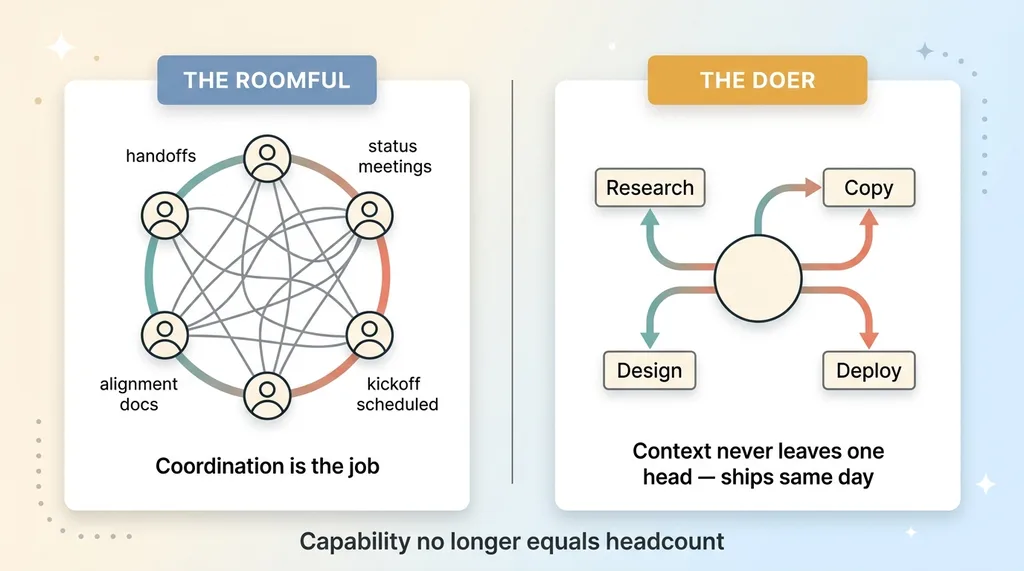 The Roomful vs The Doer
Most people frame this wrong from the start. They assume capability equals headcount. More specialists, more output. Need better content? Hire a content team. Need pricing discipline? Hire an analyst. Need faster shipping? Add engineers.
That assumption held for a long time. It does not hold anymore.
We have entered what I call the age of doers AI, where a single person directing the right systems can out-ship a department that is still scheduling its kickoff meeting. This is not a motivational slogan. It is something I have lived for the past two years running a DTC fashion brand and a consultancy at the same time, with no team behind me doing the heavy lifting.
The contrast that drives everything I am about to say is simple. On one side you have the roomful: smart people who deliberate, align, hand off, and eventually produce. On the other side you have the doer: one operator who holds the whole problem and ships.
I am not here to sell you the hype that AI transforms your business. I am here to talk about a specific consequence most leaders have not priced in yet: AI is rewriting the org chart, and the default move of adding people to get more output is now wrong for most knowledge work.
You have maybe a two to three year window before this is obvious to everyone. Right now it is still an edge. Let me show you why.
AI Didn't Just Cheapen Intelligence. It Cheapened Coordination.
Everyone noticed that AI made intelligence cheap. Research, drafting, analysis, first-pass code. The stuff that used to take a junior analyst a day now takes a prompt and a few minutes.
That is real, but it is not the part that breaks the old org chart. The part that breaks it is quieter.
What used to require a meeting now requires a prompt
The value of a large team was never just specialist knowledge. It was the coordination of that knowledge. You had a researcher, a writer, a designer, a developer, and the actual product was the result of those people aligning.
AI commoditized both halves. It made the specialist intelligence cheap, and it made the coordination cheap too, because now one person can hold context across functions that a team used to split. I write the brief, generate the research, draft the copy, produce the image, and deploy the code without handing anything to anyone.
The handoff was the product
Let me define coordination cost AI plainly. Every handoff, every status meeting, every time someone re-explains context, every alignment doc, is a tax. It is work that produces no output on its own. It exists only to keep separate brains pointed in the same direction.
That tax was justified when no single brain could hold the whole problem. You split the work because you had to.
But with agents handling the execution, one operator can hold the whole problem now. The thing you needed a team to coordinate, you can carry in one head. This is why range beats depth now. The scarce skill is no longer going deep on one function. It is holding the entire problem at once.
The Coordination Tax: Why More People Now Means Less Output
Here is the uncomfortable math. Adding people does not add output in a straight line. It adds communication.
The math of communication overhead
There is a classic idea about communication paths in a team. The formula is n times (n minus 1) divided by two. You do not need the math, just the shape of it.
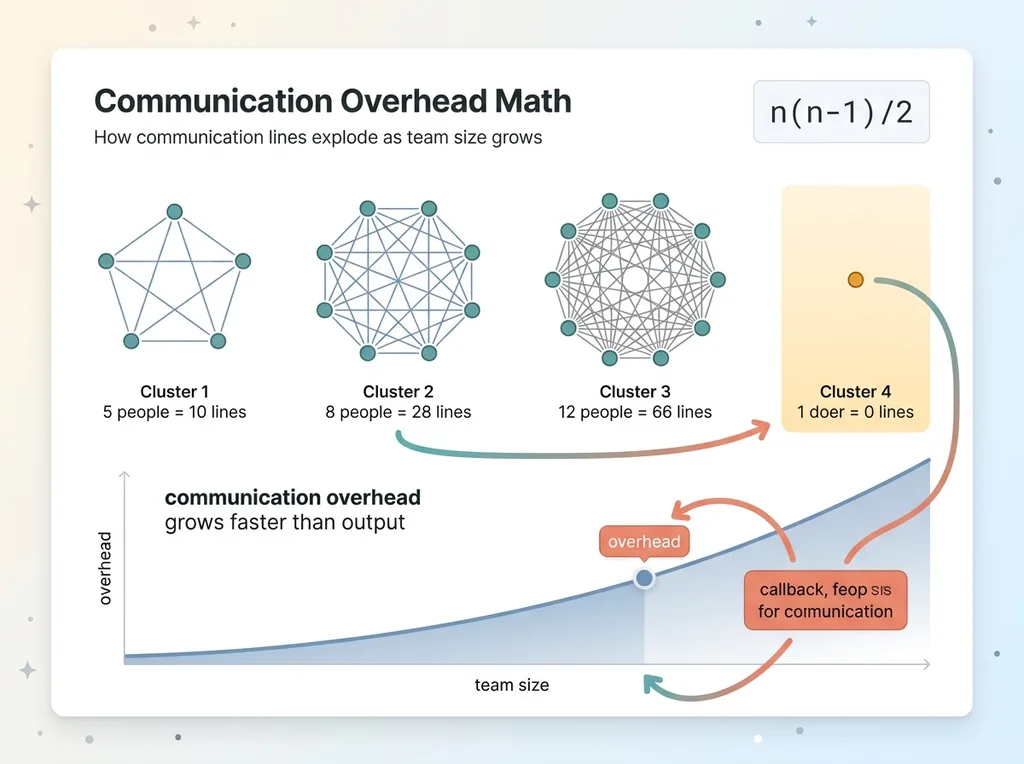 Communication Overhead Math
Five people have ten possible lines of communication. Twelve people have sixty-six. Every one of those lines is a place for delay, distortion, and a meeting that should have been a message.
So when you double a team to double output, you do not get double output. You get more output and a lot more overhead. At some point the overhead grows faster than the work.
Where the roomful actually spends its day
Watch a typical department for a week. A meaningful share of the time goes to alignment, not execution. Standups, planning sessions, reviews, the Slack threads where three people negotiate who owns what.
I am not saying these people are lazy. They are doing exactly what a multi-person structure requires. The coordination is the job. But coordination is not the product.
Now picture a single operator who carries the full mental model. There is no handoff because there is nobody to hand off to. The idea and the execution live in the same head. The thing ships the same day it is decided.
This is why a small team outperforms a large team with AI. It is not that the people are smarter. It is that the overhead is gone. The lines of communication collapse to almost zero, and what is left is execution.
I will be honest about where this breaks. It does not hold everywhere. I will get to that. But for most knowledge work, the coordination tax is now the biggest hidden cost on your books.
A Quarter of Evidence From One Operator
I do not want to argue this in the abstract, so let me put real numbers on the table. These are from a single operator running a real DTC brand and a consultancy at the same time. That operator is me.
The aggregate numbers
In one quarter I pushed 1,900 commits in a single quarter. That is shipped work, not planning.
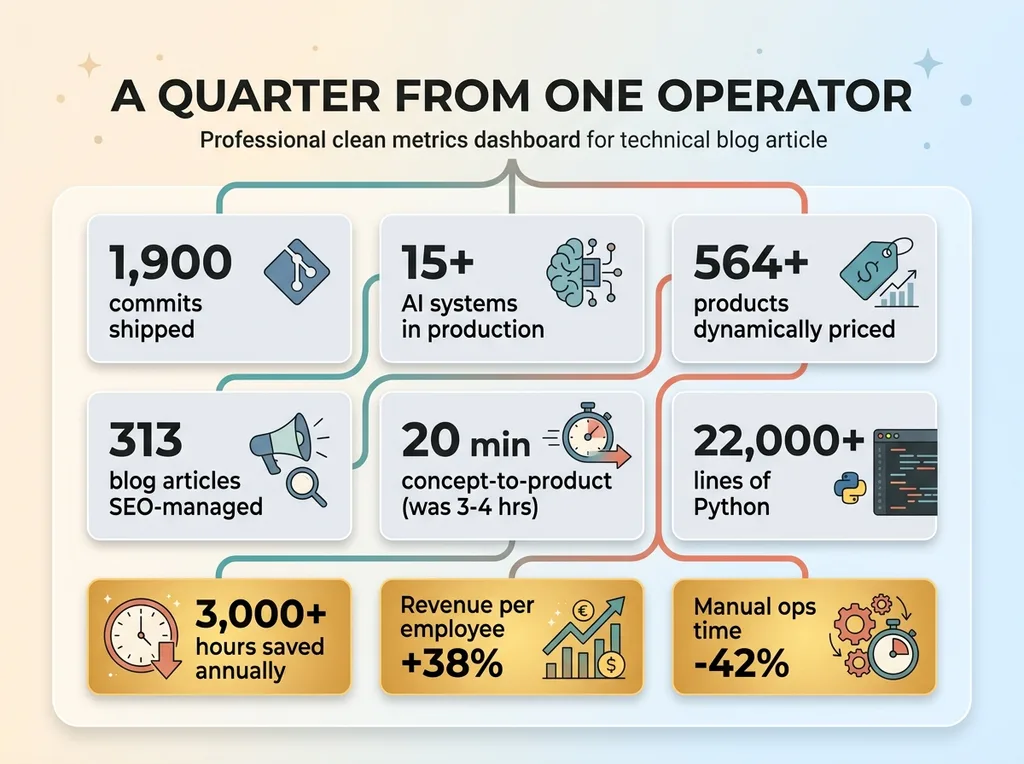 One Operator's Quarter of Output
Across my operation I have 15 plus AI systems in production. I dynamically price 564 plus products using a four-tier classification system. I manage 313 blog articles with AI-assisted SEO. My product creation pipeline takes a concept to a live product in 20 minutes, down from the three to four hours it used to take.
The aggregate effect: 3,000 plus hours saved annually, revenue per employee up 38 percent, and manual operations time down 42 percent.
What no department was needed to produce it
Map that output to a conventional org chart. The pricing engine is an analytics function. The 313 articles are a content team. The product pipeline is design plus development. The 15 systems are an engineering department. The whole thing is overseen by an operations lead.
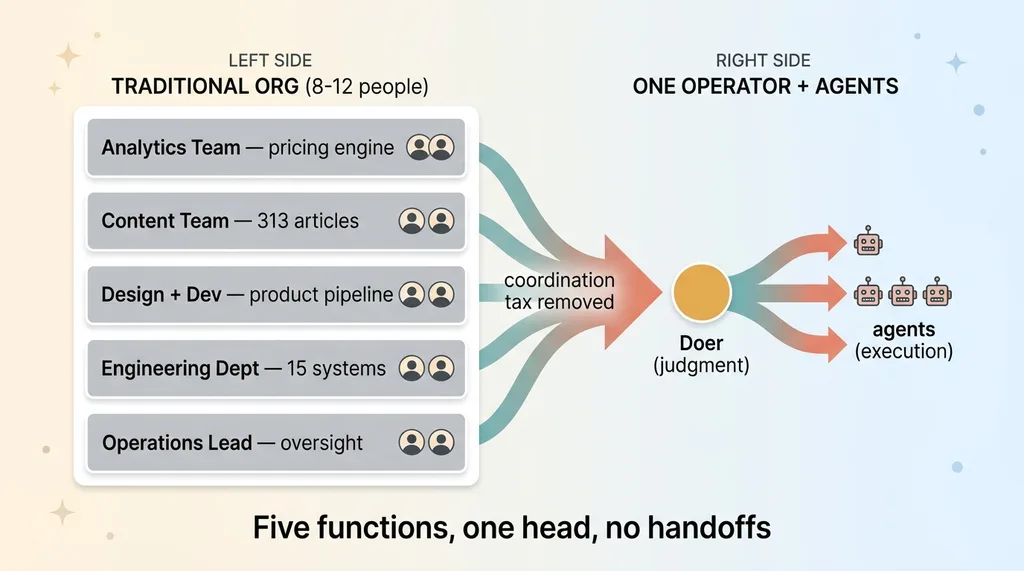 Five Functions Replaced by One Operator
That is five functions, easily a team of eight to twelve people in a traditional setup. The work got done by one person directing agents and a custom toolkit of 22,000 plus lines of Python.
I am not telling you this to brag. I am telling you because it is proof that the AI execution advantage is real and measurable, not a pitch deck claim. I have written before about being one operator delivering what used to take a studio, and the numbers above are what that looks like sustained over a quarter.
No standups. No handoffs. No alignment docs. The context never left my head, so it never needed to be re-explained.
What the Doer Actually Is (And Isn't)
Let me kill a misread before it spreads. This is not about working harder or being a 10x coder who types faster than everyone else.
High judgment, not high typing speed
The scarce resource here is judgment. Knowing what to build and what to refuse to build. Knowing where to draw the line, which features are noise, which problems are worth solving today versus never.
AI did the typing. It did not do the deciding. As I have argued before, AI replaced the typing, not the strategy. The model will happily generate a thousand lines of code or a hundred articles. Whether any of it should exist is still on you.
The agents do the work, the person holds the problem
My day is not spent producing. It is spent directing. I set the constraints, define what good looks like, point the agents at the work, and make the calls a model cannot make on its own.
The agents handle volume. I handle the problem.
This is where the real AI execution advantage comes from, and it is not raw speed. It is compressed decision-to-shipped-product latency. There is no committee between the idea and the deploy. I decide and it ships, sometimes in the same hour. The roomful cannot match that because the roomful has to align first.
Here is the honest limit. This requires range and a willingness to own the entire stack. If you only want to do the part you are good at and pass the rest to someone else, you are back to coordination cost. The doer model demands that you hold the whole thing, including the parts you find uncomfortable.
When You Still Need the Roomful
I would be lying if I told you one person with AI replaces every team. It does not, and pretending otherwise would cost you trust you should not give me.
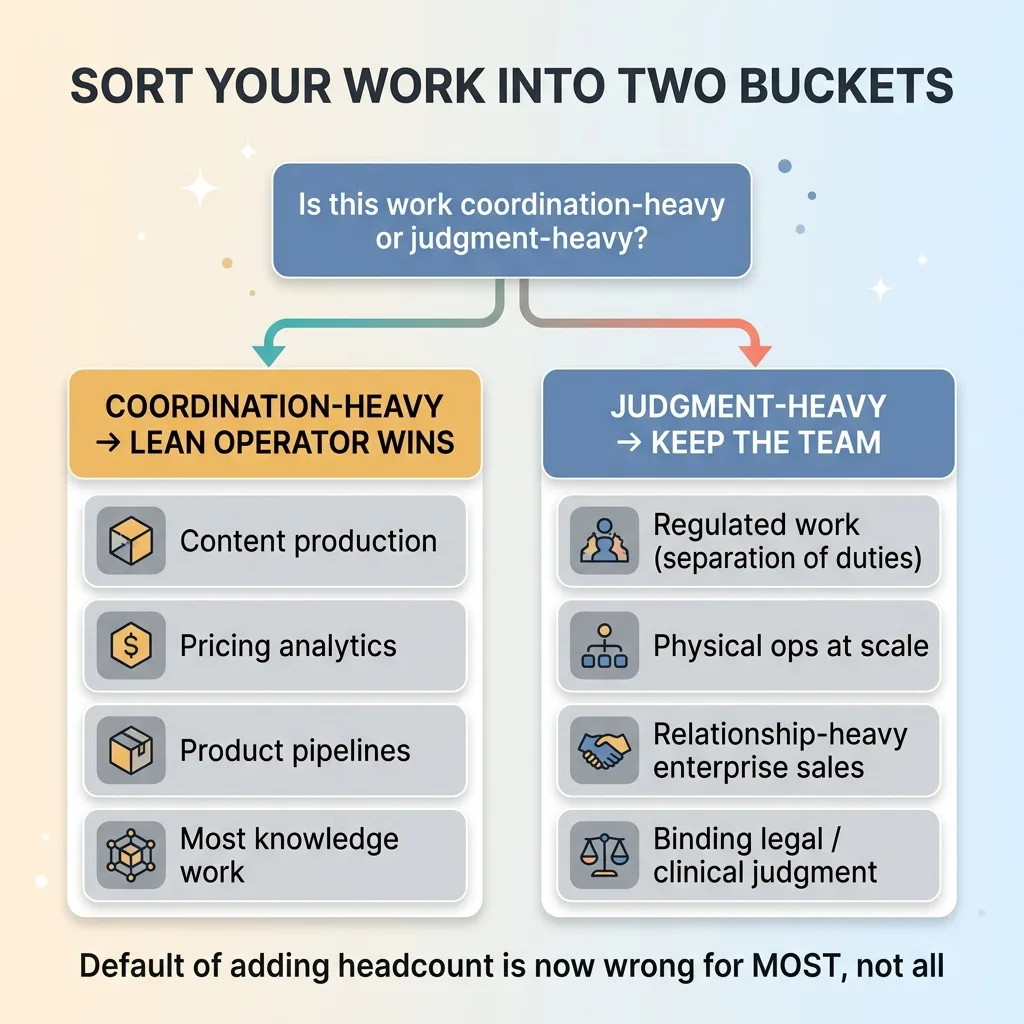 Coordination-Heavy vs Judgment-Heavy Decision Framework
There are functions where a single operator is the wrong answer. Regulated work that legally requires separation of duties, where one person controlling the whole process is the problem, not the solution. Physical operations at real scale, where you need bodies in warehouses and on floors. Relationship-heavy enterprise sales, where the buyer wants a human who has carried that account for years. True specialist depth, like a binding legal opinion or clinical judgment, where the cost of being wrong is too high to hand to an operator with broad range.
For those, the roomful still earns its keep. I am not arguing for zero employees. That would be a different kind of hype.
What I am arguing is narrower and more useful. The default move of adding headcount to get more output is now wrong for most knowledge work. Not all of it. Most of it.
So reframe the question. It is not team or no team. It is this: is this work coordination-heavy or judgment-heavy?
Coordination-heavy work, the kind where most of the effort goes to keeping people aligned, is exactly where a lean operator wins. Strip out the coordination and one person with agents covers it faster and cleaner.
Judgment-heavy work with real specialist depth or regulatory weight is where you keep the team. Sort your functions into those two buckets and the staffing decisions get a lot clearer.
The Window Is Closing Faster Than the Org Chart Can Adapt
The edge I am describing has a shelf life. Maybe two to three years before it stops being an advantage and becomes table stakes.
Why the advantage compounds
The operators who started early are not just ahead today. They are pulling further ahead every week. Each system I ship makes the next one faster to build, because the tooling, the patterns, and the judgment carry over. The gap does not stay constant. It widens.
Meanwhile, the companies still debating AI strategy in committee are spending the window in meetings. The irony writes itself. They are paying the coordination tax to decide whether to escape the coordination tax.
Become the operator or hire one
So bring it back to the doubt I opened with. Stop equating headcount with capability. For most of your knowledge work, more people now buys you more overhead, not more output.
You have two real options. Build the muscle to become that operator yourself, or bring in someone who already has it. I help with the second, and you can become that operator or hire one if that is the path that fits.
Either way, the choice will not wait for your next planning cycle. While the roomful is still scheduling the kickoff meeting, the doer already shipped. That is the whole argument in one sentence, and it is happening right now whether your org chart has caught up or not.
Thinking about AI for your business?
If this resonated, let's have a conversation. I do free 30-minute discovery calls where we look at your operations and find the places AI could actually move the needle, not the places that look good on a slide.
Get AI insights for business leaders
Practical AI strategy from someone who built the systems — not just studied them. No spam, no fluff.
Hodgen.AI
Ready to automate your growth?
Book a free 30-minute strategy call with Hodgen.AI.
Book a Strategy Call