Brand Without a Founder Story: When Anonymous Wins
Building a brand without a founder story isn't lazy. For one telehealth brand it was a positioning choice that also erased FTC endorsement obligations.
By Mike Hodgen
The Default DTC Playbook: Put a Face On It
Every DTC founder hears the same advice. People buy from people. Tell your origin story. Put your face on the About page. Write the founder letter explaining why you started this thing in your kitchen at 2am because nobody made a product that solved your specific problem.
It works. I've used it. My own DTC fashion brand leans on a personal story because the story is true and it sells. It's the playbook everyone copies for a reason.
But here's the thing nobody tells you: it's a default, not a law of physics.
For one longevity and telehealth brand I helped build, we did the exact opposite on purpose. No founder names. No bios. No ownership disclosure anywhere a customer could see it. If you went looking for a face to attach to the brand, you wouldn't find one.
That wasn't an oversight. It wasn't laziness. It was a deliberate positioning choice, and building a brand without a founder story turned out to be the smartest decision we made before writing a single page.
Why? Because the moment you put a named human on a regulated health brand, you inherit a whole category of compliance work that scales with every page you publish. We didn't want that work. So we designed it out.
Let me walk you through exactly how that decision works, when it's the right call, and when putting your face on the brand is still the better move. Because anonymous isn't always smarter. But sometimes it's the only version that survives growth.
Why a Named Founder Becomes a Compliance Liability
The instant you put a named physician-founder on a health site, two problems show up. Call her a physician who helped start the brand. The moment her name appears next to a product claim, you've created liabilities that compound.
The FTC endorsement-disclosure trap
FTC endorsement-disclosure rules are not vague. If a named human with an equity stake makes claims or endorsements about your product, you have to disclose that material connection adjacent to every quote.
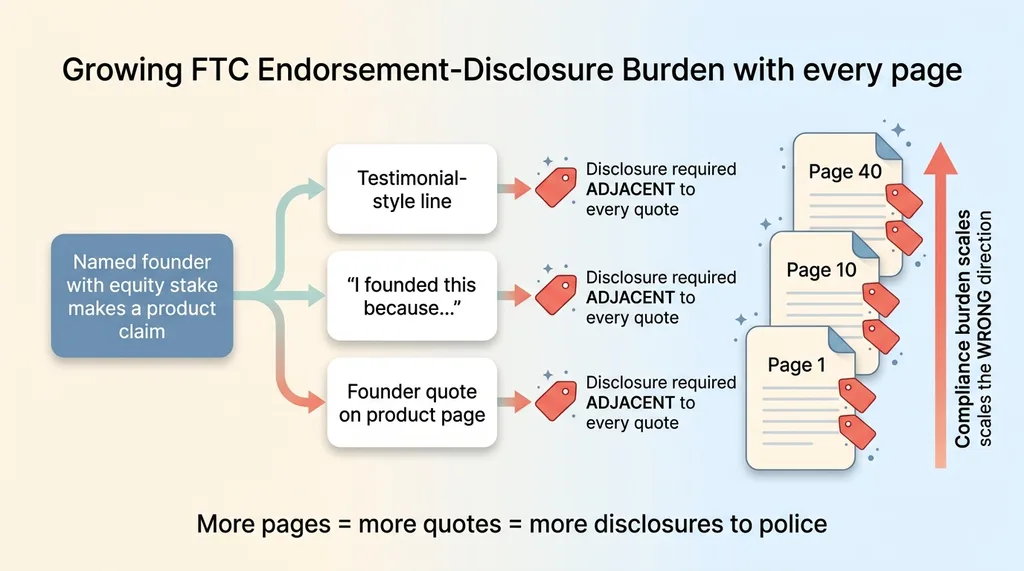 FTC endorsement-disclosure burden growing with every page
Not once on a legal page nobody reads. Adjacent to the quote. Every time it appears.
So now every testimonial-style line, every "I founded this because" statement, every product page that quotes the founder needs a disclosure sitting right next to it. That's a recurring compliance burden, and it scales in the wrong direction. More pages, more quotes, more disclosures to manage and keep accurate.
In regulated telehealth, every customer-facing word carries weight. You're already architecting decisions around compliance you'd never think about in a normal DTC brand, like how marketing consent and treatment consent are not the same thing. Adding a named endorser to that mix just multiplies the surface area you have to police.
Personalizing promises you can't scale
The second problem is subtler and it's the one that kills you later.
A named founder personalizes your operational promises. "Dr. [Name] reviews your labs" reads beautifully on the homepage. It feels personal, trustworthy, human.
It also breaks the moment you pass roughly 100 patients.
One human cannot review thousands of cases. The math doesn't work. So either the promise becomes a lie, or you quietly stop making it, or you bottleneck your entire operation around one person's calendar.
You've baked a scaling ceiling into your brand voice. Every word that ties care to a single named human is a word you'll have to walk back the moment you grow. And in a regulated space, walking back a promise about who reviews your medical results isn't a marketing tweak. It's a compliance event.
The Collective-Voice Solution
The fix is to present as a pure membership brand using collective voice. "Our physician team." "Our medical director." "Our clinical protocols."
No founder names. No equity disclosures. No individual whose material connection has to sit next to every quote.
"Our physician team" instead of a name
The language change sounds small. It isn't. "Our physician team reviews your results" makes the same promise as "Dr. [Name] reviews your results," except it's true at 50 patients and true at 50,000.
You're describing how care actually gets delivered. A team. Rotating reviewers. Standardized protocols. That's not marketing spin, that's an accurate representation of the operation.
Why this removes the endorsement obligation entirely
Here's the compliance insight that makes this worth doing. Endorsement-disclosure rules attach to named humans making endorsements.
Remove the named human and you remove the obligation. Not reduce it. Eliminate it.
There's no individual endorser whose material connection has to be disclosed, because there is no individual endorser. The collective voice isn't a loophole or a dodge. It's a structurally different thing. You can't be required to disclose the equity stake of a person who never appears.
But this only works if it's true. You actually have to have a team. If you're a solo founder hiding behind "our physician team" while one person does everything, you've created a misrepresentation, which is a much worse problem than a missing disclosure. Collective voice is honest positioning for a brand that genuinely operates as a collective.
This was one of several compliance-by-design moves for this brand. We also designed the revenue model so it couldn't vary with prescriptions, which removed another whole category of regulatory exposure. The pattern was consistent: solve compliance in the architecture, not in a disclaimer.
How Collective Voice Lets Operations Scale
Compliance was the trigger. But the strategic payoff went further than staying out of trouble.
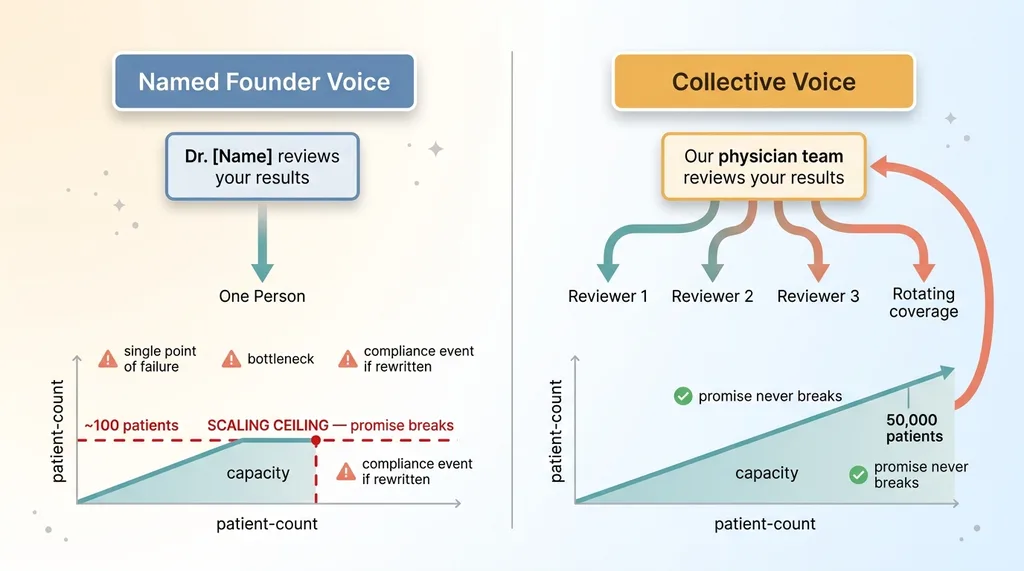 Named Founder vs Collective Voice scaling ceiling
When the promise is "our physician team reviews your results within X hours" instead of "Dr. [Name] reviews your results," the operational commitment is decoupled from any single person.
You can add reviewers. Rotate coverage. Change your medical director when someone leaves. Onboard three new physicians during a growth spurt. And the brand promise never breaks, because the brand promise was never attached to a person in the first place.
The cadence stays intact regardless of headcount. Response times, review windows, turnaround commitments, all of it survives every staffing change because none of it was ever tied to one name.
Now contrast that with a personal-brand telehealth founder.
That founder is the bottleneck. They're also the single point of failure. If they get sick, the promise pauses. If they go on vacation, the promise pauses or gets quietly handed off to someone the customer was never told about. If the company grows past what one human can handle, the promise either collapses or becomes a lie the moment patient number 101 signs up.
Remember that ~100 patient ceiling from earlier? Collective voice is what lets you walk straight through it without rewriting your homepage or breaking a single commitment.
This is the part founders miss when they're choosing brand voice. They think they're picking a tone. They're actually picking a scaling model. Personal voice locks your operational capacity to one person's throughput. Collective voice lets capacity grow without touching the brand.
The version that survives growth is almost never the one built around a single face.
When Anonymous Is Smarter Than Personal
So do you have to put your face on your brand?
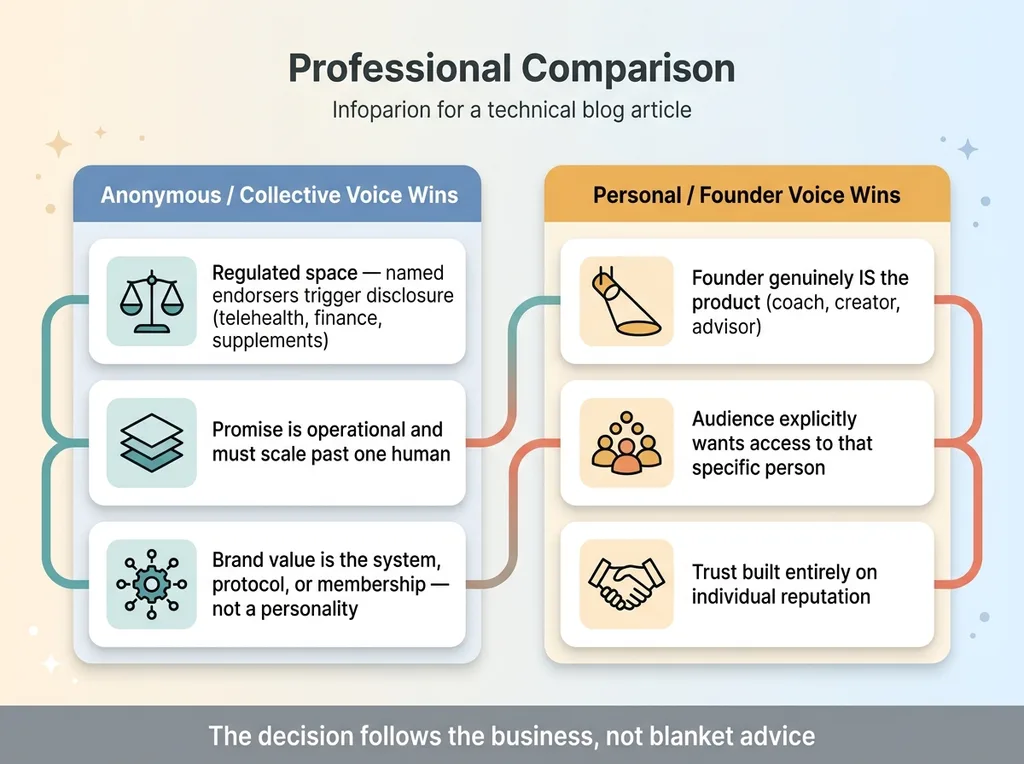 Decision framework: when anonymous wins vs when personal wins
No. And anyone who tells you it's mandatory is repeating advice without checking whether it fits your situation. But anonymous isn't always right either. Here's the framework I use.
Brands where impersonal positioning wins
Anonymous or collective voice wins in three situations.
One: you're in a regulated space where named endorsers trigger disclosure obligations. Telehealth, financial advice, supplements, anything where claims carry legal weight. The named human costs you more than they earn you.
Two: the promise is operational and must scale past one human. If your core commitment is "we review, we respond, we deliver within X," and that work can't physically be done by one person at scale, don't attach it to one person.
Three: the brand value is the system, the protocol, or the membership, not a personality. People aren't buying access to a specific human's taste. They're buying a reliable process. Depersonalized brand voice fits a depersonalized product.
Brands where it doesn't
Personal branding wins when the founder genuinely is the product.
A coach whose judgment is the offering. A creator whose taste people pay for. An advisor whose individual reputation built the trust. In those cases, removing the name removes the value. Nobody hires a named consultant and then feels reassured to learn "our consulting team" will handle them.
It also wins when the audience explicitly wants access to that person, or when trust was built entirely on individual reputation that doesn't transfer to a faceless brand.
My own fashion brand sits closer to the personal side, and that's the right call for it. The telehealth brand sat firmly on the anonymous side, and that was right too. Same operator, opposite decisions, because the decision follows the business, not a blog post's blanket advice.
The Tradeoffs of Going Nameless
I'd be selling you something if I pretended anonymous is free. It isn't.
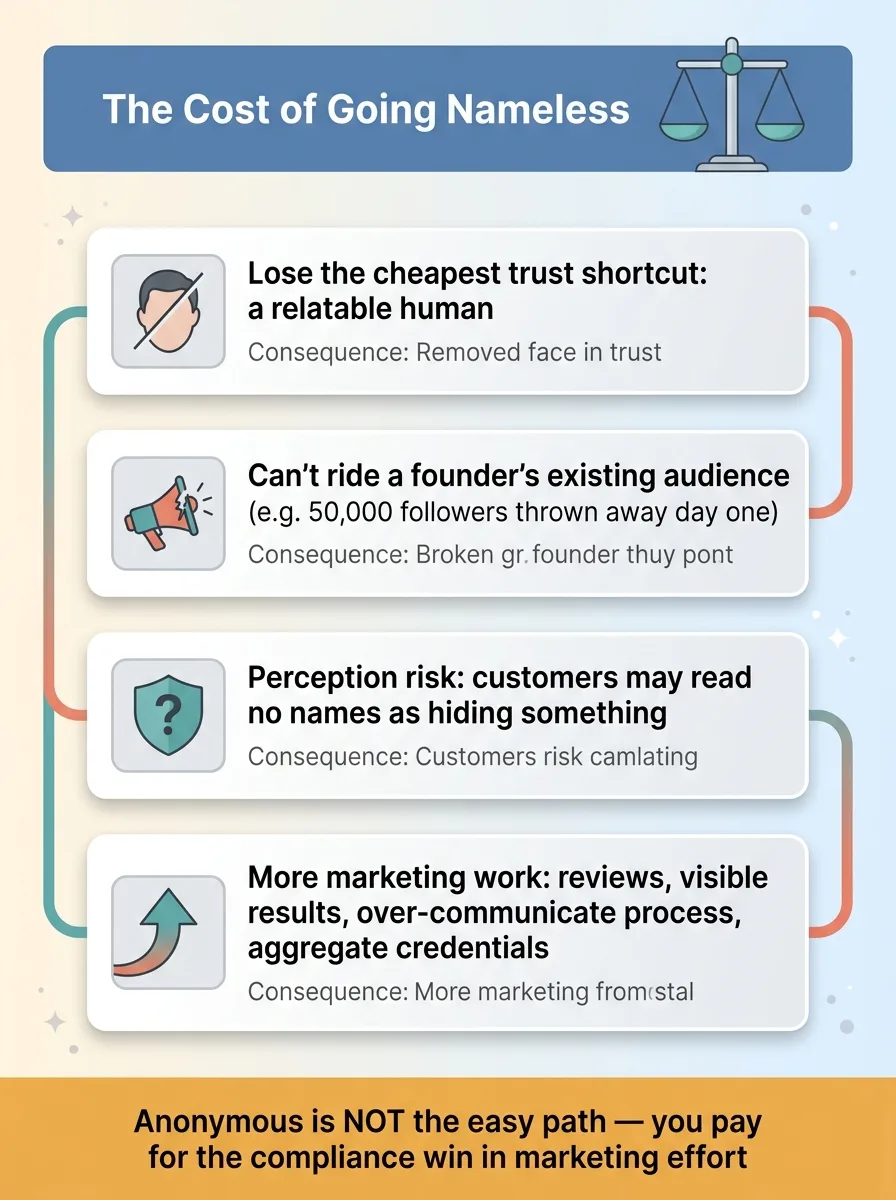 Tradeoffs of going nameless
The biggest thing you give up is the cheapest trust shortcut in marketing: a relatable human. A founder face does a lot of work for very little cost. It makes a stranger feel like they know who's behind the product. Remove it and you've removed your easiest credibility lever.
So you work harder for trust everywhere else. Reviews have to carry more weight. Results have to be visible. You over-communicate your process because you can't fall back on "trust me, I'm a real person." You signal credibility through the team's credentials in aggregate, stated generically, instead of one impressive bio.
You also can't ride a founder's existing audience. If your founder has 50,000 followers, an anonymous brand throws that distribution away on day one. That's a real cost, not a rounding error.
And there's perception risk. Some customers read "no names anywhere" as "they're hiding something." Especially in health, where people want to know who's responsible for their care. You have to over-deliver on transparency in other ways: clear protocols, real team credentials stated honestly, responsive support that proves there are competent humans behind the brand even if they're not named.
This is more work upfront, not less. The compliance win is real, but you pay for it in marketing effort. Anyone who tells you anonymous branding is the easy path hasn't actually built one.
Deciding This Before You Build, Not After
Here's why this matters more than it looks like it should.
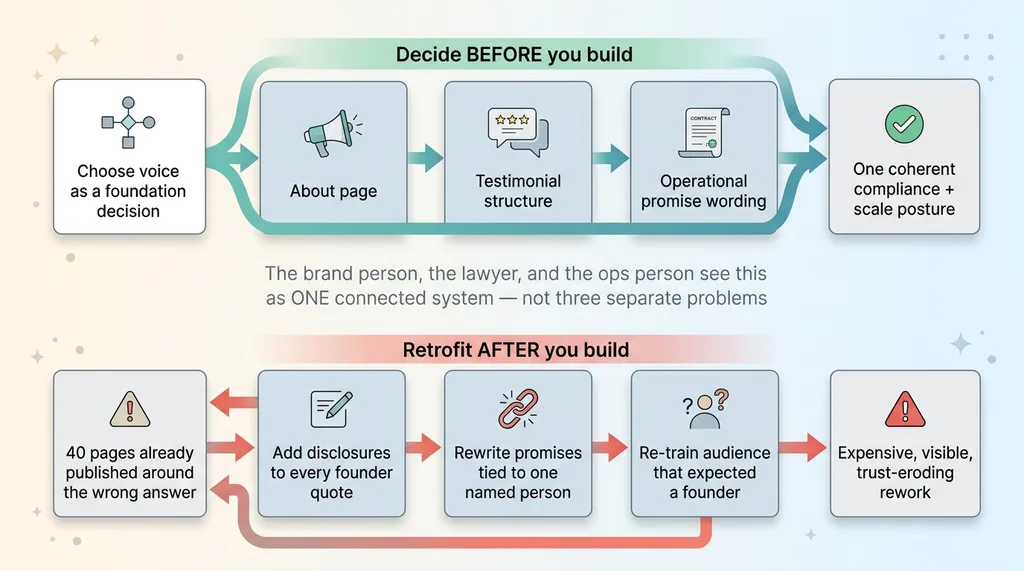 Decide before you build vs retrofit later cost
The founder-story-versus-anonymous decision shapes your entire brand architecture. Your About page. How you structure testimonials. The exact wording of your operational promises. Your whole compliance posture. It's not a tone choice you make in the copywriting phase. It's a foundation you pour before anything else gets built.
And retrofitting it later is expensive.
If you've already published founder quotes, they now need disclosures, and you're going back through every page adding them. If you've built operational promises around one named person, you're rewriting them and hoping nobody noticed the change. If you've trained your audience to expect access to a specific founder, you can't quietly swap in a team without eroding the trust you spent money building.
For this telehealth brand, we made the call before writing a single page. That one decision removed an entire category of recurring compliance work and gave operations room to grow past the patient threshold that would've capped a personal brand. It was part of standing up a regulated telehealth brand fast without baking in problems we'd have to unwind later.
That's the kind of decision an operator makes at the start, looking at positioning, compliance, and scale as one connected system. Not three separate problems handed to three different vendors who never talk to each other. The brand person picks the voice, the lawyer flags the disclosure, the ops person discovers the bottleneck six months in, and by then it's all expensive to fix.
If you're building or rebuilding a brand in a regulated space and you're not sure whether your name belongs on it, that's exactly the question worth getting right before launch. Not after you've published 40 pages around the wrong answer.
Thinking about AI for your business?
If this resonated, let's have a conversation. I do free 30-minute discovery calls where we look at your operations and find where AI could actually move the needle, no slides, no hype, just a straight look at what's worth building.
Get AI insights for business leaders
Practical AI strategy from someone who built the systems — not just studied them. No spam, no fluff.
Hodgen.AI
Ready to automate your growth?
Book a free 30-minute strategy call with Hodgen.AI.
Book a Strategy Call