The product I almost shipped was solving the wrong problem
I was three months into building a California wage-and-hour compliance tool for small employers when I realized I'd built the wrong thing.
The schema was done. The violation dashboard worked. You could feed it employee records, pay periods, and break logs, and it would flag every place an employer was exposed: missed meal breaks, late final paychecks, rounding errors, the whole catalog. Clean detection. The kind of tool I was proud of when I was automating these labor regulations.
Then I sat down and actually read a 2024 California labor reform end to end. Not a summary. Not a law firm's blog post. The statute.
And it inverted the entire value proposition of what I'd built.
My product was designed to answer one question: did you violate the law? The new reform made that question almost irrelevant. It didn't add a feature request. It changed what the most valuable thing an employer could own actually was. Overnight, detection stopped being the product. Documentation became the product.
Here's the uncomfortable part. My original data model had no concept of the artifacts the law now rewards. No audits. No remediations. No policy acknowledgments. No supervisor training records. The schema was built to catch problems, not to prove you'd done the right thing.
I had a working compliance product aimed at a problem the legislature had just redefined. That's what reading the statute late nearly cost me. A clean build, pointed at the wrong target, ready to ship to customers who would have paid for fear instead of a cure.
This is the story of the compliance product pivot that followed, why it forced me to push AI to the back of the roadmap, and what it taught me about building anything that depends on a law.
What the 2024 reform actually changed
To understand why a working product became worthless, you have to understand what the reform did to the underlying problem.
From "did you violate" to "can you defend"
Before the reform, the math for a small employer was brutal and simple. If you had violations, you owed penalties. Per employee, per pay period, stacked up over years. The exposure could bankrupt a small business over technical errors that caused no real harm.
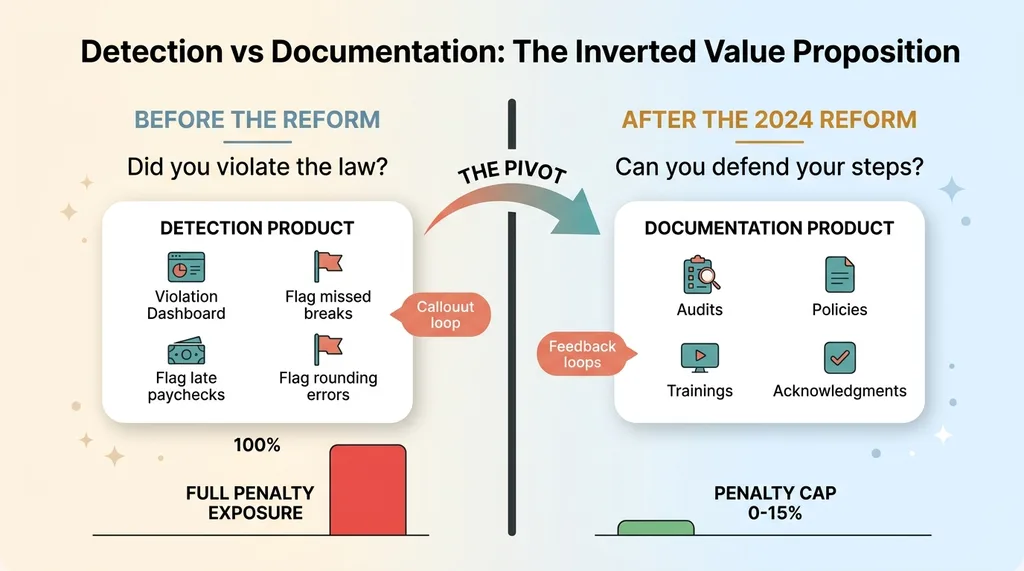 Detection vs Documentation: The Inverted Value Proposition
The reform shifted the question. It stopped asking only "did you violate the law" and started asking "can you defend the steps you took to comply." Those are completely different products.
A tool built for the first question detects. A tool built for the second question documents. My dashboard answered the first question beautifully and the second question not at all.
The reasonable-steps affirmative defense
The reform created a "reasonable steps to comply" affirmative defense. In plain terms: an employer who can document that they took reasonable steps to follow the law gets dramatically reduced penalties, even when violations exist.
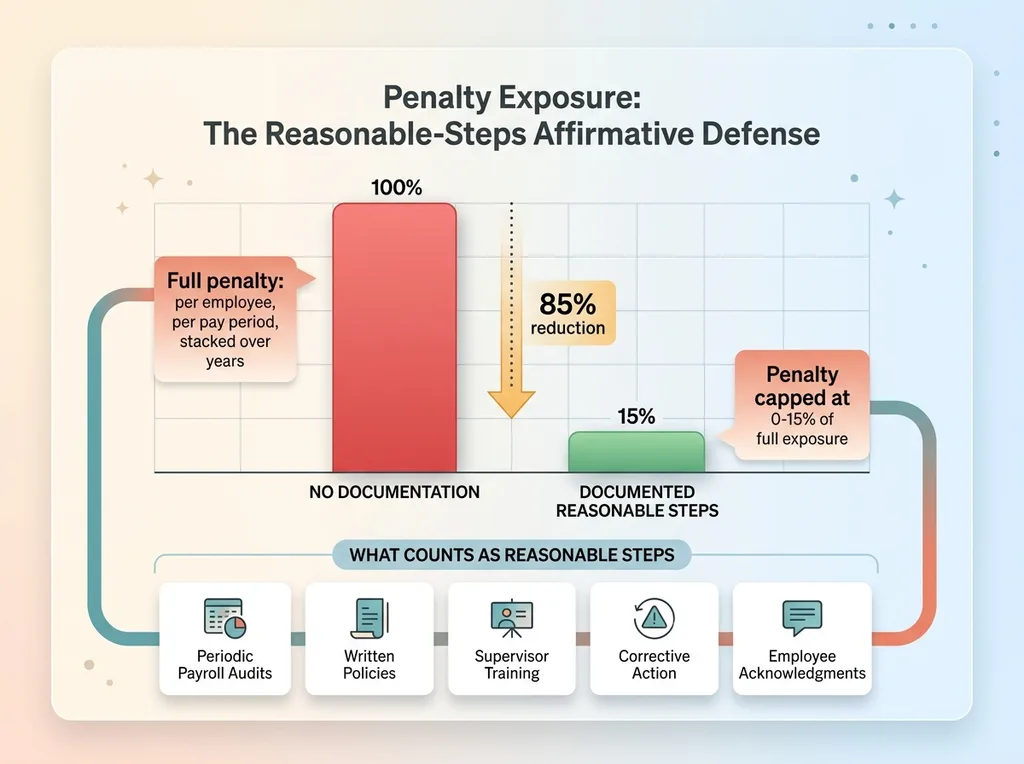 Penalty Exposure: The Reasonable-Steps Affirmative Defense
What counts as reasonable steps? Periodic payroll audits. Written policies distributed to staff. Supervisor training. Corrective action when problems surface. Documented acknowledgments that employees received the policies.
The stakes are not small. An employer who can prove reasonable steps sees penalty exposure drop to a cap in the range of zero to fifteen percent of what they'd otherwise owe. No documentation, full penalty. Documentation, a fraction of it.
Read that again, because it's the whole pivot. The law stopped rewarding detection and started rewarding documentation. The single most valuable artifact a small employer can now own is proof they took reasonable steps, structured cleanly, exportable for a court or a state agency.
That artifact didn't exist anywhere in my product. That was the pivot trigger.
Why a violation dashboard became worthless overnight
Let me be direct about why the original product lost its reason to exist.
A dashboard that flags violations tells a small employer they're exposed. That's it. It points at the problem and does nothing to reduce the penalty. Before the reform, that still had value, because there was no defense to build toward. Knowing your exposure was at least a starting point.
After the reform, the same employer can have the exact same violations and pay fifteen percent of the penalty, as long as they documented their process. So my dashboard was selling fear without selling the cure. It showed you the fire and handed you nothing to put it out.
Worse, the schema itself was pre-reform in its bones. It had pay periods and violation flags. It had no concept of audits, remediations, policies, acknowledgments, trainings, or supervisor actions. Those are the exact artifacts the law now rewards, and my data model couldn't even represent them.
I'd built a detection engine in a world that had just decided to pay for documentation. The two products share almost no schema.
This is the honest cost of building before reading the law closely enough. I wasn't wrong about the domain. Wage-and-hour compliance is a real, painful problem for small employers, and that's still true. I was wrong about the target. I'd been starting at the wrong end of the problem, building toward detection when the value had moved to defense.
A working product aimed at the wrong question is still the wrong product. The legislature redefined the problem, and I had to redefine the product to match.
The rewrite: reorienting around the evidence packet
The pivot came down to one reframe. The product was no longer a violation detector. It became the reasonable-steps system of record.
The primary artifact changed completely. It's no longer a violation list. It's a court-exportable evidence packet, the documented proof that an employer took reasonable steps, structured in a format that unlocks the zero-to-fifteen percent penalty cap. That packet is the thing the law actually pays for, so that packet became the product.
New schema for the artifacts the law rewards
I tore out the pre-reform data model and rebuilt around the artifacts the statute names. The new schema has first-class objects for:
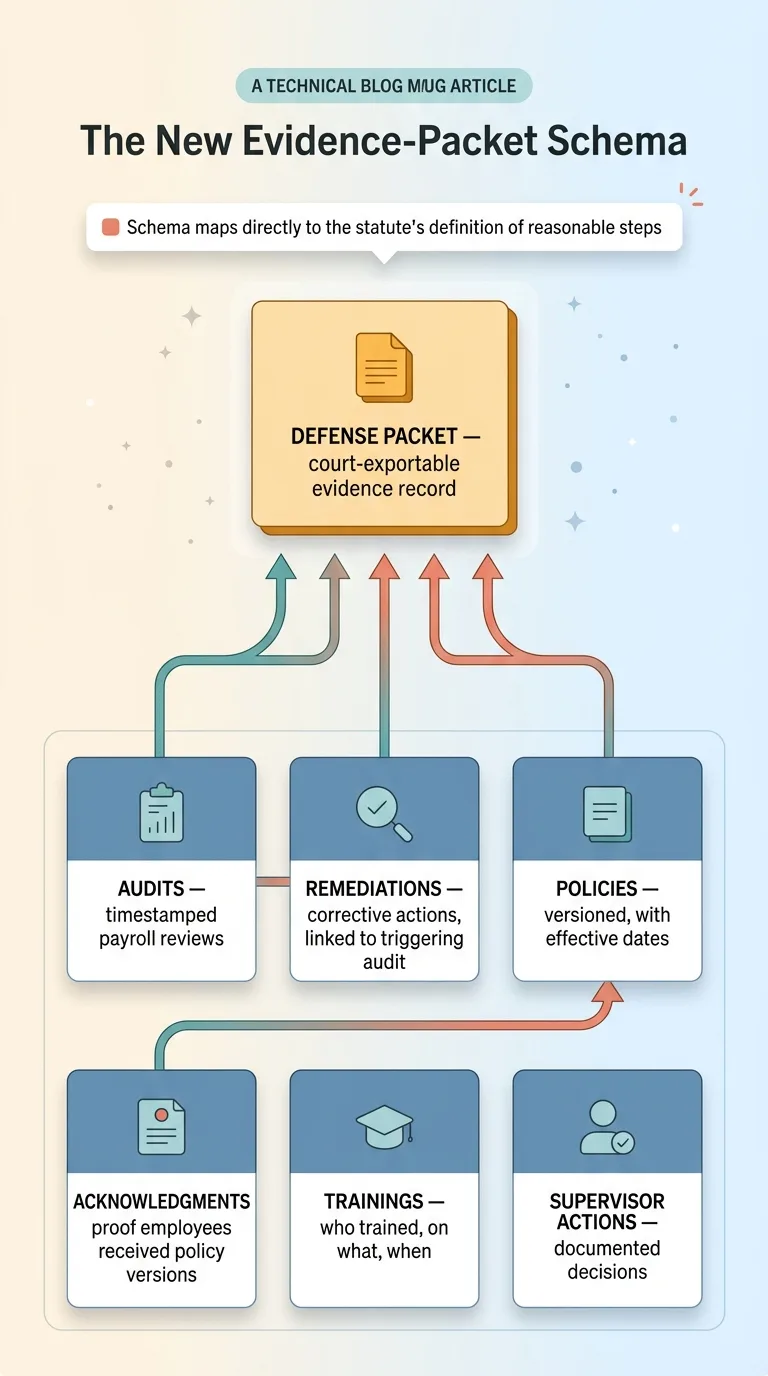 The New Evidence-Packet Schema
- Audits, timestamped records of periodic payroll reviews, what was checked, what was found
- Remediations, the corrective actions taken when an audit surfaces a problem, linked to the audit that triggered them
- Policies, written compliance policies, versioned, with effective dates
- Acknowledgments, proof that specific employees received and acknowledged specific policy versions
- Trainings, supervisor and staff training records, who was trained, on what, when
- Supervisor actions, documented decisions and interventions at the supervisor level
- Defense packets, the assembled, exportable artifact that pulls all of the above into a court-ready record
Every one of those objects exists because the law rewards it. The schema is now a direct map of the statute's definition of reasonable steps. When the law says "show me you ran periodic audits," the system can produce the audits with timestamps. When it says "show me you trained supervisors," the trainings are right there, linked to the people who took them.
Jumping the defense packet ahead of the AI
Here's the decision that surprised people who know me as an AI builder. I jumped the defense-packet feature ahead of the AI layer in the roadmap.
The defense packet is the artifact the law pays for, so it had to come first. The system of record came first, AI second. I treat AI as the value-add, not the wedge, and this product made that order obvious.
The product now answers exactly one question, on demand: can you prove you took reasonable steps, in a format a court accepts? Everything in the build serves that question.
Why AI moved to the back of the line
It's counterintuitive for someone whose business is AI to say "AI goes last." But in this product, that's the correct order, and the reason matters.
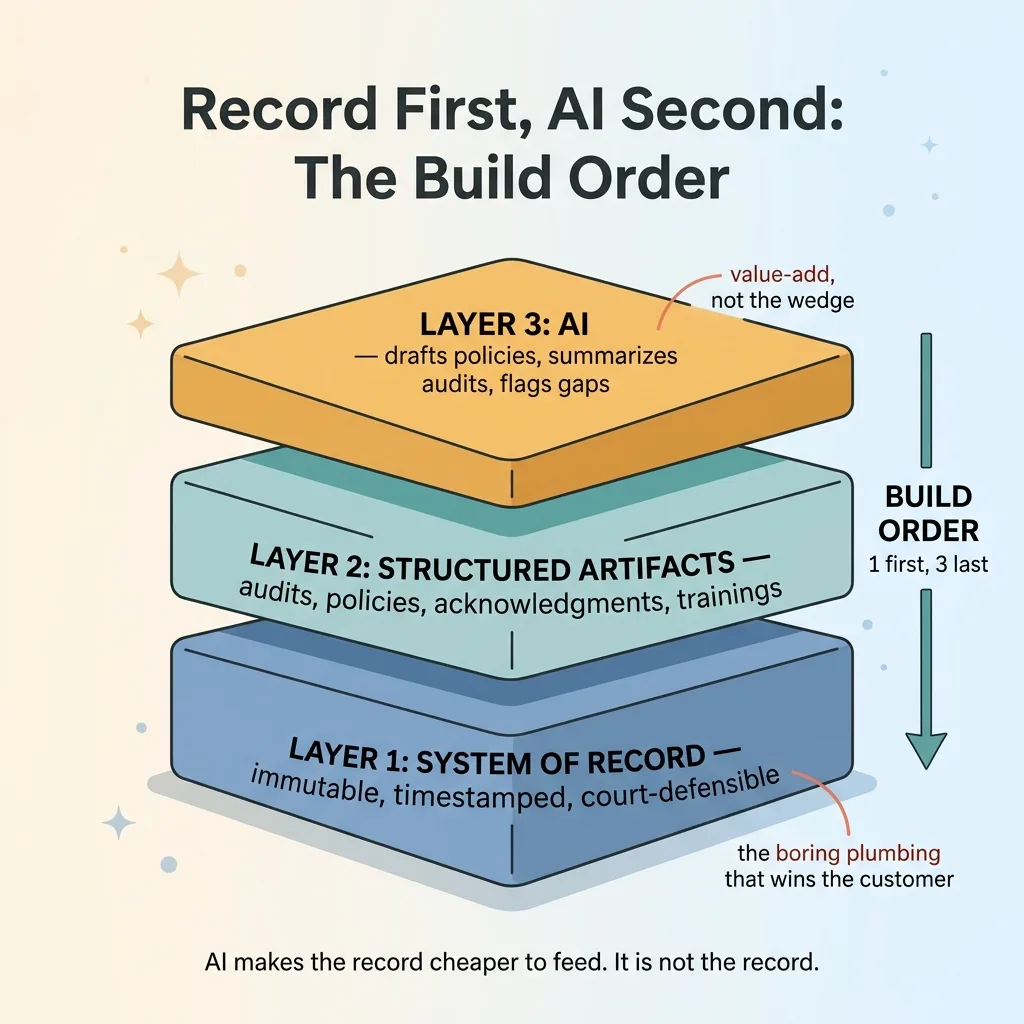 Record First, AI Second: The Build Order
The AI here is genuinely useful. It can draft compliance policies from a template and the employer's specifics. It can summarize audit findings into plain language. It can suggest corrective actions when a remediation is needed. It can scan the record and flag gaps, the missing acknowledgment, the supervisor who never completed training, the policy that's a version behind.
All of that reduces the documentation burden, which is real value, because the reason small employers don't document is that documenting is tedious and they're busy running a business.
But none of it matters if the underlying record isn't structured to produce a defensible packet. AI that drafts a beautiful policy is worthless if there's no immutable, timestamped record proving when that policy took effect and who acknowledged it. The court doesn't want a well-written summary. It wants evidence with dates attached.
So the wedge had to be the boring plumbing. A clean, timestamped, immutable system of record. AI sits on top to make documentation faster and lighter. But the value lives in the record itself, not the model.
This is the broader pattern I keep running into. In regulated domains, the AI is almost never the thing that wins the customer. The system that survives an audit is. The AI makes that system cheaper to feed. It is not the system.
If I'd led with the AI, I'd have built another impressive demo aimed at the wrong target. The pivot forced the right order: record first, intelligence second.
What this says about outside builders and regulated domains
There's a fair objection buried in this whole story, and I want to answer it head on.
The fear, if you're a CEO hiring an outside builder for anything that touches regulation, is that the builder doesn't understand the domain deeply enough. They'll build something slick that misses the thing that actually matters legally, and you'll find out when a customer gets burned or an auditor shows up.
It's a real risk. And my answer is the story you just read.
I caught this before launch, not after. I caught it because I read the actual statute, not a law firm's summary of it, and reoriented the entire product around what the law rewards while it was still a build and not a liability. Reading the actual statute before I write code is the practice that saved this product.
Here's the honest version. The reform didn't break my product because I'm an outsider to labor law. It broke my product because I built before I read closely enough. And reading closely enough is the job. That's true whether you've practiced employment law for twenty years or you're a builder who treats the statute as the spec.
The lesson isn't that outside builders should avoid regulated domains. It's that they should treat the statute as the spec, the same way you'd treat an API contract or a database schema. The law is the requirements document. If you skim the requirements, you build the wrong thing. That's not a domain-expertise failure, it's a discipline failure, and discipline is portable.
I'd rather catch the inverted value proposition in a code review than in a courtroom. The reform gave me a clean lesson in why that order matters.
If your product depends on a law, read the law first
The takeaway for any CEO running a business that touches regulation is simple. Regulatory change is a product risk, not just a legal risk.
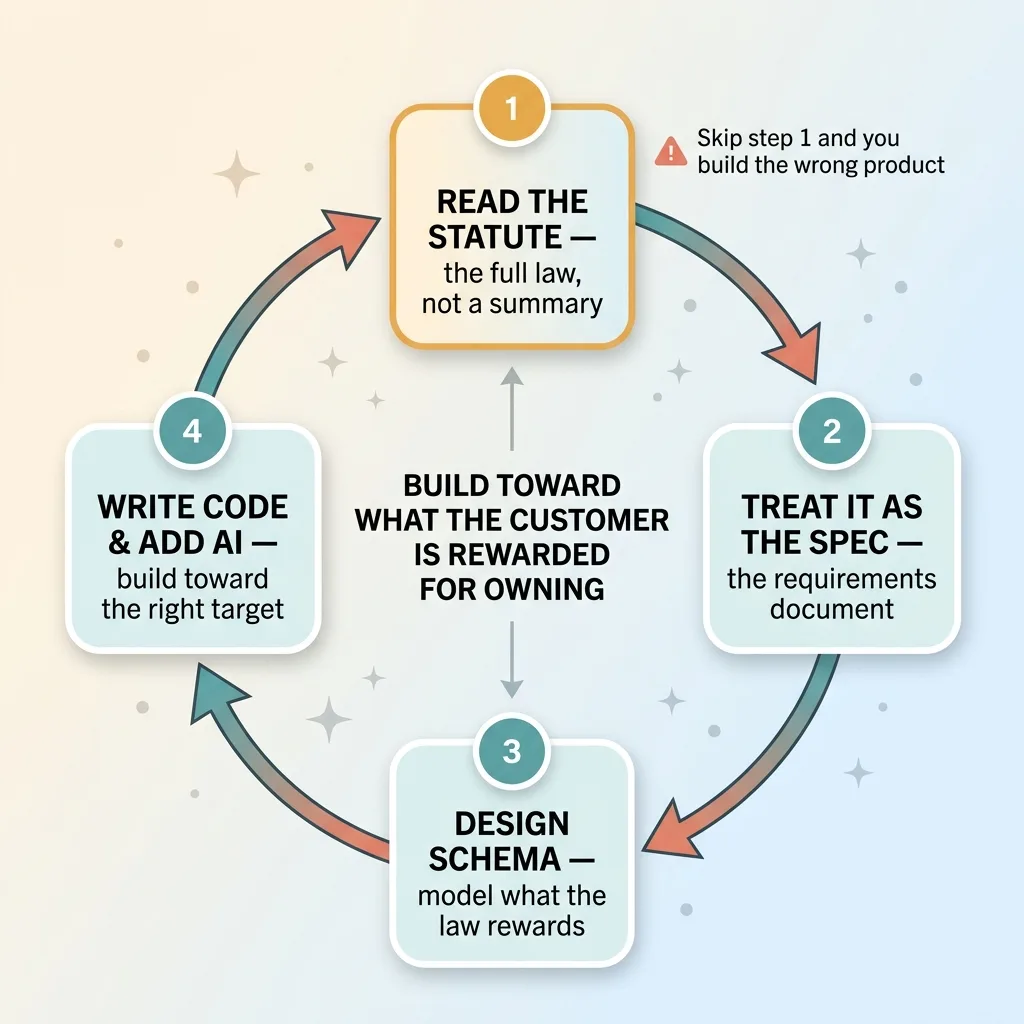 Statute as Spec: The Discipline Loop
If your business or your software depends on how a regulation works, the spec lives in the statute. And statutes change. A reform can take a feature you charge for and make it worthless, or take an artifact nobody valued and turn it into the most valuable thing you can sell. My violation dashboard and my evidence-packet system serve the same customers in the same industry, and the law is the only reason one is dead and the other is alive.
I now treat the relevant law as the first artifact I read. Before schema. Before code. Before I get excited about the AI layer. The statute tells me what the product should reward, and everything downstream follows from that.
This is exactly what I look for when I assess whether a build is aimed at the right target. Not "is the tech impressive" but "is the product structured around what the law or the market actually rewards, instead of what's easiest to build." Those are usually different things, and the gap between them is where money gets wasted.
A regulatory change forced this compliance product pivot on me. But the discipline it taught applies to any product, regulated or not. Build toward what your customer is actually rewarded for owning. Read the spec, all the way through, before you write a line.
Get the next build note.
I write up each system I build, including what broke. Subscribe to my newsletter and I'll send you the next one.