Placeholder Reviews & FTC Compliance: The Safe Way
Need social proof before you have customers? Here's how to use placeholder reviews without breaking the FTC fake-review rule (fines up to $50K each).
By Mike Hodgen
The pre-launch problem nobody talks about
When I launched a product page for my DTC fashion brand, it had zero reviews. Clean design, good photography, sharp copy. And a giant empty space where social proof should be.
Meanwhile every competitor's page showed 4.8 stars and 200 reviews.
Here's the bind that creates. I wanted to know if the page could convert before I spent a dollar on paid traffic. But you can't honestly measure a page's conversion ceiling when it's missing the single biggest trust signal a buyer expects. A review block isn't decoration. It moves the buy button, changes scroll depth, eats above-the-fold real estate. Test the page without it and you're testing a different page than the one you'll actually launch.
So the question every founder asks is reasonable: can I show reviews before I have customers?
The naive answer (just add a few glowing reviews to fill the gap) is now illegal. Not gray-area illegal. The placeholder reviews FTC compliance question is one most founders don't even know they're walking into, because they think of it as filler content, not fraud.
In 2024 the FTC made fake and deceptive reviews per se illegal, with civil penalties that can run roughly $50,000 per violation. Penalties stack per review. I cover the full legal breakdown in the FTC fake-review rule article, but the short version is this: you cannot hand-wave your way through this one.
The good news is there's a narrow, honest way to baseline a page before launch without breaking the rule. That's what this article is about. The distinction between testing layout and deceiving a buyer is the entire game.
Why fake reviews are now per se illegal (and what that means for you)
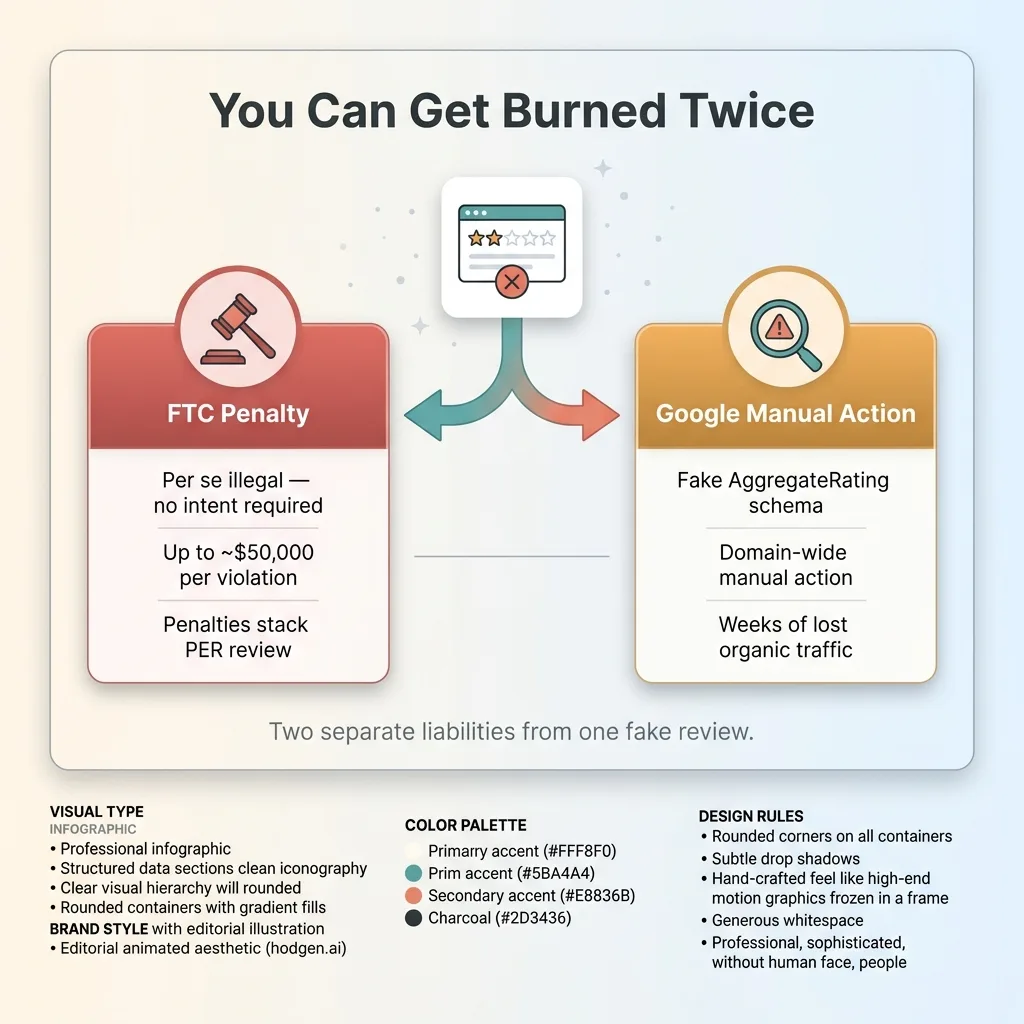 Double Liability: FTC Penalty and Google Manual Action
The 2024 rule in plain English
A fake review is any review of a product by someone who didn't actually use it, or a review that misrepresents the reviewer's real experience.
That's it. No legalese required.
The shift that matters: it's now per se illegal. The FTC doesn't have to prove you intended to deceive anyone. It doesn't have to prove a single buyer was harmed. The act itself is the violation. Invent the review, you've broken the rule. Full stop.
For a founder used to thinking in terms of "well, nobody got hurt," this is a different world.
What counts as a violation
Here's what trips the ftc fake review rule in practice:
- Invented testimonials. Quotes from people who never bought the product.
- Full names attached to non-existent people. "Sarah Mitchell, San Diego" when there is no Sarah Mitchell.
- Star ratings presented as real. A bare "4.8" that mimics aggregated buyer data when it came from nowhere.
- AggregateRating structured data with no real reviews. Telling Google you have 200 verified reviews when you have zero. This is lying to a search engine, and I'll come back to why it's especially dangerous.
Penalties stack per review. Twenty fake reviews isn't one violation, it's twenty.
Here's the part that catches good people. Most founders doing this don't think of it as fraud. They think of it as "placeholder content." Temporary. A stand-in until the real thing arrives.
That framing is exactly the trap. The FTC doesn't care what you called it in your own head. A fake review with a real-sounding name and a real-looking star count is a fake review, whether you meant it as fraud or as filler.
The mental shift you need: stop thinking "placeholder" and start thinking "is this honest to a person reading the page right now?"
Why you still need placeholder social proof to baseline a page
So if fake reviews are off the table, why not just launch the page empty and call it a day?
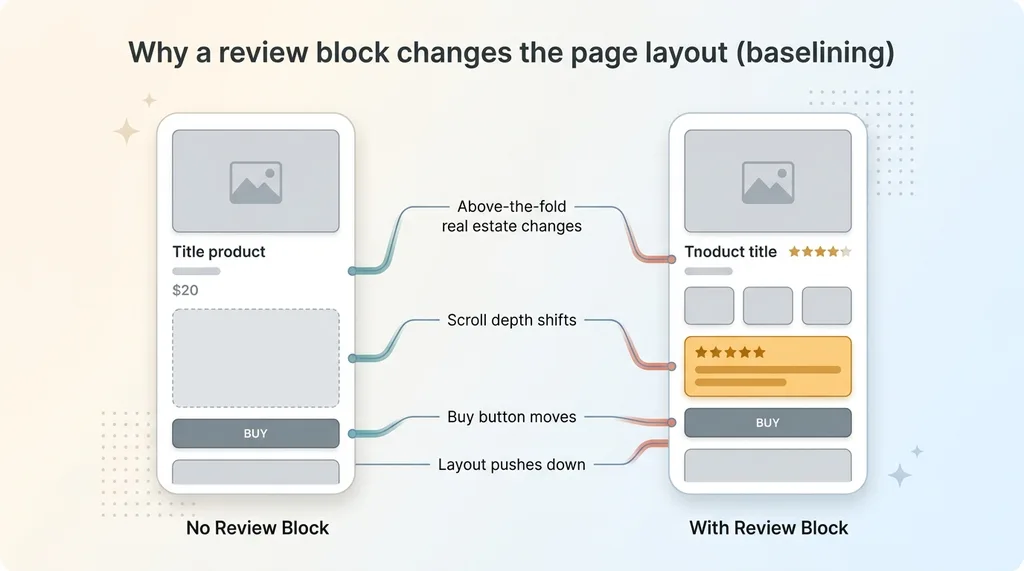 Why a Review Block Changes the Page (Baselining)
Because you can't optimize a page you can't measure.
If your product page has no reviews and your competitor's has 200, and your conversion rate comes in low, what's the cause? Is it your copy? Your pricing? Your photography? Or is it just the gaping hole where social proof should be?
You have no idea. You've confounded every variable with one missing block.
Baselining means measuring the conversion ceiling with the review block present, so you can isolate everything else before you launch. This is real conversion testing, not vanity.
From my own DTC work, here's what a review block actually changes on a page:
- Layout. It pushes everything below it down.
- Scroll depth. People scroll into and past it differently than past empty space.
- Above-the-fold real estate. On mobile, a star rating near the title changes what a buyer sees first.
- Buy button position. Reviews often sit between the gallery and the CTA, so they move where the purchase action lives.
You need to test the page as it will actually look once real reviews exist. Not a stripped-down version that no future visitor will ever see.
The honest goal here is layout and conversion testing. Pre-launch social proof exists so you can baseline the page, isolate the real conversion levers, and walk into launch knowing what's working. It is not a tool for tricking a buyer. Hold onto that distinction, because it's the whole difference between legal and not.
The narrow, honest way to mock reviews without breaking the rule
Here's the core of it. Four rules. Treat them as a checklist, not suggestions.
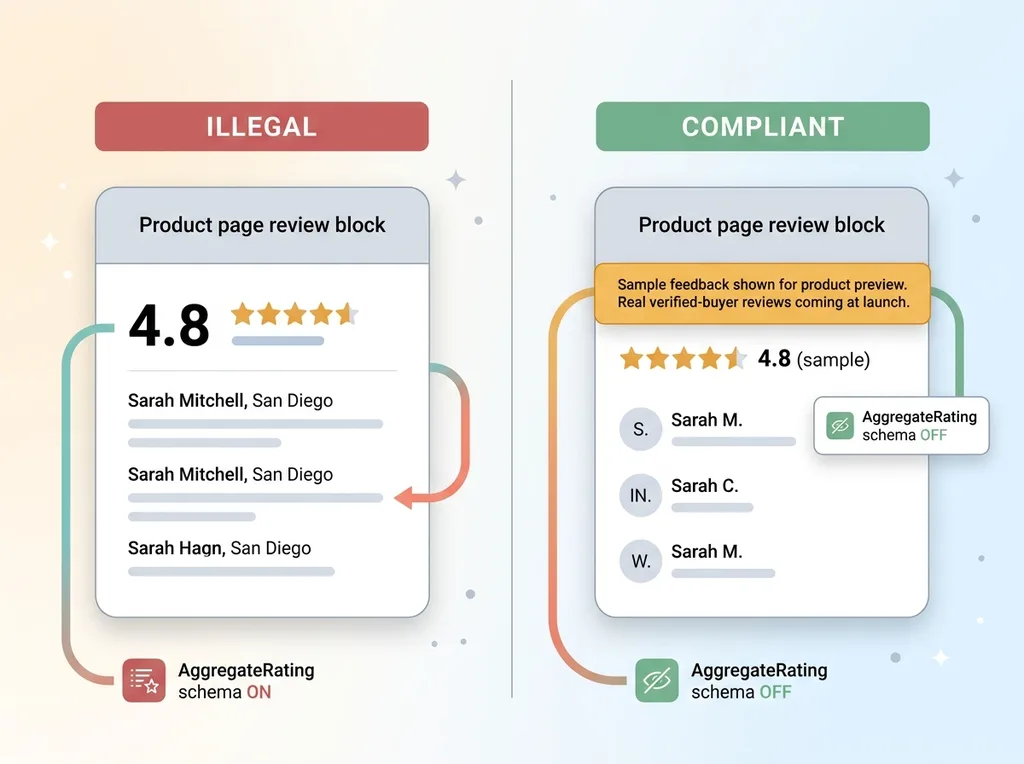 Compliant vs Non-Compliant Placeholder Review Block
Show a visible sample banner
Display an unmissable banner on or above the review block. Something like: "Sample feedback shown for product preview. Real verified-buyer reviews coming at launch."
Unmissable means exactly that. Not buried in a footer. Not in 9px gray text. Not behind a tooltip. If a normal person reading the page could miss it, it doesn't count as a disclosure. The whole legal cover here is that an honest visitor understands these aren't real customer reviews. A hidden disclosure provides zero cover.
Use first-name-plus-initial only
Use "Sarah M." Never "Sarah Mitchell, San Diego."
The more identifiable the persona, the more it reads as a specific real person you invented. A full name plus a city is the FTC's textbook example of a fabricated reviewer. First-name-plus-initial reads as a generic placeholder, which is exactly what it is.
Label the rating as a sample
Display the rating as "4.8 (sample)" rather than a bare "4.8" that mimics a real aggregate score.
The label travels with the number everywhere the number appears. A bare star rating is a claim. A labeled sample rating is a placeholder. The word "sample" is doing heavy lifting, so don't drop it.
Never emit AggregateRating schema
This is the one founders miss, and it's the most dangerous.
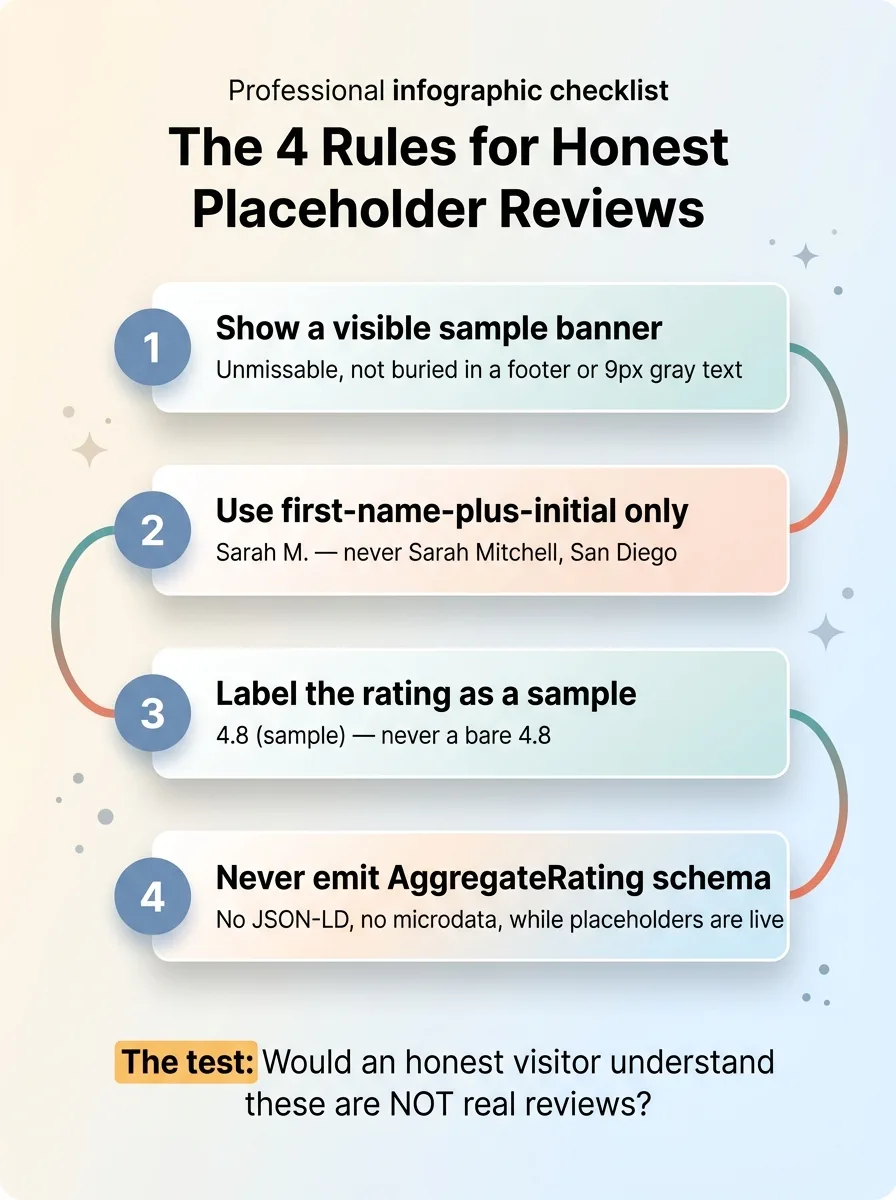 The Four Rules Checklist for Honest Placeholder Reviews
While placeholders are live, never emit AggregateRating structured data. Not the JSON-LD, not the microdata, none of it.
Schema is a machine-readable signal that tells search engines your review data is real and verified. That's the entire point of it. When you emit AggregateRating with fake numbers, you're not just misleading a human visitor who can at least see your sample banner. You're lying directly to Google, telling it you have verified reviews you don't have.
This is both an FTC issue and a Google policy violation. Google can hit your entire domain with a manual action for fake structured data. I've seen the recovery timeline on a manual action, and it's measured in weeks of lost organic traffic, not days. The aggregaterating schema risk is real and it's separate from the FTC penalty. You can get burned twice.
Here's the test that ties all four rules together. Would an honest visitor reading the page understand these are not real customer reviews? If yes, you're testing layout. If no, you're deceiving a buyer, and no clever labeling saves you.
That question is the line. Everything else is implementation.
The file-by-file swap checklist before any paid traffic
The placeholder phase isn't the dangerous part. Forgetting to fully remove it is.
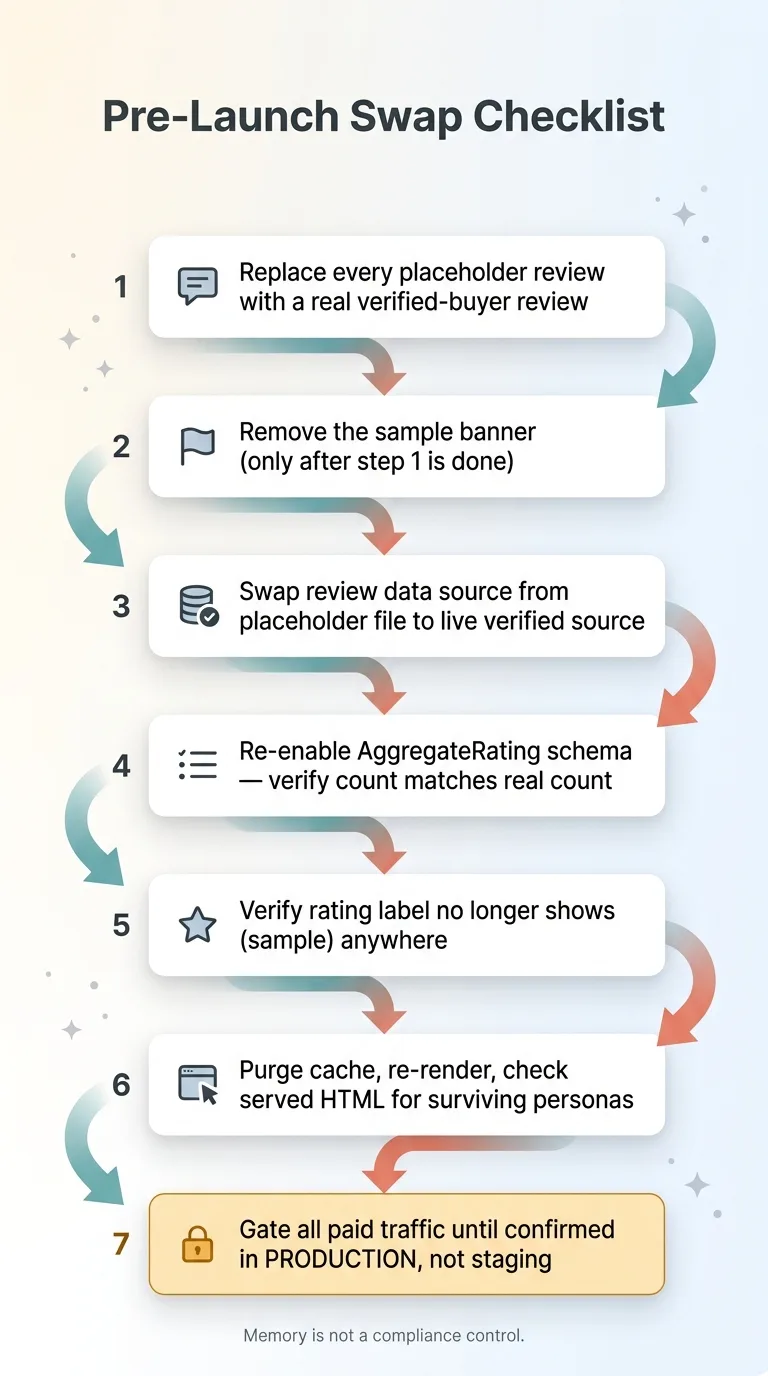 The File-by-File Swap Checklist Before Paid Traffic
The trap I've actually hit: a placeholder review lives in a config file, or a cached static render, that everyone forgot existed. The visible page looks clean. The buried artifact is still serving fake data. That's how a careful team ends up non-compliant by accident.
So build the kill switch into the process. Don't trust your memory. Here's the ordered swap checklist, run before any paid traffic touches the page:
- Replace every placeholder review with a real verified-buyer review first. Don't touch the banner until this is done.
- Remove the sample banner only after every placeholder is gone.
- Swap the review component's data source from the placeholder file to the live verified-reviews source. Confirm the component is reading the real source, not a stale import.
- Re-enable AggregateRating structured data only once you have genuine verified reviews counted. Verify the count in the schema matches the real count.
- Verify the rating label no longer shows "(sample)" anywhere it renders. Title, gallery, schema, all of it.
- Confirm no placeholder personas survive in any cached or pre-rendered version of the page. Purge the cache. Re-render. Check the actual served HTML, not the source.
- Gate all paid traffic until the swap is confirmed in production, not staging. Staging passing means nothing if production still serves the old render.
That last point matters more than it looks. I've seen teams confirm a fix in staging, high-five, and forget production was running a separate cached build. The swap has to be verified in the environment that real visitors and real ad clicks actually hit.
This is the same gating discipline I write about in shipping content in a regulated space. The principle is identical: nothing ships until you've verified what actually ships, in production, against a checklist you don't deviate from. Memory is not a compliance control.
What I'd never do, even with disclosure
Drawing hard lines is how you stay safe. Even with a visible sample banner, here's what I will not do.
Never run paid traffic to a page with placeholder reviews. The moment money is on the line, the FTC's view of "preview" evaporates. You're no longer baselining, you're advertising with fake social proof. The disclosure won't save you.
Never use placeholder reviews on a page that's indexable and ranking. Organic visitors arriving from search don't see the page the way an internal tester does. They land cold, with no context, expecting real reviews. Your "preview" framing doesn't reach them.
Never invent specific verifiable claims. No "lost 15 pounds in two weeks." No "doubled my revenue." False health or performance claims carry their own separate liability, completely independent of the review rule. A sample banner does nothing for a fabricated outcome claim.
Never let placeholders sit live longer than the test window needs. Every extra day live is extra exposure for zero additional benefit. Test, get your baseline, swap them out.
Here's the honest limitation. This technique is for internal baselining and layout testing only. It exists so you can measure your page's conversion ceiling before launch. It is not a way to fake credibility to real buyers. If that's the actual goal, no disclosure makes it legal, and I'd tell you to walk away from it.
Getting the foundation right before you scale
The brands that get burned here aren't malicious. They're moving fast and treating compliance as something to clean up later.
The discipline of building the disclosure, the labeling, and the swap checklist into the process from day one is the same discipline that separates the systems that survive an audit from the ones that get fined. Boring guardrails. The kind that prevent a $50,000 mistake you never see coming.
This is exactly the detail I build into every system I ship, whether it's a product page, a pricing engine, or a pre-launch funnel. The conversion work and the compliance work aren't separate jobs. They're the same job done right.
If you want the broader picture on standing up a brand the right way, I cover more of it in the DTC playbook nobody else is writing. And if you're building a new product page, a pre-launch funnel, or any system where compliance and conversion both matter, that's the conversation worth having.
Want to explore what AI could do for your business?
Book a free 30-minute strategy call. No pitch deck, no sales team, just a real conversation about your operations and where AI actually fits.
Get AI insights for business leaders
Practical AI strategy from someone who built the systems — not just studied them. No spam, no fluff.
Hodgen.AI
Ready to automate your growth?
Book a free 30-minute strategy call with Hodgen.AI.
Book a Strategy Call