Generalist vs Specialist AI: Why Range Wins Now
I shipped production systems across nine regulated industries in one quarter. Here's why the generalist vs specialist AI debate has flipped.
By Mike Hodgen
The Objection I Hear Most: A Generalist Can't Possibly Get Your Domain Right
The first thing a skeptical CEO says when we talk about generalist vs specialist AI is some version of this: "You don't know my industry. How can you build for it?"
It's a fair objection. For most of business history it was the correct one.
Domain knowledge took years to acquire. A lawyer spent a decade learning what gets a firm sanctioned. A winemaker learned which mistakes ruin a vintage. A security-staffing ops lead learned which post goes uncovered and what that costs. You earned that knowledge slowly, by getting burned, and the scar tissue was the expertise.
Hiring a generalist into a regulated field used to be a red flag. If someone showed up to build a compliance system for a financial advisory firm and they'd never read the ad rules, you showed them the door. Correctly.
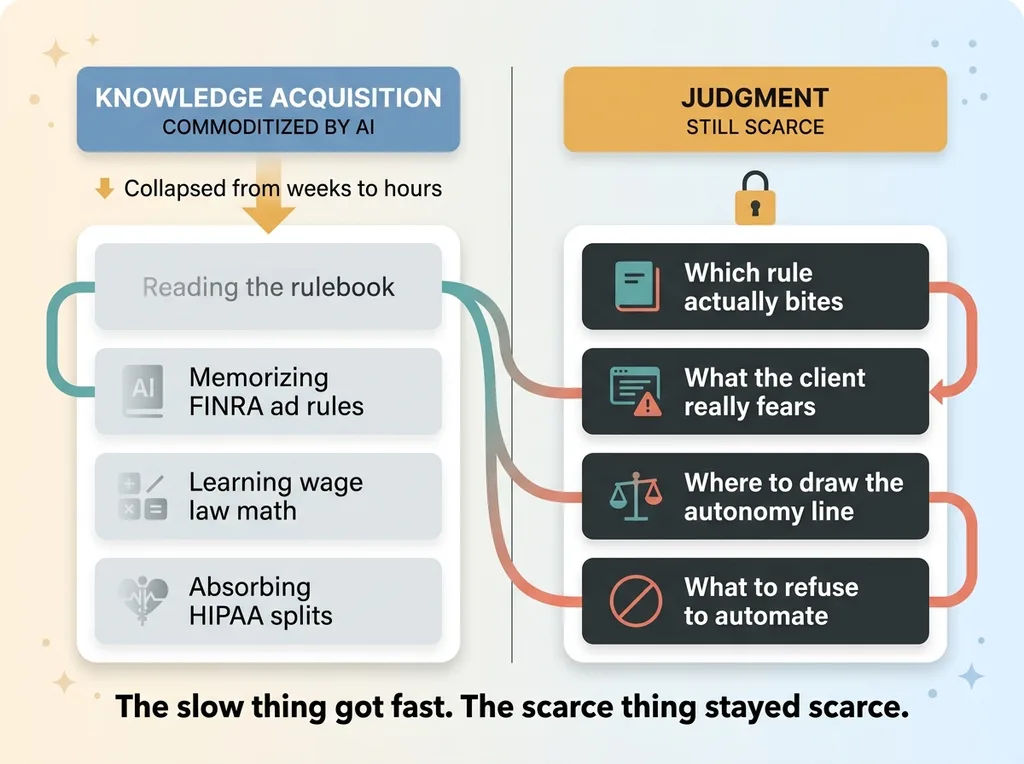
Here's my thesis, stated up front: that math has flipped. Not because AI is magic. Because AI commoditizes the knowledge-acquisition part of expertise, not the judgment part. The slow thing got fast. The scarce thing stayed scarce.
The slow thing was reading the rulebook and holding it in your head. The scarce thing is knowing which rule actually bites, where to draw the line, and what to refuse to automate.
I'll prove it with something concrete. In a single quarter I shipped production AI systems into nine unrelated regulated industries. Not slide decks. Working systems, live, with real constraints. If you want the full scope of what that looked like, I wrote it up in what a full quarter of building actually looks like.
None of those nine industries shared a domain. What transferred between them wasn't trivia. It was a method.
Nine Industries in One Quarter: The Actual Cross-Section
Let me make this concrete, because "I work across industries" is the kind of thing every consultant says.
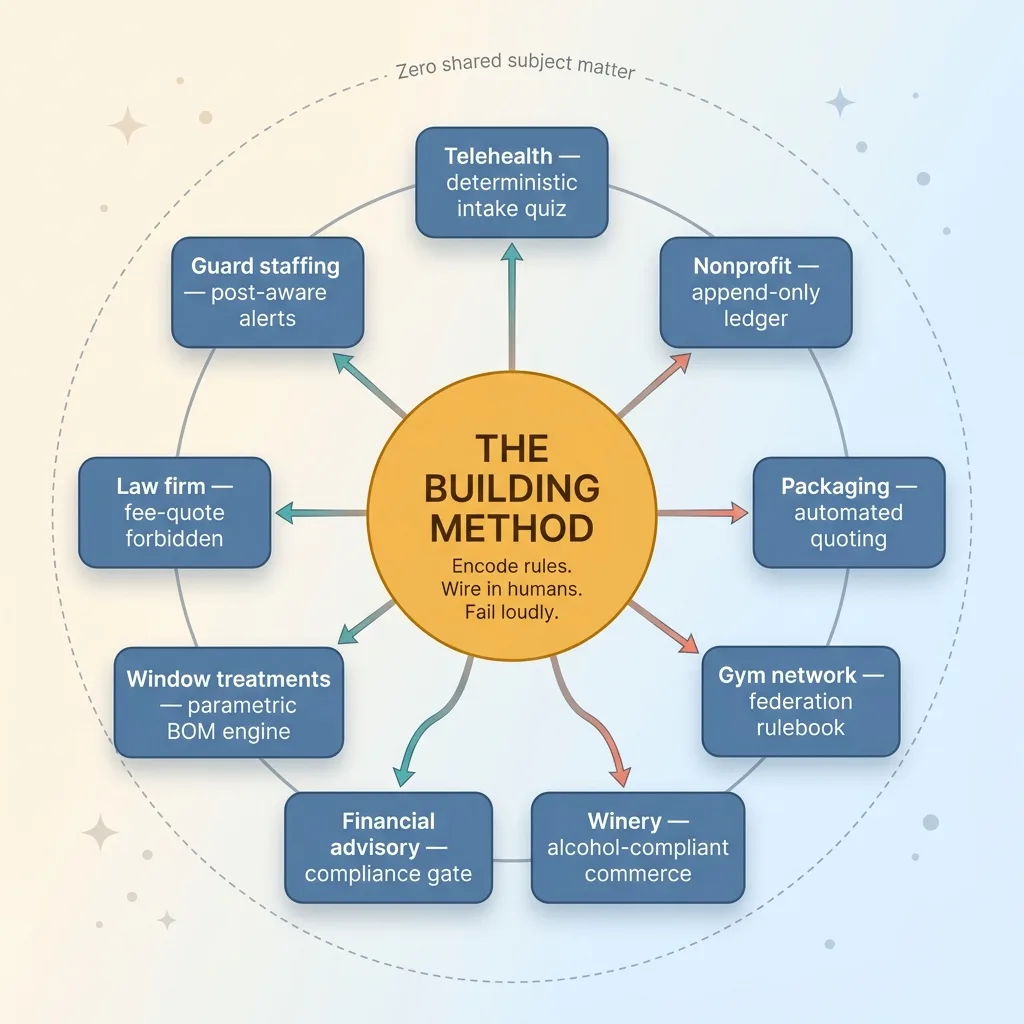 Nine Industries, One Shared Building Method
Here's the actual cross-section from one quarter:
- A longevity and telehealth venture got a deterministic intake quiz that routes patients without the model ever giving medical advice.
- A guard-staffing company got post-aware staffing alerts that flag uncovered shifts before they become a liability.
- A nonprofit got an append-only ledger that keeps donations and allocations honest and auditable.
- A packaging distributor got an automated quoting flow tied to real inventory data.
- A gym network got a member-facing system wired around a niche sport's federation rulebook.
- A winery got a content and commerce pipeline that respects alcohol marketing constraints.
- A financial advisory firm got a compliance-gated content engine where nothing publishes until it passes the rules.
- A window-treatment company got a parametric quoting and BOM engine that turns measurements into a buildable order.
- A law firm got an intake agent structurally forbidden from quoting a fee.
Read that list again. There is no shared subject matter. The wage rules for the guard company have nothing to do with the FINRA ad rules for the advisory firm. The federation rulebook for the gym is useless to the winery.
No transferable trivia. Zero.
What transferred was the building method. The way you encode a rule so the AI can't violate it. The way you wire a human into the loop at the exact point where judgment matters. The way you make a system fail loudly instead of quietly.
This is the stacking generalist made concrete. Each industry didn't make me a domain expert in that field. It made me faster at the thing that's actually scarce: turning a set of rules into a system that enforces them.
One operator. Multiple industries. One quarter. The range isn't a gimmick. It's the point.
Generalist vs Specialist AI: What Actually Got Commoditized
People lump two things together when they talk about expertise. Separate them and the whole argument becomes obvious.
 Knowledge Acquisition vs Judgment: What Got Commoditized
Knowledge acquisition collapsed
The first thing is knowledge acquisition. Reading the California wage rulebook. Learning the FINRA advertising rules. Understanding the HIPAA split between marketing communication and treatment consent. Getting the federation rulebook for a niche sport.
That used to take weeks of a specialist's time. It was the moat.
Now I can build a defensible working understanding in hours and, more importantly, encode it as ground-truth facts the AI must never contradict. The rulebook stops being something I memorize and becomes a hard constraint the system checks against.
That's the part that got commoditized. The reading. The absorbing. The "I spent ten years learning this" part. AI ate it.
Judgment did not
The second thing is judgment, and AI did not touch it.
Judgment is knowing which rule actually bites in practice versus which one is technically on the books but never enforced. It's reading what the client is actually afraid of, which is usually not the thing they said in the first meeting. It's knowing where to draw the line on autonomy, and what to flat-out refuse to automate.
A model will not do this for you. A model will confidently encode a wrong rule and never flinch. It has no fear of being sanctioned. It doesn't know what a bad day in court costs.
So the generalist's edge is not "AI knows everything." That's the wrong reading. The edge is that the slow part got fast, which leaves judgment as the only scarce skill in the room.
And judgment comes from listening before you automate, not from having spent a decade in one vertical. The specialist's decade gave them domain reflexes. It didn't give them the building method, and the building method is now the bottleneck.
How I Prove a Generalist Got a Regulated Domain Right: The Compliance Gate
Here's the part that answers the buyer's real doubt.
 The Compliance Gate: Don't Trust, Enforce
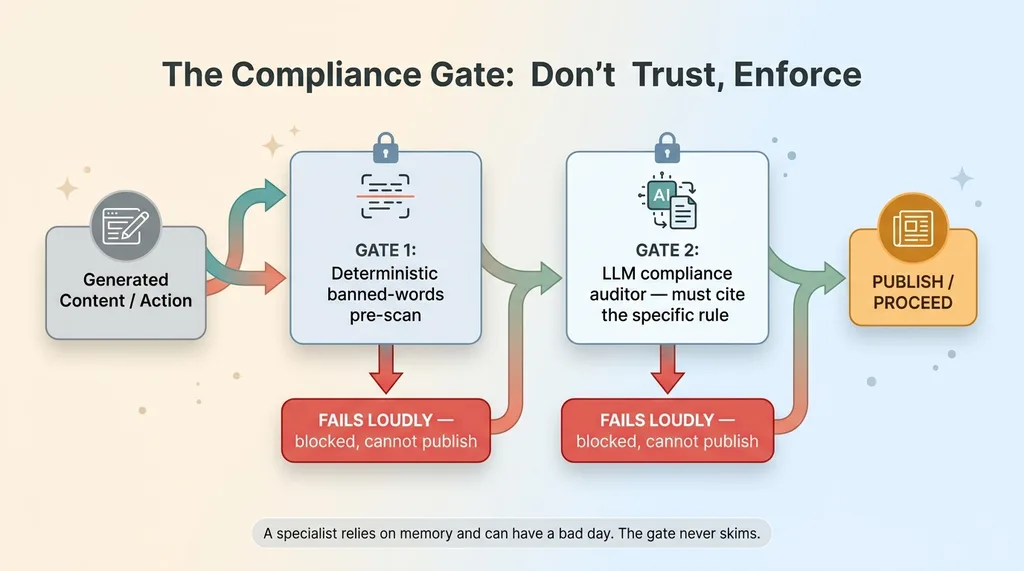
I don't ask anyone to trust that I "know" their domain. Trust is the wrong currency. I build the gate that enforces the rules, and the gate is the proof.
A specialist relies on memory and habit. That's fine until they're tired, distracted, or rushing a deadline. My systems make the rule a hard constraint that fails loudly when it's violated. No memory required.
Concrete examples, anonymized:
For the advisory firm's content engine, nothing publishes until it passes a deterministic banned-words pre-scan plus an LLM compliance auditor that has to cite the specific rule it's checking against. If it can't cite the rule, it doesn't pass. A human specialist might skim a post and miss a problem word. The gate never skims.
For the law firm's intake agent, the system is structurally forbidden from quoting a fee. Not "trained to avoid it." Forbidden at the architecture level. The path to quoting a number doesn't exist in the code.
For the telehealth funnel, the intake quiz is deterministic on purpose. The model never improvises medical advice because the model isn't in the decision path. That's a design choice that protects the client from the exact failure mode that scares them.
For the guard-staffing wage logic, I encoded California overtime math and then validated it against real court examples with 172 tests. The math doesn't depend on me remembering it correctly. It depends on the tests passing.
That's the difference. A specialist's correctness lives in their head and can have a bad day. My systems make correctness a property of the architecture that fails loudly the moment it's wrong.
I've written about how the pattern was the same in every regulated industry I worked in. The gate changes shape, but the principle holds: don't trust, enforce.
Why Range Becomes a Feature, Not a Red Flag
Now the affirmative case for range.
 Five Shared Primitives Across Every Industry
When you only work one field, you see your field's patterns and nothing else. You think the way you solve a problem is the way it's solved, because you've never watched the same problem get solved differently next door.
I get to watch it next door.
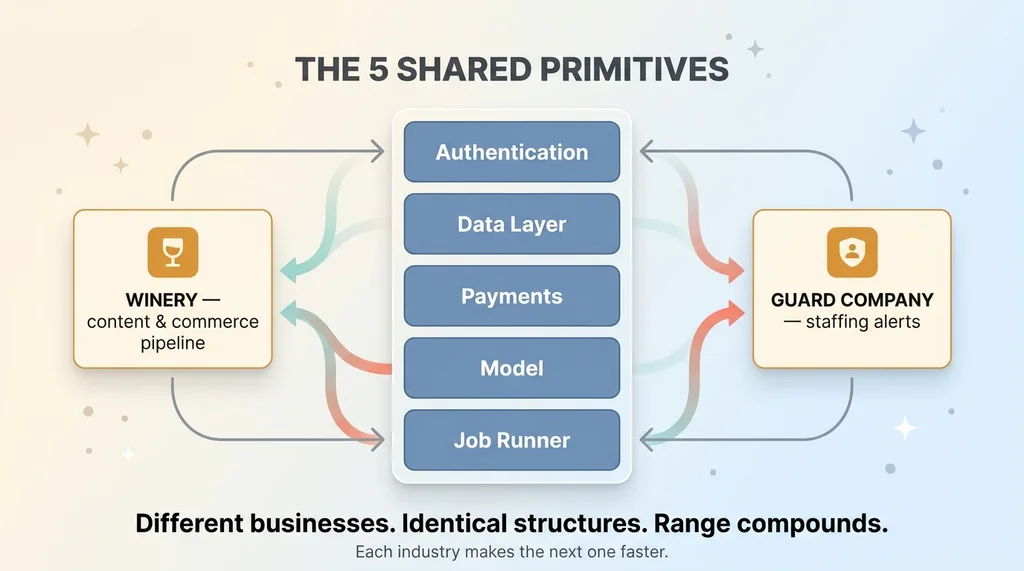
The same five primitives power a winery and a guard company: authentication, a data layer, payments, a model, and a job runner. Once you've built that stack for one, you carry the architecture into the next one. The winery and the security firm have nothing in common as businesses. As systems, they rhyme.
The human-in-the-loop design that protects a law firm from an unauthorized fee quote is the same pattern that protects a health app from giving medical advice. Different stakes, identical structure.
The append-only ledger that keeps a nonprofit's donations honest is the same ledger that keeps a marketplace's commissions honest. I built one, learned its failure modes, and the second one was faster and better because of the first.
A specialist re-learns these architectural patterns by accident, one painful project at a time, and only within their lane. A generalist carries them across lanes on purpose. Range compounds. Each industry makes the next one faster, not because the subjects connect, but because the structures do.
Let me be honest about the limit. I'm not the person to render the final legal opinion or sign off on the medical protocol. That's the licensed expert's call, and it should be. My job is to build the system so it routes to them at exactly the right moment. Range gives me the architecture. It does not give me their signature, and I don't pretend it does.
Where the Generalist Model Breaks (And When You Still Want a Specialist)
I'd be lying if I said range wins everywhere. It doesn't, and the honest boundary is what makes the rest of this credible.
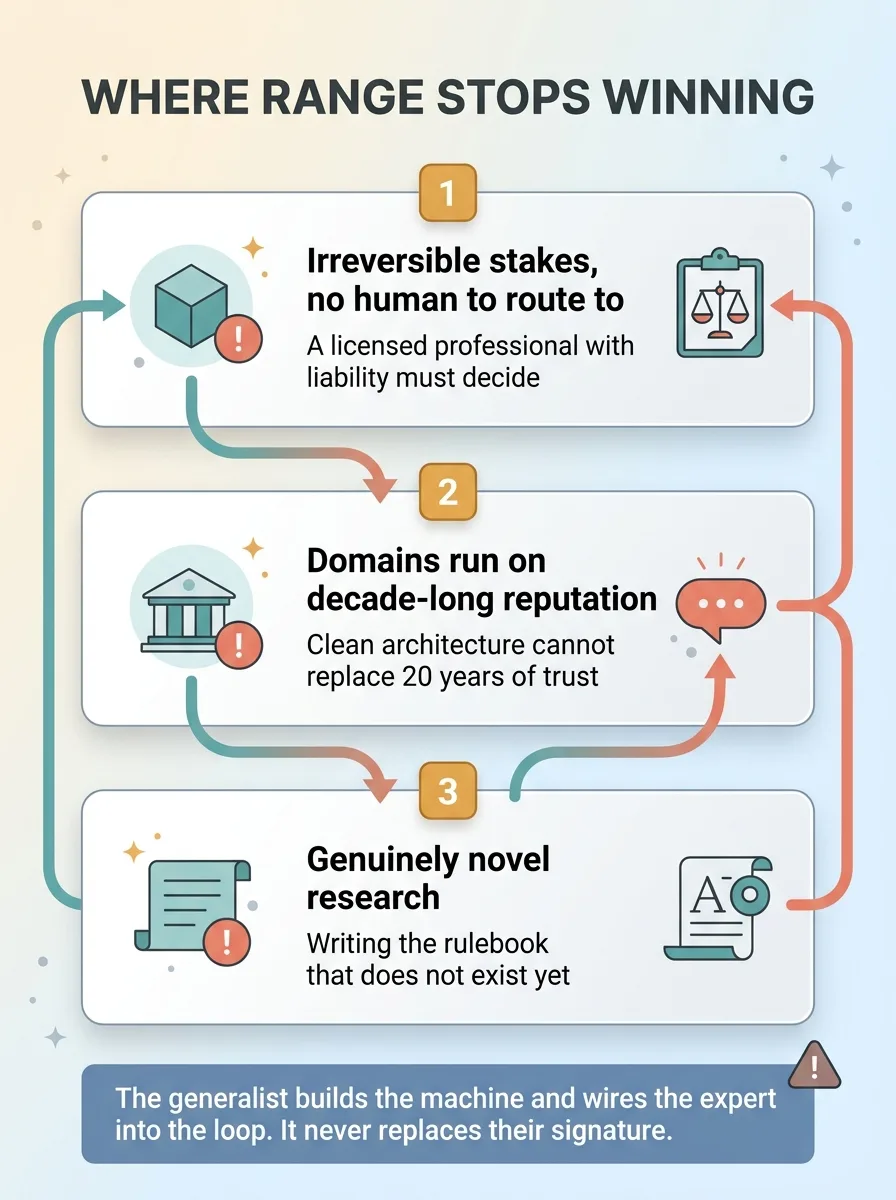 Where the Generalist Model Breaks
The generalist model breaks in three places.
First, when the judgment call has irreversible legal or clinical stakes and there's no human to route to. If a decision can ruin someone and a system makes it alone, that's not a place for "fast working understanding." That's a place for a licensed professional with liability on the line.
Second, when the domain rewards relationships and decade-long reputation more than it rewards systems. Some fields run on trust that took twenty years to build. No amount of clean architecture replaces a name people already believe.
Third, when the problem is genuinely novel research rather than encoding known rules. I'm good at turning an existing rulebook into a constraint. I'm not the person to write the rulebook that doesn't exist yet.
So here's what I actually do. I encode the wage law, and a labor attorney still reviews the edge cases. My health AI never diagnoses, full stop. The intake quiz routes to a clinician instead of pretending to be one.
The generalist's job is to build the machine and wire the expert into the loop. Not to replace the expert's signature. The moment a builder tells you the AI replaces your lawyer or your doctor, walk away. That's the tell of someone who doesn't understand the stakes.
What This Means If You're Picking Who Builds Your AI
The hiring decision used to be a tradeoff. You chose between deep domain experience and strong building ability, and you usually couldn't get both in one person. The domain expert couldn't ship. The builder didn't know your rules.
That tradeoff is gone.
Building ability plus a method for encoding domain rules fast now beats narrow depth that ships slowly. The person who can read your rulebook in a week and turn it into an enforced constraint will out-deliver the twenty-year veteran who's never built a system in their life.
So here's what to look for in whoever you hire.
Do they build, or do they just advise? Slides don't enforce a compliance rule. I wrote about why I don't just advise on AI, I build it, because the range only matters if the work actually ships.
Do they ship compliance as a hard gate, or as a hope? "The AI is trained to follow your rules" is a hope. A deterministic gate that fails loudly is a guarantee.
Do they wire your licensed experts into the loop, or pretend the AI replaces them? The right answer routes to your expert. The wrong answer cuts them out.
If you're in a regulated field and you've been told only a specialist could build your system, the real question isn't whether the builder already knows your industry. It's whether they can encode the rules that matter and prove the rules hold.
That's the work I do.
Thinking about AI for your business?
If this resonated, let's have a conversation. I do free 30-minute discovery calls where we look at your operations and identify where AI could actually move the needle.
Get AI insights for business leaders
Practical AI strategy from someone who built the systems — not just studied them. No spam, no fluff.
Hodgen.AI
Ready to automate your growth?
Book a free 30-minute strategy call with Hodgen.AI.
Book a Strategy Call