The Shipping Label Wrong Address Bug a Server Guard Fixed
A stale client state race condition shipped one customer's order to another. The fix was server side validation of the ship-to before buying the label.
By Mike Hodgen
The day we shipped one customer's order to the wrong house
A few months ago, my DTC fashion brand shipped a customer's order to a complete stranger's address. Not a typo on a unit number. A different person, a different street, a different city. Their items, somebody else's doormat.
Here is what a mis-ship actually costs, because it is never just one number. You refund the original customer. You eat the cost of the goods that are now sitting in a stranger's hallway. You reship, which means more labor, more packaging, more carrier fees. And you spend an hour in the customer's inbox apologizing while they decide whether to ever order from you again. The order was maybe forty dollars. The incident cost me a multiple of that and a dent in trust I cannot price.
I am writing this up because it was my own system that failed. Not a vendor's, not a contractor's. Mine. The shipping label wrong address bug came from code I am responsible for, and I think the fix is worth sharing because it generalizes far beyond shipping.
Here is the part that surprised even me. It was not human error in the warehouse. Nobody fat-fingered an address or grabbed the wrong box. It was a race condition in software, and the only durable fix lived on the server, not the client.
Let me walk through exactly what happened and how I hardened against the entire class of bug, not just the one incident.
How the bug actually happened: a quote/buy split that trusted the client
The pack page workflow
The pack page is where orders get labels. The flow against the shipping carrier API is two steps.
Step one: quote rates. The client sends the destination address, and the carrier returns available rates. Crucially, this call also creates a carrier shipment object, and that object has the destination address baked into it. The carrier hands back a shipment ID.
Step two: buy the label. The client passes that shipment ID back to my server, my server tells the carrier "buy the cheapest rate on this shipment," and a label gets purchased for whatever address is baked into that shipment object.
On paper, clean. Quote, then buy. The shipment ID is the handle that ties the two steps together.
Where the stale shipment ID slipped through
The problem is that step one is asynchronous, and the pack page lets you move between orders.
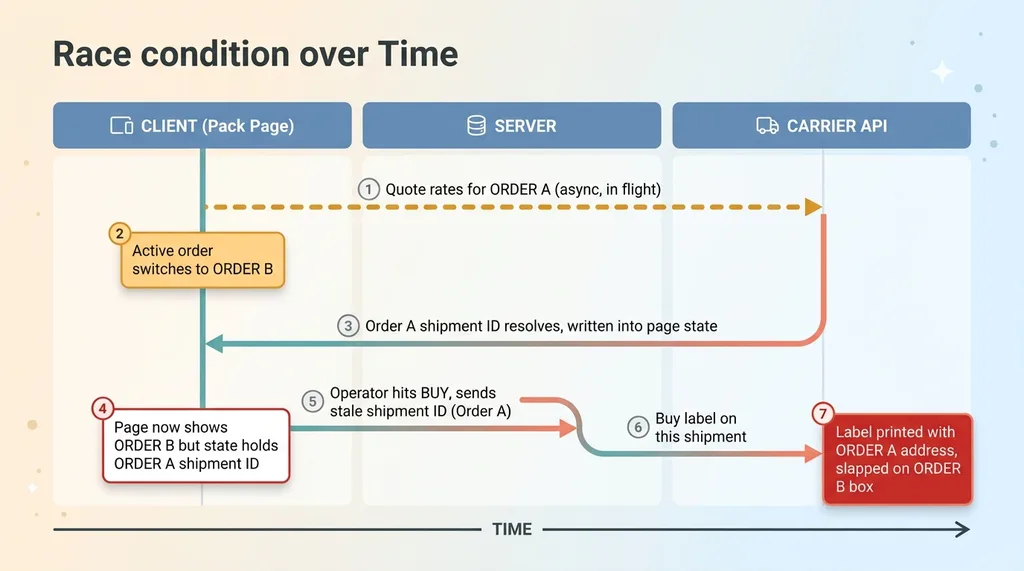 The race condition: how a stale shipment ID slipped through
Picture this. A quote for order A is still resolving over the network. While it is in flight, the active order switches to order B, either because someone clicked ahead or the page auto-advanced after a pack. The quote for order A finally resolves and writes its shipment ID into the page state. But the page is now showing order B.
Now the operator hits buy. The client sends the shipment ID that is currently sitting in state, which belongs to order A, with order A's customer address baked in. My server trusts that ID, tells the carrier to buy the label, and a label for the previous customer's house gets printed and slapped on order B's box.
The root insight is uncomfortable. The client was the source of truth for which shipment to buy, and the client state was stale. The server never questioned it. It received an ID, it bought a label. The carrier did exactly what it was told. Everything worked perfectly and produced a catastrophically wrong outcome.
That is the signature of a stale client state race condition. Each individual step is correct. The defect lives in the seam between them.
Why better client state management was the wrong fix
The obvious instinct is to fix the race on the client. Debounce the quote. Clear the shipment ID the moment the active order changes. Cancel in-flight requests when you switch orders. Lock the buy button until the quote that matches the current order resolves.
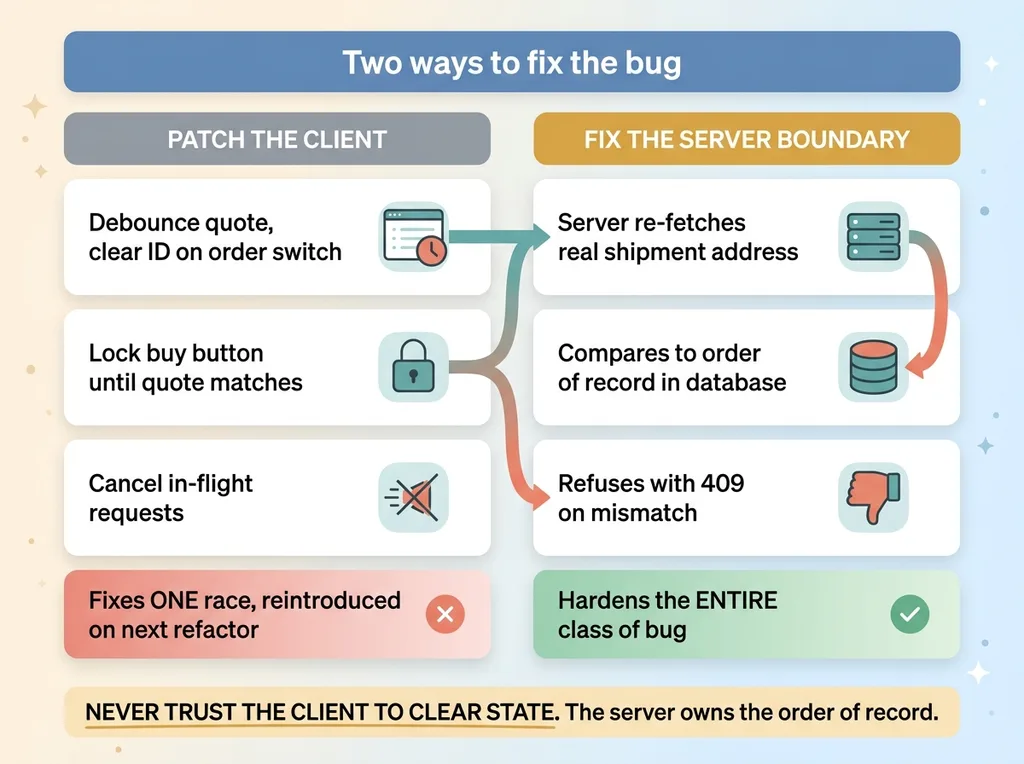 Patch the client vs fix the server trust boundary
I could do all of that. It would even work, for that specific race.
Here is why it is a trap. I can patch the one path I found, but I cannot prove the client is always clean across every future state change. The next time I refactor the pack page, add a keyboard shortcut, or change how orders advance, I reintroduce a way for state to go stale. Client state has too many entry points to guarantee.
And the deeper issue is the trust boundary. Any time the server trusts a client-supplied ID to move goods or money, you have a soft spot, no matter how clean the client looks today. The client runs in a browser I do not control, on a network I do not control, in a state machine that a hundred small UI decisions can corrupt.
So I made the principle explicit and it now governs how I build: never trust the client to clear state. The server owns the order of record. The server must verify against it.
The good news is that the verification I needed is not a judgment call. It is a deterministic comparison: does the address baked into this shipment match the address on the order in my database? That is exactly the kind of check that belongs in code, not in a model and not in a human's hands. I wrote separately about why I let the code do the deterministic checks and reserve judgment for the parts that actually require it. This is a textbook case. Two addresses either match on the fields that matter or they do not. No nuance, no guessing.
The fix: re-verify the ship-to on the server before buying the label
The durable fix lives entirely on the server, in the buy-label route, before any label gets purchased. Three steps.
Re-fetch the carrier shipment
When the buy-label request comes in with a shipment ID, the server does not assume anything about what that ID contains. It re-fetches the carrier shipment object by ID and reads the destination address that is actually baked into it.
This is the address the label will physically use. Not what the client claims, not what I hope is there. The real one.
Normalize and compare against the order of record
Then the server pulls the authoritative ship-to from the order of record, meaning the order row in my database, not anything from the client payload. The database is the only source of truth I actually control.
It normalizes both addresses (street, city, ZIP, casing, whitespace, common abbreviations) and compares them. If the shipment's baked-in destination matches the order's true ship-to, we are good. If they diverge, something is wrong, and we know it before money is spent.
Return a 409 and force a re-quote on mismatch
On a mismatch, the route refuses to buy the label. It returns a 409 Conflict that tells the client, in effect, "the shipment you handed me does not match this order, throw it away and re-quote against the current order." The client clears the stale shipment ID, re-quotes fresh, gets a new shipment ID tied to the correct address, and the operator buys the right label seconds later.
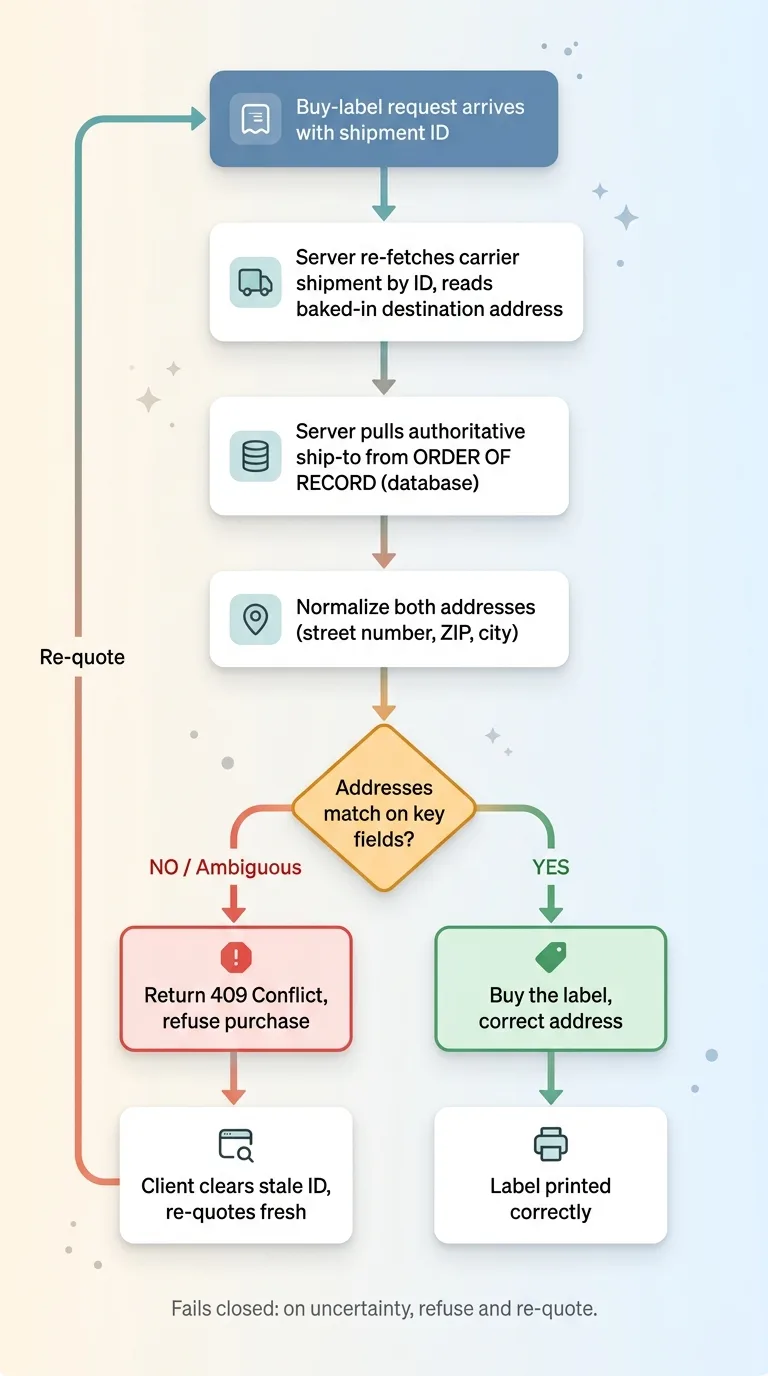 The server-side fix: re-verify ship-to before buying the label
On a match, it proceeds and buys the label exactly as before.
What this does is convert a silent catastrophic failure into a loud, recoverable one. Before, the system guessed and shipped to the wrong house and nobody knew until a customer emailed. Now the system stops and asks for a fresh quote. That is the whole philosophy behind why every system I ship stops for a human or stops cold rather than guessing when something does not line up. A stop costs seconds. A guess costs a customer.
The verify-ship-to-before-buying-label check is now the gate every label purchase passes through. The race condition can still happen on the client. It just cannot reach the carrier anymore.
The details that make address comparison hard (and how to handle them)
I want to be honest about the messy part, because server side validation of shipping addresses is not as clean as "compare two strings."
Normalization pitfalls
Addresses are a swamp. "St" versus "Street." "Apt 4" versus "Unit 4" versus "#4." ZIP+4 versus a plain 5-digit ZIP. Trailing whitespace, inconsistent casing, abbreviated directionals like "N" versus "North."
And the carrier itself rewrites addresses. Carrier-side address correction will legitimately clean up a customer's sloppy entry, so the shipment's destination can differ from my stored ship-to in ways that are correct, not wrong. If I demanded exact-string equality, I would block half of my own legitimate labels.
So I do not compare full strings. I compare on a few high-signal fields: street number, ZIP, and city. If the street number and ZIP match, the package is going to the right building. A "Street" versus "St" mismatch on that basis is noise I deliberately ignore.
When to fail open vs fail closed
The other real decision is what to do when the comparison is ambiguous. I fail closed. On uncertainty, the route refuses and forces a re-quote.
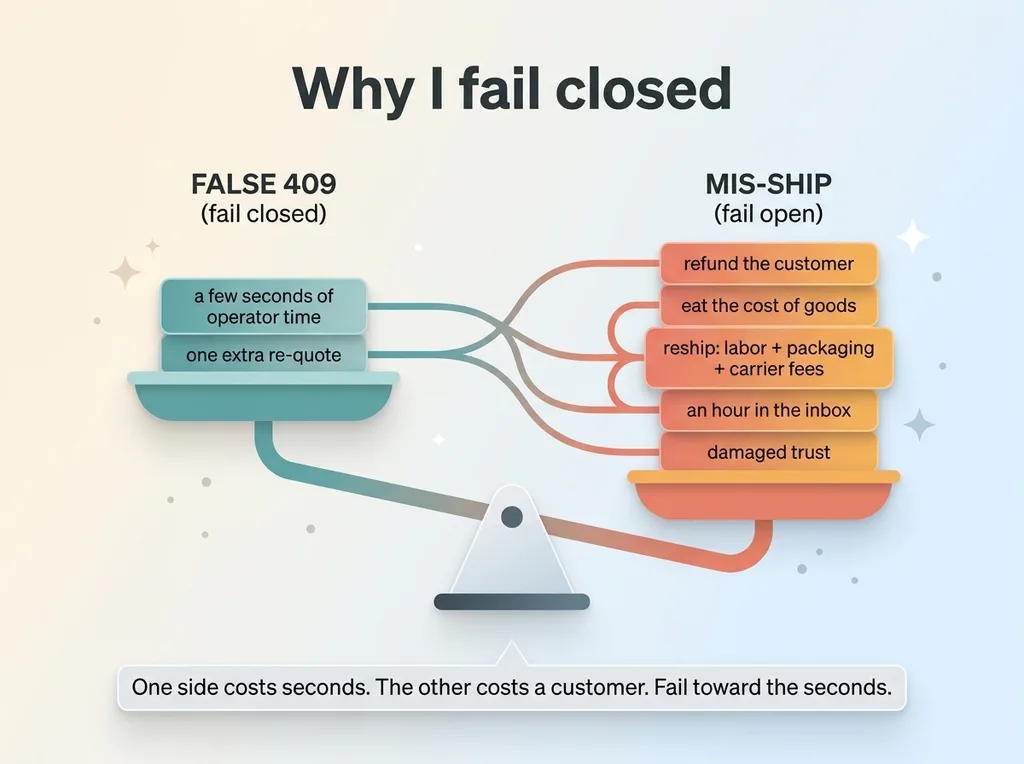 Cost of a mis-ship vs cost of a false 409 (fail closed math)
The math here is not complicated. A false 409 costs the operator a few seconds and one extra quote. A mis-ship costs a refund, a reship, a damaged relationship, and an hour of my time. When one side of the tradeoff is seconds and the other side is a lost customer, you fail toward the seconds every time.
I will be straight about the costs. This added a small amount of latency to every label purchase, because of the re-fetch. And it produces the occasional unnecessary re-quote when normalization is overly cautious. Both were obviously worth it. I have not had a single address mis-ship since, and the latency is invisible next to the value of never shipping to the wrong person again.
The general lesson: the server is the only thing you can trust
Strip away the shipping specifics and the pattern is everywhere. Any time a client passes back an ID that controls an irreversible action, the server must re-verify that ID against the authoritative record before acting.
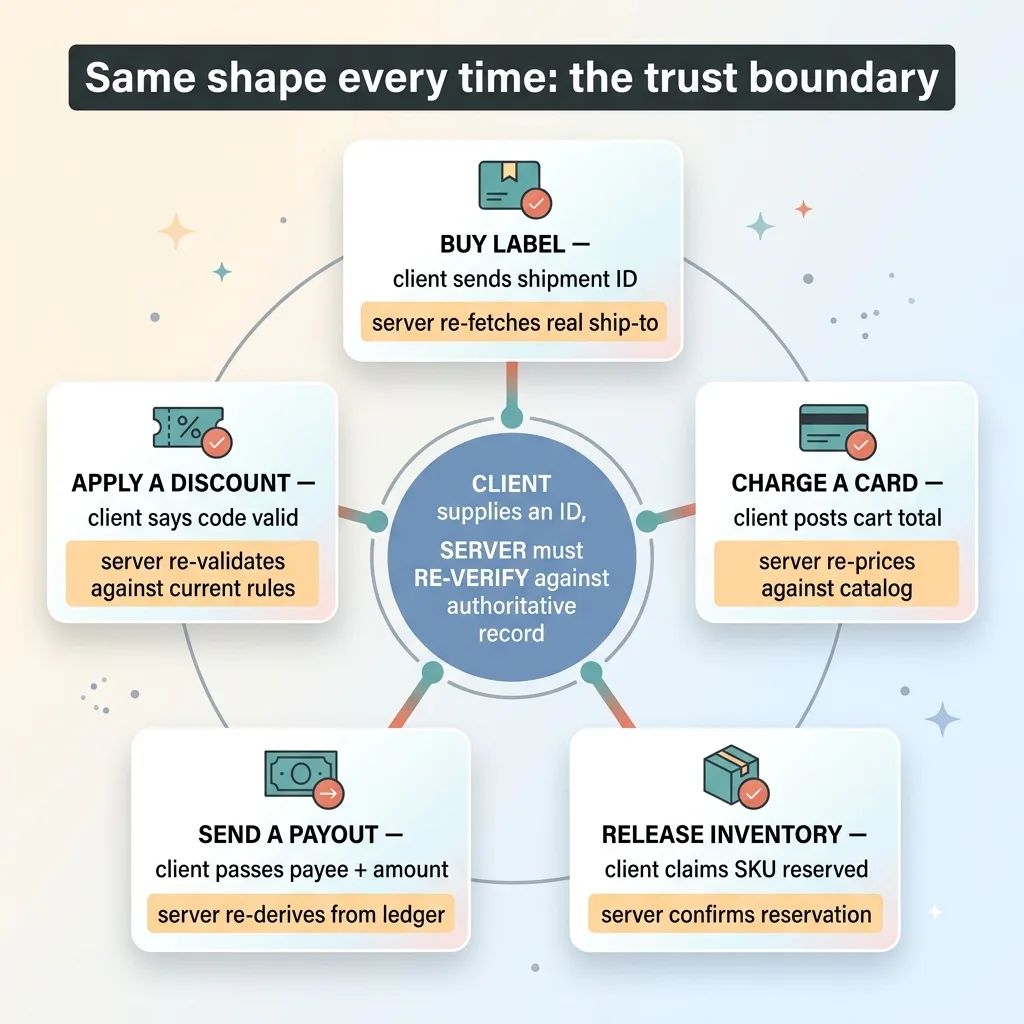 The same trust-boundary pattern across operations
Buying a shipping label is one. Here are others a CEO will recognize from their own operations:
- Charging a card. The client posts a cart total or a price ID. The server must re-price against the catalog of record, or someone pays the wrong amount.
- Releasing inventory. The client claims a SKU is reserved. The server must confirm the reservation exists and belongs to this order.
- Sending a payout. The client passes a payee or amount. The server must re-derive both from the authoritative ledger.
- Applying a discount. The client says a code is valid. The server must re-validate it against current rules.
Every one of these is the same shape as my shipping label wrong address bug. The client supplies an identifier, the server trusts it, and an irreversible action fires against stale or manipulable data.
There is also a monitoring lesson here. This failure was completely silent until a customer complained. The label printed, the box shipped, the dashboard was green. So I added a check that flags any buy-label that even came close to a mismatch, so I can see near-misses before they become incidents. Green dashboards lie, which is exactly why I build automations that tell you when nothing is wrong instead of only screaming when it already is.
The reframe I want you to leave with: fulfillment accuracy is not a warehouse problem. It is a software trust boundary problem. The wrong package left because the server trusted the client. Fix the boundary and the warehouse stops looking careless.
What this says about the people building your systems
I am not telling you this story to prove I write perfect code. I shipped the bug. It went to a real customer's wrong house and I felt it.
The point is what happens after the failure. A patch-minded builder would have debounced the quote, called it fixed, and waited for the next variation of the same bug. What I did instead was find the structural cause, the trust boundary, and harden against the entire class. Not the one race. Every place the server trusted the client to move goods.
That difference comes from running a real brand on these systems. When something ships wrong, I do not get a bug report. I get an angry customer and a refund out of my own margin. I pay for my failures directly, which is exactly why my fixes are durable and not cosmetic.
If you are running operations where software decides what ships, what gets charged, or what moves, the real question is simple. Where do your systems still trust the client? Because that is where your next silent, expensive failure is already waiting.
I can find those boundaries before a customer does. If that is worth a conversation, have me audit where your systems trust the client.
Ready to bring AI leadership into your company?
I work with a small number of companies at a time. If you are serious about AI, apply to work together and I will review your application personally.
Get AI insights for business leaders
Practical AI strategy from someone who built the systems — not just studied them. No spam, no fluff.
Hodgen.AI
Ready to automate your growth?
Book a free 30-minute strategy call with Hodgen.AI.
Book a Strategy Call