The Five-Tool Sales Stack Nobody Asked For
Most SMB sales teams I look at are running the same bloated setup. They want to build a CRM with AI someday, but right now they're paying five different vendors to do one job badly.
Here's the lineup. A lead database to find prospects. An enrichment tool to fill in the emails and phone numbers the database missed. A sequencer to send the actual outreach. A data-cleaner to dedupe and normalize the mess. And a scheduler so prospects can book a meeting.
What each tool actually does
The lead database runs you $100 to $150 per seat per month. The sequencer is another $100 per seat. Enrichment is usually usage-based, so it scales unpredictably with how aggressive your team gets. The scheduler is cheaper, maybe $15 a seat. The data-cleaner sits somewhere in the middle, often bundled or bolted on.
Each of these tools is genuinely good at its one job. The lead database has hundreds of millions of records. The sequencer has solid deliverability. I'm not here to trash any of them individually.
Why they don't talk to each other
The problem isn't the tools. It's the seams between them.
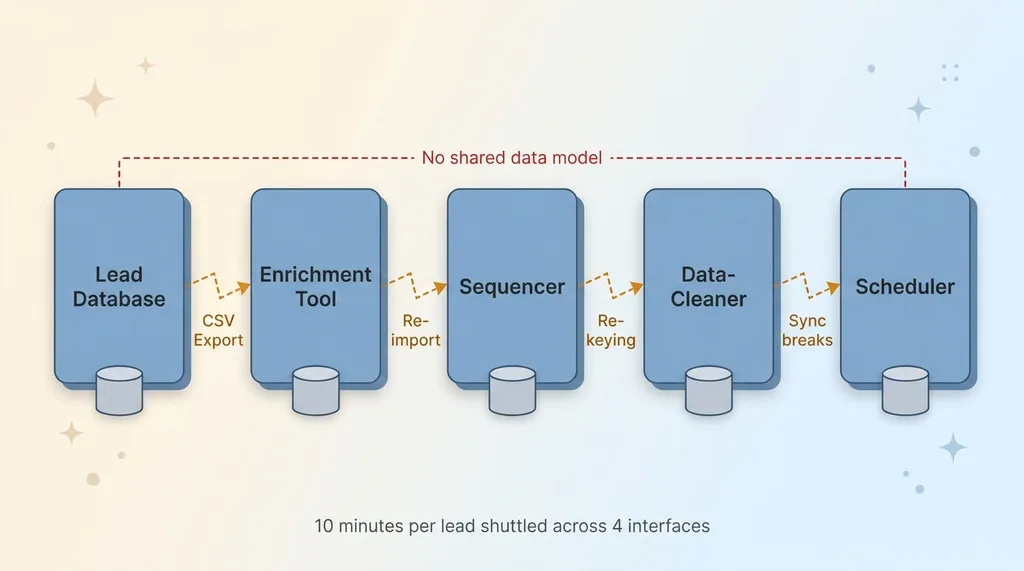 Five disconnected tools vs broken handoffs between them
None of these five share a data model. A lead gets discovered in tool one, exported as a CSV, enriched in tool two, re-imported, sequenced in tool three, and booked in tool four. Every single handoff is re-keying, lost context, and a sync that breaks on a Tuesday for no reason.
Your rep finds a great prospect, then spends ten minutes shuttling that prospect through four interfaces before a single email goes out. Multiply that across a team and a quarter. That's where the real cost lives, and it never shows up on an invoice.
That's the exact problem I set out to kill.
What I Built Instead: One App, One Data Model
I built an AI-native CRM and I run it as a live paid product with real Stripe billing. Not a prototype. Not a slide. A thing people pay for.
The whole design hinges on one decision. Every function (lead discovery, enrichment, outreach, scheduling, pipeline) reads and writes the same database behind one auth layer.
The core insight: shared auth and shared data
A lead never leaves the app. There's no CSV export, no re-import, no re-keying, no sync to break. When the lead scanner finds someone, the SDR can already see them. When a meeting gets booked, the pipeline already knows.
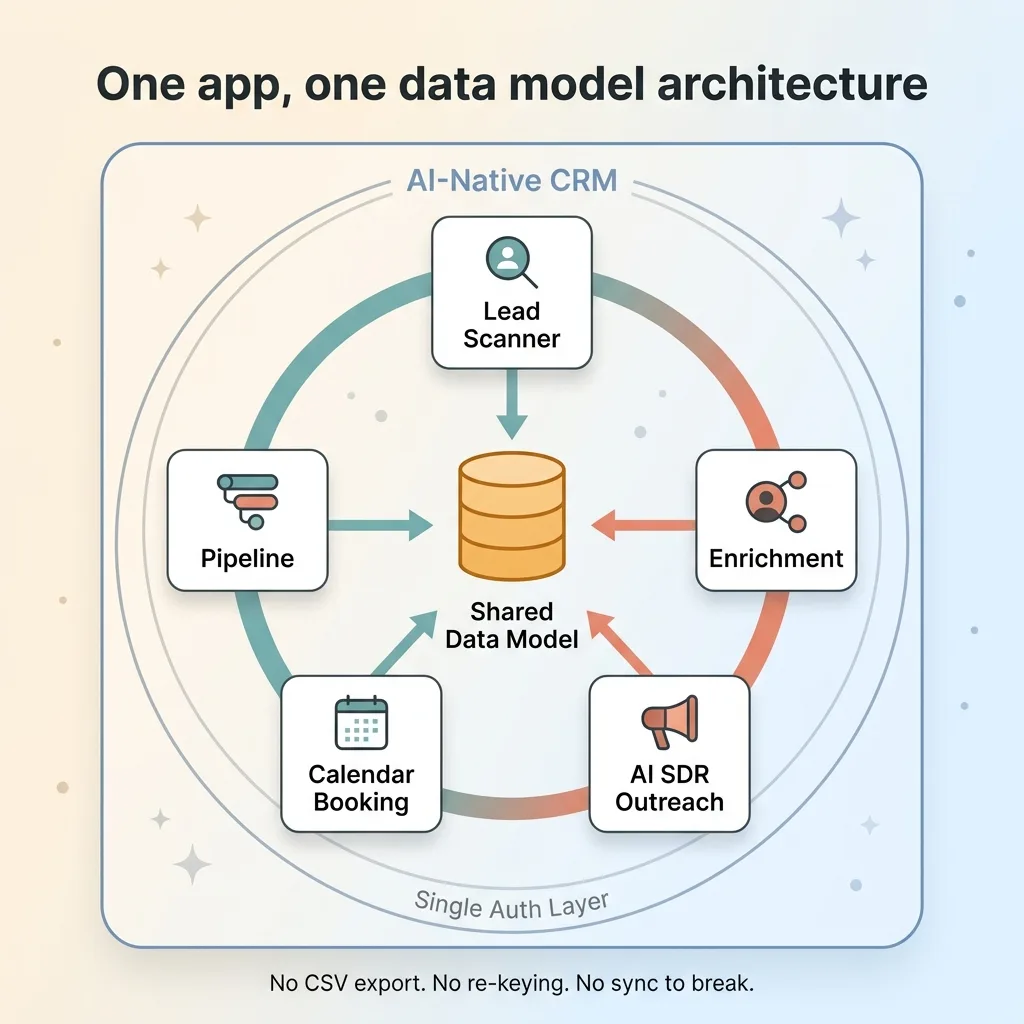 One app, one data model architecture
That sounds obvious. It's the thing five separate vendors structurally cannot give you, because they each own their own database and your data is a guest in all of them.
If you want the full technical breakdown, I wrote the full stack behind this CRM as a companion piece. This article is about the principle. That one is about the wiring.
Multi-tenant from day one
I built it multi-tenant from the start. Each customer's data is isolated by default. One codebase serves many companies, and no one ever sees anyone else's leads.
That matters because it proves this isn't a one-off script duct-taped together for a demo. It's real software with real boundaries, the kind you'd expect from a funded SaaS company.
Except this is a single operator's build. Hold onto that fact. It pays off at the end.
The Lead Scanner: Discovery Without a Database Subscription
The first subsystem replaces the lead database, and it works completely differently.
Instead of paying for a static database that goes stale the moment it's built, the lead scanner runs live web search and uses AI to extract structured prospect data from real sources. Company, role, and buying signals come out the other end.
Web search plus AI extraction
You feed it a search query. It pulls from live sources, and the AI parses unstructured pages into clean, structured, scored leads that drop straight into the same pipeline the rest of the app uses.
The advantage over a static database is freshness. A database record from eight months ago tells you nothing about whether that company is hiring, raising, or expanding right now. Live search does.
It also lets you target on signals a database can't capture. A company that just posted three sales roles is signaling growth. That's a better prospecting trigger than a job title pulled from a record that's been sitting in a CSV since last year.
Why this beats a static lead database
I'll be honest about the limits. This is not infinite scale. A 200-million-record database will always have more raw volume than live search, and you still verify what comes out before you trust it.
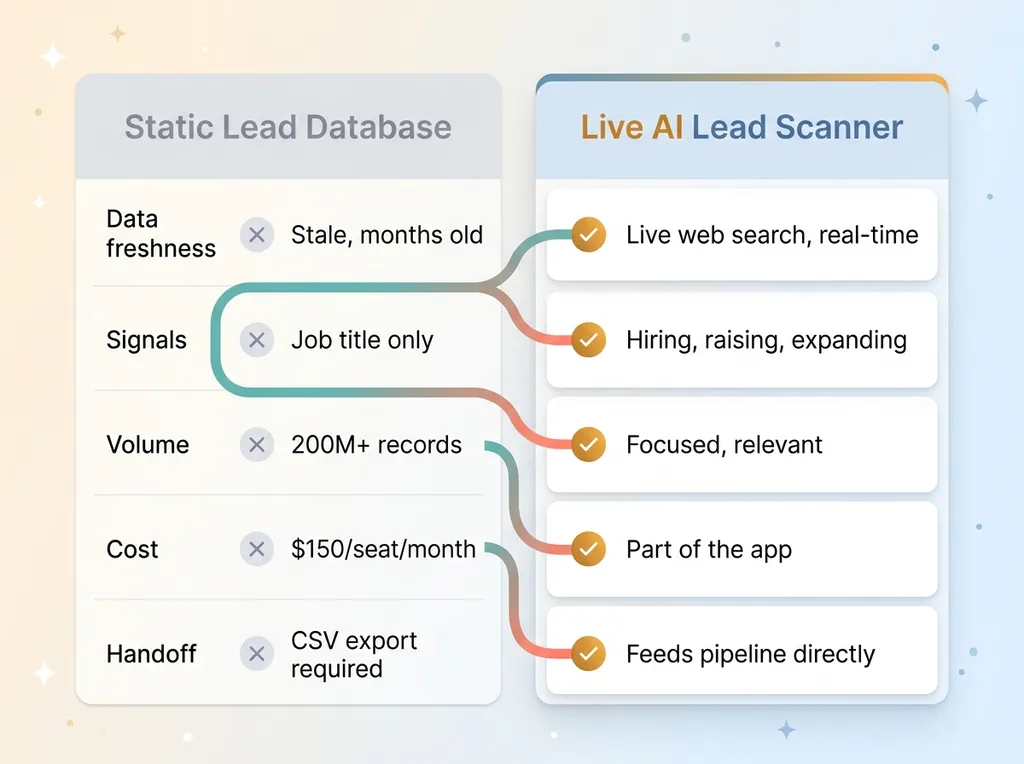 Static lead database vs live lead scanner
But for a focused team that cares about relevance over raw count, fresh and signal-driven beats big and stale. And you're not paying $150 per seat for the privilege of working stale data. The lead scanner is part of the same app, feeding the same pipeline, with no export step in between.
The AI SDR That Writes in Your Voice, Not a Robot's
This is the part buyers care about most, and the part most AI sales tools get wrong.
The AI SDR drafts outreach that sounds like the actual user. It learns tone from their real sent email, not from a generic "Hi {{FirstName}}, I noticed your company" template that every prospect has now seen a thousand times.
Learning tone from sent email
Most AI outreach fails for one reason. It sounds like AI. Prospects can smell it in the first line and the message goes straight to trash.
When the SDR learns from the emails you've already sent and that already worked, it picks up your rhythm, your openers, the way you actually talk. The draft reads like you wrote it, because it's modeled on you.
I went deep on how this works in an AI SDR that writes in your actual voice. The short version is that voice matching is the difference between a reply and a delete.
Why generic AI outreach fails
Here's the honest part. The SDR drafts. A human approves before anything sends.
That's not a limitation I'm apologizing for. It's the design. Human-in-the-loop means the AI does the heavy lifting (research, first draft, personalization) and you keep the final judgment call. You catch the rare miss before it ever reaches a prospect.
And because everything sits on the shared data model, the SDR already knows what the lead scanner found and everything sitting in the pipeline. The message is contextual without anyone copy-pasting a single detail between tools. That context is free here. In a five-tool stack, it costs you a manual handoff every time.
Knowledge Brain, Calendar, and Pipeline: Closing the Loop
Three more pieces finish the end-to-end flow.
A knowledge brain so the AI knows your business
The knowledge brain holds the facts about your business. What you actually sell, how you price, what you don't do, the claims you can stand behind.
This is what stops the AI from hallucinating or misrepresenting your offer. When the SDR drafts a message, it pulls from your real positioning, not from whatever it guessed. An AI that invents a feature you don't have is worse than no AI at all. The knowledge brain is the guardrail.
Booking without leaving the app
Calendar booking is built in. When a prospect is ready, the meeting gets scheduled inside the same app the lead already lives in. No separate scheduler subscription, no context dropped in the handoff.
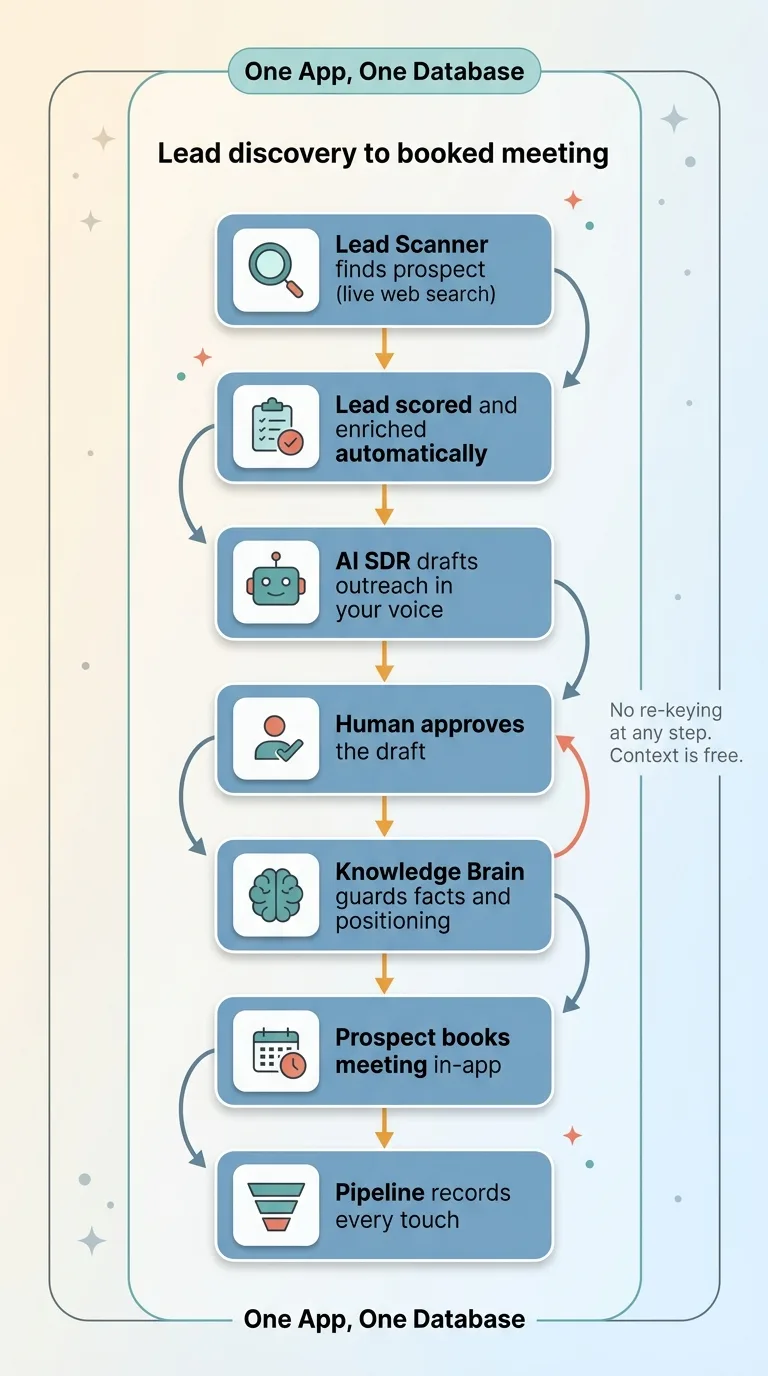 End-to-end lead flow from discovery to booked meeting
The pipeline is the system of record. It holds the lead from the moment the scanner finds it through every touch, every reply, and the booked meeting.
That's the whole point. A lead flows from discovery to enrichment to outreach to a booked meeting without ever leaving the app or getting re-keyed. One continuous flow.
Five separate tools cannot do that. Not because the vendors are lazy, but because the architecture forbids it. Each tool guards its own data. The seams are structural. A single app with a single data model doesn't have seams to lose things in.
The Economics: What Five Subscriptions Actually Cost You
Let's run the math, because that's the conversation the board actually wants.
The per-seat math at 5 reps
Take a modest five-rep team. Lead database at $125 a seat is $625 a month. Sequencer at $100 a seat is another $500. Enrichment, usage-based, call it $300 to $600 depending on volume. Scheduler at $15 a seat is $75. The data-cleaner, another $200 or so.
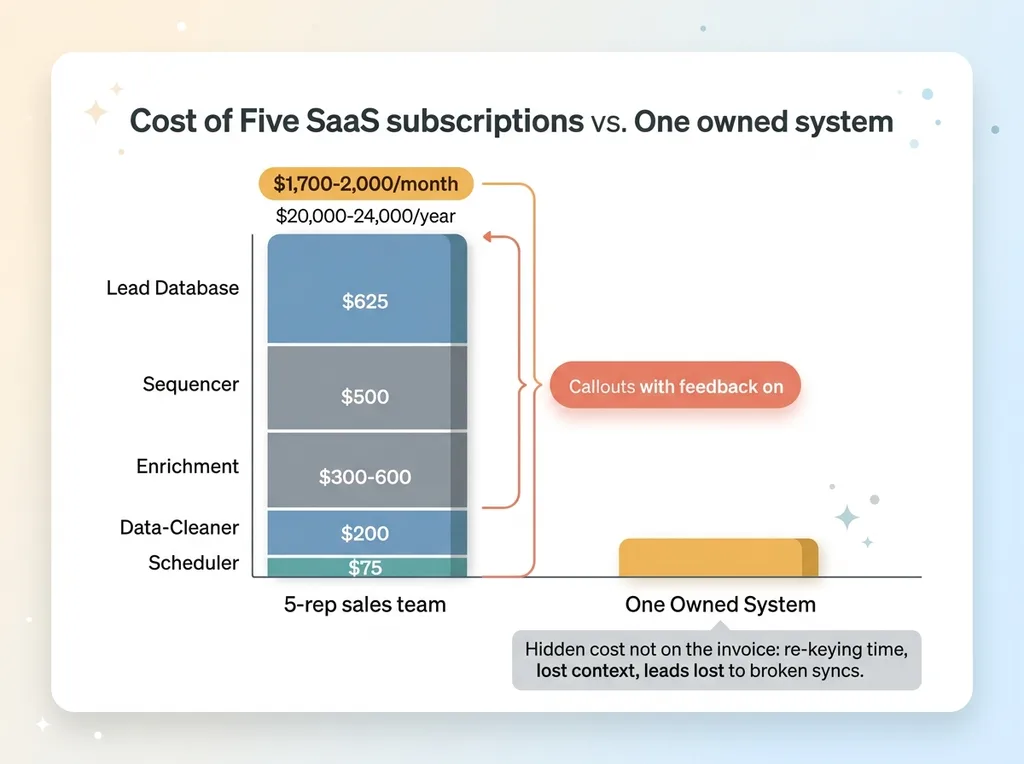 Cost of five SaaS subscriptions vs one owned system
You're at roughly $1,700 to $2,000 a month before anyone has sent an email. That's $20,000 to $24,000 a year, and it climbs every time you add a rep or get more aggressive with enrichment.
Compare that to a single owned system that does all five jobs against one database. The line-item savings are real, but they're not even the biggest number.
What you trade away by owning it
I'll be straight about the tradeoffs, because building isn't free either.
When you own the software, you take on maintenance. You don't get a vendor's roadmap or their support desk. And honestly, not every team should build this. If you have two reps and no technical resource, a clean SaaS stack might be the right call.
But the seams between five tools cost more than the invoices show. The re-keying time, the lost context, the leads that fall through a broken sync, the rep who spent Monday morning fixing an import instead of selling. That's the hidden line item.
I broke down the math on replacing SaaS subscriptions with software you own in more detail. The point isn't "never buy SaaS." It's that the true cost of five tools is the friction between them, and that number is bigger than the subscriptions.
Why This Matters If You Think AI Consultants Only Make Slides
Here's the doubt I know you're carrying, because I hear it on most first calls.
You've been burned. An AI consultant showed up, ran a workshop, handed you a strategy deck full of "opportunities," invoiced you, and vanished. Nothing shipped. The deck is in a folder you'll never open again.
So when someone says they do AI for businesses, your honest assumption is more slides.
This CRM is the counterproof. One person designed it, built it, made it multi-tenant, wired up live Stripe billing, and shipped it as a product people pay to use. It consolidates a five-tool sales stack into a single app with one data model. That's not a recommendation in a PDF. That's working software with customers.
I wrote more about this distinction in I build the systems, I don't just advise on them. The difference matters more than anything on a credentials page.
I build the systems. Not slides about the systems. When I tell you a five-tool stack can be collapsed into one owned app, it's because I've already done it and I run it every day.
Get the next build note.
I write up each system I build, including what broke. Subscribe to my newsletter and I'll send you the next one.