HIPAA Marketing Compliance: The $9M Pixel Mistake
HIPAA marketing compliance fails when tracking pixels leak treatment data. Two health brands paid ~$9M. Here's the consent split that prevents it.
By Mike Hodgen
The Growth Playbook That Becomes a $9M Liability
The growth playbook I run for my DTC fashion brand is simple: pixel everything. Meta pixel on every page. Google tag firing on every conversion event. Track the add-to-cart, the checkout, the time on page. Then retarget aggressively. That setup prints money in unregulated DTC, and I'd recommend it to anyone selling handmade goods out of San Diego.
That exact move is the single biggest enforcement risk in health. HIPAA marketing compliance isn't a footnote you bolt on later. It's the difference between a normal marketing stack and a multi-million dollar liability sitting quietly in your codebase.
Two well-known consumer health brands learned this the expensive way. Combined, they paid roughly 9 million dollars for letting health-marketing data leak through standard ad tracking. Read that again. Standard ad tracking. The same tools every marketer on earth installs on day one.
Here's the part that should make you uncomfortable. This wasn't a hack. No sophisticated breach. No hacker group. It was the default install of Meta and Google tracking on pages that revealed what people were being treated for. They ran the exact setup I just described for my fashion brand, except their pages exposed protected health information instead of which hoodie someone was eyeing.
Nobody at those companies set out to leak PHI. That's the trap. They were good marketers running the playbook that works everywhere else. The pixel doesn't know it's sitting on a page about a specific condition. It just sends what it sends, the way it always does.
The rest of this article is the structural fix. It's boring. It's two rules and a thin architectural layer. It won't win a design award. But it's load-bearing, and it's the difference between marketing that grows your health brand and marketing that ends it. Let me show you exactly what a pixel sends, why it counts as PHI, and how to wall it off without killing your growth.
What a Pixel Actually Sends (And Why It's PHI in Health)
Most marketers think a tracking pixel counts a pageview. It does much more than that, and the "more" is where the fines live.
 The Three Ingredients of an Impermissible PHI Disclosure
The URL is the leak
When a pixel fires, the first thing it sends is the full URL of the page, including query parameters. In DTC fashion, that URL might be /products/linen-shirt. Harmless. Nobody cares that you looked at a shirt.
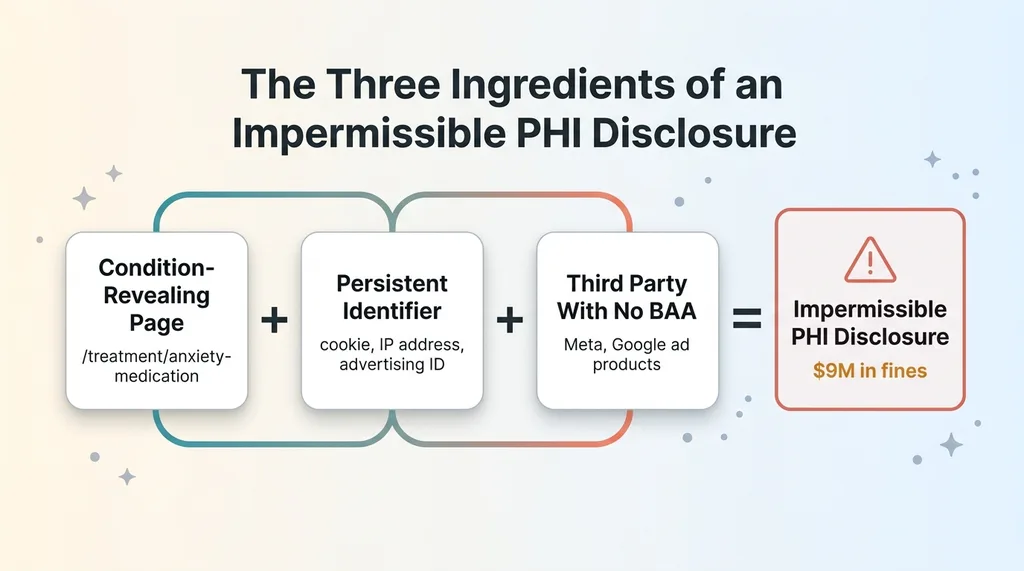
Now make it health. The URL is /treatment/anxiety-medication or /results/positive. That URL, by itself, reveals something a reasonable person considers deeply private. The moment that URL leaves your server and lands on a third party's, paired with a persistent identifier, you have a problem.
And there's always an identifier. The cookie, the IP address, the advertising ID. Pixels are built to attach a persistent identity to every event. That's their entire job. So you're not sending an anonymous "someone viewed a page." You're sending "this specific identifiable person viewed a page about this specific condition."
The event payload is worse
The URL is just the start. Custom event payloads ship the real detail: product viewed, cart contents, form field values. If your intake form posts answers and your tag captures them, those answers go to the third party too.
Picture an intake flow where someone selects their symptoms, and your tracking captures the form state on submit. That's their diagnosis, their identity, and a timestamp, all sent to an ad platform.
Here's the wall you hit. Meta and Google generally will not sign a business associate agreement for their standard ad products. So even if you wanted the data to land somewhere legal, there's nowhere for it to go. The data arrives at a third party that has no legal basis to receive PHI.
That's the whole mechanic of how the fines happened. Condition-revealing page, plus a persistent identifier, plus a third party with no BAA, equals an impermissible disclosure of protected health information. Three ingredients you assemble by accident every time you paste a tag into your site header.
Rule One: Ban Tracking From Any Page That Reveals Treatment
This is the first structural fix, and it's a hard line, not a guideline.
No third-party marketing tracking fires on any page that reveals a condition, a treatment, a diagnosis, intake answers, or anything a reasonable person would consider private health information.
Drawing the line: what counts as a treatment page
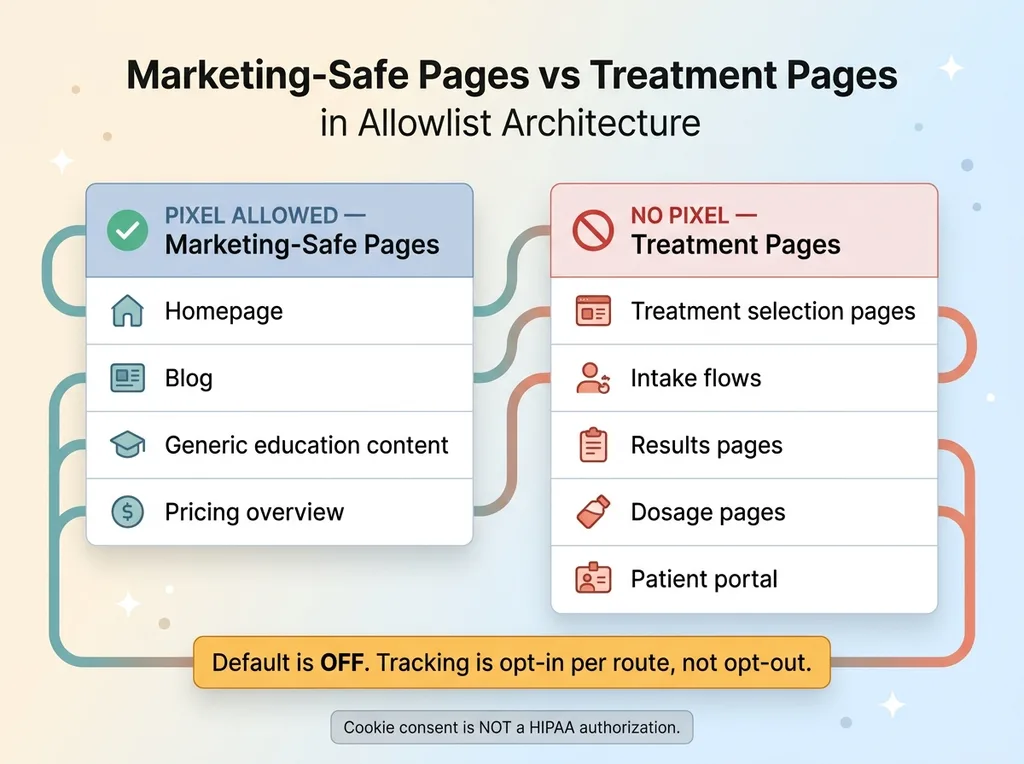
If a page tells a third party something about a specific person's health, it's a treatment page. That includes treatment selection pages, intake flows, results pages, dosage pages, and the entire patient portal. When in doubt, assume it reveals.
The test I use: would you be comfortable if the URL and form contents of this page showed up in an ad platform's logs next to a real name? If the answer is no, no pixel.
What you can still track
Marketing-safe pages are the ones that reveal nothing about an individual's health. Your homepage. Your blog. Generic education content. The pricing overview. These are top-of-funnel pages where attribution actually matters, and you can pixel them freely.
 Marketing-Safe Pages vs Treatment Pages (Allowlist Architecture)
Here's how I implement it, and it's not the way most teams do it.
Tracking scripts are not loaded globally. They're loaded per-route, on an allowlist of marketing-safe pages only. The default is OFF. A page has to be explicitly cleared as non-revealing before it gets a pixel. Tracking is opt-in at the architecture level, not opt-out.
Contrast that with the common broken pattern, which is what got those brands fined. Tag manager loaded site-wide. One cookie consent banner. The marketer assumes consent covers the disclosure. It doesn't.
Cookie consent is not the same as a HIPAA authorization. A user clicking "accept cookies" has not authorized you to ship their condition to Meta. Gating tracking on consent alone is the trap dressed up as compliance. The fix is structural: the script literally cannot load on a treatment route, regardless of what banner the user clicked.
You lose nothing that matters. The pages where attribution drives real spend optimization are top-of-funnel anyway. You keep all of those. You give up tracking on the exact pages that would have written you a 9 million dollar check.
Rule Two: Keep Marketing Consent and Treatment Consent in Separate Stores
The second structural fix is the consent split, and it's where most teams have already lost before they start.
Why one consent record fails
The mistake is a single user record that holds both a marketing_opt_in flag and treatment data in the same place. It feels efficient. One user, one record, everything in one row.
It's a loaded gun. When marketing data and treatment data live together, it becomes trivially easy for a query, a CSV export, or an AI agent to pull treatment context into a marketing audience. Someone writes a "build an audience of active users" query, and because the treatment fields are right there, they come along for the ride. Nobody intended it. The schema made it inevitable.
This is the structural failure behind the consent split that prevents it. The data was reachable, so eventually it got reached.
One-directional data flow
The fix is two physically separate stores.
 One-Directional Data Flow Between Marketing and Treatment Stores
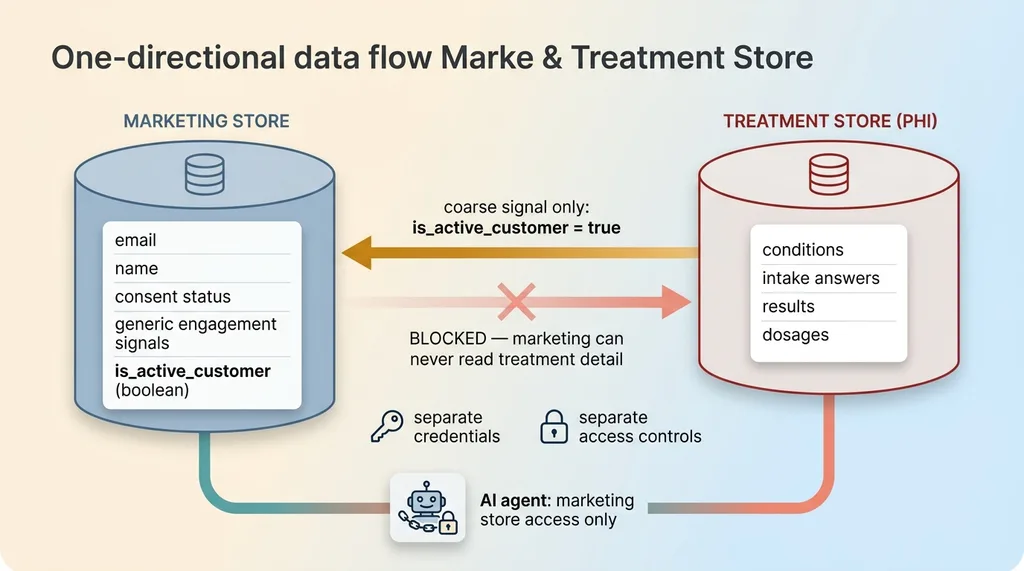
The marketing store holds email, name, consent status, and generic engagement signals. The treatment store holds the regulated PHI: conditions, intake answers, results, dosages. Different databases, different credentials, different access controls.
Data flows in one direction only. Treatment events can write a coarse, non-revealing signal into the marketing store, like an is_active_customer boolean. That tells marketing someone is a customer without revealing what they're being treated for. Marketing can never read treatment detail, and treatment detail never flows back out.
One-directional and coarse. Those are the two properties that make it safe.
Make this decision on day one. Retrofitting separation after treatment and marketing data have been comingled for two years is brutal. You're untangling foreign keys, rewriting every query, and praying you found every export script. I've seen the cost of doing it backwards, and it's an order of magnitude worse than getting it right at the start.
This is also where AI risk concentrates. An AI agent with read access across both stores will eventually leak. Not maybe. Eventually. You give it a vague instruction, it pulls the most relevant data it can find, and the most relevant data happens to be a treatment record. Lock its credentials to the marketing store only. The agent should not have the keys to the treatment store, full stop. If it can't read the PHI, it can't leak the PHI.
The Thin Business Associate Layer That Holds It Together
Once the two rules are in place, the business associate architecture gets simple. And simple is the point.
 The Per-Launch Compliance Checklist (Default to Safe Mindset)
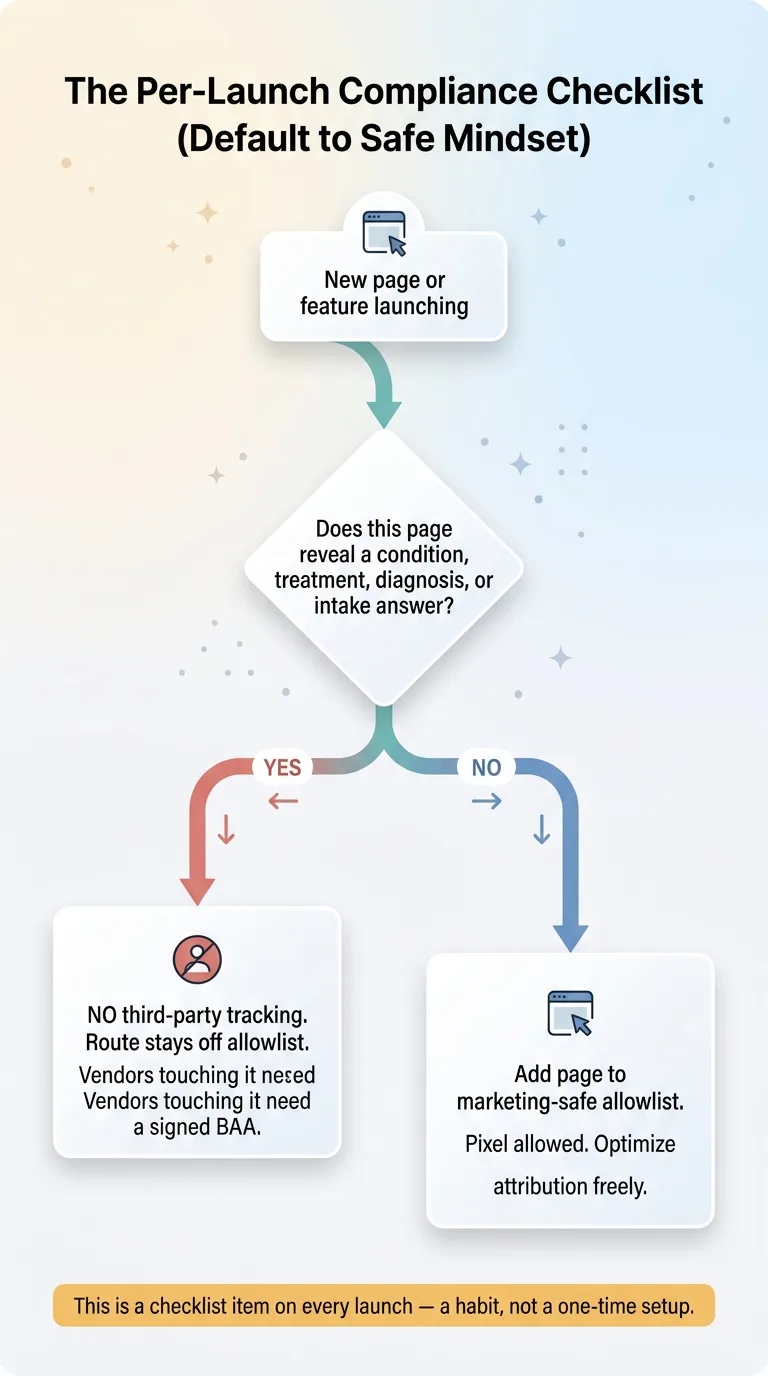
Any vendor that touches PHI needs a signed BAA. Your hosting provider. Your database provider. Your email tool, if it sends treatment-related messages. Your analytics, if it ever sees a treatment page. Each one is a legal relationship you have to establish and maintain.
The strategy I use is to keep the PHI surface area as thin as possible, so the list of vendors needing a BAA stays short. Fewer vendors touching PHI means fewer agreements to track, fewer relationships to audit, and fewer places for a leak to start.
Marketing tools are the ones that won't sign a BAA. Ad platforms, most pixel-based analytics, retargeting networks. The two rules above wall them off from PHI entirely, so they never need one.
This is the reframe that makes the whole thing work. You're not trying to make Meta HIPAA-compliant. That's impossible, and chasing it is a waste of months. You're making Meta never see PHI in the first place. The problem isn't "how do I get a BAA from an ad platform." The problem is "how do I make sure the ad platform only ever sees marketing-safe pages." The two rules answer that.
Honest caveat: this requires discipline on every new feature. The easy path is always to just add the pixel. A growth marketer wants attribution on the new intake flow, drops in the tag, and the wall has a hole. The architecture only holds if "does this page reveal a condition" is a checklist item on every launch. That's a habit, not a one-time setup.
If you want to see how this discipline plays out in practice, I wrote about shipping content in a regulated industry, where the same "default to safe" mindset governs everything that goes out the door.
Marketing Still Works Inside These Walls
The objection I always hear: doesn't this kill growth? It doesn't. Let me be specific about what you keep and what you lose.
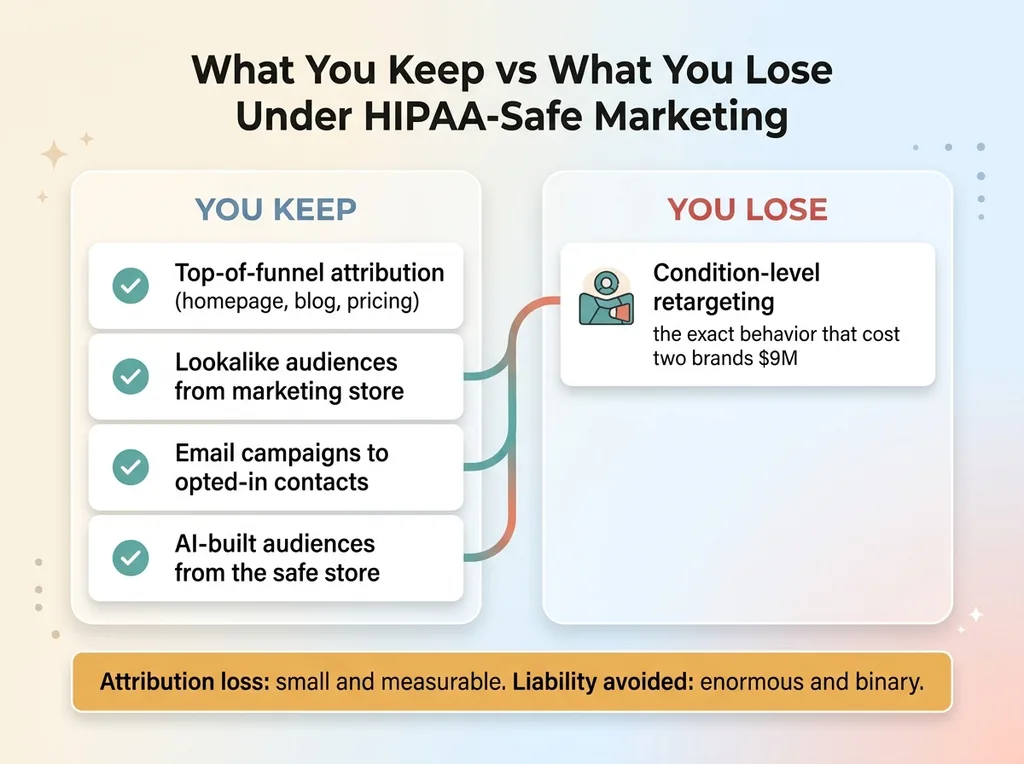 What You Keep vs What You Lose Under HIPAA-Safe Marketing
You keep attribution on top-of-funnel pages, which is where most ad spend optimizes anyway. Your campaigns optimize against homepage visits, blog reads, and pricing-page views. That's the data that actually moves your cost per acquisition.
You keep lookalike audiences, built from your marketing store. People who opted in, generic engagement signals, customer status. That's plenty of signal to find more people like your best customers.
You keep email. You run campaigns to opted-in marketing contacts all day long.
What you lose is condition-level retargeting. The ability to show an ad to someone because they looked at a specific treatment. That was the illegal part. That was the exact behavior that cost two brands 9 million dollars.
So reframe it. Those brands weren't winning because of condition-level data. They were one audit away from a nine-figure problem on a seven-figure marketing budget. The data felt like an edge. It was a liability with a delay timer.
In my experience the attribution loss here is small and measurable. The liability avoided is enormous and binary. You either get the letter or you don't. That's not a trade I have to think hard about.
AI does the heavy lifting on the safe side. I build the same campaigns and audiences off the marketing store automatically, no manual segmenting. The system pulls from the store it's allowed to touch and assembles the audiences for you. You get the marketing sophistication without anyone ever hand-querying a database that holds PHI.
Building This Without a Six-Month Compliance Project
The reason most health brands skip this is they assume it requires a legal team and a six-month build. It doesn't.
The two rules and the thin BAA layer are architecture decisions, not a compliance department. Loading tracking per-route on an allowlist is a config change. Splitting the data stores is a schema decision you make at the start. The one-directional consent flow is a single coarse write. None of this is a six-month project. It's how you build the thing in the first place.
I've stood up the data separation, the route allowlist, and the one-directional consent flow as part of the normal build, not a bolt-on afterward. When I was standing up a regulated telehealth brand, this architecture was baked in from the first commit, which is exactly why it was fast instead of painful.
And this isn't a health-only pattern. The pattern repeats across every regulated industry I've rebuilt on AI. Financial advisory, labor compliance, HR. The specifics change, but the shape is identical: keep the regulated data thin, wall it off from the tools that can't legally touch it, and lock your AI agents to the safe store.
If you're running marketing in health, telehealth, wellness, or any space where a page can reveal someone's condition, this is the first thing I'd audit. Not the brand. Not the funnel. The pixel placement and the data separation. Because the cheapest version of this fix is the one you do before an enforcement letter forces it.
Ready to bring AI leadership into your company?
I work with a small number of companies at a time. If you're serious about AI, apply to work together and I'll review your application personally.
Get AI insights for business leaders
Practical AI strategy from someone who built the systems — not just studied them. No spam, no fluff.
Hodgen.AI
Ready to automate your growth?
Book a free 30-minute strategy call with Hodgen.AI.
Book a Strategy Call