Training Compliance Scheduling: The Schedule as Liability Shield
How training compliance scheduling stops uncertified workers from claiming posts they aren't qualified for, and turns the completion log into your legal evidence.
By Mike Hodgen
The Incident That Starts Every Lawsuit
A security-guard staffing firm put a guard on a post that required a use-of-force qualification the guard never completed. Something went wrong at that post. A confrontation, an injury, a complaint. The details don't matter as much as what happened next.
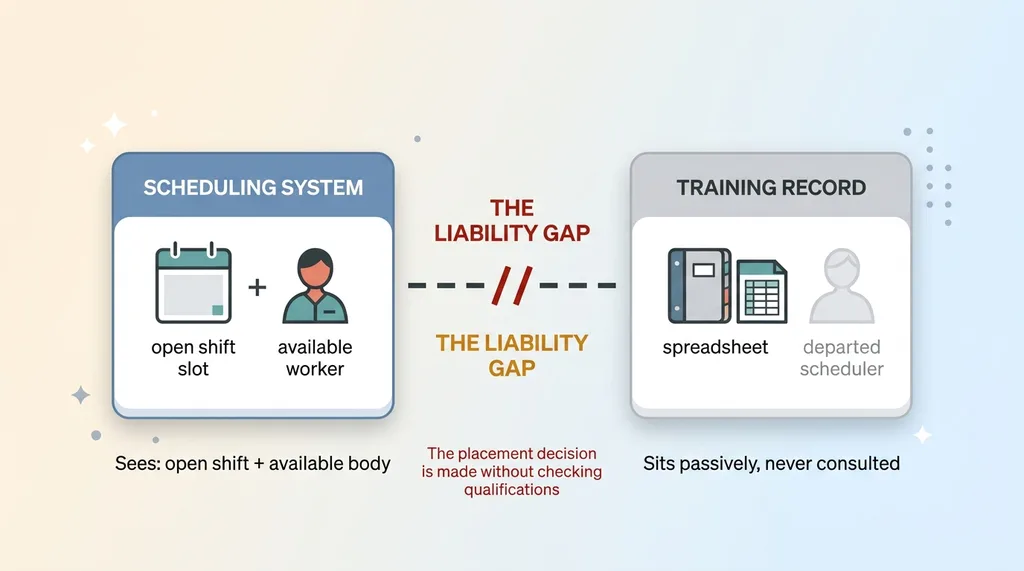 The Disconnect Between Schedule and Training Record
The firm got sued. And the first question in discovery was the one every owner in a licensed trade should fear: can you prove this person was trained for what they were doing?
They couldn't. Not cleanly, anyway. The training records lived in a binder in a back office, a half-updated spreadsheet, and the memory of a scheduler who left the company eight months ago. The scheduling system that placed the guard on that post had no idea what the guard was certified for. It just saw an open shift and an available body.
That gap is the whole problem. The schedule and the training record were two disconnected systems. The schedule made the staffing decision. The training record sat passively somewhere else, never consulted. And that disconnect is the liability. Not the incident itself, but the inability to prove the placement was defensible.
This is what training compliance scheduling is supposed to solve, and almost nobody implements it correctly. The fix isn't a better spreadsheet or a stricter manager. The fix is structural: the scheduling system itself should refuse to place an uncertified worker. Full stop. And the record of who completed what, with timestamps, becomes the firm's evidence in court.
I build these systems. The pattern of turning compliance into a liability shield shows up in every regulated trade I touch, and the mechanics are more straightforward than most owners expect. The schedule is where you close the gap, because the schedule is where the risky decision actually gets made.
Why a Spreadsheet of Certifications Is Not Compliance
Tracking certifications is not the same as enforcing them. Most firms confuse the two, and the confusion is expensive.
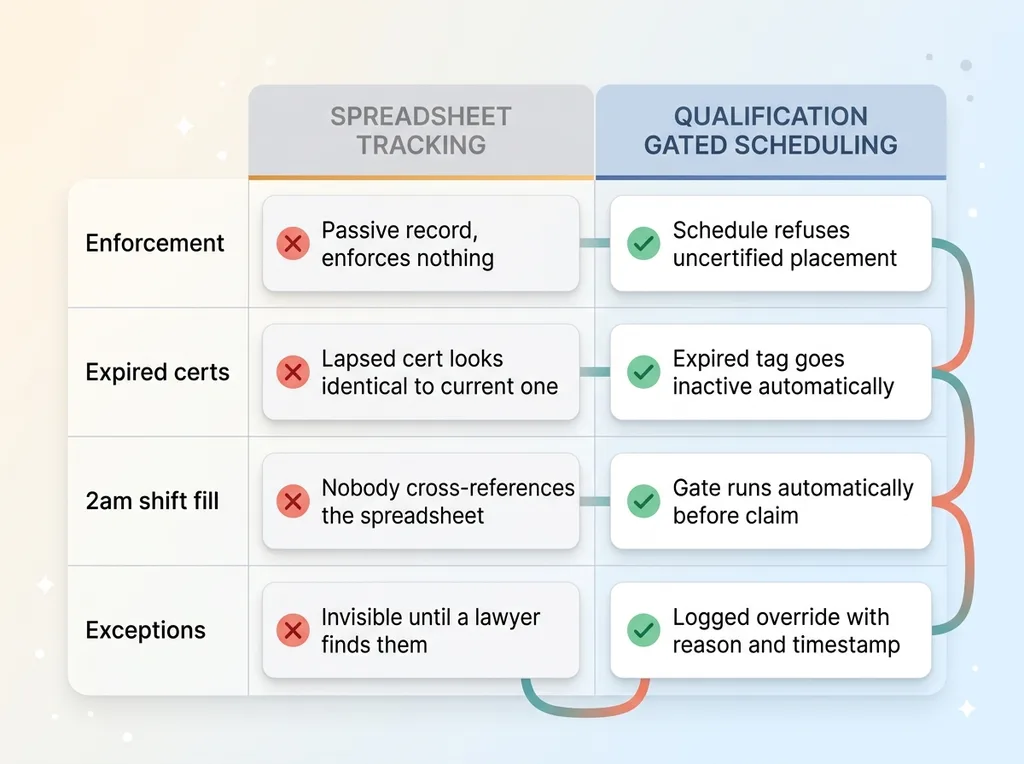 Spreadsheet Tracking vs Gated Scheduling
The record exists but doesn't enforce anything
A spreadsheet of who completed what is passive. It sits there. It does not stop a scheduler at 2am from filling an open post with whoever answered the phone. It does not raise a hand and say "this person isn't cleared for that."
The core problem is geography. The qualification data lives in one system, and the staffing decision happens in another. Nobody is going to cross-reference a spreadsheet against a schedule at 2am when a post needs covering and a client is calling. They'll fill the gap and move on. That's not a discipline problem. It's a system design problem.
A record that doesn't participate in the decision is just documentation of what should have happened, not enforcement of what did.
Expiry is where spreadsheets quietly fail
Here's the trap that bites firms hardest. State-aligned training has renewal cycles. A use-of-force cert, an alcohol-service permit, a restraint qualification: these expire and need renewal on a schedule.
In a spreadsheet, a cert that lapsed last month looks identical to a current one. Same name, same cert listed, same green checkmark. There's no visual difference between "qualified today" and "qualified eighteen months ago and lapsed in March." Nobody catches it until discovery does.
This is why the answer isn't a cleaner spreadsheet. Qualifications need to be structured data that the scheduler is forced to consult, with expiry baked into the data itself. The cert that lapsed has to behave differently from the cert that's current, automatically, without anyone remembering to check.
Qualification Gated Scheduling: How the Claim Gate Works
Here's the mechanism. Qualification gated scheduling means the schedule physically cannot place a worker who isn't currently qualified for the post.
Completing a module grants a tag with an expiry
The firm encodes its training modules generically: de-escalation, use of force, alcohol service, report writing, restraint and handcuffing. These map to the actual state-aligned requirements the firm has to meet.
A guard completes an in-app module. The system grants a qualification tag tied to that guard's record, and that tag carries an expiry date. These are the lms qualification tags that drive everything downstream. The tag isn't a note in a file. It's structured data: who holds it, what it covers, when it expires.
When the renewal date passes, the tag goes inactive on its own. No human has to remember to flip it. The data knows.
The gate checks before a guard can claim a post
Each post in the schedule carries its required qualifications. A bar-detail post might require alcohol service and de-escalation. An armed post requires use of force.
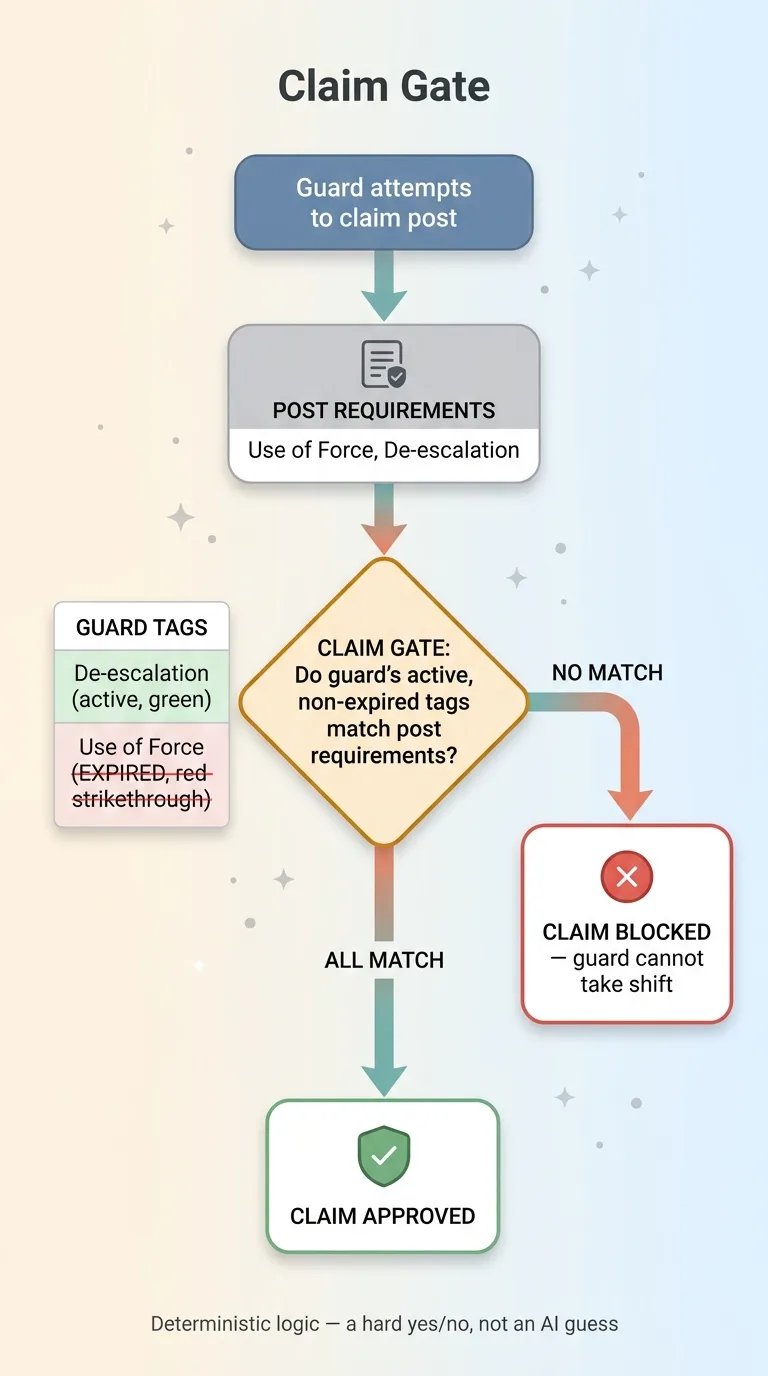 How the Claim Gate Works
When a guard tries to claim a post, a claim gate runs. It checks the guard's active, non-expired tags against the post's requirements. Match, and the claim goes through. No match, no claim. The guard simply cannot take the shift.
This is deterministic logic. A hard rule, not a model's judgment. I want to be precise here because it matters: this is deterministic logic, not an AI guess. There's no probability involved, no "the AI thinks this guard is probably fine." The gate compares two sets of data and returns yes or no. That's the only behavior I'll accept in a compliance context, because a probabilistic answer is not a defensible answer.
The result is structural. The schedule can't place an uncertified worker without a deliberate, logged override. The default state is compliance, and you have to actively work around it to break it.
One Qualification Catalog Drives Everything
The whole system depends on one thing: a single qualification catalog that everything references.
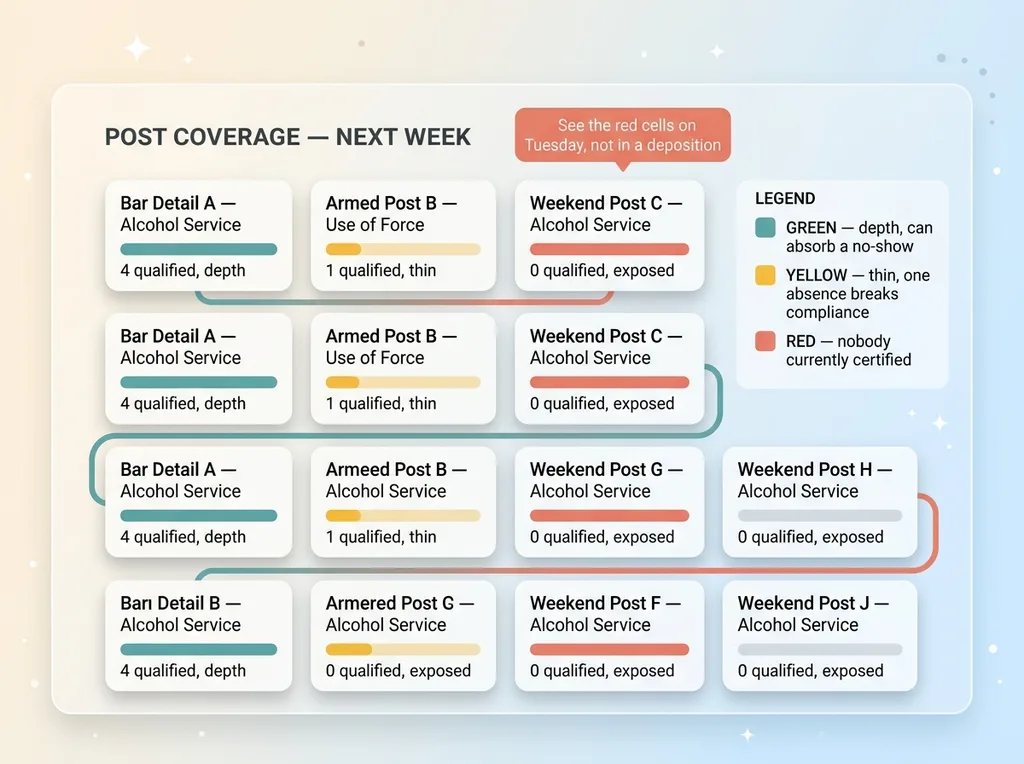 Post Coverage Dashboard (Red/Yellow/Green)
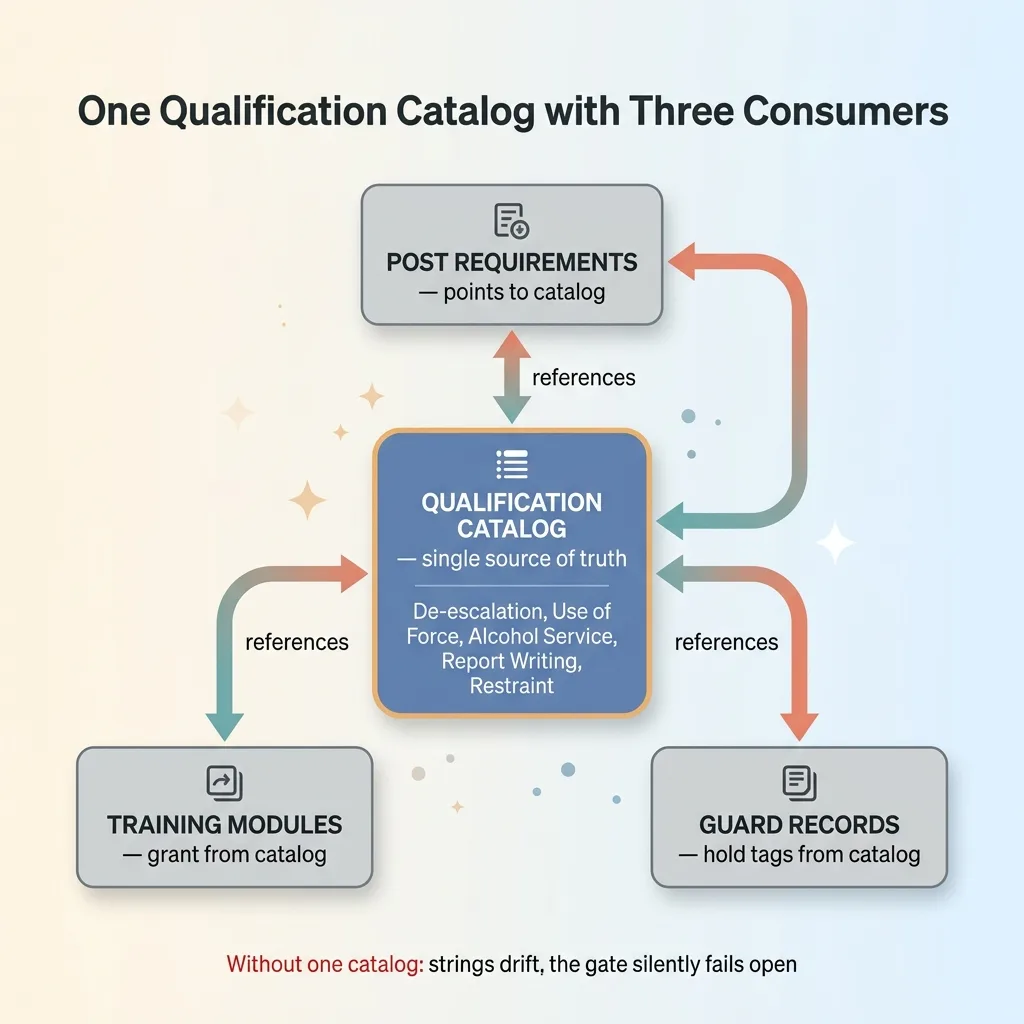 One Qualification Catalog with Three Consumers
There's one catalog. Post requirements point to it. Training modules grant from it. Guard records hold tags from it. One source of truth, three consumers.
This sounds like a small detail. It's the most important architectural decision in the build. Without a unified catalog, you get drift. The schedule says "use of force" and the training module grants "UOF cert" and a human eyeball knows those are the same thing, but the gate doesn't. The strings don't match, so the check silently fails open. The guard gets placed, the system thinks everything's fine, and you've built a compliance system that quietly doesn't work. That's worse than no system, because now you trust it.
When the catalog is unified, something useful falls out for free: a coverage view. This is where workforce certification tracking stops being a filing exercise and becomes an operational tool.
For every post, you can see your qualified depth. Red, yellow, green. Red means you have nobody currently certified for that post. Yellow means thin coverage: one person out sick and you're exposed, scrambling, or forced into an override. Green means you have depth and can absorb a no-show without breaking compliance.
That turns compliance from a reactive audit into a live dashboard. The owner can look at next week's posts and see the red cells before the shift, not after the incident. "I have one alcohol-service guard for three weekend posts" is a problem you want to solve on Tuesday, not in a deposition.
The Manager Override and Why It Has to Exist
I'll be honest about something most vendors won't admit: a hard gate with no escape hatch breaks in the real world.
Reality requires a release valve
Sometimes a post must be filled and the only available guard is one cert short. A client demands coverage tonight. The fully-qualified guard called in sick. The choice is an undertrained guard or an empty post, and an empty post is its own kind of liability.
So the system allows a manager to override the gate and place an uncertified guard. But the override is not a quiet click. It demands a reason, and it writes an audit trail entry. This follows the same principle I apply across every system I build, where every action stops for a human at the point where judgment is required. The machine enforces the rule. The human owns the exception.
The override is itself part of the evidence
Here's the counterintuitive part. The override makes the firm safer, not less safe.
The entry is logged, attributed to the manager who made it, and timestamped. The reason is captured. So when discovery asks about that placement, the firm doesn't have a gap. It has a record: "On this date, this manager placed this guard on this post despite a lapsed cert, for this stated reason."
Compare that to the spreadsheet world, where uncertified placements just happen and leave no trace at all. In that world, the exception is invisible until a lawyer finds it. In this world, the exception is documented the moment it's made.
The override turns a judgment call into a defensible record. That's the difference between a firm that managed risk and a firm that ignored it.
The Completion Log Is the Liability Shield
Everything above exists to produce one thing: the compliance liability record.
What discovery actually asks for
When the lawsuit comes, discovery asks a narrow set of questions. Was this person qualified to do what they were doing? When did they complete the training? Was the cert current on the day of the incident? Were any exceptions made, and by whom?
The completion log answers all of it with timestamps. Every module completion. Every tag grant. Every expiry. Every override with its reason and its author. That's not paperwork you assemble in a panic after a subpoena. It's a byproduct the system generated automatically, day by day, as it did its job.
The schedule didn't just enforce compliance. It generated the proof that compliance was enforced. Those are two different deliverables, and the second one is the shield.
System of record, not the legal trainer
Now the honest limit, because you should know exactly what this does and doesn't do.
The system is a system of record. It is not the legal trainer. It does not certify that your training content meets state requirements. That's on you and your counsel. If your de-escalation module doesn't satisfy what your state board demands, the system will happily track completion of inadequate training. It doesn't grade the curriculum.
What it does is narrower and more reliable: it makes sure the right people are on the right posts according to the qualifications you defined, and it makes that provable. It enforces the rules you give it and records the enforcement.
I'm explicit about this boundary with every client, because a system that overpromises on compliance is a system that creates false confidence, and false confidence in a regulated trade is how firms get hurt. The tool closes the placement gap and produces the evidence. The training content's legal sufficiency stays with the people qualified to judge it.
Building This Into Your Own Licensed Trade
This pattern isn't specific to security guards.
Any licensed trade where a worker has to hold a current qualification to do a job has the same exposure and the same fix. Medical staffing. Food handling. Heavy equipment operation. Regulated home services. The shape is identical: a qualification that expires, a schedule that places workers, and a dangerous gap between the two.
In every one of these, the schedule should be the enforcement point and the evidence generator. The decision and the proof should live in the same system. I've rebuilt enough of these that I'll say it plainly: every regulated industry follows the same pattern, and the firms that close the placement gap stop losing sleep over the one undertrained worker who slips through.
I build these as custom systems the firm owns, tuned to your actual qualification catalog and your actual state rules. Not a generic LMS bolted onto a generic scheduler with a manual reconciliation step in between, which is exactly the disconnect that creates the liability in the first place.
If you run a licensed-trade business and a single undertrained-worker incident is the thing that keeps you up at night, the schedule is where you close that gap. Not the binder, not the spreadsheet, not the after-the-fact audit. The point of placement.
Want to explore what AI could do for your business?
Book a free 30-minute strategy call. No pitch deck, no sales team, just a real conversation about your operations and where AI actually fits.
Get AI insights for business leaders
Practical AI strategy from someone who built the systems — not just studied them. No spam, no fluff.
Hodgen.AI
Ready to automate your growth?
Book a free 30-minute strategy call with Hodgen.AI.
Book a Strategy Call