UGC Ad Consent Automation: One Gate That Defuses It
Boosting customer photos as paid ads is a legal landmine. Here's the UGC ad consent automation gate I built to block unapproved content before launch.
By Mike Hodgen
The Day I Realized I Could Get Sued by My Own Customers
I was deep into building the ad automation for my DTC fashion brand in San Diego when it hit me. The pipeline I'd just wired up could grab a customer's tagged photo and turn it into a paid ad. Automatically. Without anyone signing off.
Here's the scenario. A customer buys an outfit, loves it, posts a photo wearing it, and tags my brand. That tagged photo flows into the media library. To an automated ad system, it's just another piece of content sitting there, ready to be used. And my system could take that photo, drop it into a creative, put ad spend behind it, and push it to thousands of strangers.
The customer never agreed to be in an ad. They tagged a brand they liked. That's it.
That gap is where ugc ad consent automation stops being a nice-to-have and becomes the thing that keeps you out of legal trouble. Using someone's likeness or content in a paid promotion without their consent is not a gray area. It's a rights problem. The kind that earns you a cease-and-desist on a good day, and a lawsuit on a bad one.
What made this dangerous was the automation itself. A human building one ad at a time might pause and think, "wait, did this person agree to this?" An automated pipeline running at volume doesn't pause. It just executes.
So I had a choice. Either I slow down the automation and put a human eyeball on every single ad (defeating the point), or I close the gap with one hard rule baked into the system.
I chose the rule. This article is how I built it, why it lives in exactly one place, and how you can do the same in your own ad pipeline.
Why Customer Photo Ads Are a Rights Problem Most Brands Ignore
Tagged is not the same as permission
This is the part most brand owners get wrong, and I get why. When a customer tags you, mentions you in a story, or shows up in a carousel of your posts, it feels like an invitation. They're celebrating your product. Surely they'd be fine with you sharing it.
But "tagged" is not "consent." A tag is a customer pointing at your brand. It is not a customer granting you the right to use their face and their content in commercial advertising. Those are two completely different things, and the law treats them that way.
Customer photo ads rights require an explicit, documented agreement. Not a vibe. Not an assumption. An actual yes that you can point to.
Organic reposting vs. paid promotion
There's a meaningful difference between resharing a customer's photo to your story (organic) and putting paid spend behind it (an ad). I'll be honest: organic reposting is its own debate, and it's not risk-free. But it lives in a softer zone. Lower stakes, lower exposure.
The moment money goes behind that content, everything changes. Now you're using their image and their creative work commercially. You're profiting from it. That's where the liability spikes, hard.
Most brands treat their media library like a free buffet. Anything tagged, anything mentioned, anything that landed in the folder is fair game for ads. That works fine right up until the day it doesn't, and by then you've got an angry customer and a lawyer's letter.
If you automate ad creation from customer content, this is the exact thing that bites you. Not because your intentions were bad, but because your system didn't know the difference between content someone agreed to share and content you just found.
The One Place I Decided to Put the Gate
My first instinct was to police the entire media library. Tag every photo. Flag the risky ones. Scatter warnings everywhere a piece of content might get used.
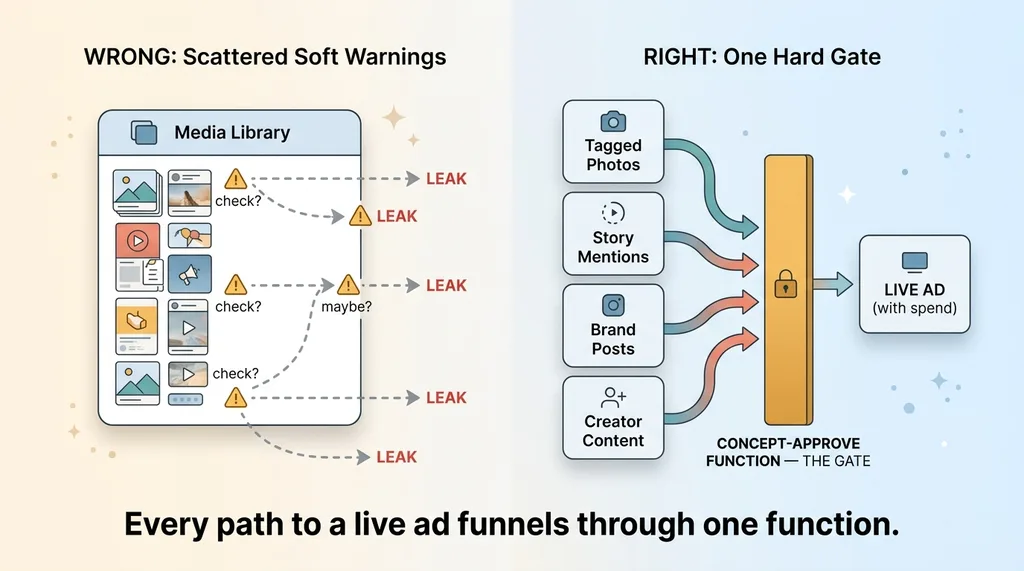 The single chokepoint architecture vs scattered checks
That's the wrong architecture, and I figured it out fast.
The problem with policing the whole library is that there are a hundred ways content moves around inside a system. You'd have to put a check at every one of them, and you'd miss some. Instead, I looked for the single chokepoint where an ad actually becomes real.
Every path to a live ad, no matter where the content came from, funnels through one function: the chokepoint where an ad actually gets launched. The concept-approve route. That's where a concept turns into a real ad object with real spend behind it.
So that's where the gate lives. One place. One function. If you want to launch an ad, you go through that door, and the consent check is built into the door.
This matters because a single hard gate beats scattered soft warnings every time. A prompt that says "are you sure this content has consent?" is worthless. A human will click through it. An agent will click through it. Soft prompts are designed to be dismissed.
The gate had to be a hard error that stops the ad from being created at all. Not a warning. A wall.
This is the same pattern I use everywhere I run AI in production: constraining what AI is allowed to touch. You don't ask the AI to be careful. You make the unsafe action impossible.
The Rule: Only Two Kinds of Content Are Allowed in Paid Ads
Once the gate had a home, I needed a rule it could enforce. I made it deliberately narrow. Paid ads may use only two kinds of content. Everything else is blocked.
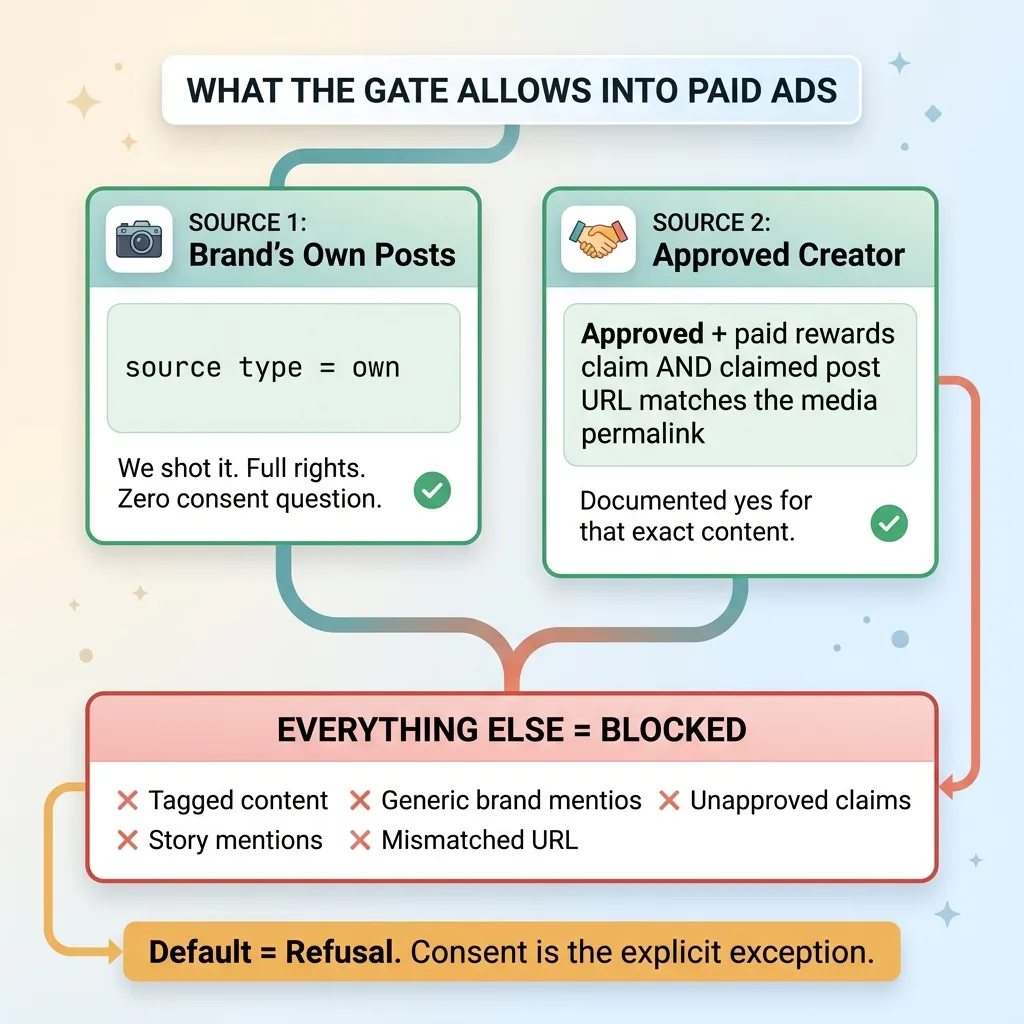 The two allowed content sources rule
Source one: the brand's own posts
The first allowed source is the brand's own Instagram posts. In the media library, these are tagged with a source type of own. This is content I created, I shot, I have full rights to. No consent question exists because it's mine.
That's the clean, zero-risk path. If the content is ours, the gate opens.
Source two: creators with a matched, approved rewards claim
The second source is creator content, but only under strict conditions. A creator can be in a paid ad if they have an approved and paid rewards claim, and the post URL they submitted matches the actual Instagram permalink of the media being used.
That match check is the part that makes this airtight. It's not enough to have a rewards claim on file. The claimed post URL has to line up with the specific media going into the ad.
Why does that matter? Because a creator agreeing to participate in your program and submitting a specific post is a documented yes for that specific content. If you use a different photo of theirs, one they never submitted, you're back to using content they didn't agree to. The match proves two things at once: the creator opted in, and you're using exactly the piece they handed you.
This is creator content paid ads compliance in plain terms. An approved claim plus a URL match equals consent the system can verify.
Everything else is blocked. Tagged content. Story mentions. Generic brand mentions. A creator who started a claim but never got it approved. A creator with an approved claim but a mismatched URL. All of it stops at the gate.
The rule is narrow on purpose. I'd rather block a few legitimate pieces of content and shoot them manually than let one unconsented photo slip into a paid campaign. The ugc consent gate errs toward refusal, and that's the correct bias when money and rights are on the line.
What Gets Blocked, and How Hard It Fails
When content fails the consent check, the system throws a hard 422 error before any ad is created. No ad object. No draft. No spend. The system just refuses to proceed.
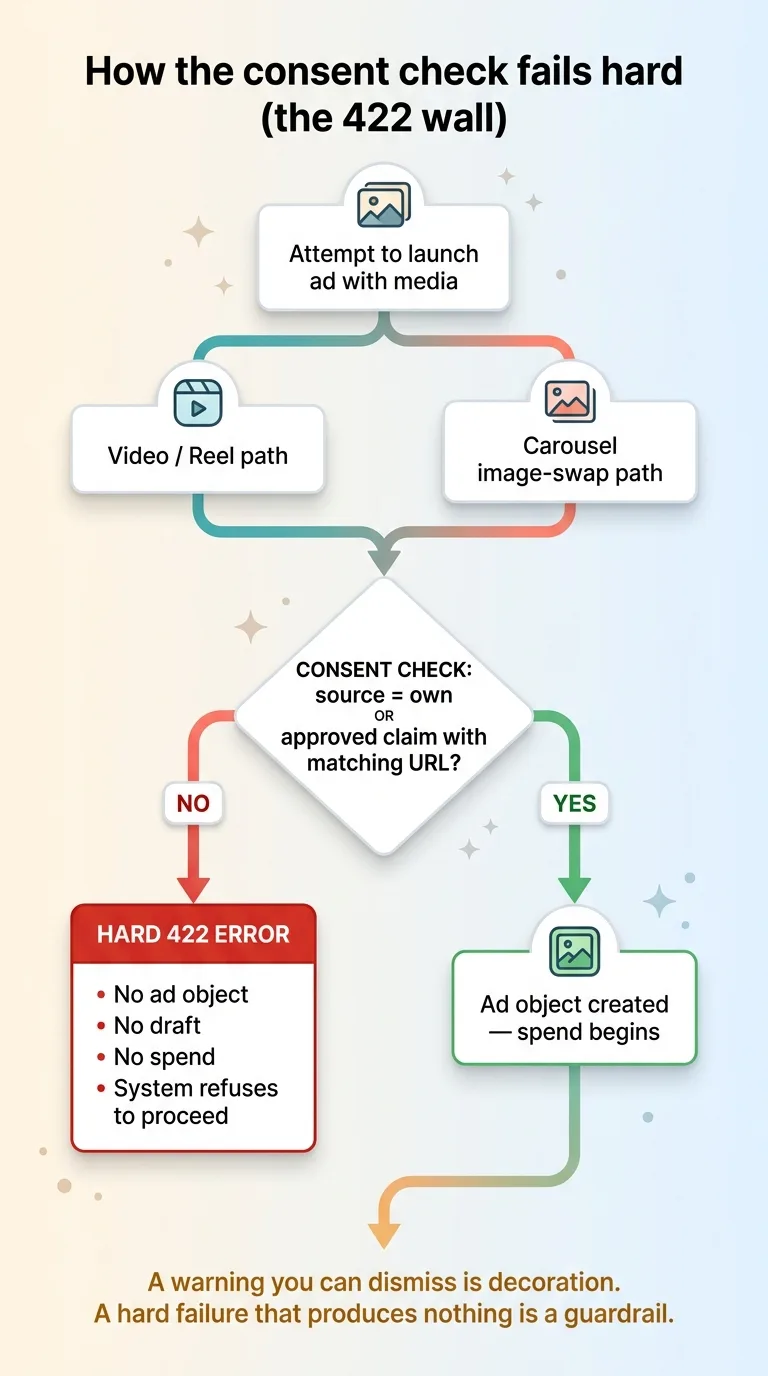 How the consent check fails hard (the 422 wall)
That's the part that actually protects you. A warning you can dismiss is decoration. A hard failure that produces nothing is a guardrail.
I hardened both creative paths where unapproved media could sneak in. The first is the video and reel path, where a creator's clip becomes the ad creative. The second is the carousel image-swap path, where you replace an image inside a carousel ad. Both go through the same consent check. You can't slip unapproved media in through a side door because both doors lead to the same gate.
Here's an honest note. The autonomous ad loop, the AI system that manages our Meta ads, never touches creator media at all. It works from the brand's own catalog and own content. So technically the consent gate protects against a problem the autonomous loop doesn't create.
I hardened it anyway, specifically on the manual UGC-swap-to-launch path. That's defense in depth. The manual path is exactly where a human takes a shortcut. Someone's in a hurry, they grab a great-looking customer photo, they swap it into a carousel, they hit launch. That's the moment the gate has to catch them, and it does.
Ad creative compliance isn't about trusting people to remember the rules under deadline pressure. It's about building a system where the wrong action simply can't complete.
Why a Soft Warning Would Have Failed
The lazy version of this is to log a warning and move on. "Heads up, this content might not have consent." Then proceed anyway. I see this pattern constantly, and it's worse than nothing because it creates the illusion of a safeguard.
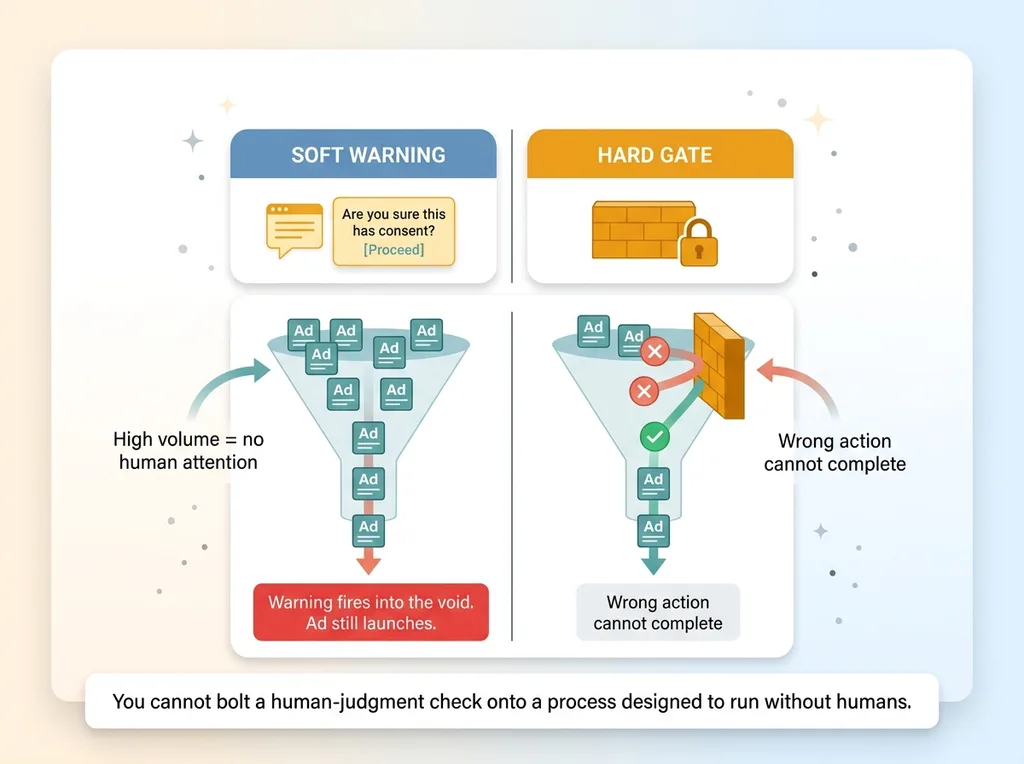 Why soft warnings fail under automation volume
Here's why it fails. Automation means volume. The entire reason you automate ad creation is to remove human attention from each individual launch. So at the exact moment a consent reminder pops up, there's no human paying attention to read it. The warning fires into the void.
You can't bolt a check that requires human judgment onto a process you designed to run without humans. The two are incompatible.
The gate has to live at the layer where the action becomes irreversible. Not earlier, where it can be ignored. Not later, after the ad is already live and the spend has started. Right at the point of no return.
This is the same trust mechanism I build across all my systems: every AI action stops for a human when it touches money or legal exposure. The AI proposes freely. It generates concepts, drafts creative, suggests audiences. But the actions that move money or create liability stop hard and check the data first.
That's what lets me actually run ads on autopilot without lying awake about it. I'm not trusting the automation to be careful. I'm trusting the gate to be impossible to get around.
How to Build This Into Your Own Ad Pipeline
If you're automating anything that touches customer content, here's the playbook I'd hand you.
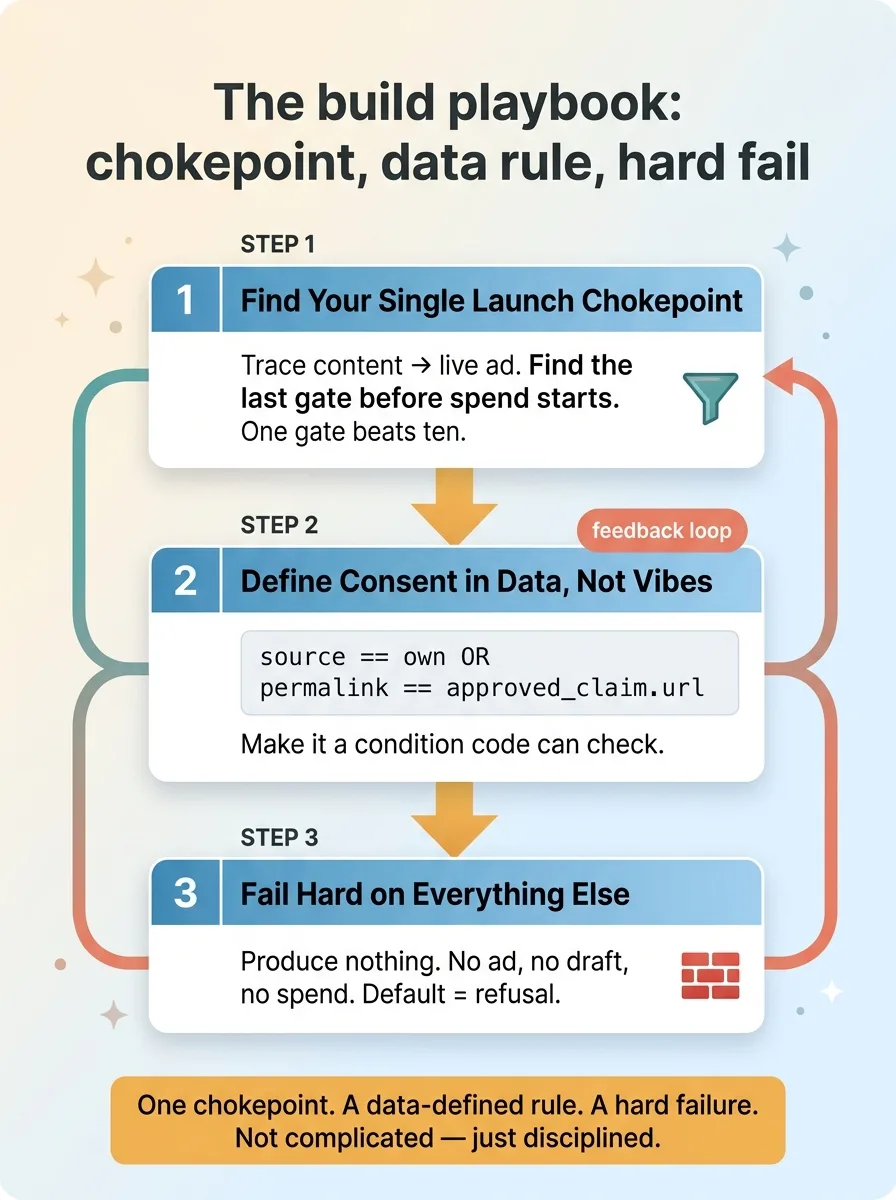 The build playbook: chokepoint, data rule, hard fail
Find your single launch chokepoint
Stop trying to police your whole media library. Find the one function where an ad actually goes live and put your check there. Every system has this point, even if it's buried under three layers of abstraction. Trace the path from "content exists" to "ad is spending money" and find the last gate before spend starts.
Put your check there and nowhere else. One gate you can actually maintain beats ten gates you'll forget to update.
Define what 'consented' means in data, not vibes
This is the step most people skip. Consent has to be a data condition your code can check, not a human judgment call. "This person probably wouldn't mind" is not enforceable. "This media has source type own, OR this media's permalink matches an approved and paid rewards claim" is enforceable.
Write down the exact data conditions that equal consent in your business. Then make those the only conditions that open the gate.
Then fail hard on everything else. Produce nothing. No ad object, no draft, no spend. The default has to be refusal, with consent as the explicit exception, not the other way around.
That's the whole model. One chokepoint, a data-defined consent rule, and a hard failure on anything outside it. It's not complicated. It's just disciplined.
This kind of guardrail is the difference between AI that creates liability and AI you can actually trust to run unattended. The flashy automation gets the attention, but this is the work that determines whether your AI is an asset or a lawsuit waiting to happen. I build these gates into every system I ship for clients, because automation without guardrails isn't a feature, it's a risk.
Want to explore what AI could do for your business?
Book a free 30-minute strategy call. No pitch deck, no sales team, just a real conversation about your operations and where AI actually fits.
Get AI insights for business leaders
Practical AI strategy from someone who built the systems — not just studied them. No spam, no fluff.
Hodgen.AI
Ready to automate your growth?
Book a free 30-minute strategy call with Hodgen.AI.
Book a Strategy Call