I Built AI Meta Ads Management With 8 Specialist Agents
How I built an AI Meta ads management system with 8 specialist agents for my DTC brand. Why one AI fails at ads and the committee pattern that works.
By Mike Hodgen
Most business owners I talk to have tried some version of AI for their advertising. They install a tool, connect their Meta account, and wait for the magic to happen. Then they watch it burn through budget while optimizing for the wrong thing.
I know because I did exactly that.
I was spending north of $8K/month on Meta ads for my DTC fashion brand — handmade products out of San Diego — and I thought a single AI agent could handle campaign management end to end. The idea was simple: feed it my product data, my audience info, my creative assets, and let it run. What I got back was an AI that was mediocre at everything. It would write decent ad copy but make terrible bidding decisions. Or it would optimize aggressively for clicks when I needed ROAS. One campaign in particular triggered the full rebuild: the agent burned through $2,400 in three days targeting an audience that was engaging like crazy — likes, comments, shares — but converting at close to zero. It had optimized for engagement metrics instead of purchase conversion because, at a fundamental level, it couldn't hold the distinction between "people who interact with ads" and "people who buy $85 handmade goods."
That's when I stopped trying to build AI Meta ads management as a single system and started thinking about it as a team.
The core problem is straightforward. Ad management isn't one job. It's eight different jobs that require eight different skill sets. Creative direction. Copywriting. Audience targeting. Bid strategy. Budget allocation. A/B testing. Analytics. Compliance. You wouldn't hire one person to be your copywriter, data analyst, graphic designer, and media buyer simultaneously. So why would you ask a single AI prompt or a single agent to do all of it?
You wouldn't. So I stopped.
The 8 Specialist Agents Behind Every Campaign
I built eight agents, each with a narrow scope, specific data inputs, and defined outputs. Here's what each one actually does.
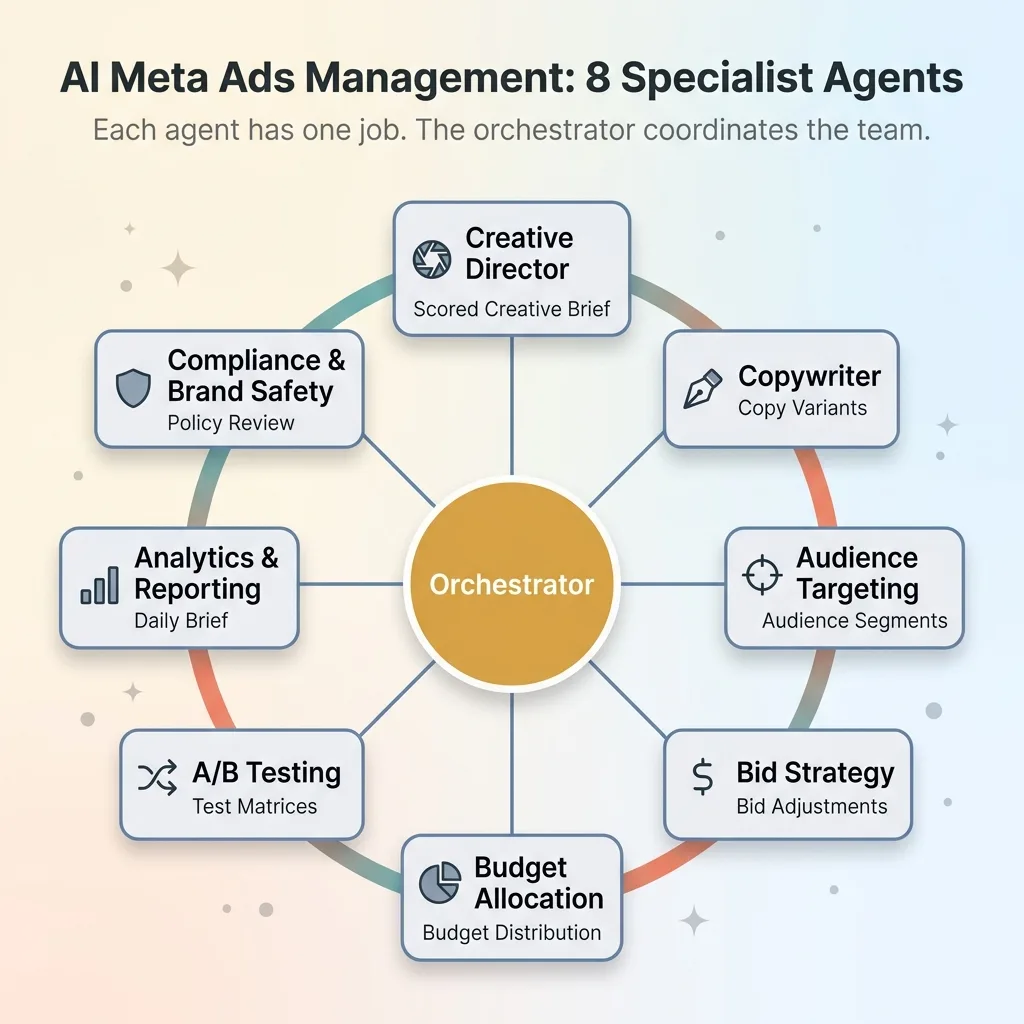 8 Specialist Agents Architecture Overview
Creative Director Agent
This agent analyzes top-performing ad visuals across all active and historical campaigns. It scores new creative assets against a performance database — click-through rate, thumb-stop ratio, conversion rate per placement. When I upload a batch of new product photos, it ranks them by predicted performance and recommends which to run in Stories versus Feed versus Reels. Its output is a scored creative brief, not a guess.
Copywriter Agent
Generates ad copy variations across headline, primary text, and description fields. It's trained on my brand voice — which is specific and hard to replicate — and writes differently depending on placement. A Stories overlay needs five words. A Feed primary text can run 150. It produces 8-12 variants per campaign launch, tagged by angle: urgency, social proof, product feature, lifestyle.
Audience Targeting Agent
Builds and refines lookalike audiences, identifies high-value customer segments from purchase data, and recommends exclusions. It pulls from my Shopify customer data — not just Meta's pixel — so it knows which segments have the highest LTV, not just the highest click rate. It also flags audience overlap between campaigns to prevent me from bidding against myself.
Bid Strategy Agent
Sets and adjusts bids based on time of day, day of week, competition signals, and real-time conversion data. It runs a different strategy for prospecting campaigns versus retargeting. During peak hours when CPMs spike, it throttles spend. During off-peak windows with cheaper inventory, it accelerates. Its input is auction-level data; its output is bid adjustments every four hours.
Budget Allocation Agent
Distributes daily budget across all active campaigns based on trailing performance. Campaigns that are hitting ROAS targets get more budget. Underperformers get cut. This agent processes margin data alongside ad performance — a critical distinction I'll come back to later. It reallocates in real time rather than waiting for me to check a dashboard at 9 AM.
A/B Testing Agent
Designs test matrices for creative and copy combinations, monitors statistical significance, and kills losing variants early. This is the agent that saves the most money. It doesn't let a bad variant run for five days "to get enough data." It uses sequential testing methods to make a call faster — sometimes within six hours of launch.
Analytics & Reporting Agent
Pulls performance data from Meta, cross-references it with Shopify conversion data, and calculates true ROAS. I say "true" because Meta's reported ROAS is almost always inflated — they take credit for conversions that would have happened anyway. This agent generates a daily brief that hits my inbox at 7 AM with the five things I need to know. No logging into Ads Manager. No digging through dashboards.
Compliance & Brand Safety Agent
Reviews all ad copy and creative against Meta's advertising policies before submission. Flags potential rejections for restricted language, checks that disclaimers are present where needed, and ensures everything aligns with brand guidelines. It's the last gate before anything goes live. Every ad goes through it. No exceptions.
How the Agents Talk to Each Other (The Committee Pattern)
Eight agents working independently would be chaos. The architecture that makes this work is what I call the committee pattern — a defined communication protocol where agents flag, request, and coordinate through an orchestration layer.
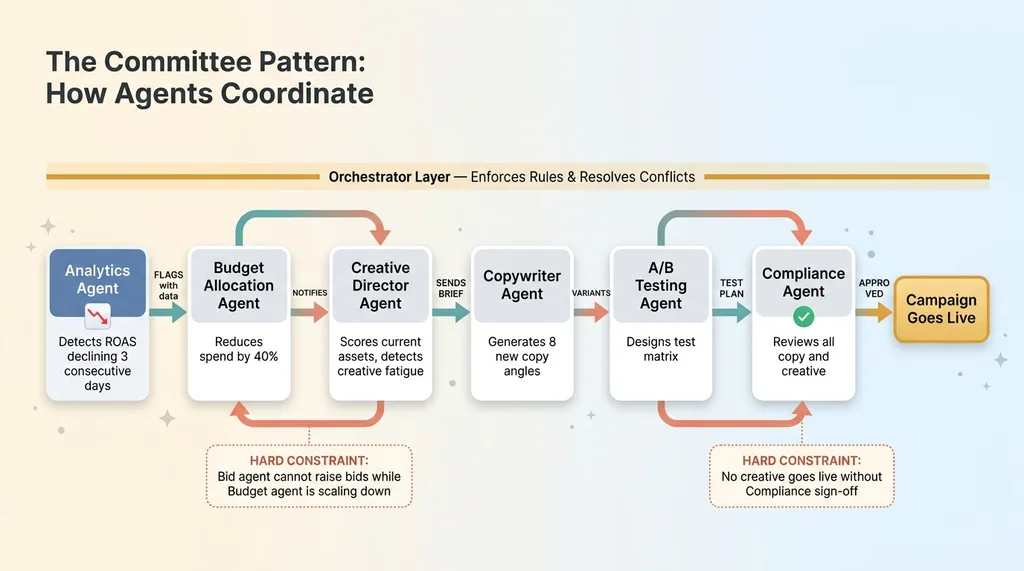 Committee Pattern Workflow — Real Agent Communication Chain
Here's a real workflow. The Analytics agent identifies a retargeting campaign with ROAS declining over three consecutive days. It flags this to the Budget Allocation agent with the data. Budget agent reduces spend by 40% and notifies the Creative Director agent. Creative Director scores the current assets against the performance database, determines the creative is fatigued, and sends a brief to the Copywriter agent requesting new variants. Copywriter generates eight new copy angles. A/B Testing agent designs the test matrix. Compliance agent reviews everything before it goes live. All of this happens without me touching it.
The orchestrator agent is the account manager. It doesn't write copy or set bids — it coordinates the team and enforces rules. The most important rule: conflict resolution. The Bid Strategy agent can't raise bids on a campaign that the Budget agent is actively scaling down. The Copywriter agent can't push creative live without Compliance sign-off. These aren't suggestions. They're hard constraints in the system architecture.
This is the same principle behind why I use multiple AI models instead of one. Different models — and different agents — excel at different tasks. The power comes from orchestration, not from asking a single system to be omniscient.
If you want to see how the ads system fits into the broader AI infrastructure I've built, the 14-skill AI platform running my ecommerce brand gives the full picture. Ads management is one of 14 interlocking systems.
Real Numbers: What Changed After Deployment
Before the multi-agent system, I was spending 12-15 hours per week on ad management. Reviewing campaigns, adjusting budgets, writing new copy, analyzing what was working, pausing what wasn't. After deployment, that dropped to about 3 hours per week — mostly reviewing the daily brief and making strategic calls on budget allocation above $500/day.
ROAS improved 34% in the first 90 days. Not because the AI is smarter than me at advertising — it's because it's faster and more consistent. It doesn't forget to check a campaign at 2 PM. It doesn't let a losing variant run over the weekend because I was busy.
Wasted ad spend dropped significantly. The clearest example: the A/B Testing agent killed a creative variant at hour six of a campaign launch. The variant was running a 0.4% CTR against a control at 1.8%. Under manual management, I would have let that run for at least two full days before making a call, burning an estimated $600-800 in the process. The agent caught it in six hours and reallocated the budget to the winning variant. That single decision saved more than I spent on the A/B testing agent's infrastructure that month.
I need to be honest about what didn't work immediately. The Bid Strategy agent took four iterations to get right. The first version was too aggressive during high-CPM periods and was overspending on expensive inventory. The Creative Director agent still needs human review for brand alignment about 20% of the time — it can tell you what's performing, but it occasionally recommends creative directions that are off-brand.
This is augmented management, not full automation. I make the final calls. The AI handles the 90% that's repetitive, data-heavy, and time-sensitive.
What Breaks (And What I'm Still Fixing)
No point writing an article about AI Meta ads management without talking about what doesn't work. Here's my honest list.
Meta's API has data delays. The Analytics agent sometimes works with data that's 30-60 minutes stale. In a fast-moving auction environment, that matters. I've built in buffers to account for this, but it means the system occasionally makes decisions on slightly outdated information.
Creative scoring is the weakest link. The Creative Director agent is excellent at telling you what performed. Predicting what will perform is a fundamentally harder problem. It gets better as it accumulates more data, but it's not clairvoyant. Novel creative concepts — a new photography style, a new product category — have no historical basis for prediction.
The Compliance agent is too conservative. It flags copy that would actually pass Meta's review about 15% of the time. I'd rather have false positives than rejected ads, but it does slow down the pipeline. I'm tuning this continuously.
Audience targeting can over-concentrate. The Audience Targeting agent finds a profitable segment and wants to pour money into it. That works until the segment saturates and CPMs spike. I've added frequency caps and saturation alerts, but this is still a problem I'm refining.
Human judgment remains essential for: seasonal strategy shifts, new product launches with no historical data, and high-level brand direction. The system can't tell you to run a holiday campaign or decide your brand's visual identity. That's still my job.
Month one was mediocre. Month three was where the system started consistently outperforming what I could do manually. The learning curve is real, and anyone selling you "instant AI ad optimization" is selling you something that doesn't exist.
Why Most 'AI Ad Tools' Don't Work Like This
Most AI advertising optimization tools on the market are either single-agent systems that try to do everything or rule-based automation wearing an AI label. "If ROAS drops below 2.0, pause the campaign" isn't AI. It's an if-then statement.
The difference with multi-agent AI ads architecture: specialist agents with domain-specific training data, inter-agent communication, and explicit conflict resolution. Each agent is good at one thing because it's designed to be good at one thing.
I also need to address the "just use Advantage+" objection. Meta's built-in optimization tools — Advantage+ campaigns, automated placements, broad targeting — are designed to maximize Meta's revenue. They optimize for spend efficiency from Meta's perspective, not yours. They don't know your margins. They don't know your inventory levels. They don't know that Product A has a 72% gross margin and Product B has 31%.
When my Budget Allocation agent knows those margin numbers, it makes fundamentally different decisions. It will push budget toward the lower-ROAS campaign if the underlying product is three times more profitable. Meta's algorithm will never make that call because it doesn't have that data. This is automated ad management built around your business model, not Meta's.
Building an AI Ad System vs. Hiring Another Media Buyer
A good media buyer costs $80-120K per year. An agency charges 15-20% of ad spend. At $10K/month in spend, that's $18-24K annually to an agency for campaign management.
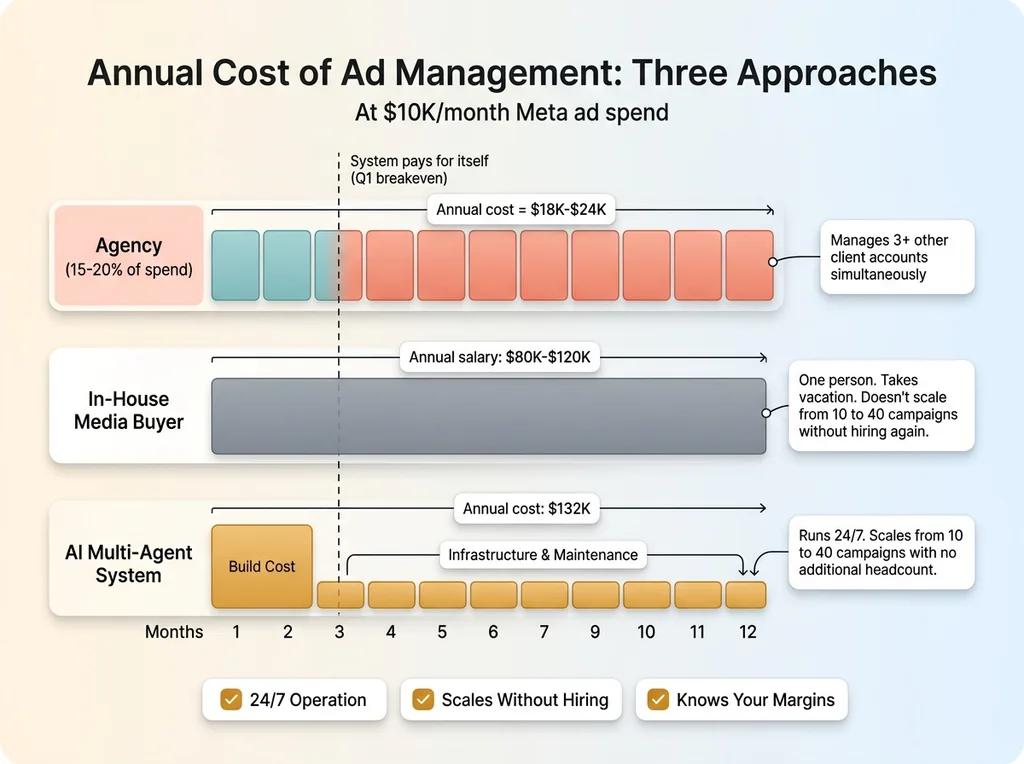 Cost Comparison: AI System vs Media Buyer vs Agency
An AI system has an upfront build cost, but it runs continuously. It doesn't take vacation. It doesn't manage three other client accounts alongside yours. And it scales — going from 10 campaigns to 40 campaigns doesn't require hiring a second media buyer.
But there's a critical requirement. You need someone who understands both multi-agent AI architecture and advertising to build it. A software engineer builds an interesting technical system that doesn't understand how Meta's auction works. A marketer can tell you what they want the system to do but can't architect inter-agent communication protocols.
This is where having a Chief AI Officer who has actually managed real ad spend for a real brand matters. I built this system because I was spending my own money. That changes how you think about every decision the AI makes.
If you're running a DTC brand or any business spending $10K+ per month on Meta and managing campaigns manually — or paying an agency to manage them with dashboards and monthly reports — this kind of system pays for itself in the first quarter. It fits into the broader AI playbook for DTC brands I've written about, where ads management is one piece of a larger operational strategy.
Ready to Talk About AI for Your Ad Spend?
If any of this hit close to home — if you're spending real money on Meta ads and wondering whether there's a better way to manage it — I'd like to hear about your situation. I do free 30-minute discovery calls where we look at your current setup and figure out where AI could actually make a measurable difference. No pitch deck. Just a conversation.
Get AI insights for business leaders
Practical AI strategy from someone who built the systems — not just studied them. No spam, no fluff.
Hodgen.AI
Ready to automate your growth?
Book a free 30-minute strategy call with Hodgen.AI.
Book a Strategy Call