UGC Reposting Attribution: Keep Creator Credit Intact
How I built UGC reposting attribution that survives every AI caption regenerate and beats Instagram's new originality penalty at scale.
By Mike Hodgen
The day a caption regenerate erased a creator's credit
A few months ago, my own content pipeline made a customer look like an afterthought. That is the kind of mistake that teaches you something about ugc reposting attribution the hard way.
Here is what happened. I run a DTC fashion brand out of San Diego, handmade product, and a big chunk of our best content comes from customers. They post photos of themselves wearing our pieces, and those photos convert better than anything my team shoots in a studio. So I built a pipeline to repost that customer-generated content at scale.
The pipeline did something clever. It would take a customer's caption, regenerate it to fit our brand voice, and slot it into the schedule. Clean, fast, on-brand. Or so I thought.
The problem showed up on a single post. A customer had shared a beautiful photo, tagged us, and written a caption crediting herself as the creator. The AI regenerated that caption into something tighter and more on-brand. And in doing so, it dropped the @creator credit entirely.
We reposted her photo with a caption that gave her zero attribution. To her, it looked like we lifted her work and rebranded it. Bad for the relationship. As I'd soon learn, it was also bad for our reach.
At scale, this is not one awkward moment. When you are reposting dozens of pieces a week, a flaw in the regenerate step is not a one-off. It is hundreds of small betrayals waiting to happen.
This article solves two problems I had to fix in production. First, making attribution survive every caption regenerate. Second, surviving the platform originality penalties that quietly punish brands who repost without transforming. Both nearly cost me reach and relationships before I caught them.
Why creator credit keeps disappearing in automated reposting
The regenerate problem
Here is the root cause, and it is not the model being dumb. It is the model doing exactly what you asked.
When you tell an AI to rewrite a caption for brand voice and length, it optimizes for voice and length. It is not optimizing for preserving one specific handle buried in the text. To the model, "@sarahwears" is just a token among many. If trimming it makes the caption tighter and more on-brand, it goes.
So every regenerate becomes a coin flip on whether the credit survives. In my testing, it was worse than a coin flip. Roughly one in four regenerates dropped the attribution.
Credit as a side effect vs. a field
The fix is conceptual before it is technical. Credit cannot be a string buried inside copy you regenerate.
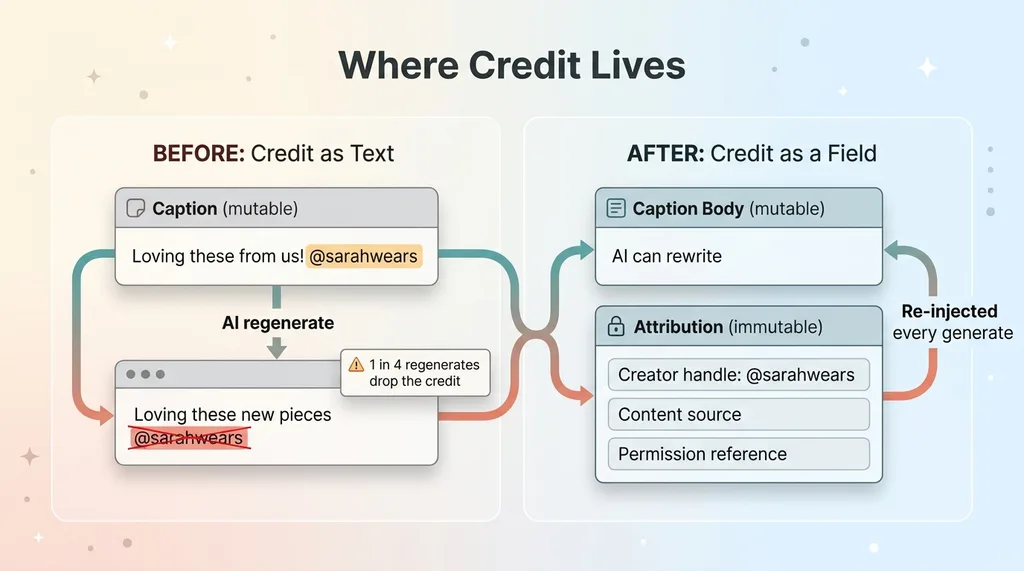 Credit as a structured field vs. text inside the caption
Think about what attribution actually is. It is not part of your brand voice. It is a fact about the post: who made it, where it came from, and whether you have permission to use it. Facts like that do not belong inside mutable creative copy.
So I split the post into two parts. The caption body is mutable. The AI can rewrite it as many times as it wants. The attribution is immutable, and it gets re-injected on every single generation.
In practice that means storing three things as structured fields the AI is forbidden to touch: the creator handle, the content source, and the permission reference. The generator never sees the credit as something it can edit. It only writes the body. The credit lives somewhere the regenerate cannot reach.
Once you frame it that way, the disappearing-credit problem stops being a prompt-engineering puzzle and becomes an architecture decision. You do not beg the model to preserve the handle. You make it structurally impossible for the model to remove it.
The 2026 originality rule that punishes lazy reposts
What changed
While I was fixing attribution, the ground shifted underneath the whole repost strategy.
A major social app rolled out a 2026 originality update. The short version: accounts that repost content without meaningful transformation get their reach slashed by 60 to 80 percent. Straight regrams, the kind where you lift someone's post and republish it untouched, get demoted or excluded from recommendation surfaces entirely.
This was not a warning shot. It was a distribution change with teeth. The platform decided that recommendation surfaces, the feeds where new audiences discover you, should reward original content and starve unoriginal content.
The reach math
Run the numbers on what an 80 percent reach cut means. If a post would have reached 50,000 people, an untransformed repost might now reach 10,000. Do that across your whole content calendar and your organic distribution quietly collapses.
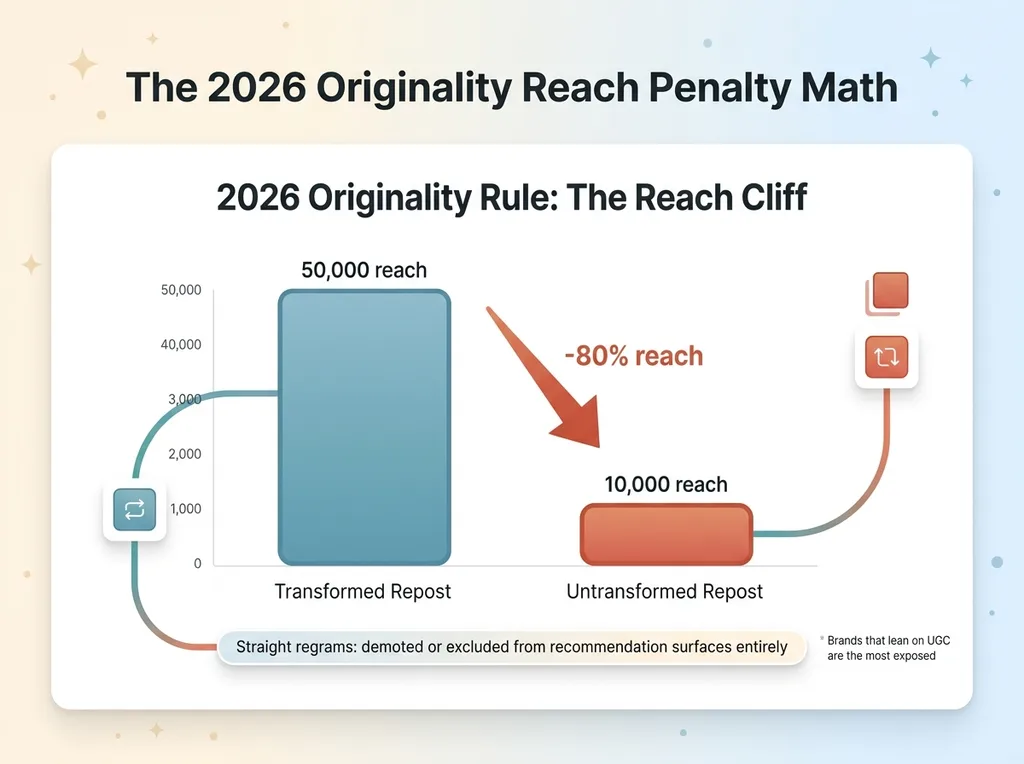 The 2026 originality reach penalty math
The cruel part is who gets hit hardest. Brands that lean on UGC are the most exposed, because their entire model is reposting. The thing that made UGC efficient, that you do not have to create everything yourself, is exactly the thing the originality rule penalizes.
So "transformation" stopped being a content-strategy nicety and became a measurable distribution requirement. It is no longer a vibe you gesture at. The platform is checking whether you actually changed the content in a meaningful way, and it is adjusting your reach based on the answer.
For a brand like mine, that meant I could not just fix attribution and call it done. I had to make sure every repost carried real transformation, or accept that half my content was getting buried.
Making attribution survive every caption regenerate
Structured credit fields
The attribution fix turned out to be the cleanest part of this whole project, once I stopped treating credit as text.
Attribution became three structured fields stored alongside the post record. The creator handle. The original content reference, so we always know which post this came from. And the permission status, so we know we are allowed to use it at all.
These fields are not part of the caption. They live next to it. The caption generator does not have access to them as editable content. Its only job is to produce the body copy in our brand voice.
Re-injection on generate
Then there is a separate assembly step. After the AI writes the body, the system re-injects the credit line every single time, before the post goes anywhere.
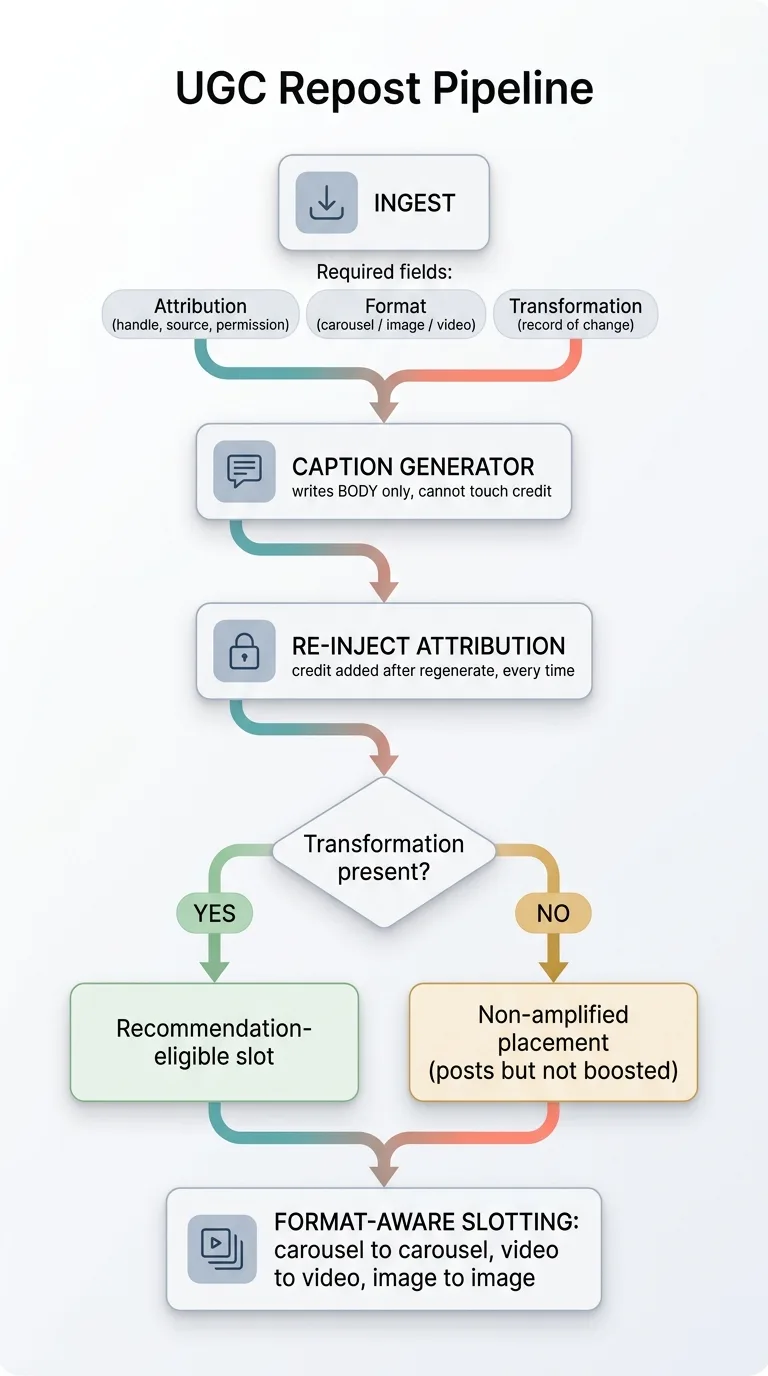 End-to-end UGC repost pipeline with three required fields
This means no regenerate can strip the attribution, because the attribution is added after the regenerate finishes. You could regenerate the caption a hundred times and the credit line would still be there on attempt one hundred.
The before and after is stark. Before, credit was lost on roughly one in four regenerates. After, zero. Not "rarely." Zero, because there is no path in the system where a regenerate touches the credit.
This pairs directly with consent tracking. Attribution answers "who made this." Consent answers "are we allowed to use it and to boost it." Those are different questions, and I handle them with the consent gate I built for boosting customer photos. Together they form the trust layer of the whole pipeline.
The principle underneath all of this is simple, and it applies far beyond captions. Anything that must survive automation cannot live inside the part the AI rewrites. If it matters, structure it. Do not trust a model to remember.
Mapping UGC formats correctly into the scheduler
Carousel vs. image vs. video
The second failure mode was uglier than the first, and it broke things visibly.
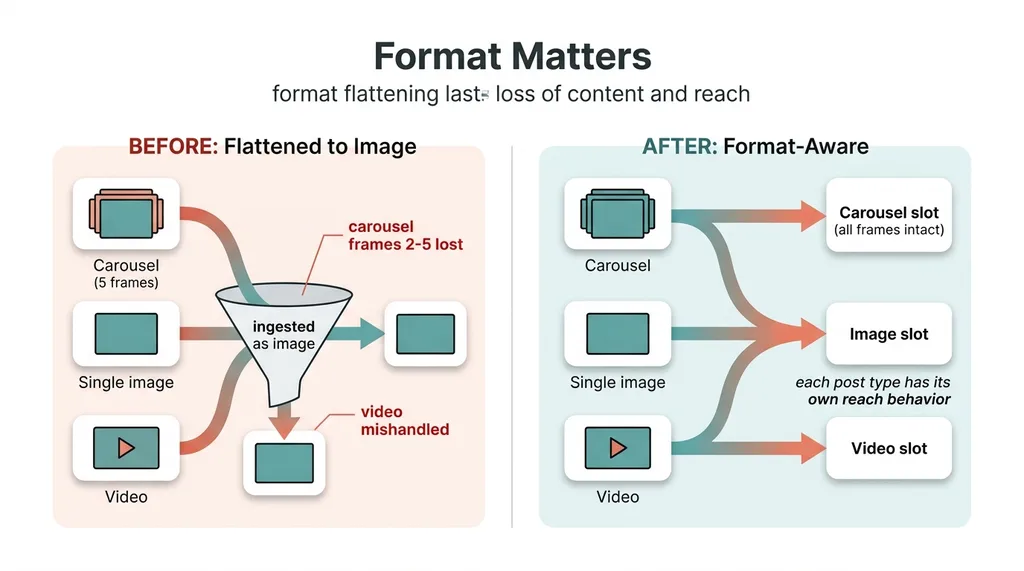 Format flattening loses content and reach
Early on, I ingested every piece of UGC as a flat "image." A customer's carousel, those swipeable multi-photo posts, got posted as a single image, losing every frame after the first. A video got mishandled entirely. The content was there, but the format was wrong, and the platform treats formats very differently.
A carousel is not an image. A video is not an image. The recommendation engine treats each one as its own post type with its own reach behavior. If you flatten everything into "image," you are not just being sloppy. You are throwing away the formats that the platform actually rewards.
Format-aware slotting
So I made format a required field on ingest. Nothing enters the pipeline without declaring whether it is a carousel, a single image, or a video.
Then the scheduler routes each one into the correct native post type. A carousel gets scheduled as a carousel, with all its frames intact. A video gets scheduled as a video. A single image stays a single image. The format determines the slot, not a default assumption.
This connects to how the rest of the calendar gets planned. I run the AI scheduler that plans a brand's whole week, and format awareness is foundational to it. You cannot balance a content week if half your posts are mislabeled.
Format also matters for the transformation logic that comes next. Whether a repost counts as "transformed" depends on what you did to it, and "repurposed into a different format" is one of the strongest transformations there is. You cannot reason about format-based transformation if you do not even know the original format. Getting this field right is the prerequisite for everything in the next section.
Requiring transformation before a slot is recommendation-eligible
The transformation field
This is the keystone fix, the one that actually protects you from the 60-to-80-percent reach cliff.
I made transformation a first-class required field, just like attribution and format. Every reposted item has to carry what was done to transform it. Not a checkbox that says "yes." An actual record of the change.
That might be added context, a new edit, brand commentary, a reframe, or repurposing into a different format. A customer's static photo turned into a styled carousel with our notes is a transformation. The same photo reposted untouched is not. The field forces you to be honest about which one you are doing.
The scheduler refuses bad reposts
Here is where it gets useful. The scheduler enforces the rule. An untransformed repost is refused from any recommendation-eligible slot. It does not get to sit in the slots that feed new-audience discovery.
It can still post. I did not want to block content entirely. But an untransformed repost gets routed to a non-amplified placement, so it does not drag down account reach. The platform never sees it competing for recommendation surfaces and penalizing the whole account.
This is the guardrail. The system makes the right thing the only thing it can do automatically. You cannot accidentally schedule a lazy regram into a slot that will get your account demoted, because the scheduler will not allow it.
One of the strongest transformations is converting content into a new format, which is why I built a pipeline for turning real product content into video without misrepresenting it. That is meaningful transformation the platform actually rewards, done without faking anything about the product.
The shift in mindset here matters. I stopped relying on my team to remember the originality rule. The rule lives in the scheduler now. Discipline that depends on people remembering is discipline you will lose at scale.
How to do UGC reposting at scale without burning reach or creators
If you are reposting UGC at volume, here is the whole answer compressed into three requirements.
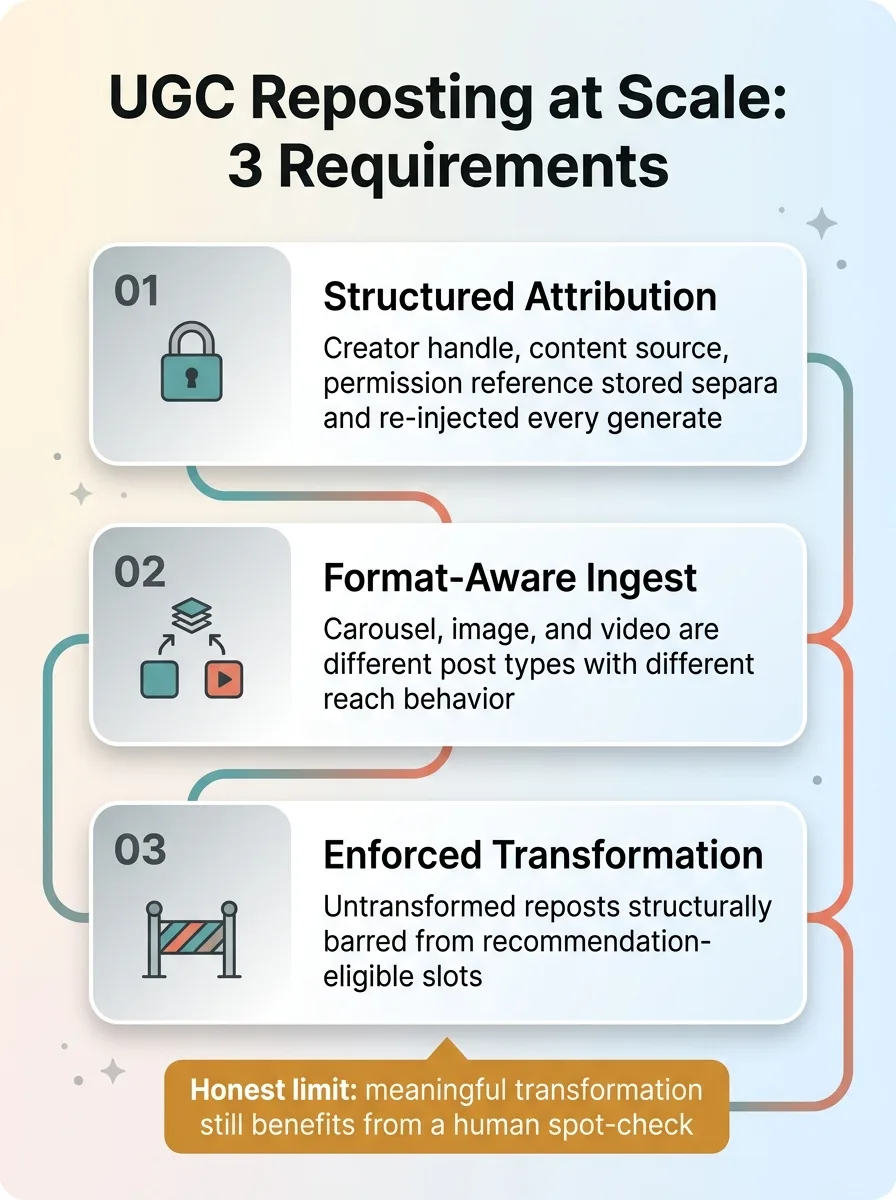 Three requirements for UGC reposting at scale
First, attribution has to be structured fields that survive regeneration. Creator handle, content source, permission reference, all stored separately from the caption and re-injected every time. Credit you keep as text inside regeneratable copy is credit you will eventually lose.
Second, ingest has to be format-aware. Carousel, image, and video are different post types with different reach behavior. Flatten them and you waste the formats the platform rewards.
Third, transformation has to be enforced at the slotting layer. Not suggested. Enforced. An untransformed repost should be structurally barred from recommendation-eligible slots so it cannot tank your reach.
Let me be honest about the limits. Judging whether a transformation is genuinely meaningful still benefits from a human spot-check. The system can require that a transformation exists; it is not perfect at judging quality. And platform rules keep changing, so what counts as "meaningful" this quarter may shift next year. This is plumbing you maintain, not plumbing you set and forget.
Here is what I notice with most brands. They discover these problems only after their reach has already dropped and a creator has already been burned. The damage comes first, the diagnosis comes second.
This is exactly the kind of plumbing I build into the systems I ship. If you want a second set of eyes, tell me what your UGC pipeline looks like today and I will tell you where it is leaking reach and trust. The goal is never more posts. It is a system where doing right by creators and doing right by your distribution are the same action.
Want to explore what AI could do for your business?
Book a free 30-minute strategy call. No pitch deck, no sales team, just a real conversation about your operations and where AI actually fits.
Get AI insights for business leaders
Practical AI strategy from someone who built the systems — not just studied them. No spam, no fluff.
Hodgen.AI
Ready to automate your growth?
Book a free 30-minute strategy call with Hodgen.AI.
Book a Strategy Call