Why Most AI Product Video Misrepresents the Product
Here is the problem that kicked this off. I run a DTC fashion brand out of San Diego, handmade product, hundreds of SKUs. Every one of those products needs social video. Not someday. Now. Reels, ad creative, the works.
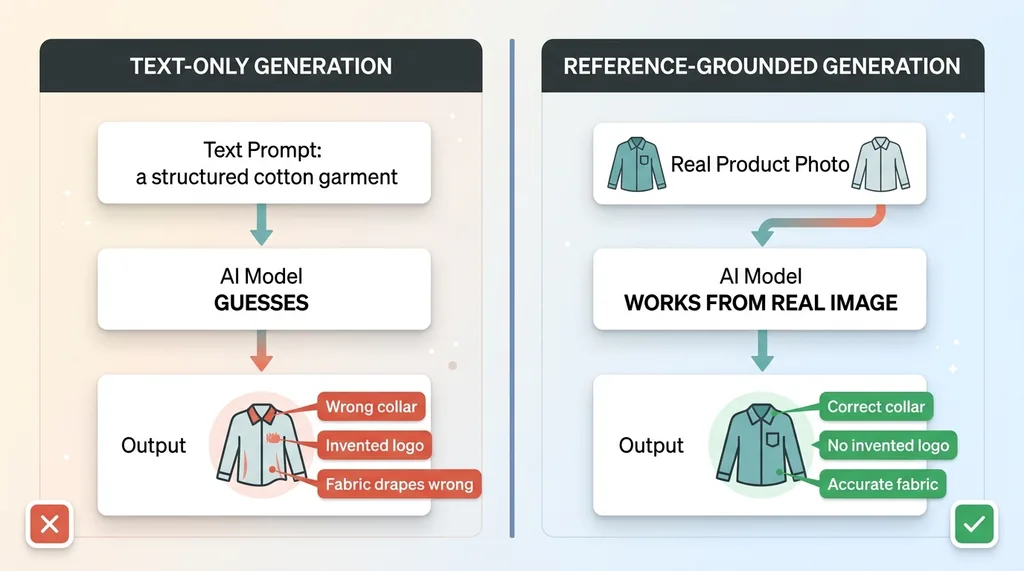 Text-only generation vs reference-grounded generation
So I did what everyone does first. I asked a video model to generate a clip of a garment from a text prompt. The result looked great until I looked closely. Wrong collar. A logo it invented out of nothing. Fabric that draped like a curtain when the real thing is structured cotton.
For most businesses, that is a cosmetic annoyance. For a fashion brand, it is a returns problem and a trust problem. The customer sees one thing in the reel, clicks buy, and gets something else in the box. That gap shows up in your return rate and your reviews, and it does not come back cheap.
There is a second risk people miss. Ad platforms run product-match validators. When your generated video does not match the still images on your listing, you can trip review and get the creative rejected, or worse, get the account flagged. Now you are not just shipping a bad reel, you are losing ad placement.
The root cause is simple. When a model generates from text alone, it is guessing at your product. It has never seen it. It cannot draw what it does not know.
So the thesis here, the thing that makes ai video generation for ecommerce actually viable, is that you do not generate from scratch. You ground every single shot in real reference imagery of the real product. The model stops inventing and starts working from photos of the thing you actually sell.
Across hundreds of products, each needing social video, doing this by hand is not viable. That is the constraint I built around.
Auto-Discovering Reference Frames From the Storefront
Pulling models and studio shots that already exist
The first thing my pipeline does not do is ask a human to upload references. That step alone kills most internal tools, because nobody has time to hunt down the right photo for hundreds of products.
Instead, the pipeline crawls the storefront product galleries for each item and auto-discovers the photos that already exist. These are real shots of the real garment, often on a real model. You already paid for this imagery. It is sitting on your product pages.
This is the same source material my photography pipeline that scores its own work draws from. The product galleries are the ground truth for everything downstream.
Picking the right frame per shot
Discovery is only half of it. A product page has different kinds of images, and they are not interchangeable. So the pipeline classifies what it finds: model-worn shots, flat studio shots, and detail crops.
Then, for each planned shot in the reel, it selects the best candidate. A wide opening shot wants a full model-worn image. A texture moment wants the detail crop. A clean product reveal wants the studio frame.
The inputs are concrete: real product photos plus brand reference imagery that carries the tone and styling I want the reel to match. Nothing is invented.
This is the line between AI video that guesses and AI video that knows what the product looks like. By the time anything reaches the video model, the system already has a real picture of the exact garment for every shot in the sequence.
Building a Per-Shot Reference-to-Video Pipeline
Reference frame in, grounded shot out
Most people treat a reel as one prompt. Describe the vibe, hit generate, hope. That is exactly how you get the invented collar.
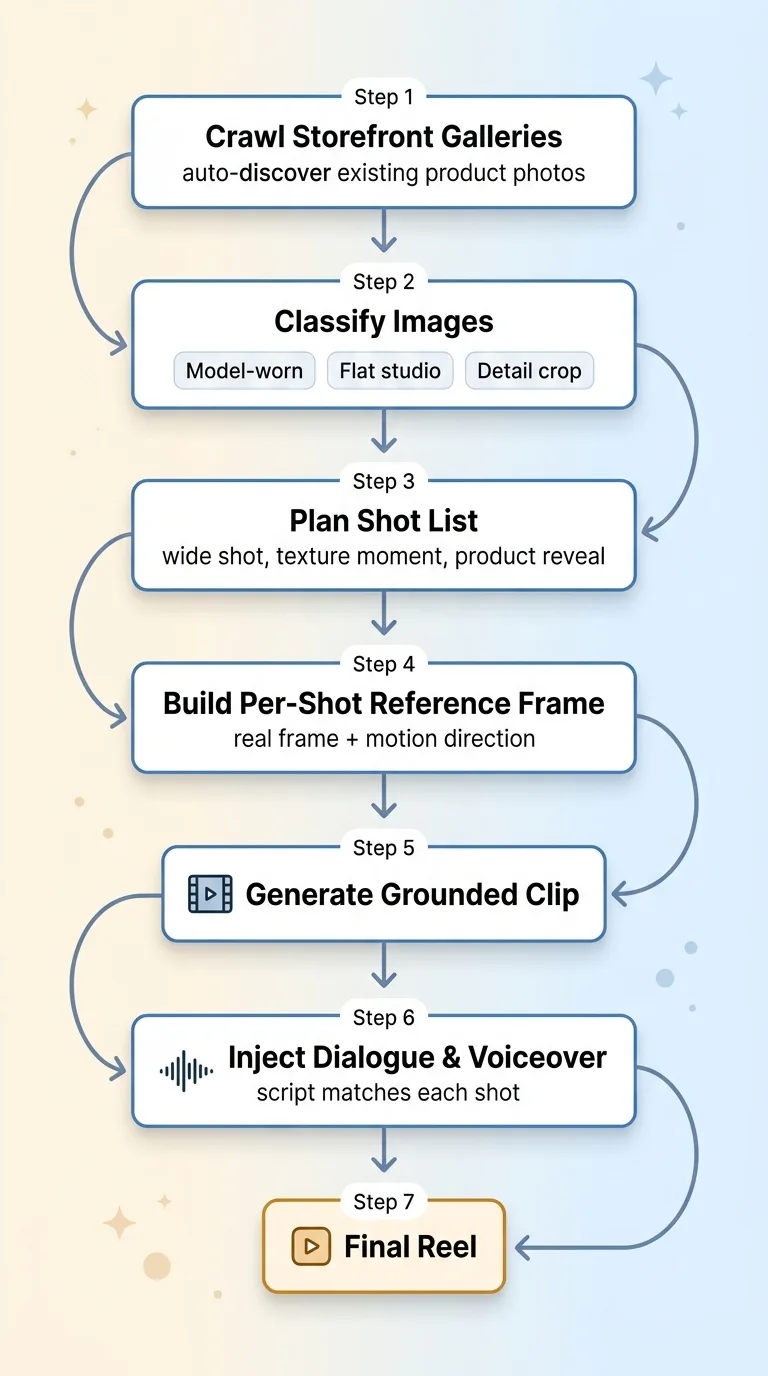 End-to-end reference-to-video pipeline
My pipeline plans a shot list first. Then it builds a per-shot reference frame so each generated clip reflects the actual garment in that specific shot. The video model receives an image reference plus motion direction, not just a paragraph of text.
That is the reference-to-video pipeline in one sentence: a real frame goes in, a grounded clip comes out. The model is animating something it can see, not hallucinating something it cannot.
This keeps the garment honest across the entire reel. The camera moves, the motion changes, the lighting shifts, but the product stays the product, shot to shot. It is the same principle I cover in depth on why you should composite the real thing instead of generating it. AI cannot draw your product accurately, so you show it the real one and let it work from there.
Injecting dialogue and voice
A reel of silent B-roll does not convert the way people pretend it does. So the pipeline does not stop at moving pictures.
It injects dialogue and voiceover, adding spoken lines so the reel has something to say. This is the difference between a pretty loop and a piece of content that actually carries a message about the product, the fit, the offer.
The voice layer is planned alongside the shot list, not bolted on after. The line being spoken matches the shot being shown, so the reel feels authored instead of assembled. For a non-technical view of it: the system writes the script, grounds the visuals in real photos, animates each shot, and lays the voice over the top, as one connected process.
The point is that grounding does not stop at the image. The whole reel, visual and audio, is built to represent a real product honestly.
The Quality and Safety Evaluator Loop
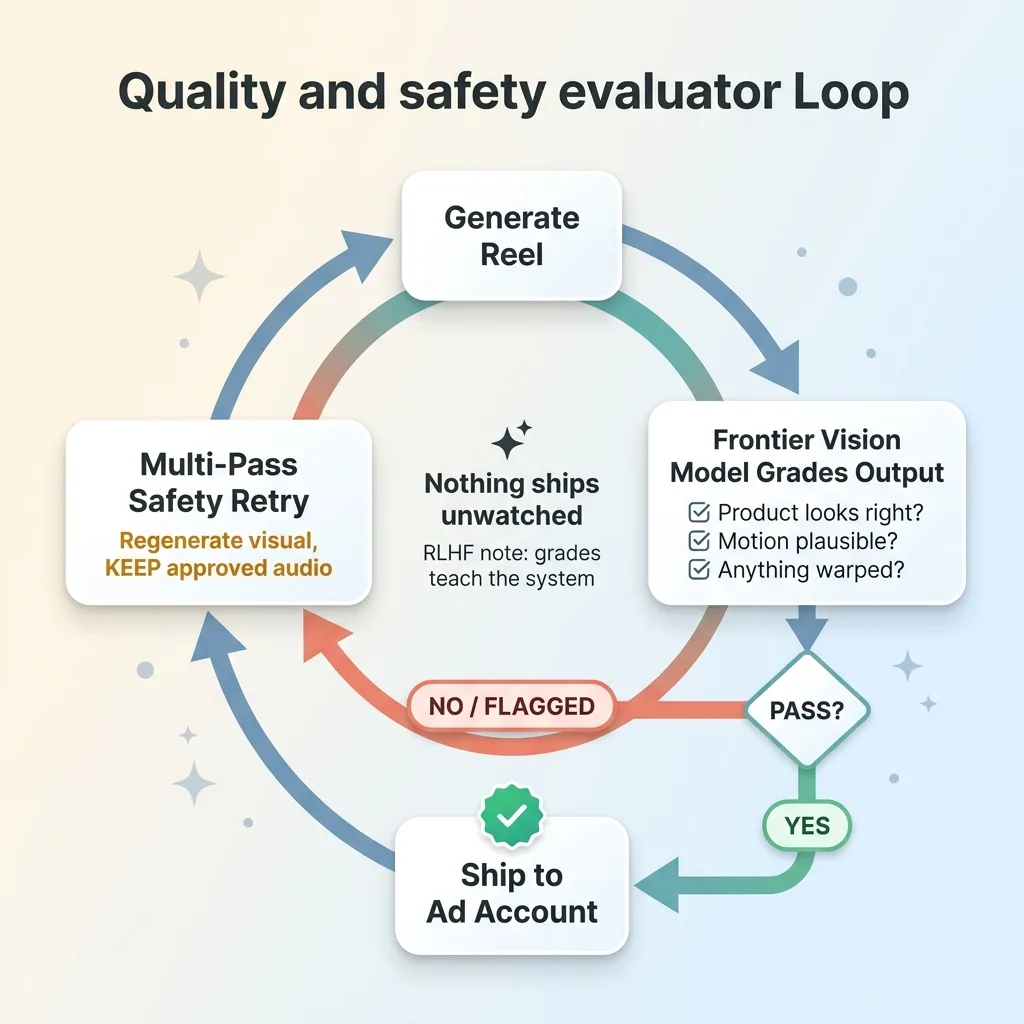 Quality and safety evaluator loop
A frontier vision model grading every output
Here is the part that makes me trust shipping this to real ad accounts. Nothing goes out unwatched.
After a reel is generated, a frontier vision model watches it back and scores it. Does the product look right. Is the motion plausible. Does anything look artificial, warped, or just wrong. If the output fails, it gets rejected and regenerated. It does not ship.
This is the same approach I use for an AI that rejects its own bad work. The generator is not allowed to be its own judge, because generators are optimists. You need a separate evaluator whose job is to find reasons to say no.
Every one of those evaluations is also signal. Over time it becomes the foundation for improving the system, an RLHF loop where the grades teach the pipeline what good looks like for my brand specifically. The evaluator gets sharper the longer it runs.
Multi-pass safety retries that keep the audio
The second job of the loop is surviving platform review. Ad validators throw false positives. A perfectly clean reel can get flagged for no good reason, and a flag can cost you the placement.
So the pipeline runs multi-pass safety retries. When something trips a validator, it re-generates to get past it, but with one important detail: it preserves the original audio track.
That matters more than it sounds. You already approved the voiceover. You do not want a safety retry to hand you a passing visual attached to a brand-new, unapproved voice. So the system keeps the audio you signed off on and only regenerates the visual until it clears.
This is the direct answer to the doubt every CEO has about ai reels generation: that it always looks fake. It does not have to, because in this system nothing ships without passing the evaluator. The fakes get caught and killed before a customer ever sees them.
The Boring Infrastructure That Makes It Actually Work
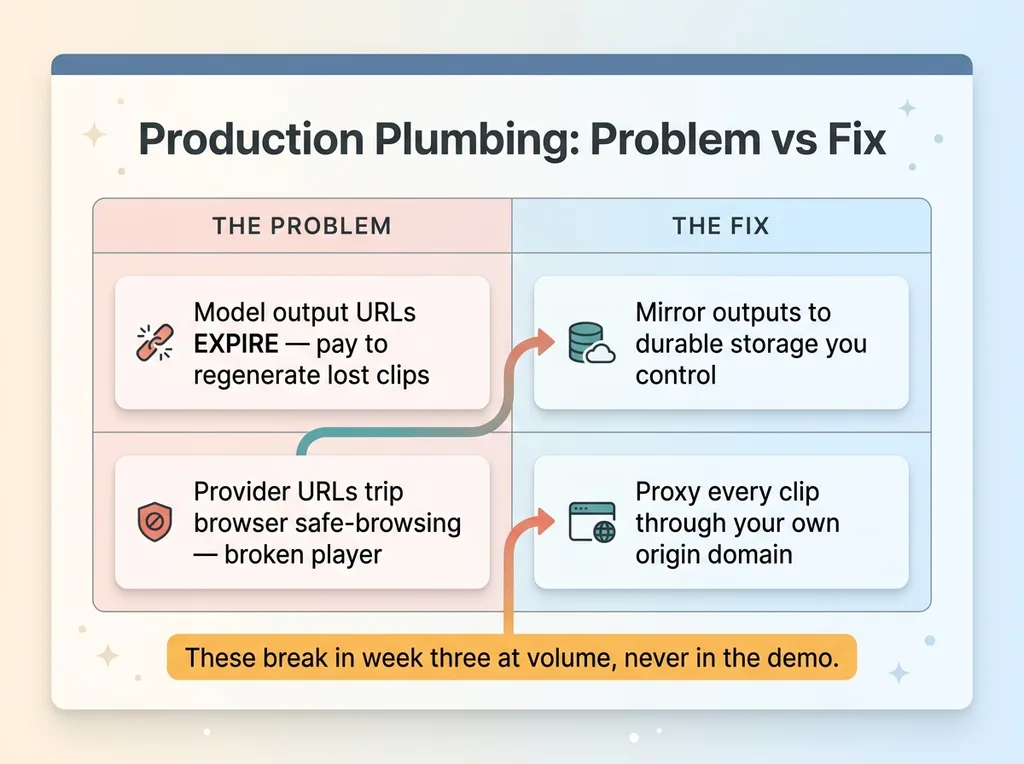 Production infrastructure plumbing problems and fixes
Mirroring outputs to durable storage
This is the unglamorous part nobody puts in a sales deck, and it is the part that decides whether the thing works for real customers.
Model output URLs expire. You generate a clip, you pay for it, and the link the provider hands you is temporary. If you wait, that asset is gone and you are paying to generate it again.
So the moment a reel is generated, it gets mirrored to durable storage. The output you paid for is captured immediately and lives somewhere you control. Sounds obvious. Almost nobody does it until they lose a batch of clips they liked.
Proxying video through my own origin
This one cost me real iteration to get right, so I will save you the headache.
If you serve generated video straight from the model provider's URL, it can trip browser safe-browsing checks. The clip gets flagged or blocked before it even plays for your customer. You did everything right, the reel is great, and the customer sees a broken player.
The fix is proxying every clip through my own origin domain. The video loads from a domain I own and trust, it plays cleanly, and the safe-browsing checks have nothing to choke on.
Neither of these problems shows up in a demo. They show up in week three when you are running at volume and clips start vanishing or refusing to play. The difference between a flashy prototype and a production system is mostly this kind of plumbing, and getting it wrong means the whole pipeline looks broken to the only person who matters, the customer trying to watch your reel.
What This Costs You to Run vs. Doing It by Hand
If you are in the market, you are doing the math, so let me lay it out straight.
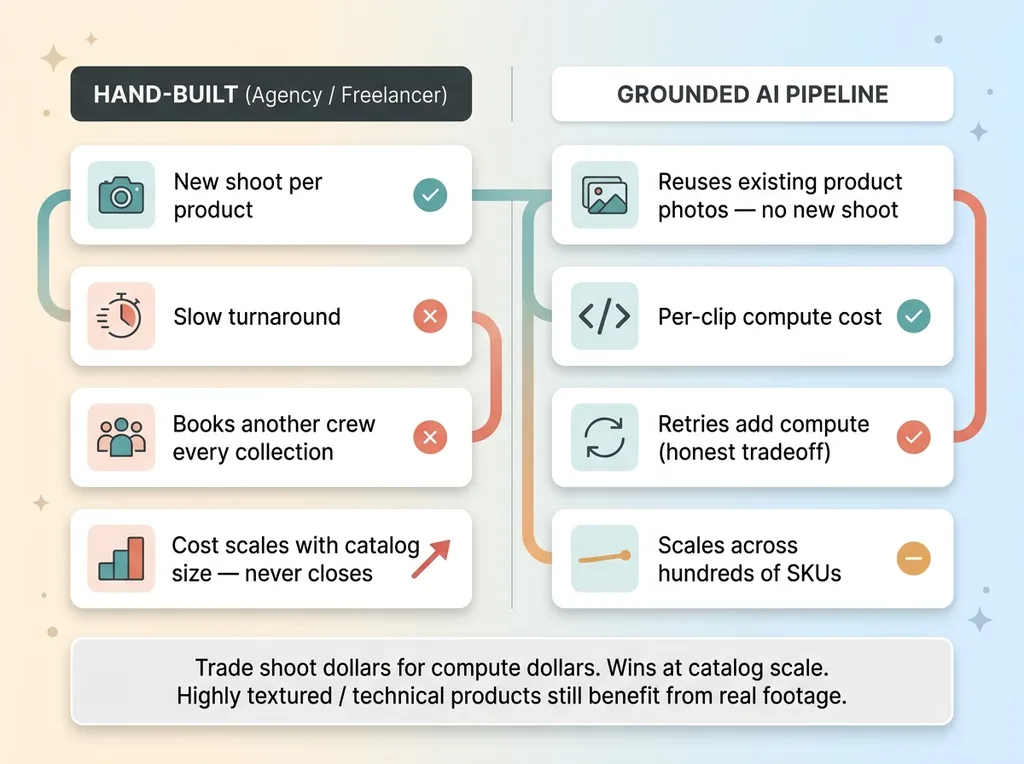 Hand-built agency cost vs grounded AI pipeline cost
The hand-built path is an agency or a freelancer producing social video per product. It is slow, it is expensive, and it does not scale. Every time you launch a collection or refresh a product, you are booking another shoot. Across a large catalog, that math never closes.
The pipeline turns existing product photos into evaluated reels with no new shoot. You are converting product photos to video using imagery you already own. That is the real unlock for catalog-scale brands.
Now the honest tradeoffs, because this is not free.
Generation has a per-clip cost. The evaluator loop adds retries, and retries cost compute, so a reel that fails twice before passing costs more than one that clears on the first pass. You are trading shoot dollars for compute dollars, and across hundreds of SKUs that trade is heavily in your favor, but it is not zero.
And not every product is a good candidate. Highly textured or technical products, where the fabric behavior or mechanism really sells the thing, still benefit from real footage of the real item in motion. The reference-grounding helps, but it does not fully replace a genuine demo for those.
Where this wins decisively is catalog-scale social, the situation where shooting everything is simply impractical. That is exactly my brand's reality. Hundreds of products, all needing video, and no world where a camera crew gets to every one of them. For that problem, grounded AI video is not a nice-to-have. It is the only thing that scales.
Whether This Belongs in Your Stack
Let me reframe the decision, because the obvious question is the wrong one.
The question is not "can AI make video." It can. Anyone can generate a clip in thirty seconds. The real question is "can AI make video that represents my actual product and survives platform review."
That is a much harder bar, and clearing it requires three things working together. Grounding in real references, so the product is honest. An evaluator that rejects bad output, so fakes never ship. And the infrastructure to serve it reliably, so it actually plays for customers and gets past the validators.
If you run a catalog where filming every product on video is not realistic, a grounded reference-to-video pipeline is the difference between scaling your social content and faking it. One builds trust and protects your return rate. The other gets caught, by the customer or the platform, usually both.
I built this for my own brand first. It has been pressure-tested on real products and live ad accounts, not on a slide. The expired URLs, the safe-browsing blocks, the validator false positives, I hit all of them and fixed them on my own catalog before anyone else's.
If that is the problem you are staring at, the next step is simple. See what this would look like for your catalog and we can map it to your actual product line.
Get the next build note.
I write up each system I build, including what broke. Subscribe to my newsletter and I'll send you the next one.