AI Content Brand Voice Matching: Cloning an Expert
AI content brand voice matching means the AI writes like you, not a chatbot. Here's how I built a reusable voice DNA from 137 transcripts.
By Mike Hodgen
Why generic AI content is worse than no content for a personal brand
I worked with a financial advisor who also hosts a radio show. His entire business runs on one thing: people trust the way he explains money. His audience has heard him talk for years. They know his cadence, the way he pauses before he tells you the thing nobody else will, the plain-language analogies he reaches for instead of jargon.
So when we started building him a content engine, the obvious solution was the worst possible one. The second a blog post on his site reads like every other AI article on the internet, his trust evaporates and he looks like he outsourced his thinking to a chatbot. That is the problem ai content brand voice matching actually has to solve, and almost nobody solves it.
Here is the distinction most people miss. For a marketer running a content program, generic-but-present often beats silent. Something on the page is better than nothing, and the brand can absorb a little blandness.
For an expert whose entire value is being himself, off-brand content does not just underperform. It actively damages the asset. The thing you are selling is your judgment, and a flat AI draft tells your audience your judgment is now a template.
I will answer the buyer doubt directly, because I know you are thinking it. Yes, bad AI content makes you look worse. People can smell it. That is exactly the problem I set out to solve, not the reason to avoid the work.
In regulated fields the stakes climb higher. An advisor, a doctor, a founder raising money. Their content is a proxy for them when they are not in the room. Get the voice wrong and you have not just published a weak article. You have signaled that the person stopped showing up.
The two layers most people collapse into one: what to say vs. how to say it
Most AI content setups do the same thing. They hand the model a topic and a tone instruction. "Write this professionally and friendly." Then they hope.
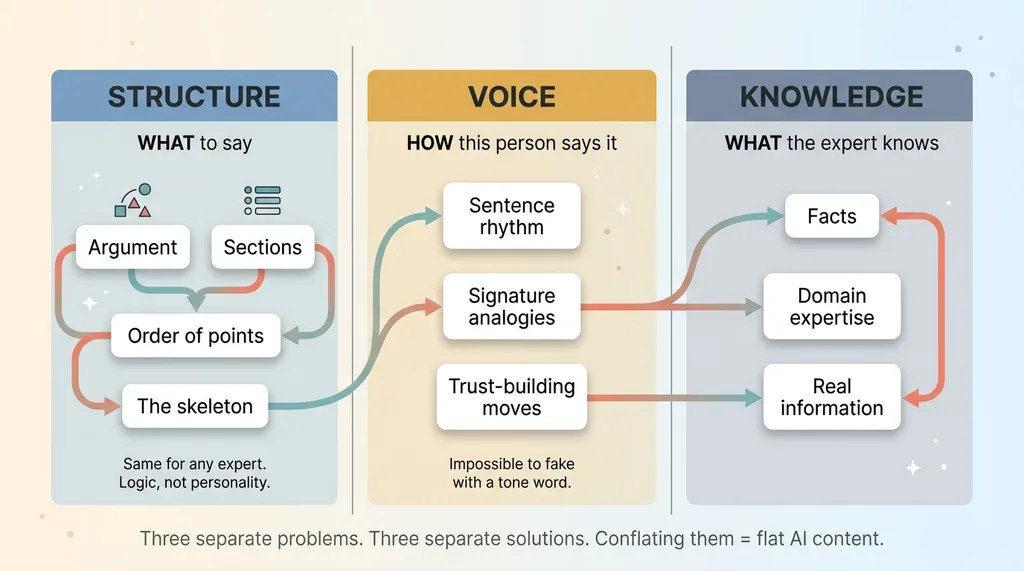 Three separate layers: Structure vs Voice vs Knowledge
That produces generic prose every time, because tone words are abstractions. "Friendly" means nothing to a model in a way you can hear. It is a direction, not a fingerprint. So the model defaults to the average of every friendly article it ever read, which is exactly the sound you are trying to escape.
I separate two things that most people crush into one.
The structural layer (the template)
The structural template tells the model what to write. The argument, the sections, the angle, the order the points should land in. This is the skeleton of the piece. It decides that paragraph three reassures the reader before paragraph four teaches them something.
This layer is the same whether the author is a financial advisor or a plumber. It is logic, not personality.
The voice layer (the DNA)
The voice layer tells the model how this specific person actually says it. Sentence rhythm. The analogies he reaches for. The signature trust-building moves he makes without thinking about them.
This is the part that is impossible to fake with a tone word, and it is the part that makes content sound like the expert instead of about the expert.
There is a third thing too, and it is worth keeping separate: teaching the model real domain knowledge. Knowledge is the facts the expert actually knows. Voice is the way he speaks. Structure is what he is arguing. Three separate problems, three separate solutions. Conflating them is the single biggest reason AI content sounds flat.
This was one layer of a larger build, a content machine for a financial advisory firm, but the voice work is the part that made all of it shippable.
Building voice DNA from 137 transcripts
You cannot describe a voice into existence. You have to extract it from real source material. For this advisor, I had the best material possible: 137 archived radio transcripts of him and his co-host actually talking.
Why transcripts beat written copy
Written copy is a trap. By the time something is published, an editor has cleaned it, tightened it, and quietly sanded off the human edges. You end up cloning the editor, not the expert.
Transcripts capture how someone speaks unscripted. The half-sentences, the way he circles back, the moment he says "here is what people are actually afraid to ask." That is the real person. Spoken language is where the voice lives, because nobody is performing for the page.
For building ai voice dna from transcripts, raw and slightly messy beats polished every single time.
What I extracted
I did not just dump 137 transcripts into a prompt and call it done. That would blow the context window, cost a fortune per generation, and over-fit the model to whatever three shows happened to dominate the pile.
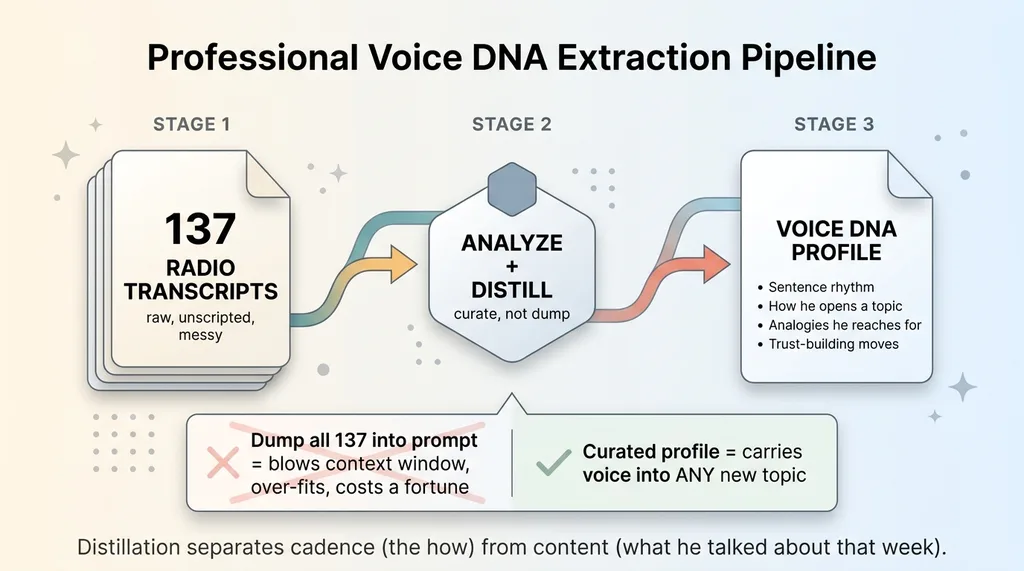 Voice DNA extraction pipeline from 137 transcripts
Instead I analyzed all of it and curated a distilled voice DNA profile. Specifically:
- Sentence rhythm, how long his sentences run, where he breaks, when he goes short for emphasis.
- How he opens a topic, the on-ramp he uses to bring a listener into a subject.
- The analogies he reaches for, the recurring plain-language comparisons he uses instead of industry jargon.
- His trust-building moves, acknowledging the listener's worry before answering it, naming the thing people are afraid to ask out loud, admitting when something is genuinely uncertain.
The key word is curated. A voice DNA profile is distilled, not dumped. I separated cadence (the how) from content (the what he happened to talk about that week) so the profile carries the man's voice into any new topic, not just the topics he already covered on air.
That distillation is the actual work. Anyone can paste a transcript. Building a profile that generalizes is the difference between a clone and a parrot.
The rotation trick that stops the AI from over-fitting one show
Here is the part I am most proud of, and it is the mechanism that makes the whole thing feel like a real person with range.
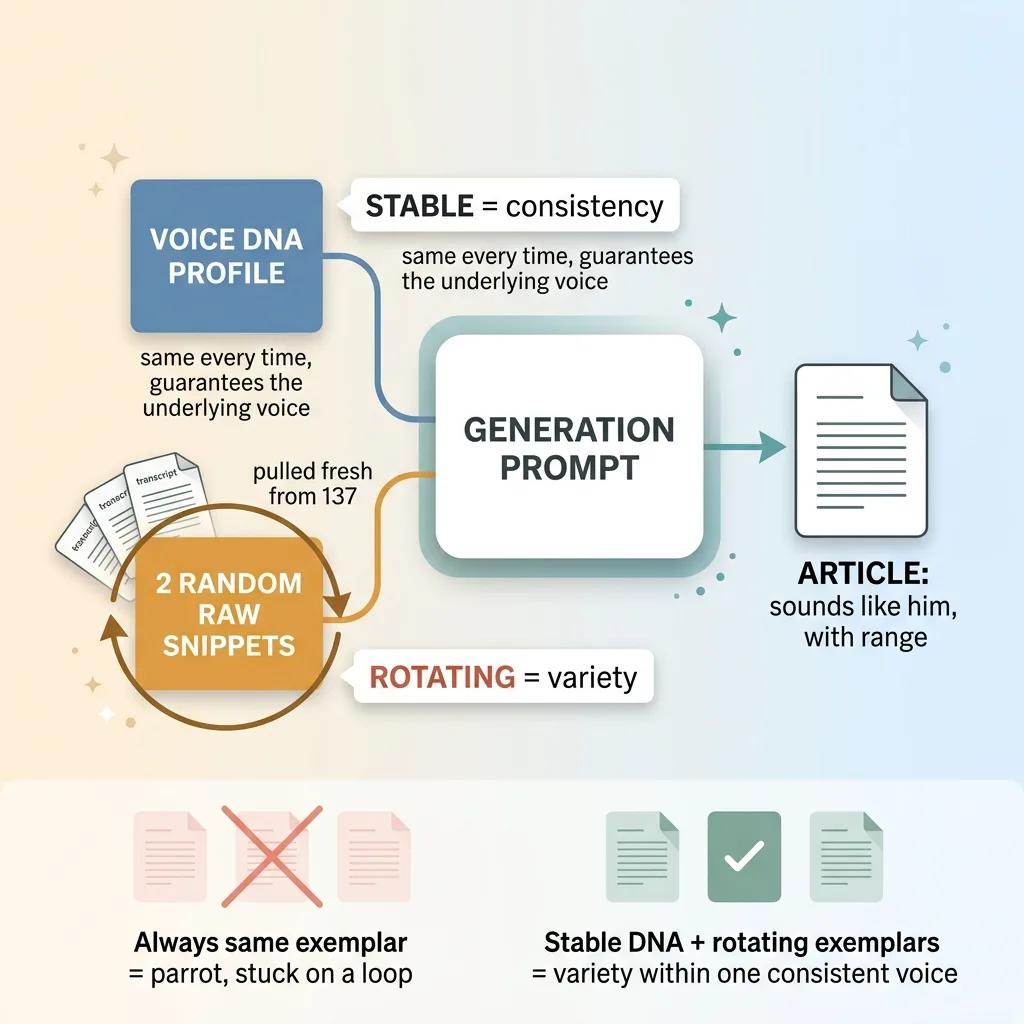 The rotation mechanism: stable DNA + rotating raw snippets
At generation time, the system loads two things. First, the curated voice DNA profile. Second, two randomly rotated raw transcript snippets pulled fresh from the archive of 137.
Why feed raw snippets on top of the distilled profile? Because each one does a different job.
The DNA profile gives stable structure. It guarantees every article carries the same underlying voice no matter the subject. That is your consistency.
The rotating raw snippets keep the output anchored on fresh, unfiltered real speech. They are the variety. Because the snippets change every time, the model is constantly re-exposed to slightly different real examples of how the man actually talks.
If you always feed the same exemplar, the model parrots it. Every post converges on the same three phrasings, and you end up with a different flavor of generic. It sounds like the person, but it sounds like the person stuck on a loop.
Rotation breaks the loop. Stable DNA plus rotating real exemplars equals variety within a consistent voice. The articles feel like they came from someone who has range, who would not say the exact same thing the exact same way in two different posts, because no real person does.
This is also why I keep saying it is a build problem and not a prompt problem. You cannot type your way to rotation logic. You have to engineer the retrieval, the sampling, and the assembly of the prompt at runtime. That is code, not clever instructions.
What 'signature trust-building tics' actually means in practice
Let me make this concrete, because "voice" gets hand-waved a lot.
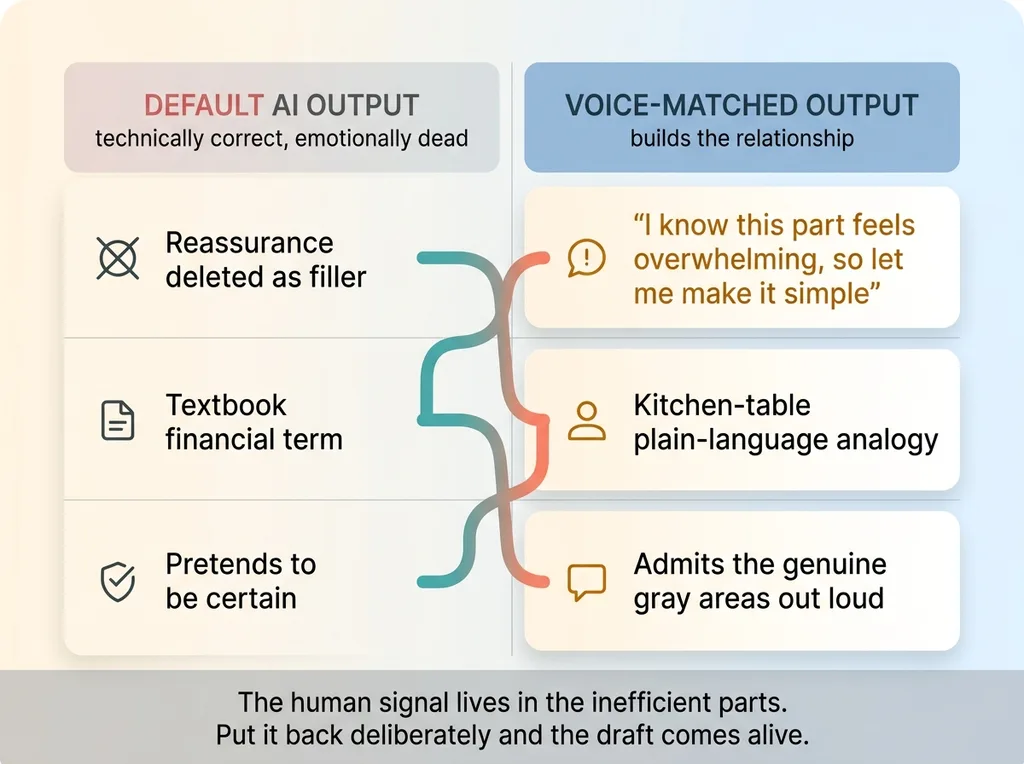 Trust-building tics: what default AI strips out vs what to put back
A personal brand is built on small repeated moves. The way the advisor reassures before he educates. The way he reaches for a plain-language analogy instead of a financial term. The way he admits, out loud, when something is genuinely uncertain instead of pretending to be sure.
Those are his trust-building tics. They are why his audience believes him. When he says "I know this part feels overwhelming, so let me make it simple," that single move does more for trust than three paragraphs of credentials.
Default AI strips those moves out. Every one of them. A model trained to be helpful and tidy reads "I know this feels overwhelming" as filler, as inefficiency, as words that do not advance the answer. So it deletes them and gives you the clean version.
The clean version is technically correct and emotionally dead.
Capturing those tics in the voice DNA is the entire point of the exercise. The profile explicitly tells the system: reassure before you explain. Name the worry. Use the kitchen-table analogy, not the textbook term. Admit the gray areas.
That is the difference between content that sounds like the expert and content that sounds like it is about the expert. The first one builds the relationship the expert spent years building. The second one quietly burns it.
When people say AI content "lacks a human touch," this is what they are pointing at. The human signal is in the inefficient parts. Put it back in deliberately and the draft comes alive.
Why this matters more in regulated and credibility-driven fields
For an advisor, a doctor, a founder, the entire business is the person's judgment and reputation. There is no product behind the person. The person is the product.
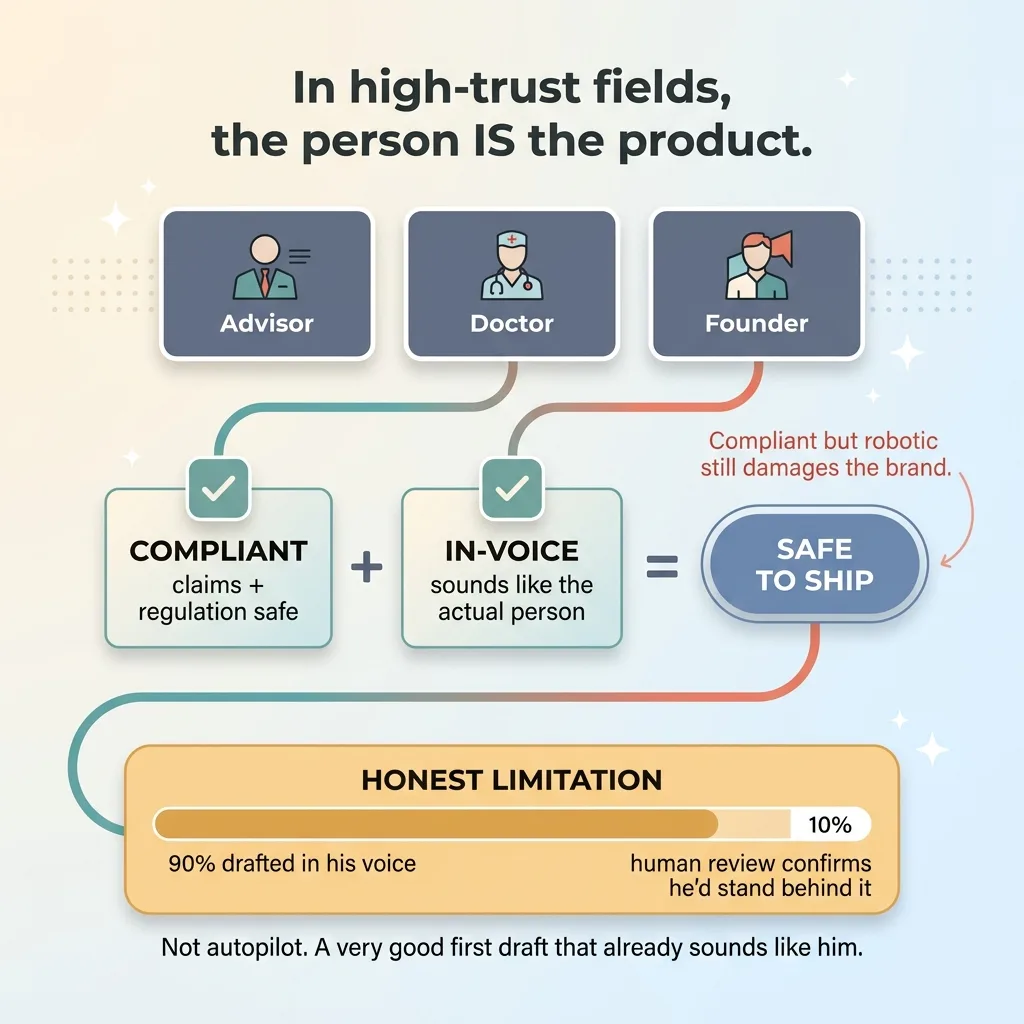 Why voice matters more in regulated, credibility-driven fields
Content in that world is not decoration. It is a proxy for them when they are not in the room. Someone reads the blog post at 11pm before they decide whether to book a call. That post is doing the trust-building the expert would do in person.
So off-brand content in a high-trust field does not just underperform on engagement. It raises a flag. The reader gets a faint sense that something is automated and impersonal, and in a field built on trust, "automated and impersonal" is the kiss of death. It is the opposite of what they came for.
This is also why the regulatory piece matters. When you are shipping content in finance or healthcare, you already have to be careful about claims and compliance. I wrote about the guardrails for that in shipping AI content in a regulated industry. But the voice layer is what makes any of it safe to ship at all. A compliant article that sounds like a robot still damages the brand. You need both.
So the voice layer is not a nice-to-have for these people. It is the thing that makes automated content acceptable in the first place.
Honest limitation, because I will not pretend otherwise: this does not replace the expert's review. The system drafts in his voice. A human still confirms it is actually something he would stand behind. The goal is to get the draft 90 percent of the way there in his actual voice, so review takes five minutes instead of a rewrite. It is not autopilot. It is a very good first draft that already sounds like him.
The point isn't volume. It's sounding like yourself at scale.
It would be easy to brag about output. We could ship a lot of articles. But that is not the win.
The win is that an expert who is not a marketer, who does not have time to write, now has a consistent content presence that actually sounds like him. Built once, from how he already talks, working in the background while he does his real job.
So let me reframe the doubt one final time, because it is the whole argument. AI content sounds generic when you treat tone as an afterthought, a word you tack onto a prompt and hope for the best. It sounds like you when you build voice DNA from real source material and engineer the generation to actually use it, with rotation, with structure, with the trust-building tics intact.
That is a build problem, not a prompt problem. You cannot subscribe your way to it. Somebody has to do the work of extracting the voice, distilling it, and wiring it into how the content gets made.
If your content presence depends on you sounding like yourself, and right now it either does not exist or it sounds like everyone else, that is exactly the kind of thing I build. Let's talk about what your content should actually sound like.
Thinking about AI for your business?
If this resonated, let's have a conversation. I do free 30-minute discovery calls where we look at your operations and find the places where AI could actually move the needle, not the places where it just looks impressive in a slide deck.
Get AI insights for business leaders
Practical AI strategy from someone who built the systems — not just studied them. No spam, no fluff.
Hodgen.AI
Ready to automate your growth?
Book a free 30-minute strategy call with Hodgen.AI.
Book a Strategy Call