The Contract I Almost Signed on One Read
I had a critical vendor agreement for a regulated startup sitting in my inbox, and my cursor was hovering over the signature field.
I'd read it once. It looked standard. Forty pages of the kind of language you've seen a hundred times: fees, term, termination, a liability cap that seemed reasonable, the usual indemnity boilerplate. I was busy, the deal mattered, and the platform on the other side was the obvious choice. Sign and move on.
Here's what I had to remind myself before I clicked. Platform contracts are written by the platform's lawyers, for the platform. Every word is there because it benefits them or protects them. The document is not neutral, and it is not designed to be readable. It's designed to be defensible.
A single read misses three specific things every time. First, an exhibit that quietly says it "controls in the event of conflict" over the main body, which means your negotiated terms don't actually govern. Second, survival clauses that keep obligations alive long after you've terminated, so "we can just leave" turns out to be false. Third, excluded claims that carve holes in the damages waiver you thought protected you.
So instead of trusting my own read, I ran the agreement through seven AI agents before I'd sign it. The result wasn't a cosmetic cleanup. The system found a liability that was, in practical terms, perpetual and uncapped, hiding in a place my eyes had skimmed right past.
This is the ai contract review workflow I now use on anything high-stakes. Here's how it works, what it caught, and why one careful read is not enough.
Why a Single Read Misses the Landmines
The reason a founder misses the danger isn't carelessness. It's structure. The dangerous terms are never in one place.
Risk hides in cross-references
The damage in a contract lives in the connections between clauses, not the clauses themselves. A liability cap in Section 11 reads fine in isolation. But then an exhibit forty pages later states it "controls in the event of conflict" over the main body. Now your cap doesn't bind the exhibit's obligations. The protection you negotiated still exists on paper, it just doesn't reach the thing that can actually hurt you.
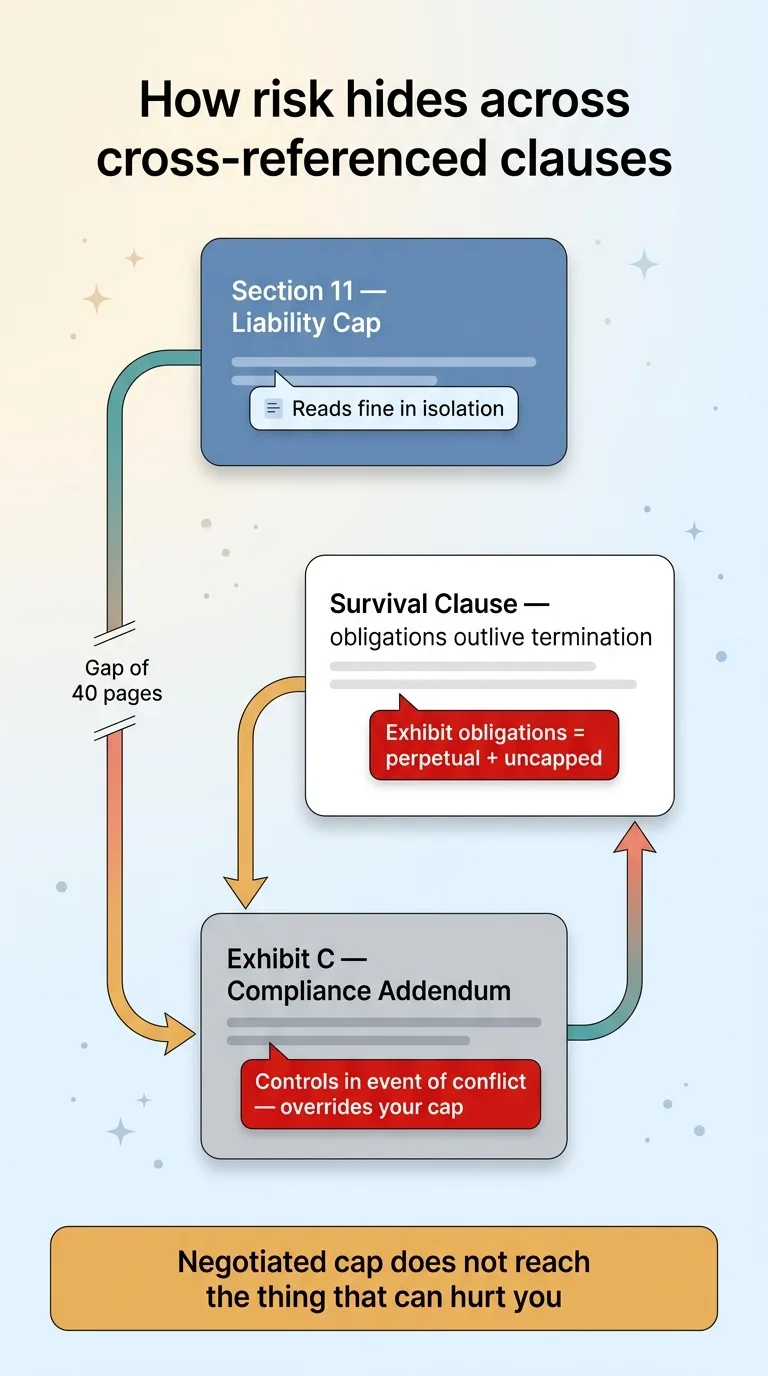 How risk hides across cross-referenced clauses
This is a compliance or data processing addendum problem more often than not. Those exhibits get written by a different team, with different priorities, and they're bolted on without anyone reconciling them against the cap you fought for.
The clauses that outlive the contract
Survival clauses are the other trap. Indemnity and confidentiality obligations typically survive termination, which means exiting the relationship does not end your exposure. If an exhibit's obligations are uncapped and they survive, you've signed something that can follow you indefinitely.
Then there are excluded claims. The damages waiver you read as a shield usually has carve-outs for IP, confidentiality, and indemnity. Those carve-outs are holes. The waiver protects you against the small stuff and leaves you fully exposed on the categories most likely to produce a real claim.
None of this is about reading slowly. The human brain cannot hold forty pages of cross-references in working memory at once. You read Section 11, then read Exhibit C, and by the time you get there you've forgotten the exact wording that would have triggered the alarm. That's not a discipline failure. That's a working-memory limit.
And holding a large set of cross-references in active comparison is exactly what AI is good at.
How I Set Up the Multi-Agent Contract Review
I didn't hand the whole contract to one general model and ask "is this safe to sign." That gives you a confident, mushy answer that misses the specifics. I ran a multi-agent legal review instead.
The specialist agents
Seven agents, each attacking from one angle, each with a narrow brief and a clear standard.
A pricing and economics agent: does the fee structure protect margin, and are there open-ended cost terms? A compliance agent: does the regulatory exhibit create new obligations the main body never mentions? A contract-terms agent focused only on caps, indemnity, termination, and survival. Others covered IP, data handling, and exit mechanics.
The reason specialists beat one general model is focus. A single model trying to evaluate the whole document spreads itself thin and gets distracted by the parts that read cleanly. A pricing agent doesn't care about confidentiality language, so it doesn't get pulled off course. It hunts for one kind of problem and reports back. This is the same logic behind the specialist agents that argue with each other in the medical-team setup. Narrow brief, clear standard, deeper coverage.
The adversarial cross-checker
The move that makes this work is a dedicated adversarial agent whose only job is to disagree with the emerging consensus. When the other agents start converging on "this looks acceptable," the adversary's job is to break that, to find the reading where the contract bites.
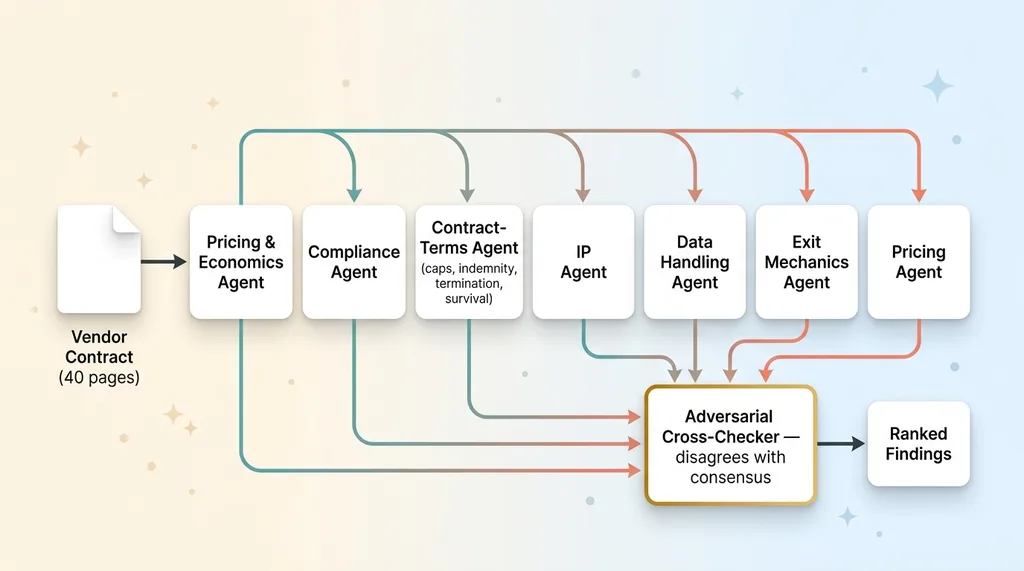 Seven specialist agents plus adversarial cross-checker architecture
Consensus is comfortable and consensus is dangerous. A room full of agents agreeing with each other is how you miss the thing in the exhibit. The adversary exists to manufacture the disagreement that surfaces it.
This mirrors how I build for clients. Not one oracle that hands down a verdict, but a range of specialists plus a designated skeptic. You get coverage and you get a built-in check against your own optimism.
What the Agents Actually Caught
This is the part that matters. Three findings, all of which I'd missed on my read.
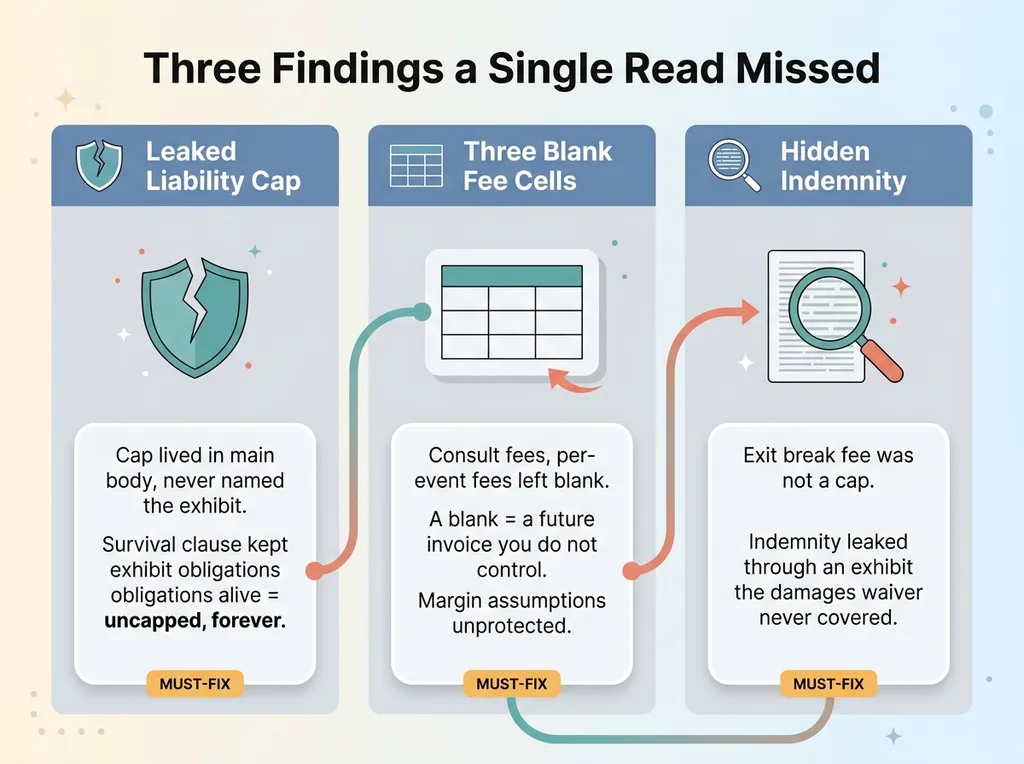 The three findings the agents caught
The liability cap that leaked through the exhibit
My negotiated liability cap lived in the main body. It did not expressly name or bind the compliance exhibit. The exhibit had its own obligations, and a survival clause kept those obligations alive after termination.
Put those together: the exhibit's obligations were effectively perpetual, and the cap I'd negotiated didn't reach them. I had a contract where my exposure on the most regulated, highest-risk part of the deal was uncapped and forever. I read it as a capped agreement. It wasn't.
The fix the system surfaced was specific. The cap language had to explicitly name and bind the exhibit, not just sit in the main body and hope. One sentence of drafting closed a hole that could have outlived the entire business relationship.
Three blank fee cells
The pricing agent flagged three fee cells left blank. Consult fees, per-event fees, the kind of thing that looks like an oversight you'll "fill in later."
A blank in a contract is a future invoice you don't control. Every margin assumption I'd modeled moved with those cells. The other side could populate them after signing, and I'd have agreed to a pricing structure I never actually saw. The agent's point was blunt: you cannot sign a fee schedule with holes in it and call your margin protected.
An indemnity hiding in the exhibits
I'd read the early-exit "break fee" as a cap on what leaving would cost. It wasn't a cap. And separately, an indemnity obligation leaked through an exhibit that the main body's damages waiver didn't cover.
So the protection I thought I had on exit was weaker than I believed, and a category of liability the waiver was supposed to handle wasn't actually handled. Two readings I'd gotten wrong, both caught because the adversarial agent refused to accept the clean surface reading.
This is the proof that adversarial review beats a single careful read. Not because the AI is smarter than me, but because it holds every cross-reference in view at once and has a skeptic forcing the uncomfortable interpretation.
The Output: A Ranked MUST-FIX / STRONG / NOTE Redline
The deliverable was not a wall of margin comments. A wall of comments is noise, and noise is how real issues get buried under cosmetic ones.
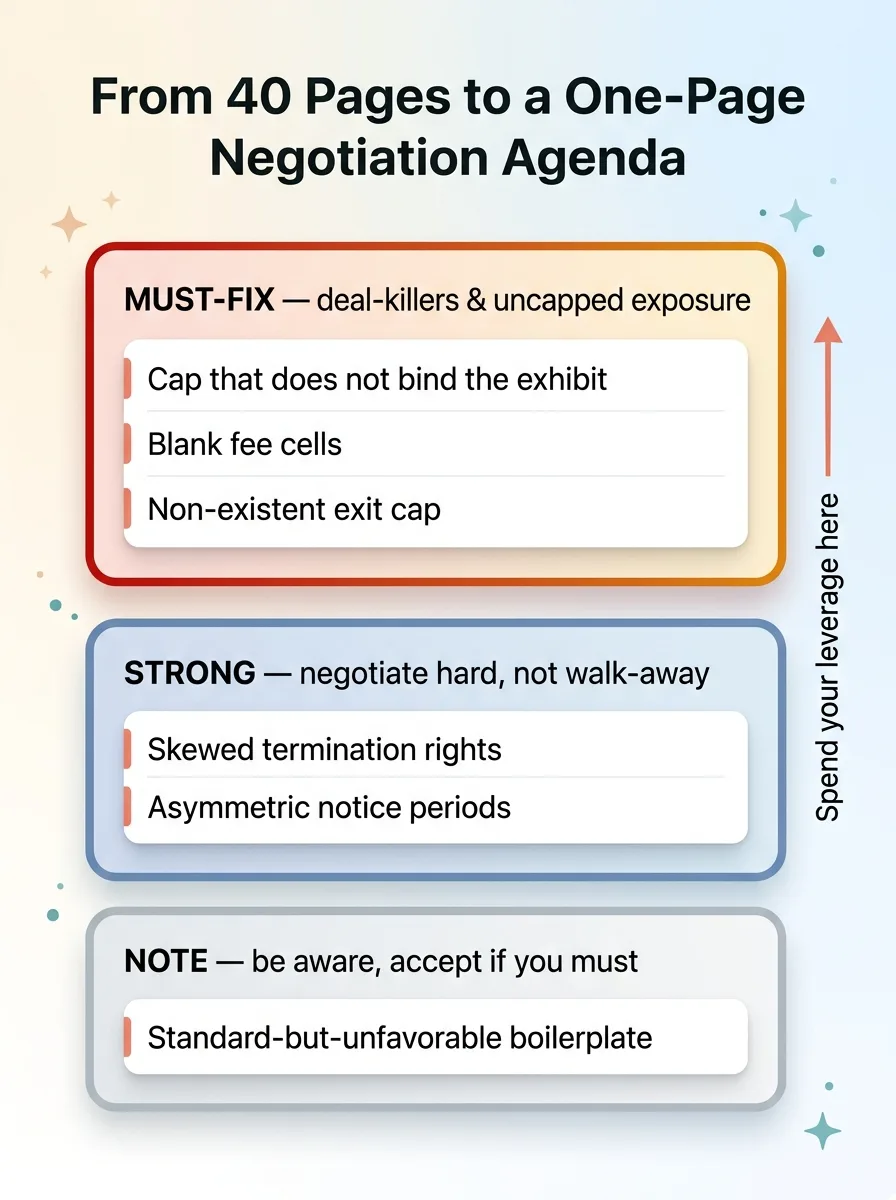 Ranked MUST-FIX / STRONG / NOTE tiering
What I got was a ranked list in three tiers.
MUST-FIX: deal-killers and uncapped exposure. The cap that didn't bind the exhibit. The blank fee cells. The non-existent exit cap. These don't get signed as-is.
STRONG: terms worth negotiating hard but not walk-away items. Skewed termination rights, asymmetric notice periods, the things you push on because you can.
NOTE: be aware, accept if you must. Standard-but-unfavorable language that isn't worth your leverage.
Ranking matters because it turns forty pages into a one-page negotiation agenda. It tells you where to spend your leverage. You have a finite amount of pushback you can use before the other side walks, and you want to spend all of it on the MUST-FIX items, not waste it arguing about a NOTE.
The discipline here is important. Every item was framed as a question to take to counsel and the other side, not a final ruling. The system flagged and ranked. It did not decide. That boundary is the same one I apply across every build: let the model judge and the code compute. The AI identifies and prioritizes the risk. The human makes the call.
This is decision support that makes the expensive human, your lawyer, faster and cheaper. Not a replacement for them.
Decision Support, Not Legal Advice
Let me be plain about what this is and isn't. This does not replace a lawyer, and I'm not pretending it does.
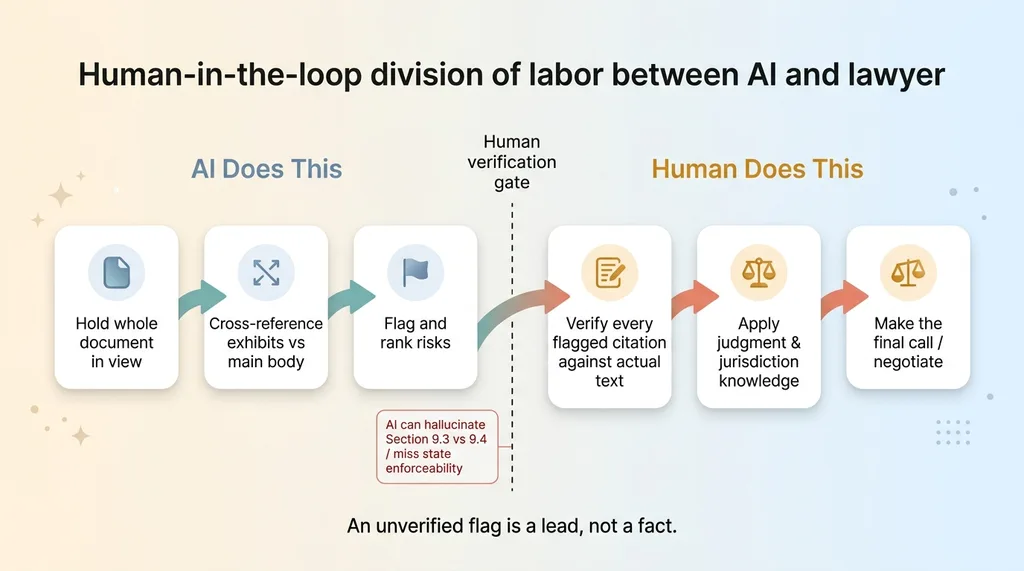 Human-in-the-loop division of labor between AI and lawyer
What it does is two things. It surfaces the clauses a single read misses. And it lets me walk into my lawyer's office with a ranked list instead of "can you look at this." That second thing changes the economics. My counsel review got faster and cheaper because the agents had already done the grunt work of cross-referencing exhibits against the main body and flagging exactly where to look.
I'm not asking the AI to give me legal advice. I'm asking it to do the part it's good at, holding the whole document in view, and leaving judgment to the people qualified to exercise it. That's the human-in-the-loop principle that every system I ship is built around. The model never gets the final word on something this expensive to get wrong.
The failure modes are real and worth naming. AI can miss jurisdiction-specific enforceability, where a clause is technically present but unenforceable in the relevant state or country. It can hallucinate a clause reference, citing Section 9.3 when the relevant language is in 9.4. That is exactly why the adversarial cross-checker and human sign-off exist.
I verify every flagged citation against the actual text before it goes to counsel. The agents tell me where to look. I confirm what's there. An unverified flag is a lead, not a fact.
What This Means for Your Next Vendor Agreement
Here's the uncomfortable generalization. Most founders sign platform and vendor contracts they've read once, under time pressure, where the other side wrote every word.
The structural risks I described are not unusual. Controlling exhibits, survival clauses, carved-out waivers, blank fee cells. These show up in almost every SaaS agreement, data processing addendum, and supplier contract I've looked at. The other side knows you'll read it once. The document is built for that.
The same multi-agent review pattern I use on my own contracts is the pattern I build into client systems for due diligence, compliance, and any high-stakes document. It's not a one-off trick. It's a repeatable way to make sure the dangerous cross-reference doesn't slip past a tired human at 11pm before a deadline.
If you're about to sign something that could create perpetual or uncapped exposure, run it through this kind of review first. And if you want this wired into how your company operates, so every vendor agreement gets the seven-agent treatment before anyone signs, that's the kind of system I build.
Get the next build note.
I write up each system I build, including what broke. Subscribe to my newsletter and I'll send you the next one.