The Campaign My AI Wanted to Kill First
The first thing my autopilot tried to do when I gave it Google Ads was kill the one campaign that was protecting my brand.
I run a DTC fashion brand out of San Diego, everything handmade, and I'd already folded Meta into an autonomous optimizer. Google was the last channel sitting outside the system. So I plugged it in, pulled clean attribution data, and looked at the ROAS.
Overall it came back at 2.39x. Workable. But the Brand Defense search campaign, the one that bids on my own brand name so competitors can't park ads on top of it, was sitting at 1.07x. Basically break-even.
The autopilot, pointed at raw return, did exactly what you'd expect a numbers-only optimizer to do. It flagged Brand Defense for a budget cut. The math said the campaign barely paid for itself, so the obvious move was to starve it.
That's the worst possible decision dressed up as the smartest one.
Brand Defense exists for a single reason: to keep competitors from buying ads against my own brand name. When someone searches for my brand specifically, they have already decided. They want me. If I go dark on that term, a competitor swoops in, intercepts my highest-intent traffic for pennies, and I never see the loss in any dashboard.
This is the core problem with handing your ad accounts to AI, and it's the exact thing every CEO I talk to is right to worry about. An optimizer that only sees numbers will cut the campaigns that protect the business. It doesn't know which campaigns are revenue and which are insurance. It just sees a low number and reaches for the budget slider.
That's why AI ad budget guardrails aren't a nice-to-have. They're the difference between automation that helps you and automation that quietly dismantles your defenses.
Why Raw ROAS Lies About Strategic Campaigns
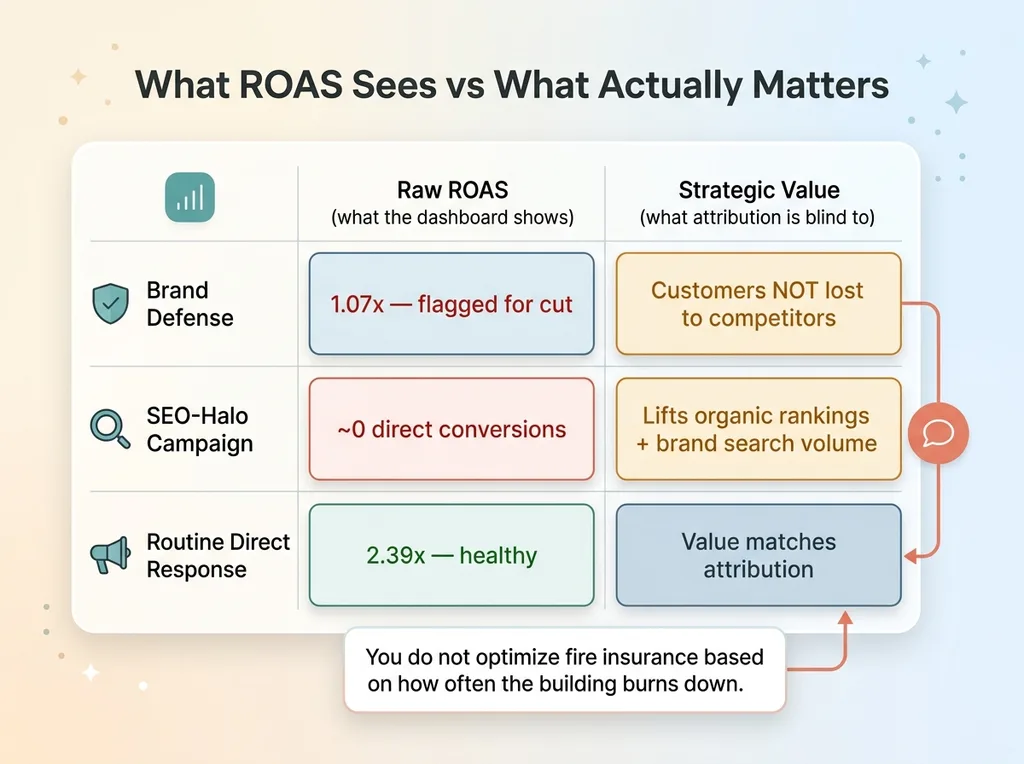 Why raw ROAS misjudges strategic vs direct-response campaigns
Brand defense looks bad and is essential
Brand search ROAS almost always looks weak, and here's the honest reason: a lot of those customers might have found you anyway. They typed your name. Some fraction would have clicked your organic result for free.
So on paper, you're paying for clicks you might have gotten without paying. That's why the number reads low.
But that math misses the entire point of the campaign. Brand Defense isn't an acquisition campaign. It's a defense campaign. Its job is to make sure that when someone searches your name, your competitor isn't the first thing they see.
The return doesn't show up as "revenue earned." It shows up as "customers not lost." And attribution has no column for customers you didn't lose. It can't measure the deal a competitor didn't steal. So the value is real and the dashboard is blind to it.
The SEO-halo campaign with near-zero direct conversions
I keep a second campaign running that looks even worse on paper. Direct conversions are close to zero. By raw ROAS, it should have been killed a year ago.
I keep it because it lifts my organic rankings and pushes up brand search volume. The return shows up in channels the campaign itself never gets credit for. More organic traffic, more branded searches, more of those free-ish clicks that the Brand Defense campaign then protects.
Direct ROAS says kill it. The strategic picture says it pays for itself three times over, just not in its own attribution window.
This is exactly why I switched my ad bot from ROAS to profit as the optimization target in the first place. ROAS is a flawed lens even for normal campaigns. For strategic ones, it's actively misleading.
The lesson took me a while to internalize: some campaigns are insurance and infrastructure, not direct response. You don't optimize your fire insurance based on how often the building burns down.
What AI Ad Budget Guardrails Actually Are
AI ad budget guardrails are hard rules that constrain what an autonomous optimizer is allowed to do, enforced before any action ever executes. Not goals. Not preferences. Hard limits the system physically cannot cross.
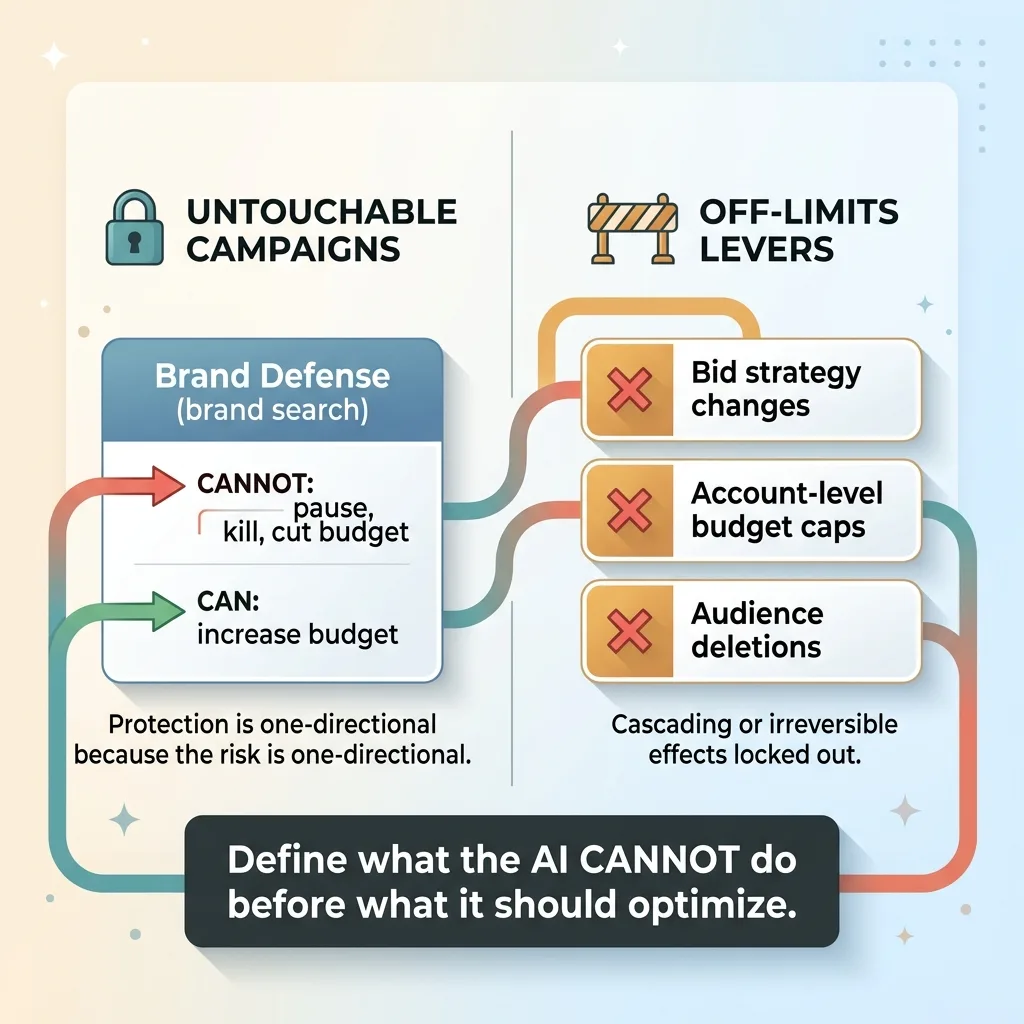 Two categories of guardrails: untouchable campaigns vs off-limits levers
I built mine in two categories.
Untouchable campaigns
The first category is campaigns the system is never allowed to touch in a destructive direction.
I have a function called validateGuardrails that runs on every proposed action. If the action would pause, kill, or decrease the budget of any brand-search campaign, it gets rejected. Full stop. The campaigns are matched by a regex on the campaign name, so anything tagged as brand defense is automatically protected.
There's an environment-variable override for the rare case where I genuinely want to change one of these by hand. But that's a deliberate, manual decision I make outside the autopilot. The agent itself can never make it.
The autopilot can still increase budget on those campaigns if the data supports it. It just can never cut them. The protection is one-directional, because the risk is one-directional.
Off-limits levers
The second category isn't about specific campaigns. It's about specific actions.
The system can never directly change a bid strategy. Target CPA, target ROAS, manual bidding, none of it. Those are decisions with cascading effects across an entire campaign's performance, and the learning periods alone can wreck a month of data. The agent isn't allowed near them.
Same with account-level budget caps and audience deletions. Anything with cascading or irreversible consequences gets locked out.
The principle underneath both categories is the one I'd tattoo on every optimizer if I could: define what the AI cannot do before you define what it should optimize. The constraints come first. The objective comes second.
Enforce Guardrails in Code AND in the Prompt
Here's the part that actually keeps me sleeping at night. I enforce the same rules in two completely separate places.
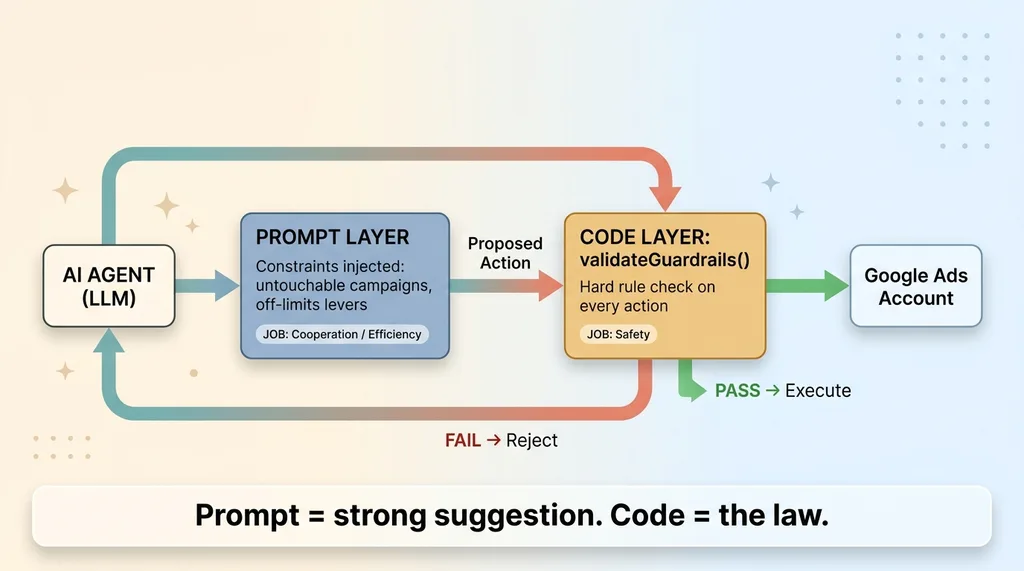 Two-layer guardrail enforcement (code AND prompt)
In code, validateGuardrails runs on every single proposed action and rejects anything that breaks a rule. It does not care what the model decided, why it decided it, or how confident it was. If the action touches a protected campaign or an off-limits lever, the code throws it out. The model gets no vote.
In the agent prompt, I inject those exact same constraints. I tell the model up front: these campaigns are untouchable, these levers are off-limits, don't propose changes to them. So the agent doesn't waste reasoning generating moves it can't make, and the whole cycle runs cleaner.
Why both? Because they do different jobs.
The prompt makes the agent cooperative. It keeps the model on-task and stops it from burning tokens on forbidden actions. That's efficiency.
The code makes the agent safe even when the prompt fails. And prompts fail. They get ignored, they drift over long contexts, they can be jailbroken by weird input data, and model behavior shifts between versions. A prompt is a strong suggestion to a system that doesn't have to listen.
Code doesn't have that problem. Code is the law.
This is the single most important thing I can tell anyone building autonomous systems on top of LLMs: prompt-only guardrails are not guardrails. They're suggestions. If the only thing stopping your AI from cutting your brand campaign is a polite instruction in a prompt, you don't have protection. You have a hope.
Belt and suspenders. The prompt for cooperation, the code for safety. The code is the one I'd never ship without.
Propose-First Before Full Auto
Even with all the guardrails coded, I did not flip Google straight to full autonomy. That would have been reckless, and I'd have deserved whatever happened.
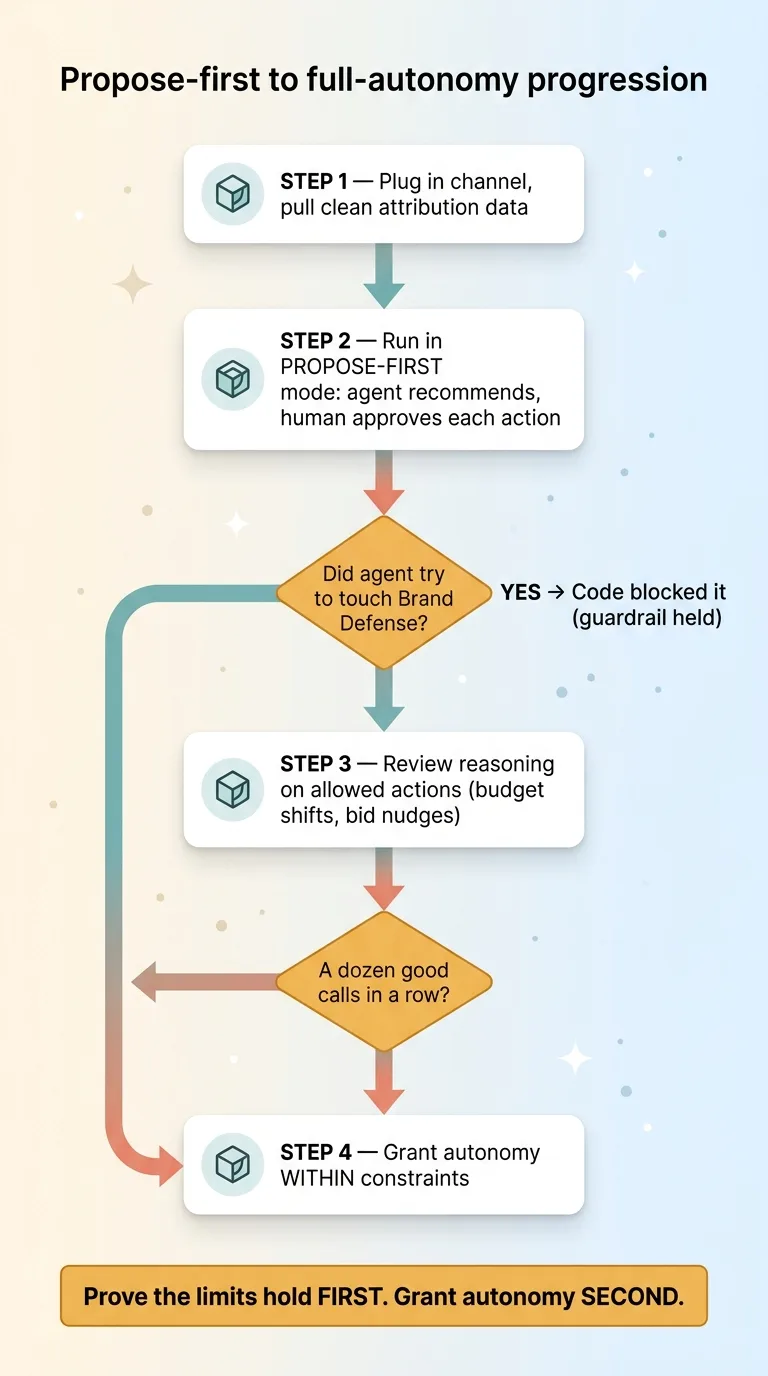 Propose-first to full-autonomy progression
The first cycle ran in propose-first mode. The system surfaced every recommended action and waited for my explicit approval before executing anything. Nothing moved without me clicking yes.
This did two things at once.
First, it let me validate that the guardrails actually worked against real proposals, not test cases. Did the agent try to touch Brand Defense? It did, on that very first run. Did the code block it? Yes. Watching the rejection fire on a live proposal told me more than any unit test could.
Second, it built my trust in the agent's judgment on the actions it WAS allowed to take. I got to see its reasoning on real budget shifts, real bid adjustments within the legal moves, and decide whether I agreed. After a dozen good calls in a row, I believed it.
This propose-first stage isn't unique to Google. Every AI system I ship stops for a human before it earns the right to run on its own. The pattern is always the same: show me what you'd do, let me approve it, prove yourself, then we talk about autonomy.
Only after a clean cycle, where the guardrails held and the judgment was sound, did I let it execute within the constraints on its own.
The order matters more than anything. Prove the limits hold first. Grant autonomy second. Do it the other way around and you find out your guardrails were broken at the worst possible moment.
The Decision Framework I Use Now
If you're going to point an autonomous optimizer at your ad accounts, here's the prerequisite work. Not optional. Do this before you automate anything.
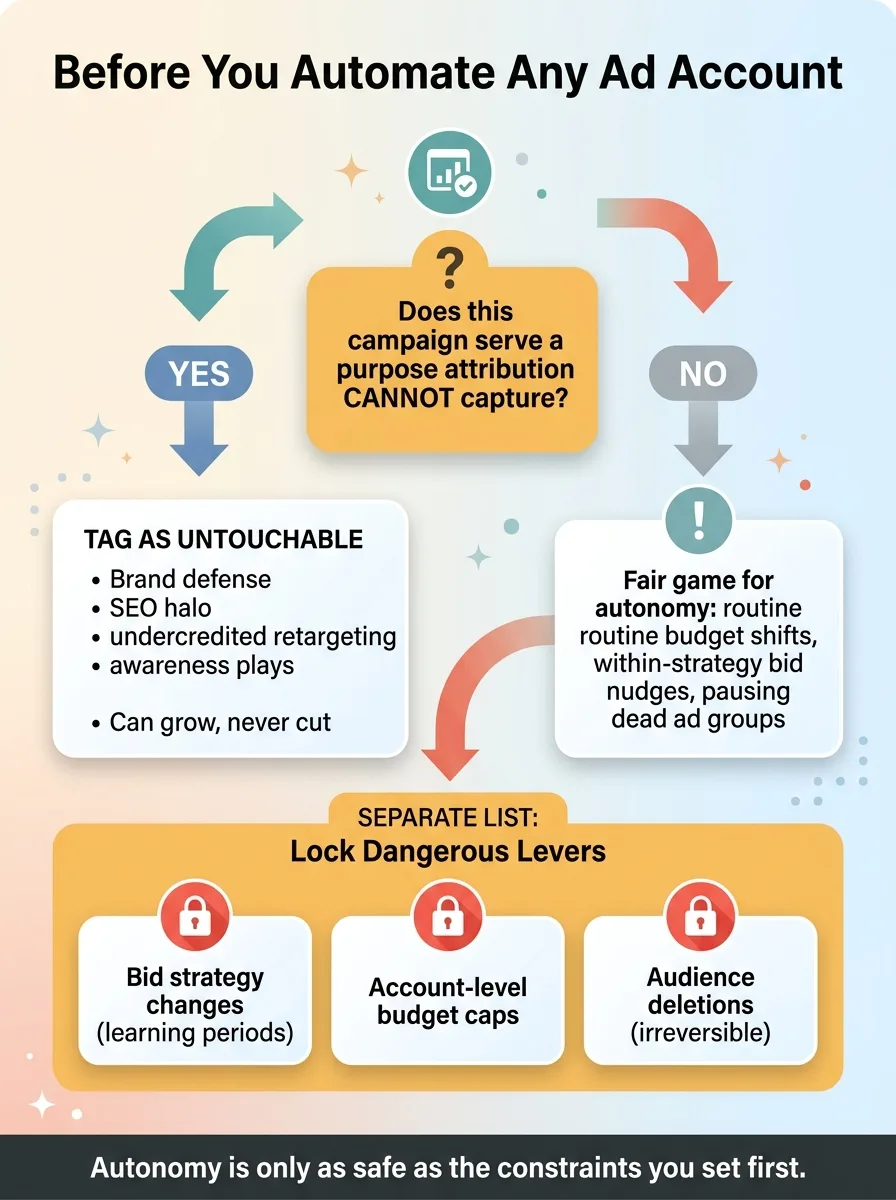 Pre-automation decision framework: tag campaigns and lock levers
Tag what's strategic before you automate
Go through every campaign and ask one question: does this serve a purpose that attribution can't capture?
Brand defense. SEO halo. Retargeting that supports other channels and gets undercredited. Awareness plays that feed your funnel but rarely close directly. Any campaign whose value shows up somewhere other than its own ROAS line.
Tag every one of those with the untouchable flag. The optimizer can grow them but never cut them.
Decide which levers are too dangerous to delegate
Then make a separate list. Not campaigns this time, levers.
Which actions have cascading or irreversible effects? Bid strategy changes that trigger learning periods. Account-level budget caps that throttle everything at once. Audience deletions you can't undo. Anything that's hard to walk back or that ripples across your whole account.
Those go off-limits. The agent can recommend you look at them, but it can never pull them itself.
Everything that's left, the routine budget shifts between healthy campaigns, the within-strategy bid nudges, the pausing of genuinely dead ad groups, that's fair game. That's where the autonomy earns its keep.
When I collapsed three ad systems into one engine, this framework was what made it safe to consolidate. One autopilot running multiple channels is powerful, and that's exactly why the constraints have to be airtight before you let it loose.
The autonomy is only ever as safe as the constraints you set first. Skip this step and you're not automating your marketing, you're gambling with it.
AI Optimizes Numbers; You Define What Matters
Let me answer the doubt directly, because it's the right doubt to have.
Yes. An AI optimizing purely on numbers WILL cut the campaigns that protect your brand. Mine tried to do it on the first run. If I'd had it on full autopilot with no guardrails, my Brand Defense campaign would have been gone before I finished my coffee, and a competitor would be sitting on my brand name right now.
That's not an argument against automation. That's the actual work of doing automation right.
The model is genuinely excellent at execution within constraints. It'll find budget inefficiencies I'd miss, move money toward what's working faster than I ever could, and do it every single day without getting tired. What it's terrible at is knowing which constraints matter to your business. It doesn't know your brand term is sacred. It doesn't know that SEO-halo campaign is quietly funding three other channels.
That judgment is yours. It always will be. And encoding it correctly, in code, not just in a prompt, is where most of the real value lives. The optimizer is the cheap part. The guardrails are the expertise.
This is also why I'm careful about the kill-switches I build into every system. Designing the limits is not the boring prerequisite to the fun automation. It IS the automation, done by someone who's been burned enough to respect the downside.
This is the kind of thing I get hired to figure out before a single campaign gets touched. If you're thinking about handing parts of your marketing to AI and you're worried about exactly this scenario, you should be, and that's the conversation worth having.
Get the next build note.
I write up each system I build, including what broke. Subscribe to my newsletter and I'll send you the next one.