AI for Financial Data Accuracy: Propose, Don't Post
AI agents find financial errors fast but recommend bad fixes. Here's how I use AI for financial data accuracy without letting it corrupt the ledger.
By Mike Hodgen
The Agent That Confidently Recommended Deleting Real Cash
I was rebuilding the books for a company I run. Years of messy data, half-reconciled accounts, the kind of cleanup nobody wants to touch. So I did what I do: I pointed a multi-agent AI audit at the financial data and let it go to work.
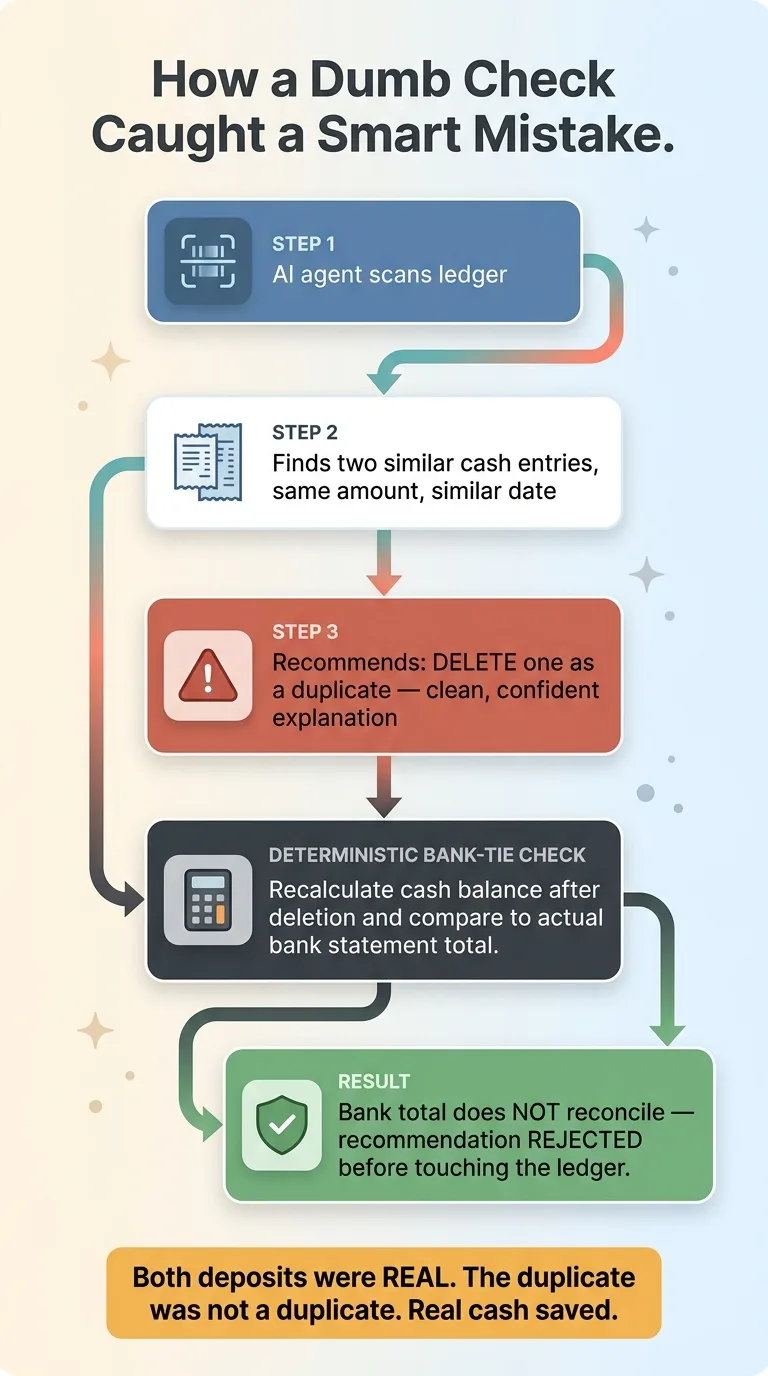 The deleted-cash disaster caught by the bank-tie
One agent came back with something that looked sharp. It had found what appeared to be a duplicate cash entry. Same amount, similar date, posted twice. It recommended removing one of them, and it explained itself beautifully. Clean logic. Confident tone. The kind of explanation that makes you nod and click "approve."
There was just one problem. That cash was real. It traced to an actual bank deposit. Both entries existed because both deposits happened. The "duplicate" wasn't a duplicate at all.
If I'd trusted the recommendation, I would have deleted real money from the books. The totals would have come up short by that exact amount, and I might not have noticed for weeks.
What caught it wasn't a smarter agent. It was a dumb, deterministic bank-tie check that compared every cash change against the actual bank statement total. The math didn't reconcile. The recommendation got rejected before it ever touched the ledger.
That moment crystallized something I've come to believe about ai for financial data accuracy: the AI was right to flag something unusual, and completely wrong about what to do with it. Those are two different jobs. The whole discipline of putting AI on your financial data comes down to never confusing them.
Let me walk you through why AI is genuinely great at one of those jobs, dangerous at the other, and how to build a system that gets the upside without the disaster.
Why AI Is Excellent at Finding Financial Problems
Let me give AI its due, because it earned it during that rebuild.
A multi-agent ai audit is a genuinely good finder. The agents surfaced real, non-obvious issues fast, the kind of thing that hides in thousands of rows until it bites you at year-end.
The non-obvious errors a human misses
Here are the kinds of problems the agents caught, anonymized but real in shape.
A transaction posted to the wrong month. The amount was correct, the account was correct, but it landed in March when it belonged in February. Nothing about that entry looks wrong in isolation. You only catch it when you compare timing against a source, and the agent flagged the mismatch immediately.
A near-duplicate that turned out to be a wash pair: two offsetting entries that netted to zero. A human scanning the ledger sees two similar amounts and either panics or ignores both. The agent isolated the pair and asked the right question about it.
An amount that didn't reconcile to its source document. Off by a few dollars, the kind of rounding or fee discrepancy that's invisible until you stack it against the original invoice. The agent caught the gap.
Speed across thousands of rows
Here's the part humans can't compete with. A person reviewing thousands of ledger rows gets tired around row 200. By row 800 they're skimming. By row 1,500 they're approving anything that looks roughly normal.
The agents don't get tired. They apply the same scrutiny to row 4,000 that they applied to row 1. They pattern-match every entry against the rest of the ledger and surface the ones that don't fit.
As a hypothesis generator, AI is superb. It points at the suspicious stuff and it does it at a speed and consistency no human reviewer can match. If finding problems were the whole job, you could stop reading here.
It isn't.
Why You Can Never Trust Its Recommendation Blind
The exact quality that makes AI a great finder makes it dangerous as an actor.
Confidence is not correctness
AI states wrong recommendations with the same confidence as right ones. There's no tremor in its voice when it's about to delete your cash. The duplicate-that-wasn't came with a clean, well-reasoned explanation, identical in tone to the recommendations that were actually correct.
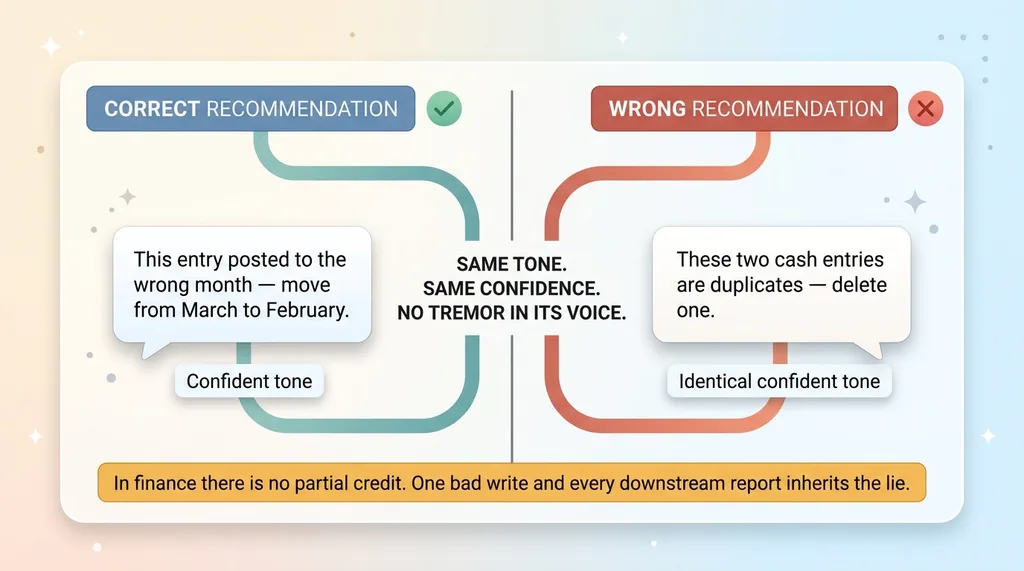 Confidence is not correctness, the hallucination trap
In most domains a confident wrong answer costs you a little rework. In finance there's no partial credit. One bad write to the ledger and your totals lie. Every report downstream of that ledger inherits the lie. Your tax filing, your board deck, your cash position, all built on a number that an agent invented a plausible story for.
The hallucination problem in finance
This is where ai hallucination finance stops being an abstract concern and becomes a money problem.
An agent can invent a perfectly reasonable explanation for why a real entry is a duplicate. It's not lying on purpose. It pattern-matched, found two similar amounts, and generated the most likely story: these are the same transaction entered twice. The story is coherent. It's just wrong.
The agent can't tell the difference between a genuine error and a legitimate edge case it doesn't understand. When it hits something outside its pattern, it doesn't say "I'm not sure." It produces a confident recommendation anyway, because producing confident text is what these models do.
And the recommendation always sounds reasonable. That's the trap. A clean tie-out doesn't prove your books are right, either: I've written about how books that balance to the penny and still lie because offsetting errors hide in the aggregate. The fluency is the danger, not the safeguard.
The Rule: Every Agent Finding Is a Hypothesis
So here's the operating rule I established, and it's the single most important sentence in this article.
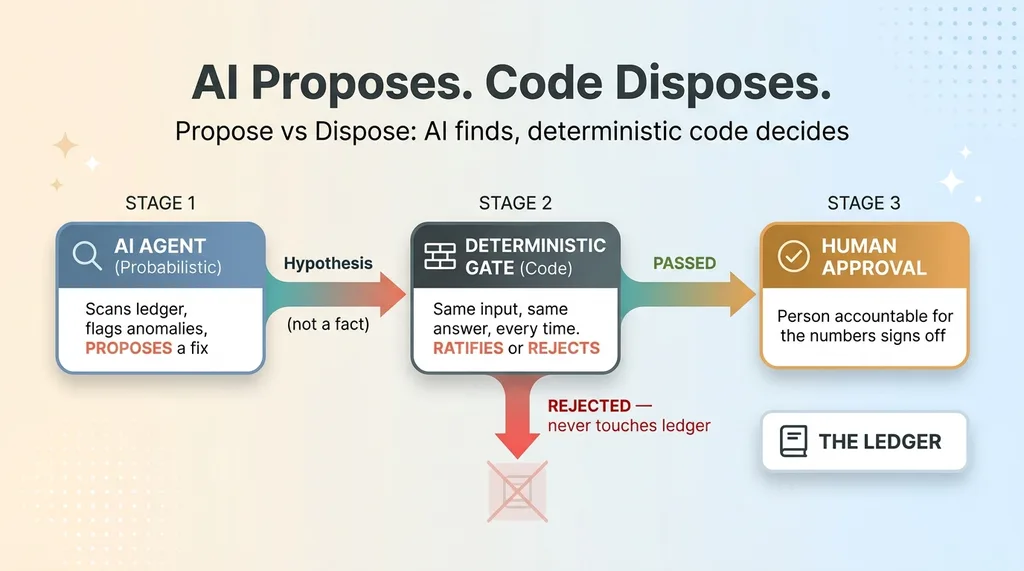 Propose vs Dispose: AI finds, deterministic code decides
Every agent finding is a hypothesis that must pass a deterministic gate before it touches the ledger.
AI proposes. Deterministic code disposes. No agent writes to the books directly. Ever. The agent's recommendation is an input to a verification process, not an instruction to be executed.
A journal entry is unverified until two things are true: it traces to a source document, and it cross-checks against an independent total. Until both of those pass, the entry doesn't exist as far as the books are concerned. It's a candidate, not a fact.
This reframes the entire job of AI in your finance stack. The agent's role is to point, not to post. It's a brilliant assistant that walks the ledger and taps you on the shoulder when something looks off. It is never the hand that picks up the pen.
This is a specific case of a broader principle I apply across every system I build: let the model judge and let the code compute. The model is good at judgment, at noticing, at flagging. The code is good at math, at verification, at giving the same answer every time. You assign each one the job it's actually good at.
When you blur that line, when you let the model both judge and compute, you get confident recommendations writing themselves into your books. Which is exactly how you end up deleting real cash.
The Deterministic Gates That Ratify or Reject
Now the practical part. What does a deterministic gate actually look like? Here are the real checks from the rebuild, described generically so you can apply them to your own books.
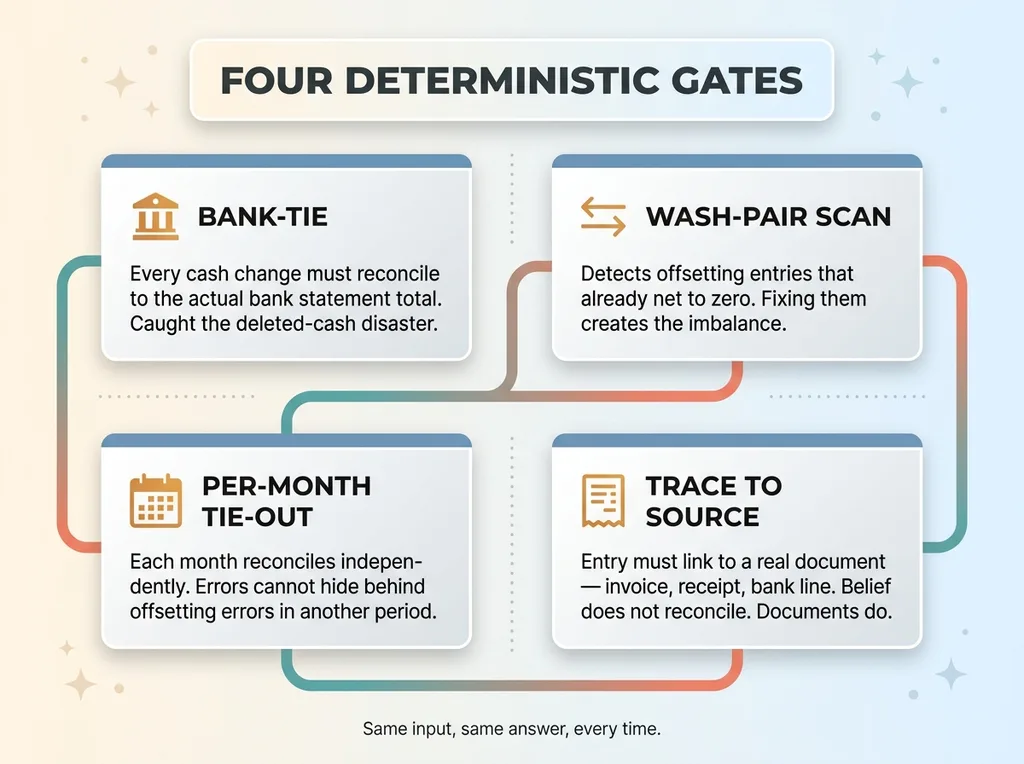 The four deterministic gates that ratify or reject findings
The key property running through all of them: these checks are deterministic, not probabilistic. Same input, same answer, every time. That's what makes them trustworthy in exactly the place AI isn't.
The bank-tie
Every cash change must reconcile to the bank statement total. If an agent recommends a cash entry change, the gate recalculates what the cash balance would be after that change and compares it against the actual bank total.
This is the check that caught my disaster. The duplicate-removal recommendation would have left cash short by the deposit amount. The bank-tie failed, the recommendation was rejected, and the agent never got to touch the ledger. No human judgment required at that step. The math simply didn't agree.
The wash-pair scan
Before "fixing" any suspicious pair, the gate scans for offsetting pairs that already net to zero. If two entries cancel out, the books are already correct on that line, and "correcting" one of them would create the exact imbalance you were trying to avoid.
This catches the wash-pair trap directly. An agent sees two similar amounts and wants to act. The scan asks the prior question: do these already cancel? If they do, hands off.
The per-month tie-out
Each month's totals must independently reconcile. Not the annual total: each individual month, on its own.
This matters because errors hide in aggregate. You can have a positive error in March and a negative error in September that net to zero across the year, so the annual tie-out looks perfect. The per-month tie-out makes that impossible. An error can't hide behind an offsetting error in a different period, because each period has to stand on its own.
Trace to source document
An entry isn't accepted until it links to an actual document. A bank statement line, an invoice, a receipt, a contract. Something real that exists outside the ledger.
If the agent can't tie its proposed entry to a source, the entry doesn't get written. This is the difference between a number someone believes and a number someone can prove. Belief doesn't reconcile. Documents do.
Put these four gates together and you have a wall between AI's hypotheses and your books. The agent can propose anything it wants. Nothing gets through that wall unless the deterministic checks ratify it. Deterministic verification ai isn't a buzzword here, it's the load-bearing structure. The probabilistic part finds; the deterministic part decides.
Human in the Loop Is the Design, Not a Weakness
The question I get from every CEO and finance lead is some version of: can I actually trust AI with my financial data?
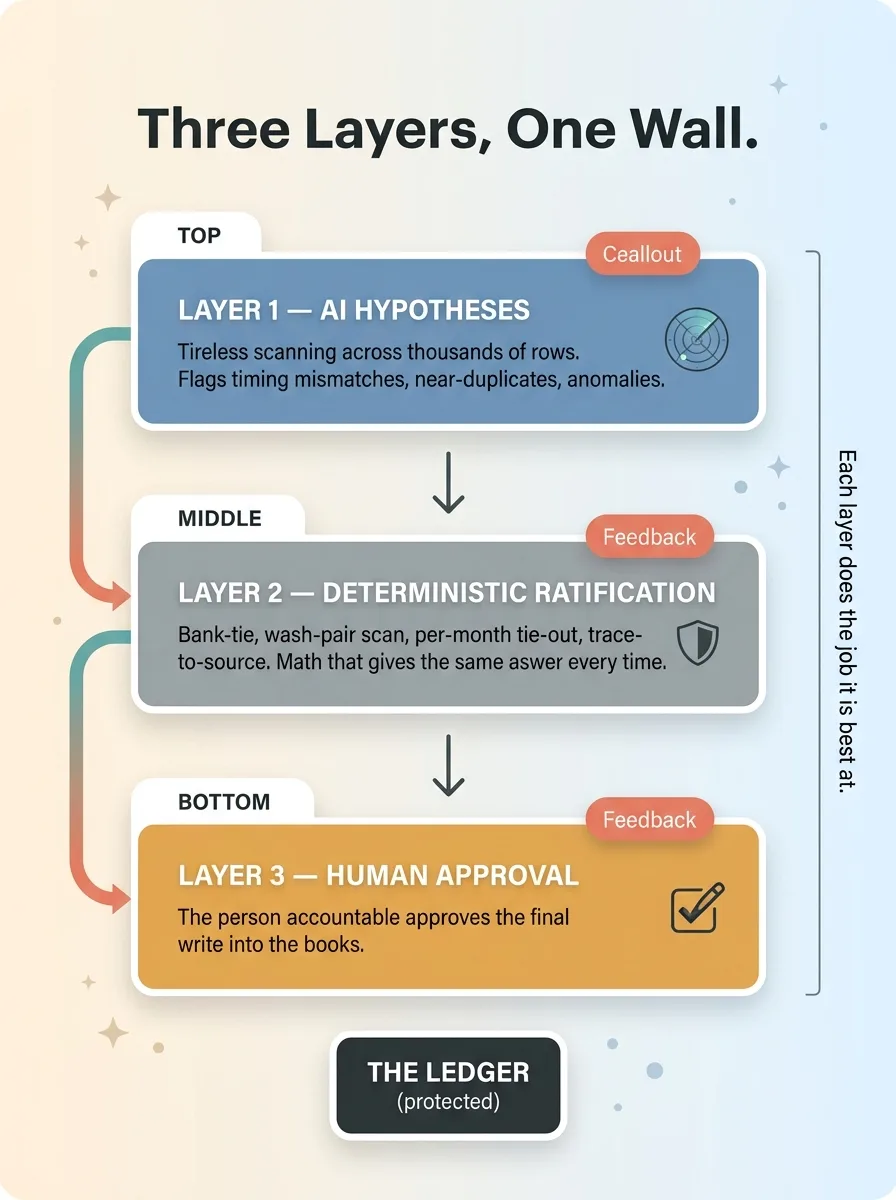 Three-layer human-in-the-loop architecture
Yes. But only inside this structure.
The combination of AI hypotheses, plus deterministic ratification, plus a human approving the final write, is not a crutch for immature technology. It's not a temporary measure until the models get better. It's the correct architecture for anything that moves money, and it will still be correct when the models are twice as capable as they are today.
This is human in the loop accounting done right. The AI does the tireless scanning. The deterministic gates do the verification. And a human looks at what survived both steps and approves the final entry into the books. Three layers, each doing the job it's best at.
Let me be honest about the tradeoff, because pretending it doesn't exist would insult you. This is slower than letting an agent run wild and write directly to the ledger. The gates add steps. The human approval adds a pause.
That slowness is the entire point. The speed you'd gain by removing the gates is speed toward corrupting your own books. I'd rather be slower and right than fast and lying to my own balance sheet.
I build this into every AI system I ship stops for a human at the high-stakes moments, and the discipline generalizes far beyond accounting. Any time AI touches data where a wrong write costs you real money or real trust, this same structure applies. AI is great at finding problems, terrible at being trusted to act alone, and that's true whether the data is a ledger, a customer record, or an inventory count.
How to Put AI on Your Financial Data Without Getting Burned
Here's the playbook, condensed.
Use AI to generate hypotheses across your books. Let it scan everything, flag the timing mismatches, the suspicious round numbers, the near-duplicates, the entries that don't pattern-match. This is where it shines, and you should use it aggressively for exactly this.
Build deterministic gates that independently verify every total. Bank-ties, wash-pair scans, per-month tie-outs, trace-to-source. Code that gives the same answer every time, sitting between the AI's suggestions and your actual ledger.
Never let an agent write unchecked. No direct writes to the books. Every finding is a hypothesis until the gates ratify it.
Keep a human approving the final entries. The person who's accountable for the numbers signs off on the numbers.
That's the difference between AI that speeds up your finance work and AI that quietly corrupts it. Same models, same data. The only difference is whether you built the wall.
Almost every team I've seen get burned by AI on financial data skipped the gate and trusted the recommendation. The agent sounded confident, the explanation read clean, somebody clicked approve. The error surfaced months later, buried in a total nobody re-checked.
If you want AI working on your numbers without that risk, that's the kind of system I build. Not an agent you have to pray is right. A structure where being right is the only way through.
Thinking about AI for your business?
If this resonated, let's have a conversation. I do free 30-minute discovery calls where we look at your operations and find where AI could actually move the needle, without the parts that quietly break things.
Get AI insights for business leaders
Practical AI strategy from someone who built the systems — not just studied them. No spam, no fluff.
Hodgen.AI
Ready to automate your growth?
Book a free 30-minute strategy call with Hodgen.AI.
Book a Strategy Call