AI for Traditional Small Businesses: 3 Real Examples
AI for traditional small businesses isn't a chatbot. See how a salon, an electrician, and a distributor solved real workflow pain with invisible AI.
By Mike Hodgen
None of Them Asked for AI
Here's something that took me a while to understand about AI for traditional small businesses: the owners who need it most almost never ask for it. They assume AI is for software companies, for the big guys with engineering teams, for anybody but them.
I've now worked with three businesses that prove the opposite. A hair salon. A one-truck electrician. A paper-packaging distributor. Three industries that could not be further from Silicon Valley.
Not one of those owners walked in saying "I want AI." They wanted specific, boring things. The salon owner wanted the phone answered when her hands were full of someone's hair. The electrician wanted his invoices paid before net-30 turned into net-90. The distributor wanted his sales rep to stop recommending products that didn't exist.
None of them cared about models. None of them wanted a chatbot. They had real money leaking out of real workflows, and they wanted the leak fixed.
That's the throughline I want you to take from this article: AI for local business works when it disappears inside one workflow the owner already cares about. The moment you bolt a chatbot onto the side and call it "AI strategy," it dies. Nobody uses it. The board nods, the vendor invoices, and nothing changes.
So I'm going to walk you through three concrete examples. Recognizable businesses, real problems, real numbers. Then I'll show you the single repeatable pattern underneath all three, because once you see it, you'll start spotting the same opportunity in your own operation.
No hype. Just what actually shipped and what it did.
The Salon: Every Missed Call Was a Lost Booking
The real problem (not "we need AI")
The salon owner had one chair, two stylists, and a front desk that was usually empty because everyone was doing hair. When the phone rang, it went to voicemail. And here's the thing about people booking a haircut: they don't leave a voicemail. They hang up and call the salon down the street.
She didn't track "AI adoption." She tracked bookings per week. That was the number that paid her rent. Every missed call was a booking that walked.
What I actually shipped
I built her an AI that answers the phone and books the job. It picks up on the first ring, talks like an actual person, takes the appointment request, and writes it straight into her booking system.
The hard part wasn't the booking logic. It was the tone. Early versions sounded like a robot reading a script, opening every reply with "Wonderful!" and "I'd be happy to help you with that!" Nobody books a salon from a machine that talks like a customer service bot from 2009. So I tuned it down until it sounded like a calm, competent receptionist who's done this a thousand times.
The owner never saw a model. She never saw a prompt. From her side, the phone just started getting answered.
How we measured it
We measured against bookings recovered from previously missed calls. Not adoption, not "engagement," not how many times the AI ran. Bookings. The actual number she already lived and died by.
Within the first few weeks she was capturing appointments that used to vanish into voicemail. The calls that came in after hours, during a double-booked Saturday, while she was foiling someone's highlights: those turned into money instead of dial tones.
The honest limitation: it doesn't do everything. A complex color consult, a "can you fix what another salon ruined" call, a pricing negotiation: those get handed off to a human. The AI knows its lane. It books the straightforward stuff and routes the rest. That's by design, and it's why she trusts it.
The Electrician: One Truck, Thousands in Unpaid Invoices
The collections gap nobody had time for
A solo electrician is on a ladder all day. He's not sitting at a desk drafting follow-up emails to clients who owe him money. So net-30 quietly became net-90, and at any given moment he had several thousand dollars sitting in invoices he'd done the work for but never chased.
His metric wasn't sophisticated. It was cash in the bank, and roughly how long invoices took to get paid. Days sales outstanding, if you want the formal term, but he just called it "people not paying me."
The collections work wasn't hard. It was just something nobody had time to do consistently. And inconsistent collections is the same as no collections.
Tone-laddered follow-ups and lien notices
I built him an AI that escalates a collections email the way a tired tradesman would. The first message is friendly: hey, just a reminder, here's the invoice. The second is firmer. By the fourth, the tone has shifted to "this is now seriously overdue" without ever crossing into something a lawyer would wince at.
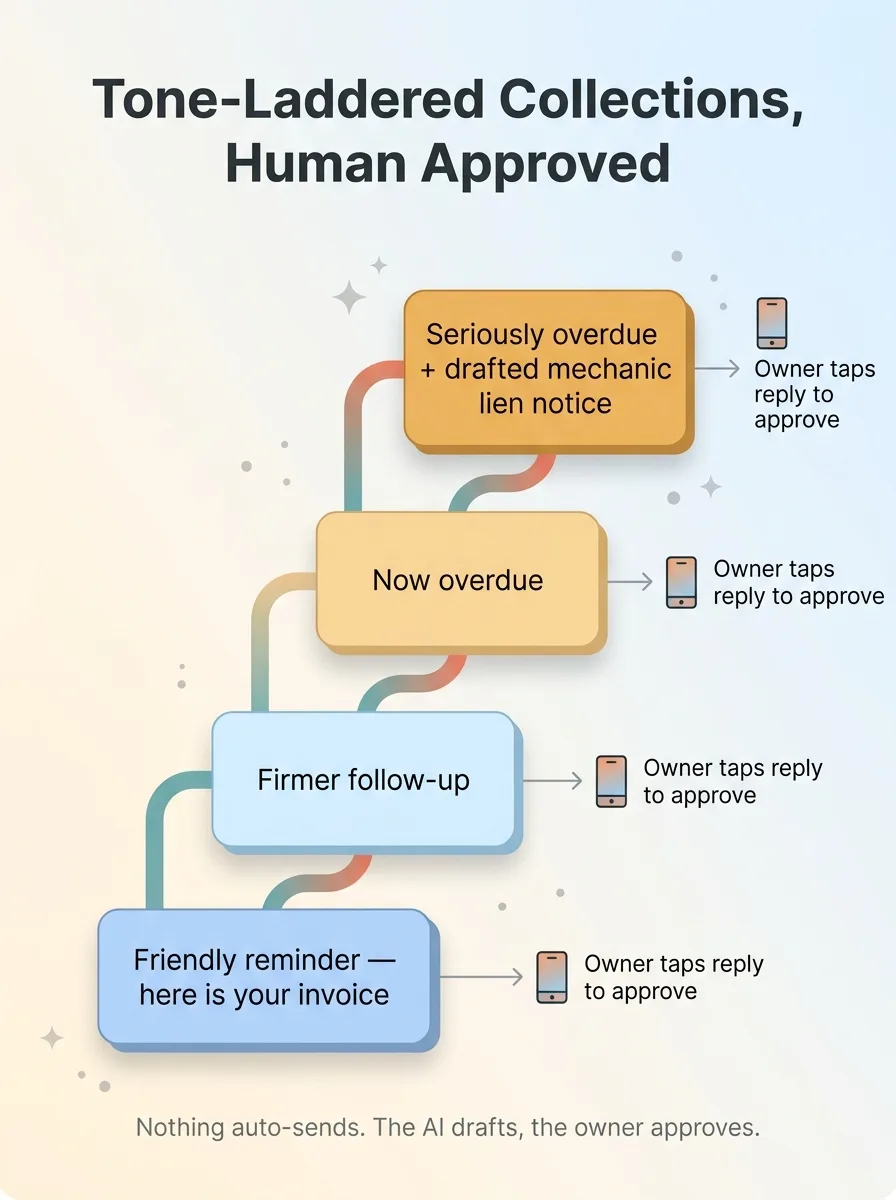 Human-in-the-loop collections escalation ladder
When an invoice gets old enough that it's worth protecting, the system also drafts a mechanic's lien notice. That's the document that legally secures his right to get paid on a property he did work on. It's a real lever, and most solo tradesmen never use it because they don't know how to draft one.
The whole thing is human-in-the-loop. Nothing auto-sends. He gets a text, reads the draft, and approves each escalation by tapping reply. He stays in control of every message that goes out under his name.
What got paid
We measured against invoices collected and days-to-pay. Both moved. Invoices that would have sat for months started getting paid in weeks, because somebody was finally following up like clockwork, even though that somebody was a system.
Honest limitation: it doesn't file the lien. It prepares the draft. Actually filing a mechanic's lien is a legal step, and for that he still talks to a lawyer or a filing service. The AI gets him 90% of the way there so the last 10% is cheap and fast. It's a drafter, not an attorney, and I never pretended otherwise.
The Distributor: An Empty CRM and Risky Recommendations
Quotes lived in someone's head and inbox
The paper-packaging distributor had a CRM. Technically. It was empty. Every deal lived in somebody's memory and a tangle of email threads. If the sales rep got hit by a bus, the pipeline went with him.
That was one problem. The second was scarier. The rep quoted from a general sense of the catalog. He knew the product line well enough to be dangerous, which meant he'd occasionally recommend something the company didn't actually carry, or quote a spec that didn't exist. Those mistakes don't show up until a customer's expecting boxes that were never going to arrive.
So this business had two separate issues: capture and accuracy.
Capture plus catalog-locked quoting
For capture, I built AI that reads pasted email threads and pulls the lead and order context straight into the CRM. The rep drops in the email chain, and the deal gets logged: who, what, how much, what stage. The pipeline stopped living in one person's head.
For accuracy, I built a quoting assistant that's locked to the catalog. This is the part that matters most. The AI physically cannot quote a product the company doesn't sell. It can't invent a spec. It draws only from the real, current catalog, so every quote it produces is a quote the company can actually fulfill.
The owner saw a faster quote box. He didn't see a model, didn't learn a prompt, didn't think about AI at all. He typed what the customer wanted and got back a quote that was right.
Why locking the catalog matters
A general-purpose chatbot will happily make something up. Ask it for a product and it'll confidently describe one whether it exists or not. In a sales context, that's not a quirk. That's a customer relationship blown up and a fulfillment team scrambling.
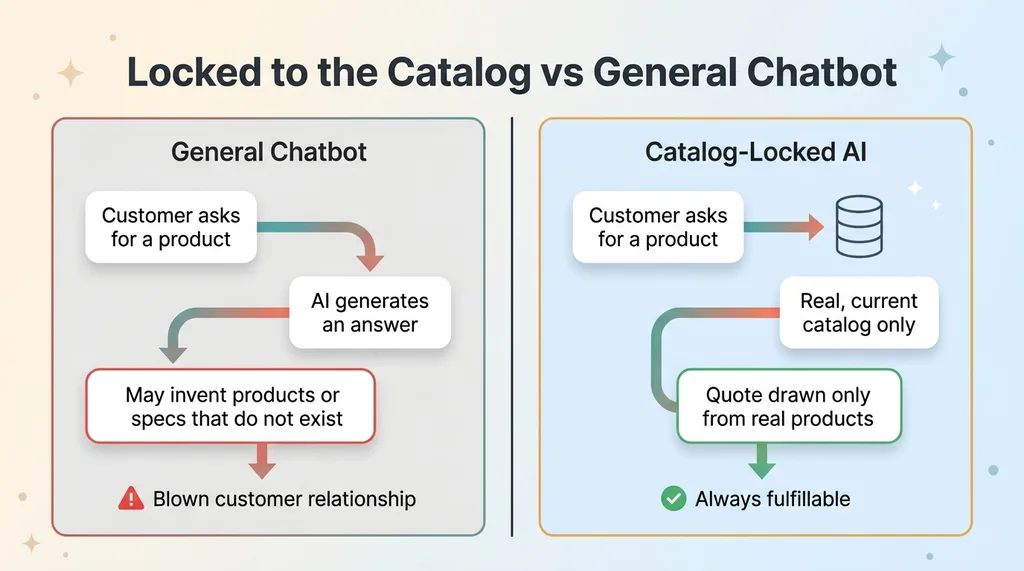 Catalog-locked quoting vs general chatbot
Locking the AI to the catalog turns a tool that's "usually right" into one that's structurally incapable of being wrong about what you sell. That's the difference between a demo and something you'd put in front of customers.
We measured against quote turnaround time and quote accuracy. Quotes got faster and stopped containing products that didn't exist.
What doesn't work yet: genuine custom orders, the weird one-off specs that aren't in the catalog, still route to a human. That's correct. Those are exactly the deals that need a person's judgment, and the system knows to step back.
The Pattern Across All Three: Invisible AI Inside One Workflow
Three industries, one playbook. Once you see it, you see it everywhere.
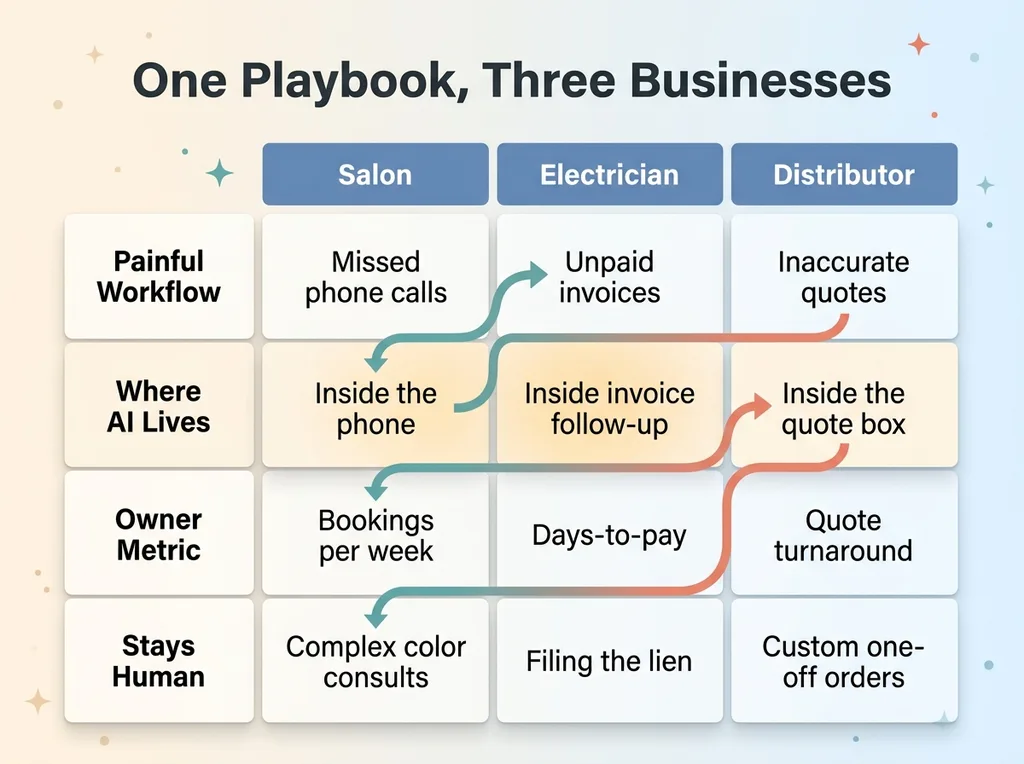 The repeatable pattern across all three businesses
Scope to one painful workflow
I didn't build any of these businesses an "AI strategy." I picked the single workflow the owner already lost sleep over and built for that. Missed calls. Unpaid invoices. Inaccurate quotes. One workflow each.
This is the most important discipline in the whole thing, and it's why I always scope it to one painful workflow first. Broad AI initiatives die in committee. Narrow ones ship and pay for themselves.
Hide the model
Not one of these three owners learned a prompt. None of them opened a chatbot. None of them saw the word "AI" anywhere in their daily work.
The AI lived inside the phone for the salon. Inside the invoice follow-up for the electrician. Inside the quote box for the distributor. The technology disappeared into a tool they already understood.
That's the opposite of the usual failure mode: a chatbot bolted onto the corner of a website that nobody touches. When you make the owner go find the AI and talk to it, you've added work. When the AI shows up inside the work they're already doing, you've removed it.
Measure against the owner's existing metric
Bookings. Days-to-pay. Quote turnaround. Every one of these was a number the owner already tracked before I showed up.
I never asked them to care about a new metric. I attached the AI to a number they were already watching and moved it in the right direction. That's how you prove value to a skeptical owner: not with a dashboard of AI activity, but with the line on their P&L they already check.
Here's the reframe. "AI is for software companies" is the wrong frame entirely. The right frame is "AI is for any business with a repetitive, painful workflow." And that's every business I've ever seen.
How to Tell Which Workflow to Start With
You can apply this lens to your own business tomorrow. The right first workflow usually passes three tests.
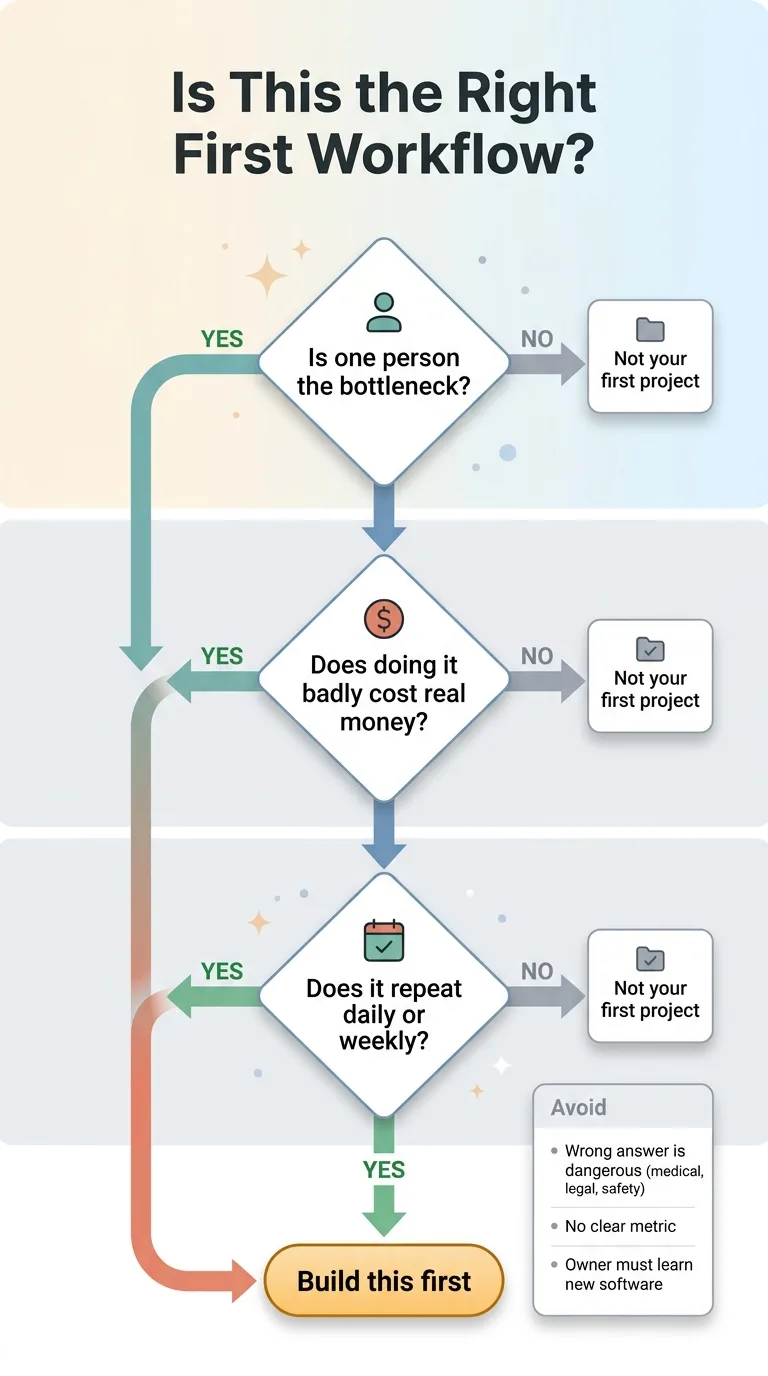 The three-test filter for choosing your first AI workflow
One: someone is the bottleneck. A specific person, often the owner, is the constraint. The salon owner was the bottleneck on answering calls. The electrician was the bottleneck on collections. The distributor's rep was the bottleneck on quoting. If a workflow only happens when one busy person finds time, that's your candidate.
Two: doing it badly costs real money. Not vague "efficiency." Actual dollars or lost customers you can point to. Missed calls equal lost bookings. Slow collections equal cash crunch. Wrong quotes equal blown deals. If you can't put a number on the cost of doing it badly, it's not the right first project.
Three: it repeats often. Daily or weekly, not once a quarter. Automation only pays off on repetition. All three of these workflows happened constantly, which is exactly why they were worth building for.
Now, what to avoid as your first project. Skip anything where a wrong answer is dangerous (medical, legal, safety-critical decisions). Skip anything with no clear metric, because you'll never know if it worked. And skip anything that requires the owner to learn new software, because they won't, and the project dies.
Start where the pain is obvious, the cost is measurable, and the workflow is so routine that a system can handle most of it. That's the whole filter.
Start With the Pain, Not the Technology
A salon, a one-truck electrician, and a paper-packaging distributor. Three businesses nobody would call "tech." All three got real results, and not one of them set out to "do AI."
They got results because we started with the painful workflow and let the AI disappear into it. The phone got answered. The invoices got paid. The quotes got accurate. The technology never announced itself.
If you run a business you think of as non-tech, you're not the exception to this. You're the whole point. The traditional businesses with repetitive, expensive, manual workflows are exactly where practical AI use cases for SMBs pay off fastest, precisely because so little has been automated yet.
My job as a Chief AI Officer is straightforward. I find the one workflow that's quietly costing you money, build the system that solves it, and measure it against a number you already track. No chatbot bolted on the side. No strategy deck. A tool that works inside the way you already operate.
If you want a sense of where to begin, I wrote up the AI systems most small businesses should build first. Start there, then let's talk.
Thinking about AI for your business?
If this resonated, let's have a conversation. I do free 30-minute discovery calls where we look at your operations and find the one workflow where AI could actually move a number you care about. No pitch, no jargon, just a practical look at what's worth building.
Get AI insights for business leaders
Practical AI strategy from someone who built the systems — not just studied them. No spam, no fluff.
Hodgen.AI
Ready to automate your growth?
Book a free 30-minute strategy call with Hodgen.AI.
Book a Strategy Call