AI Collections Email Automation That Sounds Like You
How I built AI collections email automation with a 5-tone ladder that drafts firm-but-fair invoice reminders in the owner's voice and names the real legal lever.
By Mike Hodgen
The Real Problem Isn't the Invoice. It's Sending the Second One.
Picture a one-truck electrician in San Diego. Good at his job, booked solid, runs the whole business out of a van and a phone. He finished a panel upgrade for a property-management company 40 days ago. The invoice went out the same day. He's been paid nothing.
He's owed real money. Four figures. And he won't send a firm email about it.
Why? Because it feels like begging. Or worse, like picking a fight with a client he wants more work from next quarter. So he sends a limp "just checking in" every week or two, and the invoice keeps aging in someone else's bank account.
This is the part nobody warns small contractors about. Cash flow death doesn't come from not doing the work. It comes from money sitting in someone else's account while you float materials and payroll out of your own pocket. The work is done. The value is delivered. The dollars are stuck.
And the thing standing between him and his money isn't his billing software. QuickBooks can fire off a reminder. That's not the problem. The problem is that the right email, the one that's firm without being hostile, professional without being soft, is genuinely hard to write. Especially at 9pm after a 10-hour day, when you're tired and the last thing you want is to sound like a jerk to a client.
This is a writing problem and a confidence problem wearing a billing problem's clothes. That's exactly why I built AI collections email automation for this. Not to automate the chase, but to write the email he never wants to write, in a tone he can actually stand behind.
Why Most Invoice Reminders Get Ignored (or Backfire)
There are two ways owners screw up collections, and most people manage to do both.
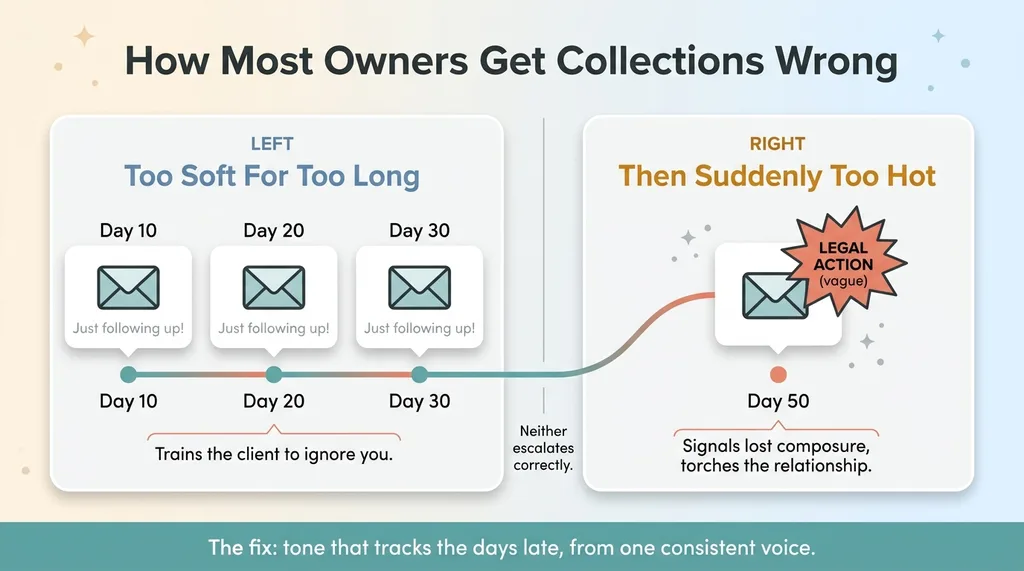 The two failure modes: too soft for too long, then suddenly too hot
Too soft for too long
The first failure mode is the friendly broken record. "Hi! Just following up on that invoice when you get a chance!" Sent on day 10. Then again, identical, on day 20. And day 30.
You think you're being polite. What you're actually doing is training the client to ignore you. Every soft, consequence-free reminder teaches them that nothing happens if they don't pay. Why would they prioritize you over the vendor who actually escalates? You've made yourself the easiest invoice to skip.
Then suddenly too hot
The second failure mode shows up on day 50, when the frustration finally boils over. Now the email threatens "legal action" out of nowhere. No specifics. No named process. Just a vague threat that any slow payer has seen a hundred times and knows is empty.
It doesn't scare them. It just signals you've lost your composure. And it torches a client relationship you spent two years building, over an invoice you could have collected with the right pressure applied at the right time.
Neither approach escalates correctly. The tone needs to track the days late. A reminder on day 3 and a notice on day 60 should not sound remotely the same, but they also shouldn't sound like two different companies wrote them.
Effective collections is a calibrated ladder, not a single template you reuse five times. Getting the timing and the tone right on every rung is precise, judgment-heavy work. It's exactly the kind of thinking a one-person operation has zero bandwidth for at the end of a long day.
The Five-Tone Ladder: How AI Collections Email Automation Escalates
Here's the core of what I built. The drafter reads how many days an invoice is actually past due and picks the tone automatically. No guessing, no agonizing over phrasing. Five rungs, keyed to real days late.
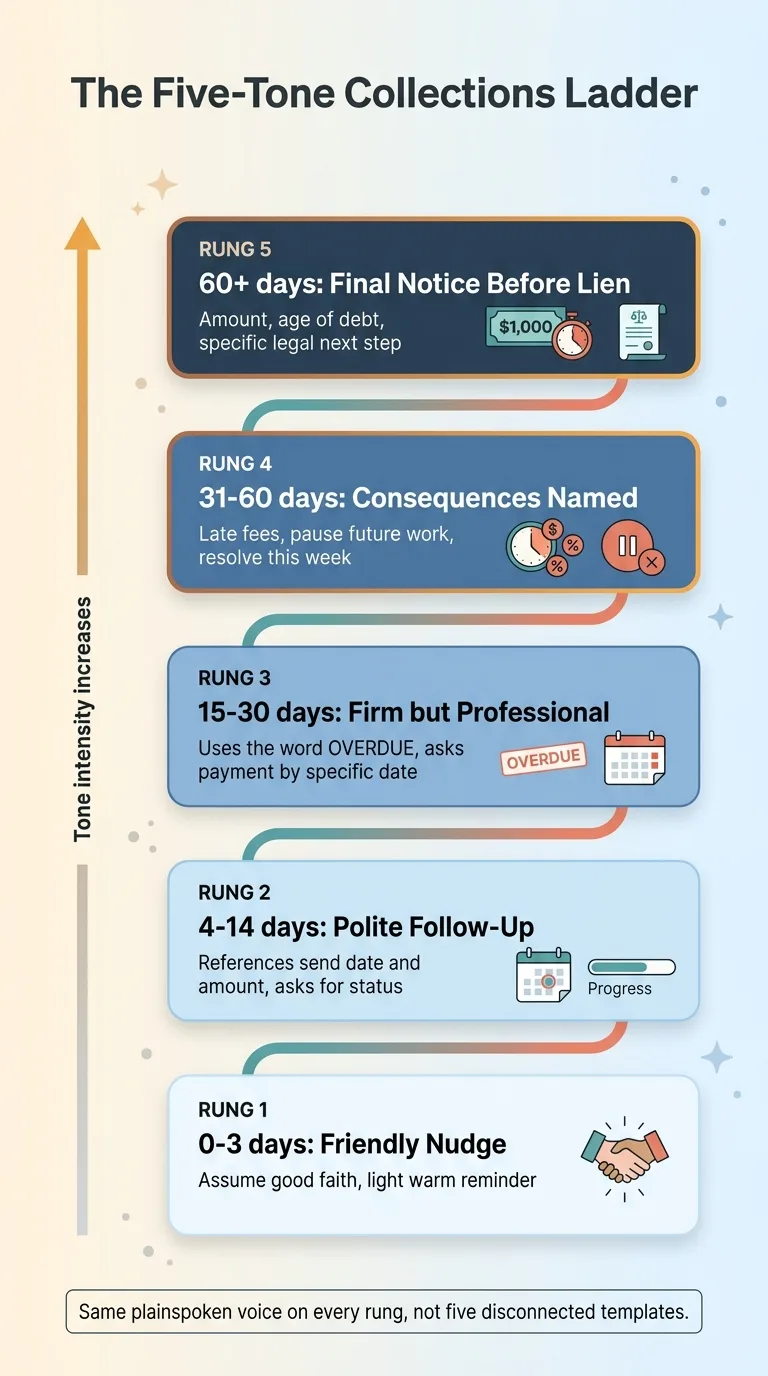 The Five-Tone Escalation Ladder keyed to days past due
0-3 days: the friendly nudge
Assume good faith. The invoice probably slipped through. This is a light, warm reminder that the bill is out and payment is appreciated when convenient. No pressure, no edge. Most of the time this is all it takes.
4-14 days: the polite follow-up
Still friendly, but now you're following up, not nudging. The email references the original send date and the amount, and gently asks for a status or a timeline. The subtext shifts from "in case you missed it" to "I'm tracking this."
15-30 days: firm but professional
The warmth dials down. The language gets direct. This invoice is now overdue, that word gets used, and the email asks for payment by a specific date. It's still respectful, but there's no mistaking that this has your attention and it should have theirs.
31-60 days: serious, with consequences named
Now the email names what happens next. Not vague threats, actual consequences. Late fees if your terms allow them. The fact that you'll have to pause future work. A clear statement that the account is seriously past due and needs resolution this week. The tone is businesslike and unflinching.
60+ days: final notice before the lien
The last rung is a final notice. It states the amount, the age of the debt, and the specific next step you're prepared to take, including the legal lever I'll cover below. It's formal, documented, and leaves no room for misreading. This is the email that gets a check cut.
The principle that ties it all together: each rung sounds like a natural progression from the same human, not five disconnected templates. The day-3 nudge and the day-60 notice come from the same plainspoken tradesman who's been patient and is now done being patient. That continuity is what makes it credible.
Naming the One Legal Lever That Actually Works
Here's the differentiator most reminder tools miss completely.
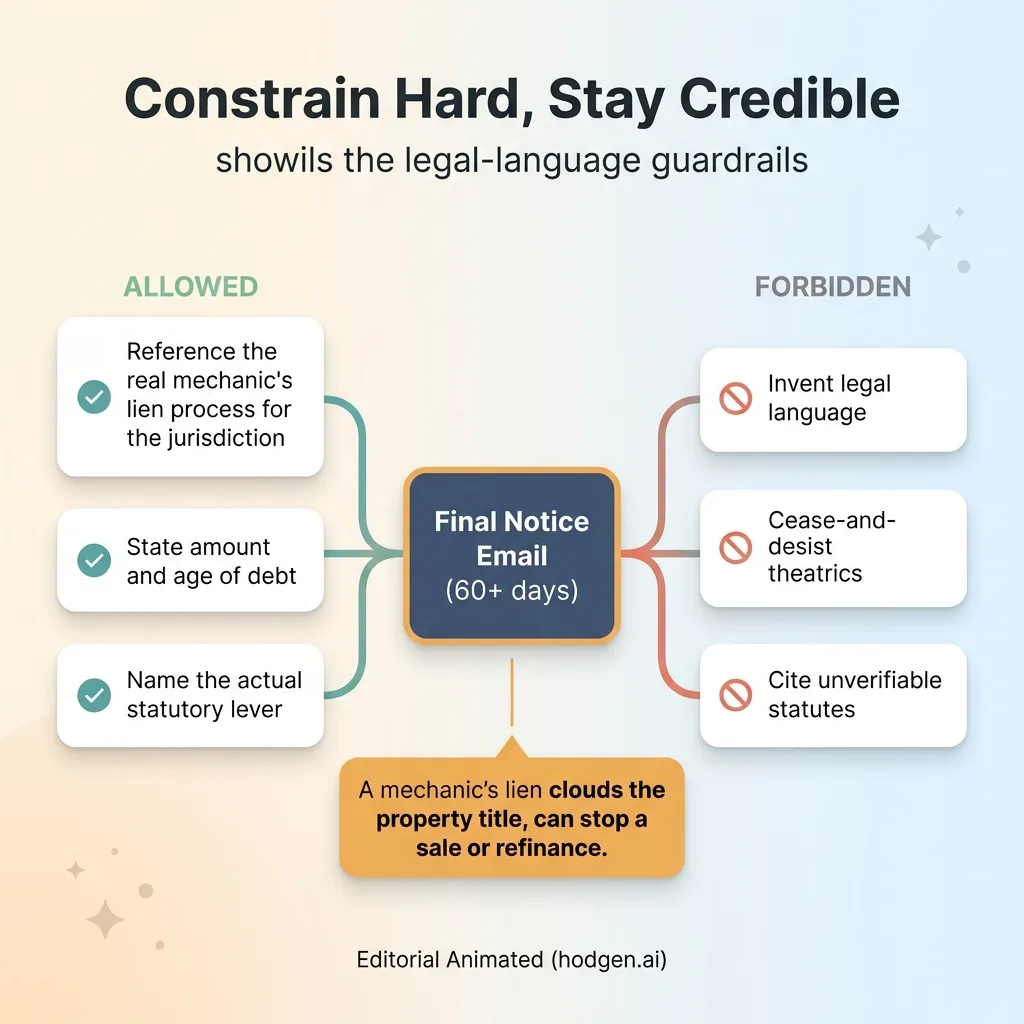 The constraint discipline around the mechanic's lien legal lever
They all say some version of "we may pursue legal action." Every slow payer on earth knows that line is empty. It costs them nothing to ignore it, because chasing a few thousand dollars through small claims is a hassle most contractors never bother with, and the client knows it.
In California, a contractor has a far sharper tool: recording a mechanic's lien. That's a public-record claim against the property itself. It clouds the title. It can stop a sale or a refinance. And critically, when you're owed money by a property-management company, the property owner they answer to understands exactly what a lien means the second they hear about it.
So I built a hard rule into the final rung. At 60+ days, the email references the specific lien process for the jurisdiction, not a vague threat. It names the actual statutory lever. That's concrete, it's credible, and it changes the math for a property manager who was happy to let you sit.
The constraint discipline here matters as much as the capability. The AI is told to reference the real legal mechanism that exists in the contractor's state, and it's forbidden from inventing legal language beyond that. It does not draft cease-and-desist theatrics. It does not cite statutes it can't verify. It names the one lever that's real and stops.
This is the same constraint philosophy behind an AI intake agent that's forbidden from quoting a number. When you put AI anywhere near a legal or financial line, the value isn't in what it'll say. It's in what you've forbidden it from saying. Constrain hard, and the output stays credible.
Property Manager vs. Homeowner: Shaping Tone for Who Owes You
Same overdue invoice, same dollar amount, two completely different debtors. The tone has to change based on who actually owes you.
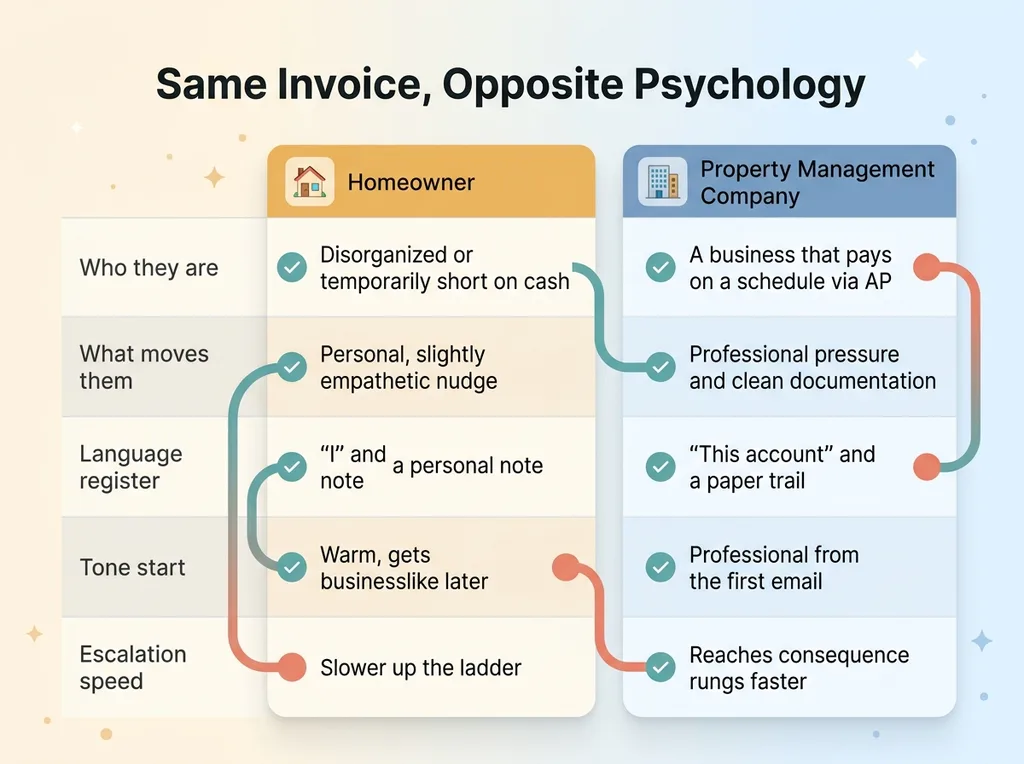 Property Manager vs. Homeowner tone shaping
A homeowner who's late is usually disorganized or temporarily short on cash. They're not a business with an AP department. They respond to a personal, slightly empathetic nudge. "I know things get busy, just wanted to get this squared away when you can." That register gets a homeowner to pay because it treats them like a person who fell behind, not a deadbeat.
A property-management company is a different animal entirely. It's a business that pays on a schedule, runs invoices through a process, and responds to professional pressure and clean documentation. Empathy is wasted on them. What moves a property manager is a businesslike tone, specific amounts and dates, and the clear sense that you document everything and escalate on a timeline.
So the drafter shapes tone based on which type of debtor it is. For a homeowner, it leans warmer and gets businesslike later in the ladder. For a property manager, it's professional from the first email and reaches the documented, consequence-named rungs faster.
It also adjusts formality and the empathy-versus-process balance. A homeowner gets "I" and a personal note. A property manager gets "this account" and a paper trail. Same money owed, opposite psychology, and the email meets each one where they actually are.
Writing in the Owner's Voice, Not a Corporate Template
Here's the reason this system gets used instead of ignored: it sounds like the owner. A senior tradesman who's been doing this 20 years. Not a SaaS billing robot, not a law firm, not some corporate template stuffed with "per our records" and "kindly remit."
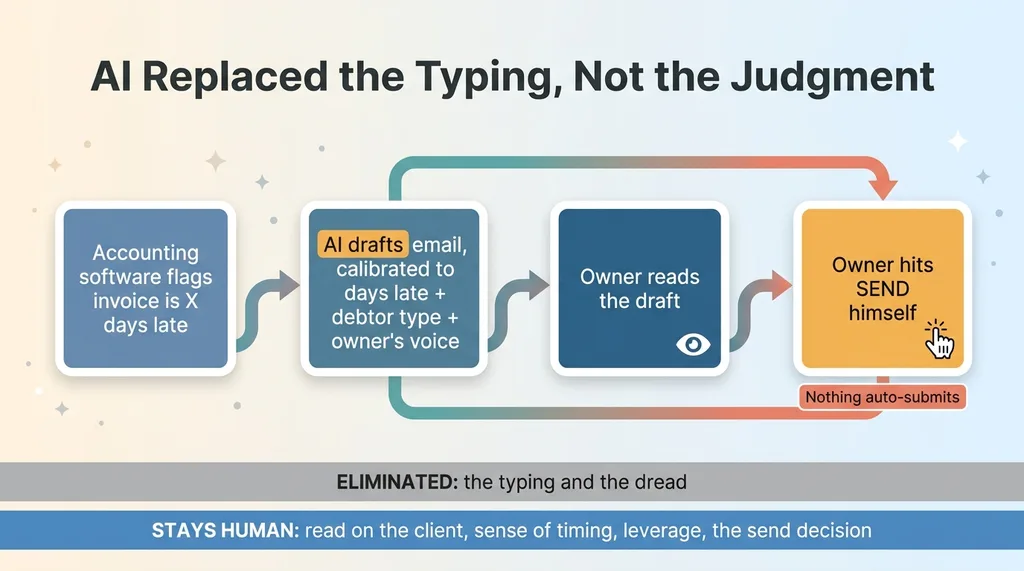 What the system replaces vs. what stays human
I spent real time capturing his voice before writing a line of automation. He's plainspoken and direct. No corporate hedging, no fake warmth, no five-dollar words. When he says an invoice is overdue, he says "this is overdue." So every draft reads like something he'd actually send, because it's written in his register, not a generic one.
That's the whole game. The email he dreads writing, written for him in his own voice, in seconds. He doesn't have to find the words or manage the tone or wonder if he sounds too soft or too harsh. The draft is already calibrated to the days late, the debtor type, and his way of talking.
And nothing goes out on its own. He still reads every draft and hits send himself. Nothing auto-submits. That's a deliberate design choice, not a limitation. He owns the relationship and the decision, and he should be the one who decides this client gets the day-31 email today.
What the AI replaced is the typing and the dread, not his judgment. AI replaced the typing, not the thinking. His read on the client, his sense of when to push, his leverage, all of that stays his. The friction that let invoices sit for 40 days is what's gone.
What This Looks Like for Any Business Chasing Money
The electrician is just the example. The pattern is the point.
A calibrated tone ladder, plus the real legal lever for your jurisdiction, plus your actual voice, plus human approval before anything sends. That combination works for any small business sitting on accounts receivable. Trades, agencies, freelancers, professional services. Anyone who delivers work and then waits to get paid.
Because getting paid faster is mostly a writing-and-timing problem, and that's something AI handles well when you constrain it properly. The hard part was never knowing the invoice is late. Your accounting software already knows. The hard part is writing the firm email at the right moment in a tone you can stand behind. That's the friction this removes.
Let me be honest about what it doesn't do. It doesn't collect the money. It doesn't guarantee payment. It doesn't sue anyone or file the lien for you. What it does is eliminate the reason invoices sit untouched for weeks, which is that nobody wanted to write the uncomfortable email. Remove that friction and the average days-to-pay drops on its own.
If you're a traditional business that's never touched any of this, start here: AI for businesses that have never touched it. The collections drafter is a small, self-contained system, and it's one of the fastest things I build to pay for itself. A few invoices collected three weeks sooner covers it.
If you're losing weeks of cash flow because nobody wants to send the firm email, this is exactly the kind of small system worth building.
Want to explore what AI could do for your business?
Book a free 30-minute strategy call. No pitch deck, no sales team, just a real conversation about your operations and where AI actually fits.
Get AI insights for business leaders
Practical AI strategy from someone who built the systems — not just studied them. No spam, no fluff.
Hodgen.AI
Ready to automate your growth?
Book a free 30-minute strategy call with Hodgen.AI.
Book a Strategy Call