AI Photo Diagnosis Lead Capture for Trades Websites
How AI photo diagnosis lead capture turns a confused homeowner into a pre-diagnosed booking. The intake hook I built for a one-truck contractor.
By Mike Hodgen
The Form Field That Actually Converts on a Trades Site Is a Camera
The best lead-capture tool on a trades website isn't a smarter form. It's a camera. AI photo diagnosis lead capture beats a text box because the customer with a problem can't describe what they're looking at, but they can absolutely point their phone at it.
Think about it from the homeowner's side. Their breaker keeps tripping and won't reset. Or the AC is blowing warm air on a 95-degree day. They're stressed, they don't know the vocabulary, and they land on a contractor's site that asks them to "describe your issue."
So they freeze. They type "electrical problem" or "AC not working" and either bounce or submit something useless. Either way, the contractor gets nothing worth acting on.
I built a marketing site for a one-truck electrician and HVAC contractor in Southern California where the lead-capture hook is exactly this. An AI reads a photo of the customer's problem and starts the diagnosis before a human ever picks up the phone.
The site he had before was converting almost nobody. Traffic was fine. People showed up, looked around, hit the contact form, and left.
For a one-truck operator, that's not an abstract metric. Every missed lead is a job that went to the next guy in the search results. When you're the owner, the technician, and the dispatcher, you can't afford a website that filters out the people who are ready to hire you.
The fix wasn't more traffic or better copy. It was changing the thing the visitor is asked to do at the moment they're ready to act. Stop asking them to write. Let them take a picture.
Why Generic Contact Forms Fail Service Businesses
The conversion problem on most trades sites isn't traffic. It's the intake. And generic contact forms fail service businesses in two specific ways.
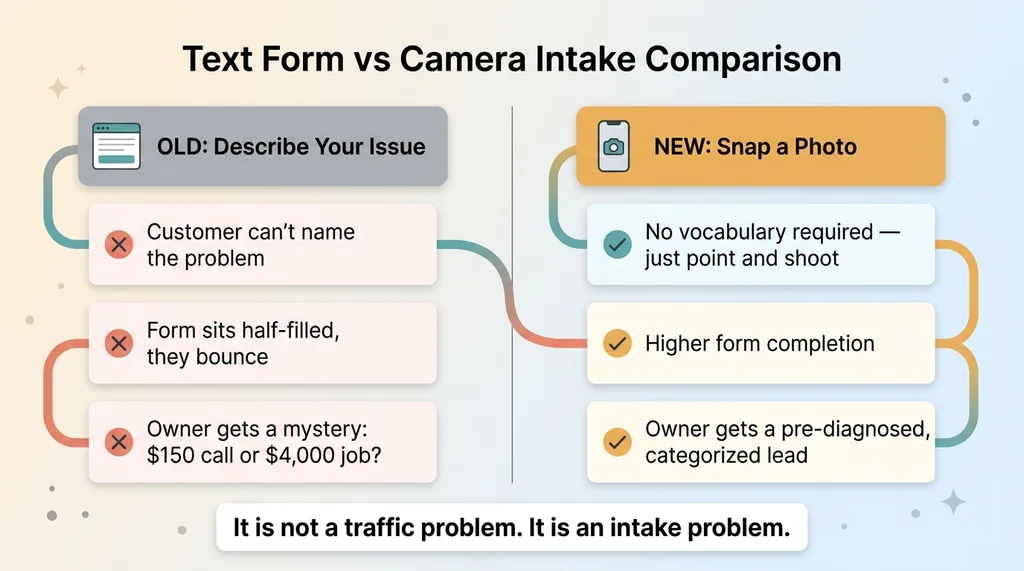 Text Form vs Camera Intake Comparison
The customer can't name the problem
Homeowners don't speak electrician or HVAC. They see sparks. They see a breaker that flips back the second they reset it. They see an outdoor unit caked in ice in July. They have no idea what any of it is called.
A standard form asks them to translate a thing they can't name into a sentence. That's a cognitive wall, and it shows up right when they're already anxious about the problem.
So the form sits half-filled. They give up, hit back, and call the next contractor whose site felt easier. You never even knew they were there.
The friction isn't laziness. It's that you asked someone to do something they genuinely can't do.
Unqualified leads waste the owner's only resource: time
The handful of people who do push through give the owner almost nothing to work with. "My power keeps going out" could be a $150 service call or a $4,000 panel replacement.
The owner can't tell which from the form. So he calls back, asks twenty questions, and half the time still has to schedule a diagnostic trip just to find out what he's dealing with.
For a one-truck business, the bottleneck is the owner's time. It's the single scarcest resource in the whole operation. Every unqualified lead burns it, and there's no way to get it back.
So you've got two failure modes stacked on top of each other. Most people can't fill out the form, and the few who do hand you a mystery. That's not a traffic problem. That's an intake problem, and you fix it by changing the intake.
How AI Photo Diagnosis Lead Capture Works
Here's the flow, plainly, no jargon.
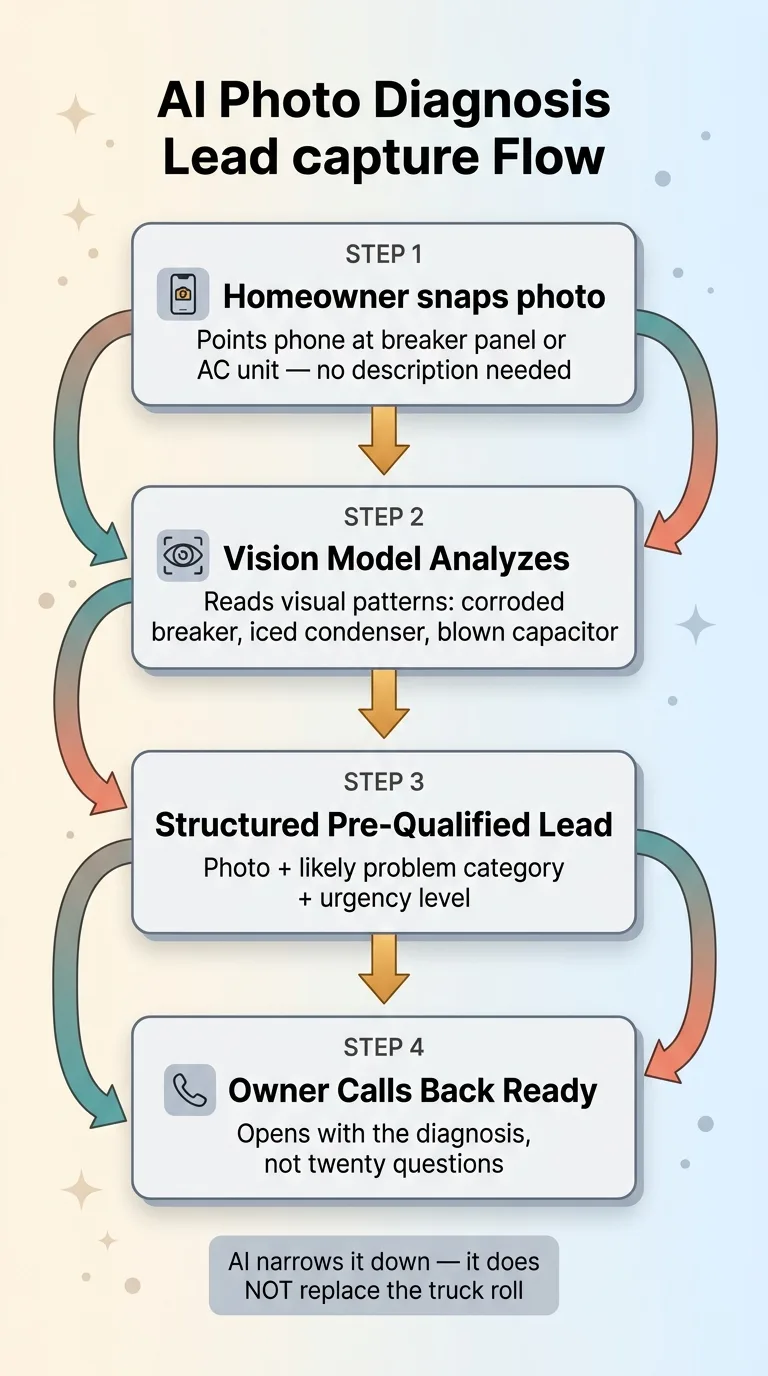 AI Photo Diagnosis Lead Capture Flow
Upload replaces the description field
The customer lands on the site and the primary call to action isn't "describe your issue." It's "snap a photo of your panel" or "show us the unit that's acting up."
That's it. No vocabulary required. They point, they shoot, they upload. The thing they were going to fail at, writing a description, is gone.
The model identifies likely problem and scope
A vision model looks at the image and identifies the likely issue and rough scope. A corroded breaker. A double-tapped neutral. An outdoor condenser that's iced over. A capacitor that's clearly blown.
The model isn't guessing wildly. These are visual patterns that show up over and over in panel and unit photos, and a good vision model reads them well. It pulls out a likely category and a sense of urgency.
It becomes a pre-diagnosed, qualified lead
The output isn't a quote, and it isn't a diagnosis the homeowner is told to treat as gospel. It's a structured, pre-qualified lead that lands in front of the owner.
Here's the photo. Here's what the AI thinks it is. Here's the likely category and how urgent it looks. The owner now calls back already knowing roughly what he's walking into.
That changes the entire callback. Instead of twenty questions, he opens with "I saw your panel, looks like the main breaker's corroded, let me get you on the schedule."
I wrote up the deeper version of this build, where a customer snaps a photo of their breaker panel and the AI books the job, if you want to see how the pieces fit together.
I'll be honest about the limit. The AI narrows it down. It doesn't replace the truck roll. A photo gets you a strong starting point, not certainty, and the owner still confirms on site. But "strong starting point" is a massive upgrade over "my power keeps going out."
Why the AI Never Quotes a Price or Promises a Fix
This part is deliberate. The system identifies and routes. It does not auto-quote, it does not promise the work can be done, and it never hands the homeowner a number that might be wrong.
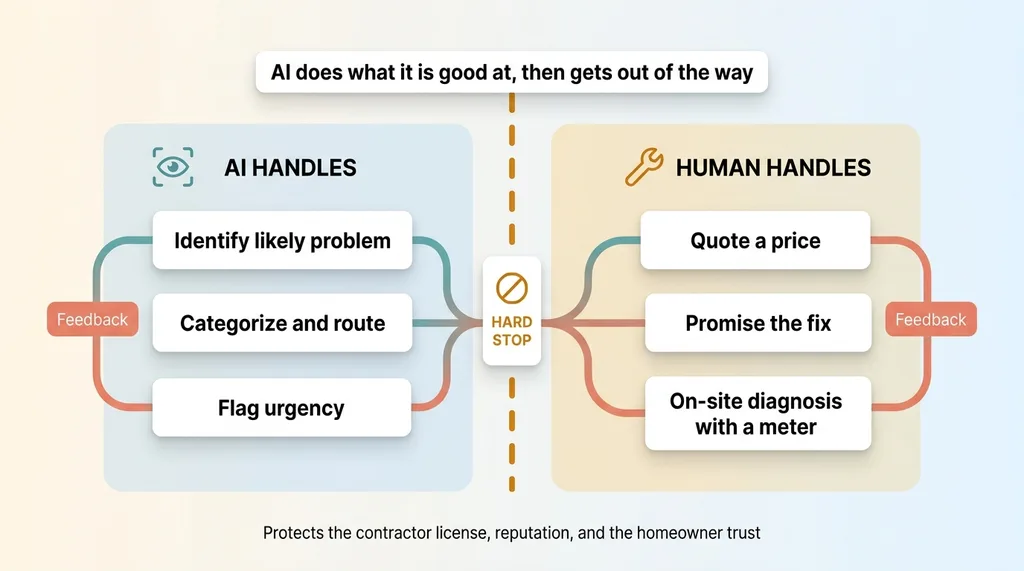 Where the AI Stops, Human Handoff Boundary
That's design, not a missing feature.
A photo of a panel hides as much as it shows. Real problems live behind the cover, in the wiring, in things you only find when you're standing in front of it with a meter. If the AI threw out a price, it would be guessing on incomplete information and putting the contractor's name behind that guess.
So the AI's job has a hard stop. It turns a confused homeowner into a warm, pre-diagnosed booking. Then it hands off to the human and gets out of the way.
This matters for the contractor's license and reputation. The last thing a service business needs is a black box on its website making promises it can't keep and pricing work it's never seen.
Every system I build works this way. The AI does the part it's good at, narrowing and organizing, and stops before the part that needs a human's judgment and a human's liability. I wrote about why every AI system I ship stops for a human, because this isn't a one-off rule. It's how I design.
For the buyer reading this, that's the trust point. You're not turning your business over to an algorithm that commits you to things. You're adding a tool that captures leads better and then puts the decision back in your hands.
What Changes for a One-Truck Owner
The practical wins are simple, and they all point at the same place: the owner's time.
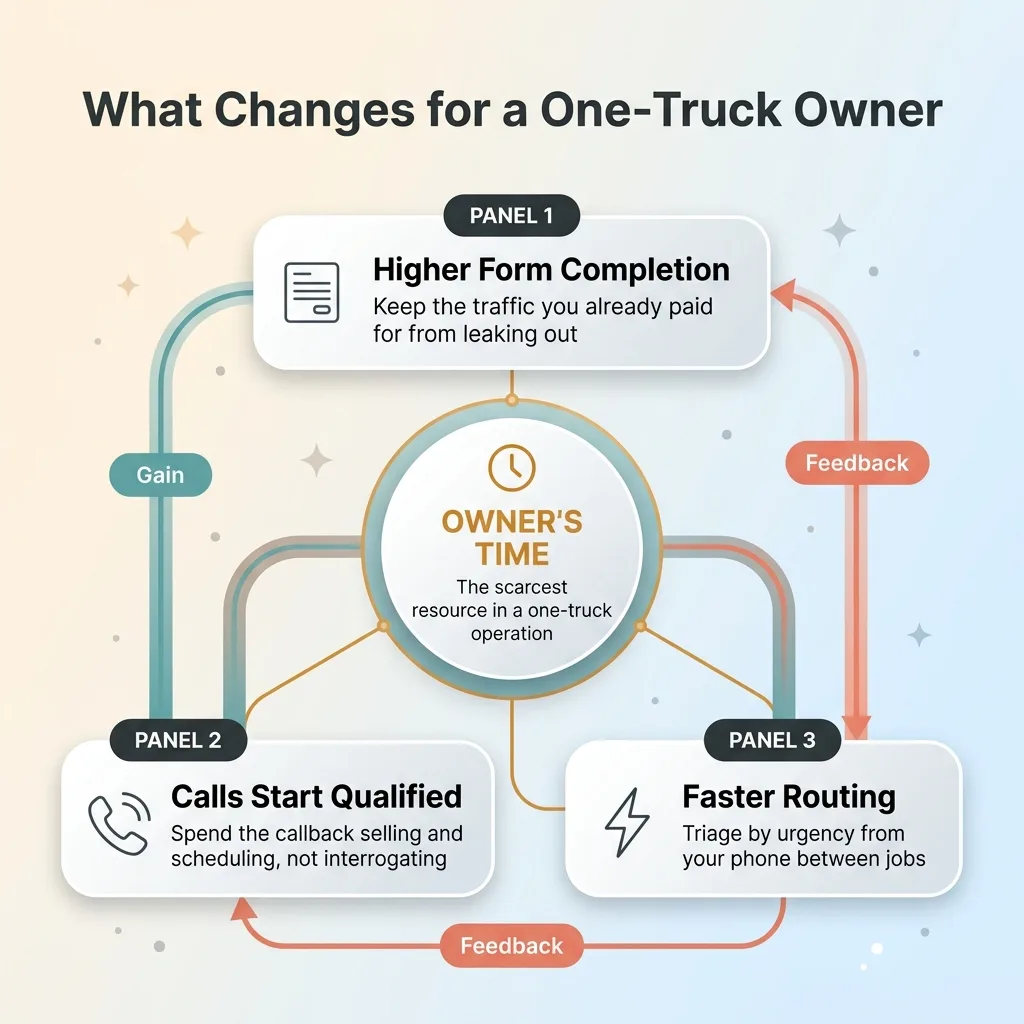 What Changes for a One-Truck Owner
Higher form completion
Pointing a camera is easier than writing a paragraph. Far easier. So more of the people who land on the site actually complete the intake instead of bouncing to the next contractor.
You're not winning more traffic. You're keeping the traffic you already paid for from leaking out at the form.
Calls start qualified
The leads that come through are warmer and pre-categorized. So when the owner calls back, he spends that time selling and scheduling instead of interrogating.
That's a real shift in how the callback feels. The homeowner already showed their problem. The owner already has a read on it. The conversation is about when, not what.
Faster routing means fewer lost jobs
The owner can triage by urgency from his phone, between jobs, standing in someone's garage. The iced-over condenser on a hot day jumps the line. The flickering light that's been flickering for a month can wait.
Speed wins jobs in the trades. Whoever calls back first, ready to talk, usually gets the work. Pre-diagnosed leads let a one-truck operator respond like a shop with a dispatcher.
The bottleneck for a small trades business is the owner's attention. This intake protects it. It filters the noise, organizes the signal, and hands the owner only the decisions that need him.
This is part of a bigger pattern of removing intake friction. The same logic applies to the phone, which is why I also build systems where an AI answers your phone and books the job when the owner is up a ladder and can't pick up.
But I'm a Contractor, Does AI Even Apply to Me?
A lot of trades owners assume AI is for tech companies. Software people in offices. Not a guy with a truck, a ladder, and a panel to wire by noon.
I get why. The AI conversation is all chatbots writing essays and tools that have nothing to do with running a service business.
But the most valuable AI for a service business isn't a chatbot. It's the boring plumbing that captures a lead better than your competitor's form. It doesn't write poetry. It just makes sure the homeowner who's ready to hire you actually gets through.
A camera-based intake is something every homeowner already knows how to use. There's no learning curve, no app to download, no new behavior. They take photos all day. You're just pointing that habit at their problem.
And this isn't theoretical. It's a working site for a real one-truck electrician and HVAC contractor in Southern California. Not a demo. Not a pitch deck. A live intake that captures real leads.
If you want to see how this lands across different kinds of businesses, I broke down what AI actually looks like for a salon, an electrician, and a guy who sells boxes. None of them are tech companies. All of them have intake that AI improves.
Meanwhile the competitor across town is still running a contact form from 2012, asking confused homeowners to describe a thing they can't name. The advantage here is available and cheap. It just isn't widely used yet, which is exactly why it's an advantage.
If Your Website Asks Customers to Describe a Problem They Can't Name
Here's the core idea one more time. The intake is the conversion lever. And for a trades business, the right intake is a camera, not a text box.
Most service-business sites leave money on the table at the exact moment a homeowner is ready to act. The visitor shows up with a real problem and real intent, hits a form that asks them to do something they can't, and leaves.
So look at your own intake honestly. How many visitors hit your form and disappear? You're probably paying for that traffic. You just never see the people who bounce.
If your site asks customers to describe a problem they can't name, you're filtering out the exact people you want most. The ones with a problem right now, ready to pay to make it go away.
This is the kind of intake I build for service businesses. Not a slide deck about AI strategy. A working tool that captures the lead your old form was losing. If you want to start, tell me what your intake looks like today and we'll figure out where it's leaking.
Thinking about AI for your business?
If this resonated, let's have a conversation. I do free 30-minute discovery calls where we look at your operations and find where AI could actually move the needle.
Get AI insights for business leaders
Practical AI strategy from someone who built the systems — not just studied them. No spam, no fluff.
Hodgen.AI
Ready to automate your growth?
Book a free 30-minute strategy call with Hodgen.AI.
Book a Strategy Call