The Problem Nobody in Marketplaces Talks About: Dead-Weight Supply
Every marketplace I've ever studied optimizes the same thing: matching. Connect a seller to an offer, take a cut, repeat. That's the whole pitch in most pitch decks. And it's wrong, or at least incomplete, which is why I built an AI UGC video generation pipeline to solve the part everyone ignores.
Here's the part everyone ignores. In the creator and affiliate marketplace I'm building, matching was never the hard problem. The hard problem is that most sellers can't make content that converts.
Matching isn't the moat
You can connect ten thousand sellers to ten thousand offers in an afternoon. Software does that. There's no defensibility in matching because the next platform does it just as well, often cheaper.
The dashboard says you have thousands of sellers. The reality is maybe 5% of them produce anything sellable. The other 95% sign up, post one shaky vertical video, get zero sales, and churn within a week.
Average sellers produce unsellable content
That's the dead weight nobody talks about. The marginal seller isn't lazy. They just don't know how to make a video that stops a thumb. They don't have lighting, a script, or the instinct for a hook.
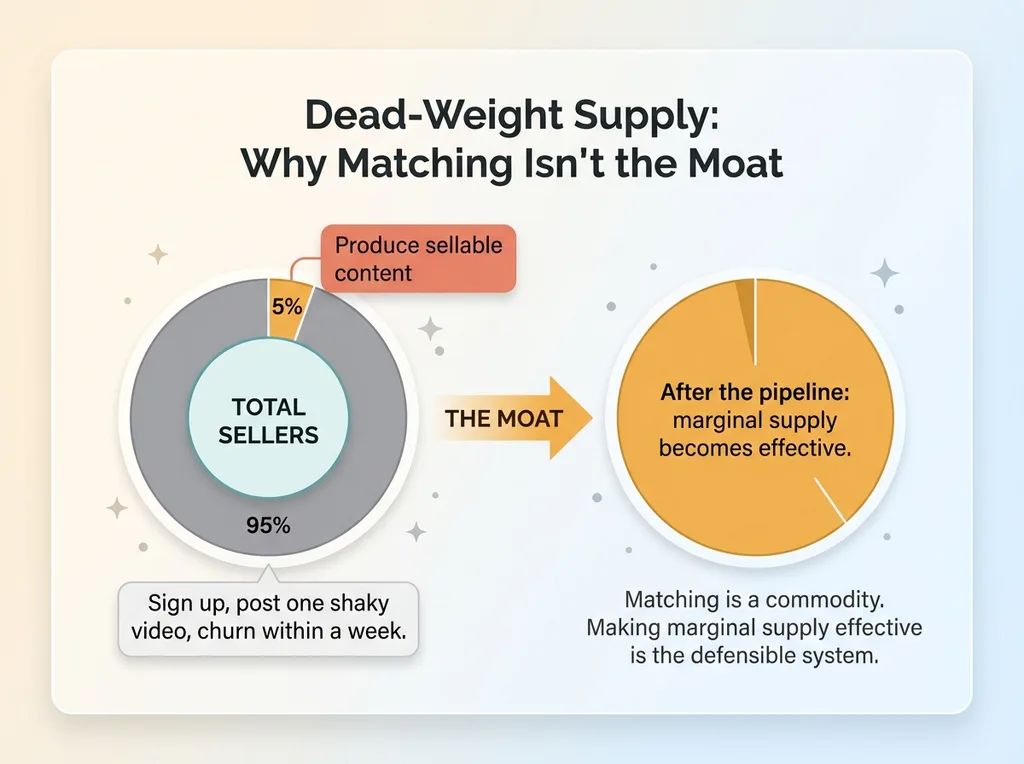 Dead-Weight Supply: Why Matching Isn't the Moat
So they produce nothing usable, and the marketplace quietly carries a roster of ghosts.
Here's the insight that changed how I built the whole thing. The moat isn't matching supply to demand. It's making marginal supply effective.
If I can take a seller who'd otherwise produce nothing and turn them into a working content channel, I've expanded the supply side by an order of magnitude without recruiting a single new person. That's leverage no recruiter can match.
The rest of this article is the production pipeline I built to do exactly that. One selfie in, a posting-ready video ad out.
What the Pipeline Actually Does: One Selfie In, Video Ad Out
Before I go deep on any single piece, here's the whole thing in one view. The pipeline has four stages, and a non-technical seller only ever touches the first one.
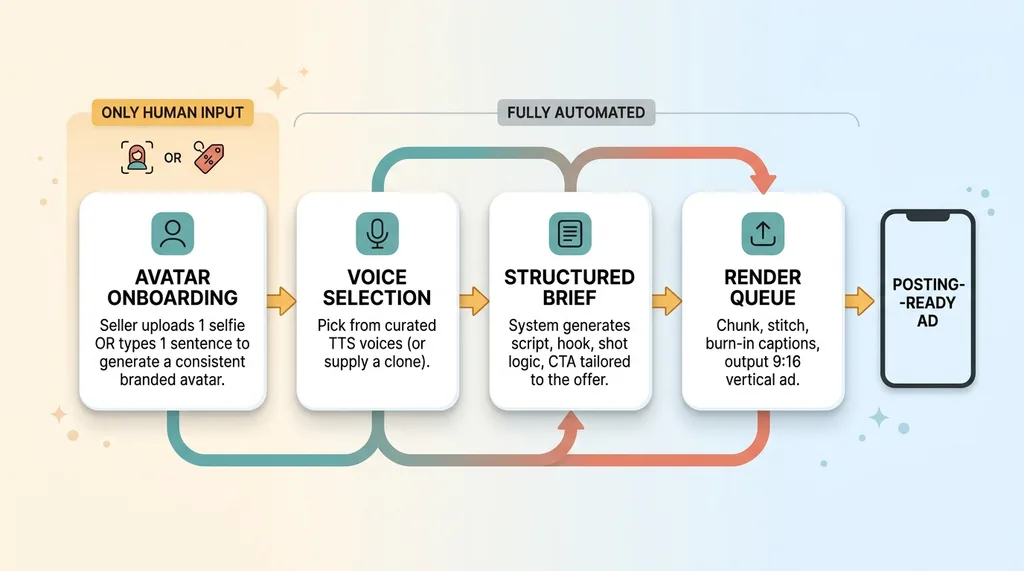 The Four-Stage Pipeline: Selfie to Ad
The four stages
Stage one: avatar onboarding. The seller uploads a single selfie, or types a one-sentence description of who they want to be on camera. From that, the system generates a consistent branded avatar that can speak.
Stage two: voice selection. The seller picks from a curated set of TTS engine voices. If they want, they can supply a cloned voice. Most don't, and that's fine.
Stage three: structured brief generation. The OS takes the specific offer the seller chose and produces the actual script, the hook, the shot logic, and the call to action, tailored to that product.
Stage four: the render queue. The system chunks the video generation, runs the pieces through video providers, stitches them together, and burns in word-by-word captions. Out comes a branded 9:16 vertical ad ready to post.
Why each stage exists
Each stage removes a decision the average seller would otherwise get wrong.
Avatar onboarding exists because most sellers won't shoot footage. Voice selection is curated, not infinite, because choice paralysis kills completion rates. The brief engine exists because sellers don't know what to say. The render queue exists because long single-shot AI video is slow and fails unpredictably.
The design principle is simple: the seller does one thing, and the system handles the rest. Upload a selfie, pick an offer. That's the entire human input. Everything downstream is automated video ad rendering with a quality gate before anything ships.
I built it this way because the moment you ask a marginal seller to make three decisions, two of them get made badly and the third gets abandoned.
Avatar Onboarding: From One Photo (or One Sentence) to a Branded Face
Stage one is where most of the supply-side magic happens, because it's the lowest-effort ask I could engineer.
The single-selfie path
Most sellers won't shoot polished footage. But almost all of them will give you one decent selfie. They already have forty of them on their phone.
From that single photo, the system generates an AI avatar from one selfie that stays consistent across the entire video. Same face, same look, frame after frame. The avatar speaks the generated script in the selected voice.
That consistency is the hard part. Character drift is exactly where cheap AI video falls apart. You've seen it: the face subtly morphs between shots, the eyes go wrong, and suddenly the whole thing reads as fake. I spend most of my engineering effort holding the avatar steady, not making it fancier.
This connects to a principle I apply everywhere: I composite the real product instead of generating it. I constrain what the AI is allowed to invent rather than letting it freelance. A locked avatar plus a real product image beats a fully synthetic scene every time.
The text-description path for sellers who won't upload
Some sellers won't upload a photo at all. Privacy, low effort, whatever the reason. So I added a fallback: a one-sentence text description.
"A friendly woman in her thirties, casual style" gets turned into a synthetic spokesperson the seller can reuse across every offer.
Let me be honest about the limit. This will not replace a charismatic creator with a real audience and real trust. It was never meant to. It replaces zero content with usable content, which for 95% of the roster is the entire game.
The Brief Engine: Why the Script Matters More Than the Pixels
If you take one thing from this article, take this: the biggest lever in the whole pipeline isn't render quality. It's the brief.
Structured briefs per offer
I built a structured AI brief generator that takes a specific offer and produces the script, the hook, the shot logic, and the CTA, all tailored to that exact product.
This is where average sellers actually fail. It's not that their video looks bad. It's that they don't know what to say. They open their mouth and produce generic filler that converts nobody.
The brief engine fixes the root cause. Instead of asking a seller to write copy, I give them copy that's already structured around the offer's actual value proposition. The hook in the first second. The product benefit in the middle. The CTA at the end. Every time.
This is the same quality-gate philosophy I use in a pipeline that scores its own work. The system doesn't just generate, it generates against a standard. A brief that doesn't have a clear hook and a clear CTA doesn't pass.
Curated voices, not infinite choices
The voice selection follows the same logic. I could offer a hundred TTS voices. I offer a handful of good ones.
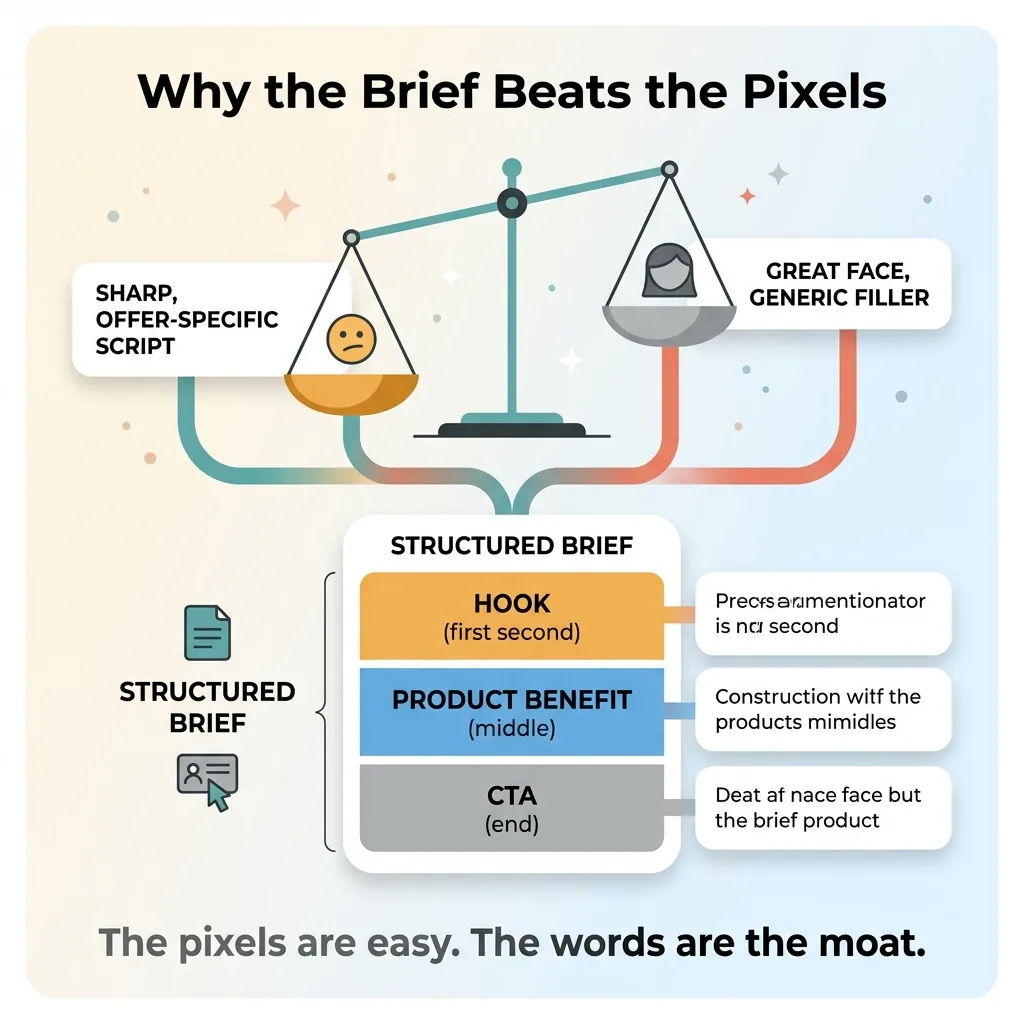 Why the Brief Beats the Pixels
Fewer, better choices reduce decision paralysis and keep brand consistency across the marketplace. A seller staring at a hundred voices picks none and abandons. A seller choosing from six finishes the flow.
Here's the argument that drives the whole stage: a mediocre face reading a sharp, offer-specific script beats a great face reading generic filler. Every single time. The pixels are the easy part. The words are the moat.
The Render Queue: Chunk, Stitch, and Burn In Captions
Stage four is the technical core. I'll keep it accessible, but this is where the engineering actually lives.
Why chunk-and-stitch
Long single-shot AI video generations are slow, expensive, and fail unpredictably. Ask a model for one continuous thirty-second clip and you're rolling dice on a render that takes minutes and might come back broken.
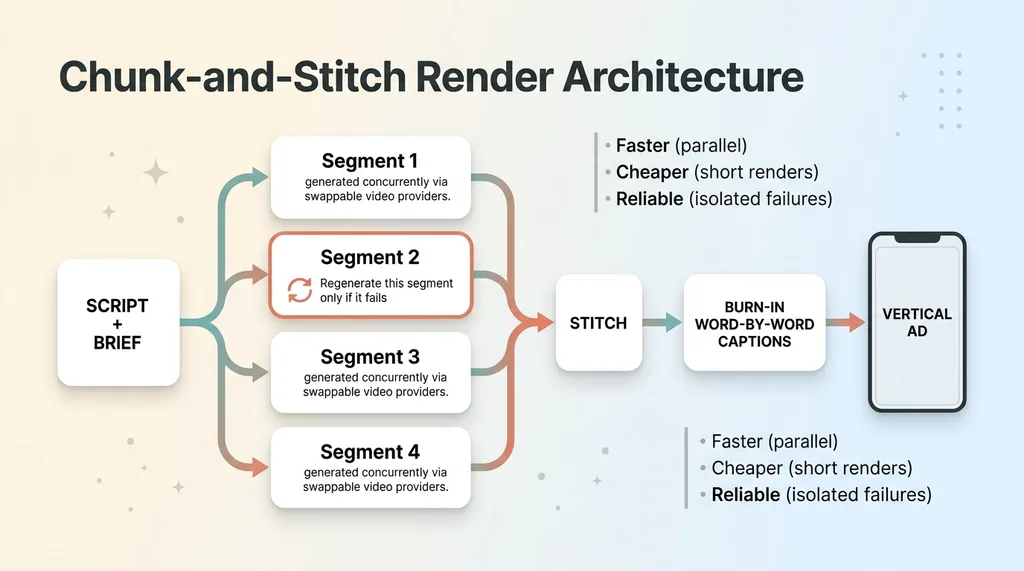 Chunk-and-Stitch Render Architecture
So I don't. I chunk the render into short segments, generate them in parallel, and stitch the pieces into one video.
This does three things. It's faster because the segments run concurrently. It's cheaper because short generations cost less and fail less. And it's more reliable because if one segment comes back wrong, I regenerate that segment, not the whole thing.
The fast tier is the default. For ad creative, speed and volume beat marginal quality. I'd rather produce forty good-enough videos than four perfect ones, because the marketplace needs working supply at scale.
Word-by-word caption burn-in
I bake captions directly into the video. Not platform auto-captions, which are inconsistent and ugly. An OpusClip-style word-by-word AI caption burn-in pipeline, where each word pops as it's spoken.
That style measurably lifts retention and watch-through on vertical feeds. People watch with the sound off, and the burned-in captions keep them reading even when they're not listening. Relying on platform captions means surrendering control of the single biggest retention lever you have.
Pluggable providers and a fast-tier default
I don't bet the entire pipeline on one video model. The video providers are swappable. I can route a render by cost, by quality, or by availability, depending on what each job needs and which models are up that day.
This matters more than it sounds. The AI video space moves fast, and the best provider this quarter might be the worst next quarter. If you hardcode one model, you're stuck. I covered what these models can actually deliver in what AI video generation actually delivers in production, and the short version is that it changes constantly.
Now the honest part. Some renders still come out wrong. A weird artifact, a face that drifts, a stitch that doesn't quite land. So there's a regenerate-and-review step before anything reaches a seller. Nothing ships unchecked.
Is AI Video Actually Usable Yet? The Honest Answer
This is the question every skeptical buyer asks, so let me answer it directly instead of dancing around it.
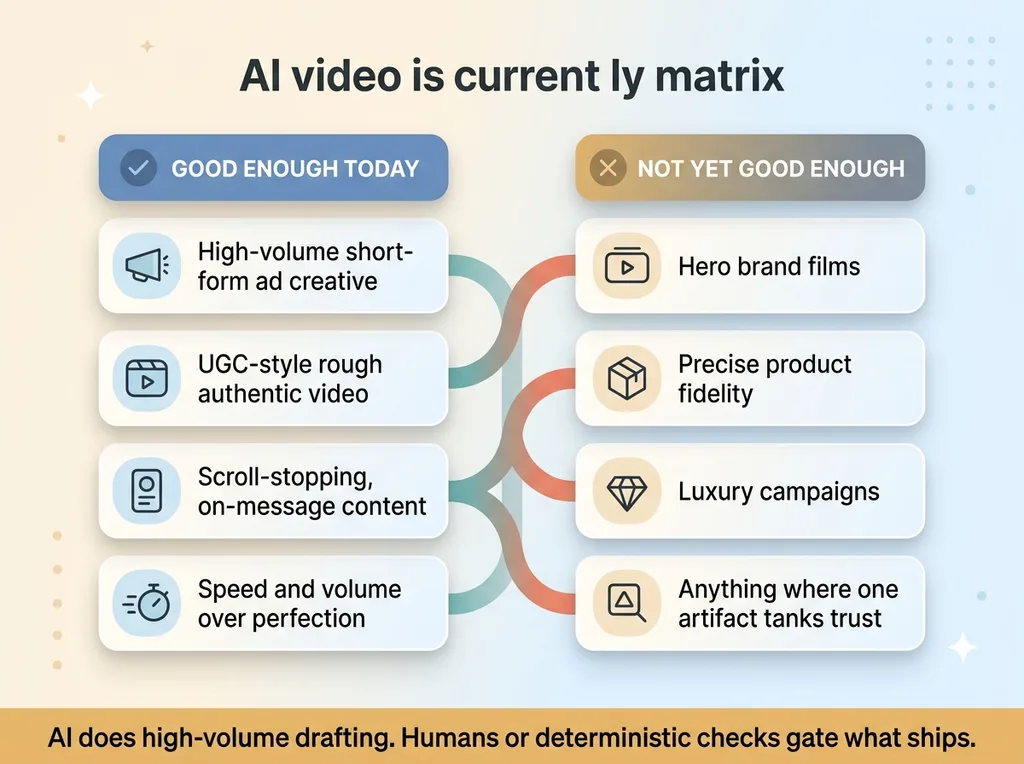 Where AI Video Is Good Enough (and Where It Isn't)
What it's good enough for
Yes. For high-volume short-form ad creative where the bar is "scroll-stopping and on-message," AI video clears it today.
That's a real bar, but it's a forgiving one. UGC-style content is supposed to look rough. The audience expects a regular person with a phone, not a film crew. When the production value is intentionally low, AI's imperfections stop being flaws and start being native to the format.
For my marketplace, this is the entire sweet spot. Sellers need volume, they need speed, and their audience already tolerates authentic-feeling rough video. That's exactly the zone where this pipeline wins.
What it's still not good enough for
No. Not for hero brand films. Not for anything requiring precise product fidelity. Not for content where a single uncanny artifact would damage trust.
If you're shooting a luxury campaign or a product where the exact stitching and color have to be perfect, AI video will let you down. One weird frame and credibility is gone.
Here's the line I draw across every AI system I build: AI does the high-volume drafting, and humans or deterministic checks gate what ships. AI video where volume and speed matter. Human review where one artifact tanks the whole thing.
The marketplace tolerates rough, authentic video. So I deploy AI exactly there, and nowhere it would embarrass anyone.
Why This Is the Real Marketplace Moat
Let me bring it back to where I started, because the pipeline is the means, not the point.
In a creator or affiliate marketplace, matching is a commodity. Anyone can connect sellers to offers. The defensible thing, the thing competitors can't copy by throwing money at it, is an operating system that makes average supply effective.
When my marginal sellers produce sellable content, I have an order of magnitude more working supply than a competitor who only matches. They're recruiting harder to fill a leaky bucket. I'm making the sellers I already have actually function.
That's a moat you can't replicate by hiring more recruiters. It's a systems advantage, and systems compound.
Here's why I'm telling you this if you don't run a marketplace. Almost every business I work with has the same shape of problem. A supply or production bottleneck they assume is a people problem when it's actually a systems problem.
If you've got a process where output quality depends entirely on which person happens to be doing it that day, that's the exact thing I build pipelines to fix. The good salesperson, the one designer who gets it, the rep who writes the proposals that close. Right now that quality lives in a head, not a system.
Get the next build note.
I write up each system I build, including what broke. Subscribe to my newsletter and I'll send you the next one.