AI Website Compliance Audit Found 174 Violations
I ran a regulated firm's whole site through an AI compliance audit. It found 174 advertising violations, each tied to a rule, line, and fix. Here's how.
By Mike Hodgen
What a Single AI Pass Found That Weeks of Human Review Wouldn't
I ran an AI website compliance audit across a financial advisory firm's entire web presence and it surfaced 174 distinct advertising-compliance violations. Seventy-one of them were critical. One pass.
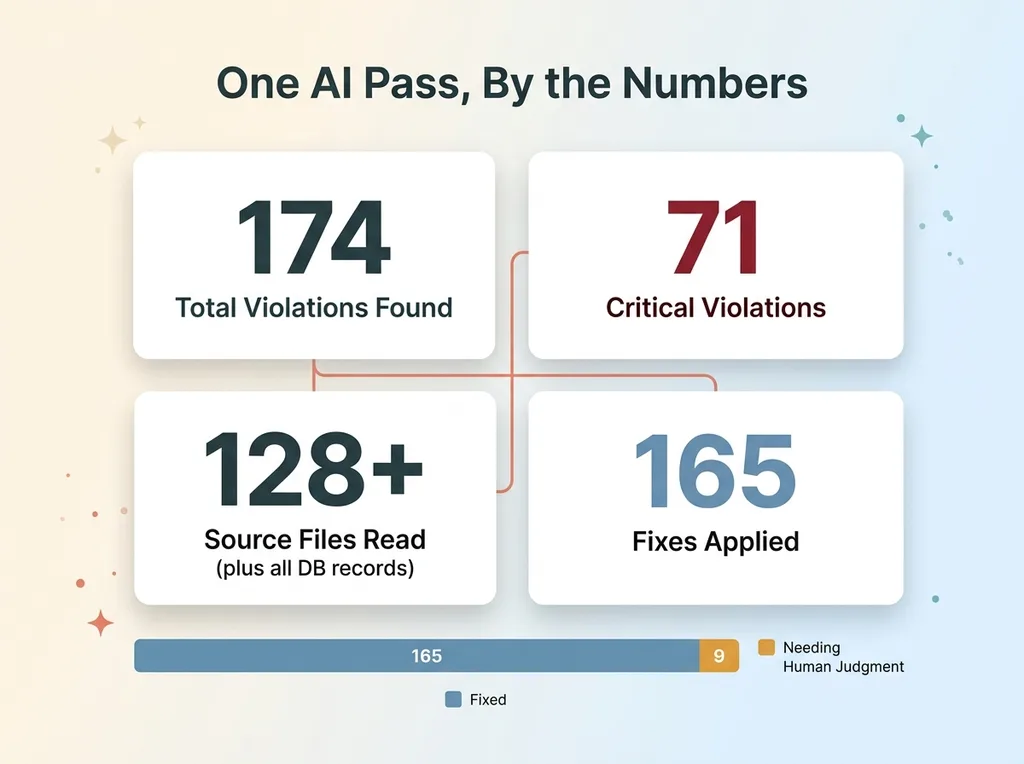 Audit by the Numbers
Here's what that pass actually read: 128 source files plus every blog post and advisor bio stored in the database. Not the rendered pages a human would click through. The actual source, including content that gets assembled dynamically and never shows up in a page-by-page manual review.
The firm operates as a DBA under a national broker-dealer, which means their public-facing copy is governed by advertising rules they can be examined against. That's the box they live in. And inside that box, every banned superlative, every undisclosed testimonial, every missing registration notice is a potential examination finding.
What made the output usable wasn't the count. It was the specificity. Each of the 174 findings came with four things: the exact rule it broke, the verbatim text currently live on the site, the file and line it lived on, and a compliant replacement written to the firm's standards.
The old way was different. A specialist would block out weeks, read pages by hand, and still miss things scattered across a site this size. Not because they weren't good. Because no human reads all 128 files and every database record without their attention degrading somewhere around the 90th page.
So the buyer doubt I want to answer in this article is the obvious one. What does an AI auditor actually catch that a trained human misses? And is the output specific enough to act on, or is it just another PDF of vague complaints that lands on someone's desk and dies there?
Both questions have concrete answers. Let me walk through what the audit found, why a machine caught it, and what it cost the firm to leave it live.
The Violations Were Real, Specific, and Mostly Invisible to the Naked Eye
These weren't theoretical. Each one was a real string of text or a real measurement in the code. Here are the categories.
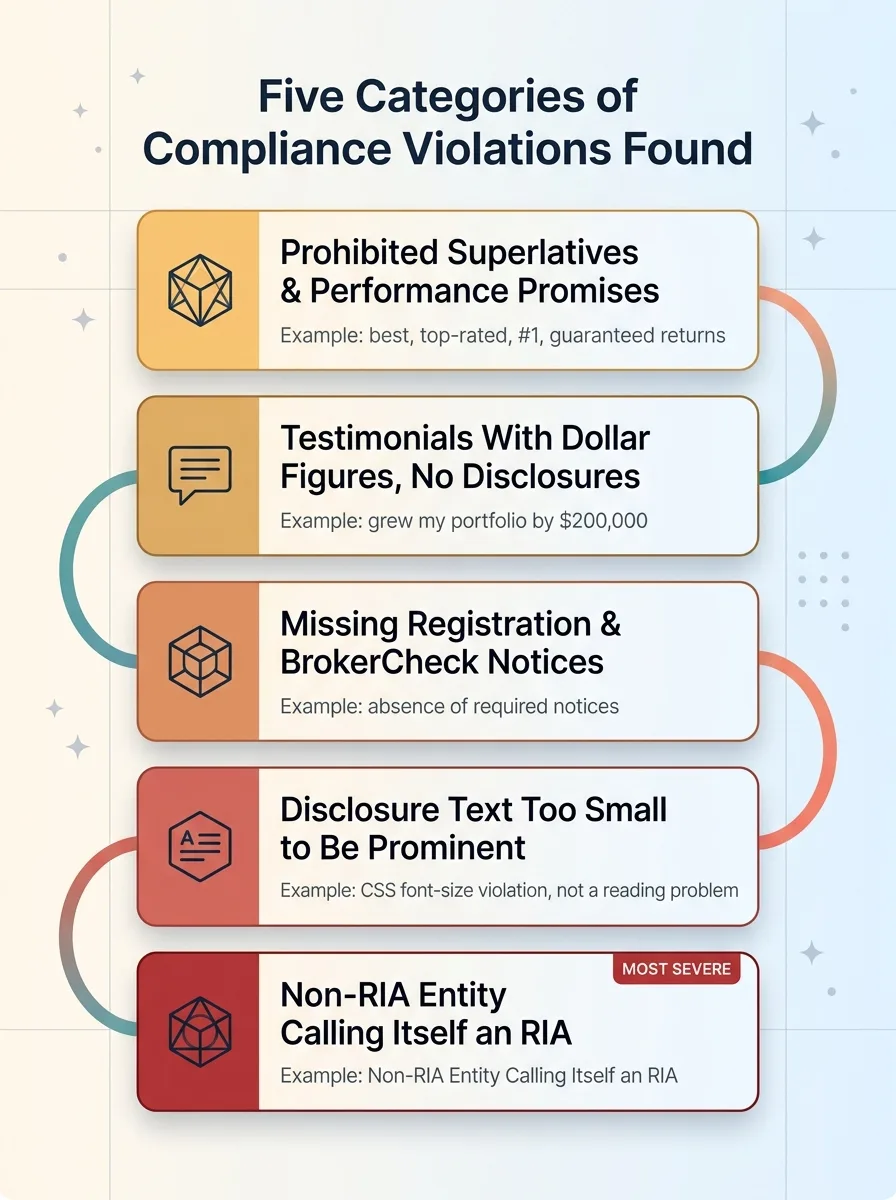 The Five Violation Categories Found
Prohibited superlatives and performance promises
The site was full of "best," "top-rated," and "#1" language sprinkled through marketing copy. Under FINRA advertising compliance rules, those superlatives are prohibited unless you can substantiate them, and you almost never can.
Worse were the forward-looking performance promises buried in the prose. Language that implied a return or guaranteed an outcome. A human skimming for tone might read right past these because they sound like normal marketing. The rules don't care how normal they sound.
Testimonials with dollar figures and no disclosures
The firm had client testimonials quoting specific dollar gains. "They helped me grow my portfolio by $200,000." No disclosures attached. No statement that results aren't typical, no mention of compensation, none of the required language.
A testimonial with a dollar figure and no disclosure is one of the cleaner ways to draw an examiner's attention. The audit flagged every instance.
Missing registration and BrokerCheck notices
Several pages were missing required state-registration notices and BrokerCheck references. These aren't copy problems. They're presence-or-absence problems, which is exactly the kind of thing a human reviewer forgets to check on page 60 because they're focused on reading the words that are there, not noticing the words that aren't.
Disclosure text too small to be legally prominent
This one is my favorite, because no human would ever catch it by reading. The disclosure text was set in a font size too small to count as "prominent" under the rules. That's a CSS measurement, not a reading problem. You can read the disclosure fine. It's just legally not prominent enough.
The only way to flag this is to read the code and the content together. A reviewer looking at a rendered page sees the disclosure and moves on.
A firm misrepresenting its regulatory status
The most serious finding: a firm misrepresenting its regulatory status. That's a material misrepresentation, full stop. It's the kind of thing that turns an exam into a problem.
The pattern across all five categories is the same. Several of these are structural or technical. They only surface when you read code and content together, not when you look at the page the way a visitor does.
Why an AI Auditor Catches What a Human Reviewer Doesn't
Let me address the doubt directly, because if you're skeptical you should be. Here are the three reasons AI beats manual review at this scale.
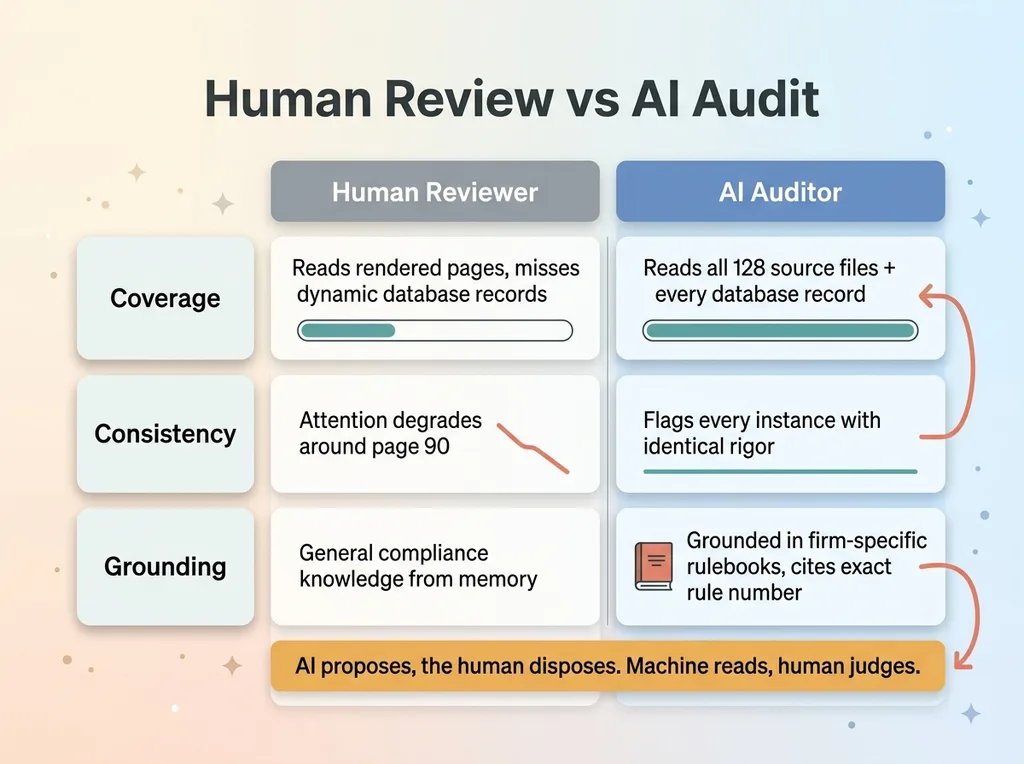 Why AI Catches What Humans Miss
Coverage. A human compliance reviewer reads pages. They rarely read all 128 source files plus every database-stored blog post and advisor bio. The AI read everything. That includes content that renders dynamically and never gets eyeballed in a manual page-by-page review. The font-size violation and the missing notices lived in exactly that blind spot. A human review of the rendered site would never touch them.
Consistency. A human reviewer gets fatigued. They catch the first banned superlative, the fifth, the twentieth, and then their attention drifts and the 90th slides through. The AI flags every instance with identical rigor. It doesn't get bored on page 60. Of the 174 findings, a meaningful chunk were repeat offenses of the same rule scattered across the site, and the value was catching all of them, not just the obvious ones up top.
Grounding. This is the one that matters most. The auditor wasn't running on generic compliance knowledge it picked up from training data. I grounded the AI in the firm's actual rulebooks, the specific broker-dealer advertising rules they're examined against.
That's the difference between an audit you can act on and an audit you have to second-guess. Every finding cited the specific rule it broke. The output isn't a vibe. It's a defensible position with a rule number attached.
Now the honest limit. AI does not replace the compliance officer's judgment. It doesn't decide whether a borderline value proposition crosses the line, and it shouldn't. What it replaces is the manual scanning, the part that eats a specialist's entire week. The machine does the reading. The human does the judging. That division is the whole point.
The Output Was a Remediation Plan, Not a List of Complaints
Most audits hand you a PDF of problems and walk away. You're left to translate "you have prohibited superlatives" into "go find them and figure out what to write instead." That translation is where audits die.
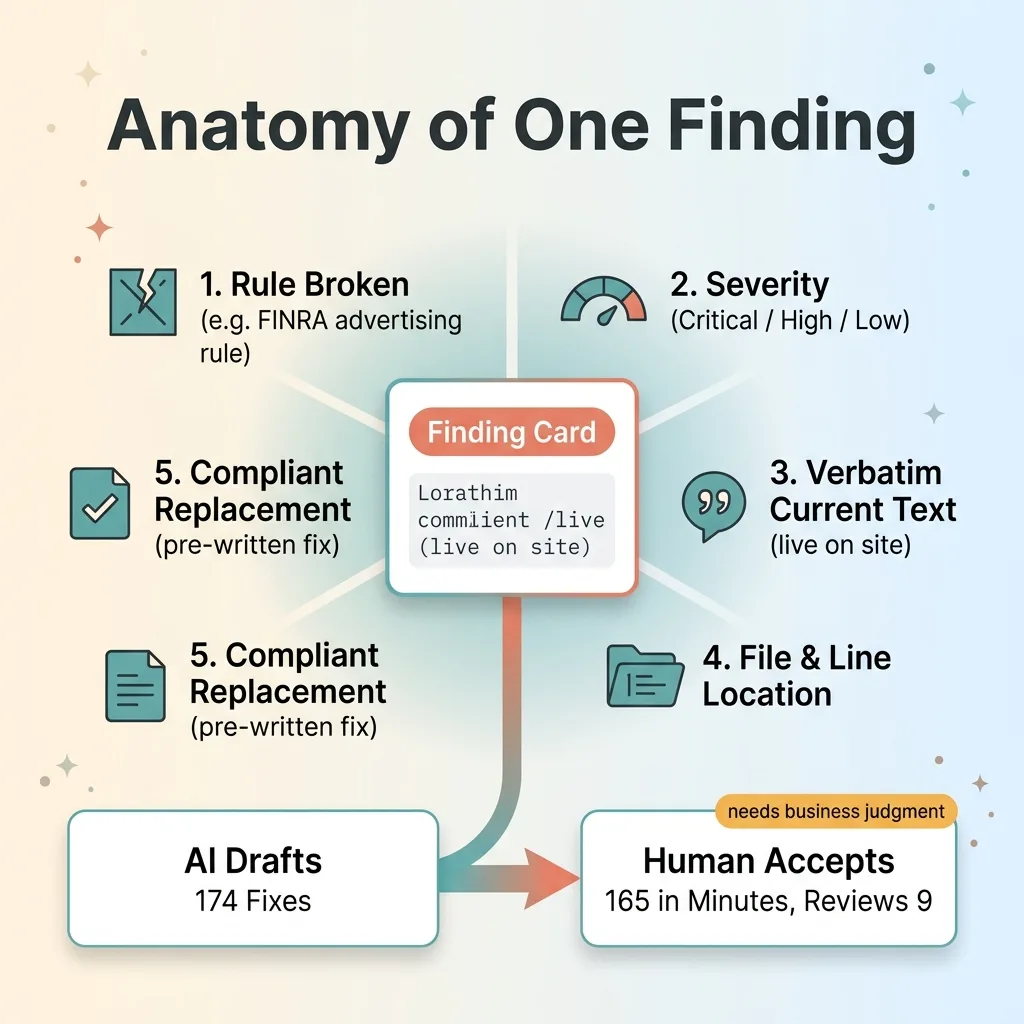 Anatomy of a Single Finding (Remediation Plan)
This one produced, for each of the 174 findings: the rule broken, the severity, the verbatim current text, the file and line, and a compliant replacement written to the firm's standards.
That structure is what made it act-on-able. A developer or a marketer could take the report and make the change without re-interpreting anything. The fix was already written. They just had to apply it.
That's how this drove an actual remediation that fixed roughly 165 of the 174 violations. The report wasn't advice. It was a punch list with the answers filled in.
Be honest about the remaining nine. They weren't auto-fixable because they needed a human business decision. Rewording a core value proposition isn't something I want a machine deciding unilaterally. Deciding whether to remove a testimonial entirely or rewrite it is a judgment call. Restructuring the entity claim, the regulatory-status misrepresentation, touches how the business describes itself legally. That's a person's call.
The model is simple. The AI proposes, the human disposes. The machine drafts 174 fixes. The human accepts 165 of them in minutes and spends real thought on the nine that deserve it.
And because every finding cited the exact rule, the firm could go either way on any of them. Fix it, or push back. If a finding felt overzealous, the rulebook citation arms you to push back on a compliance flag with the actual rule in hand instead of arguing from gut feel.
What This Used to Cost in Time and Risk
Let's quantify the before, because it's the part that makes the case.
A specialist compliance review of a site this size is weeks of billable time. And here's the thing that gets glossed over: even after those weeks, it's still partial. Nobody reads every dynamic database record by hand. The font-size violation, the missing notices, the testimonials buried three layers deep in a blog archive, those slip through every time because the human is doing the best a human can do.
Meanwhile, the firm carried 71 critical violations live on the public internet. Each one is a potential examination finding or a client complaint waiting to happen. The regulatory-status misrepresentation alone is the kind of thing that reframes an entire exam.
The cost of a single advertising-rule violation at exam time dwarfs the cost of the audit. That's the math that should land. You're not weighing the audit against doing nothing. You're weighing it against the downside of one examiner finding one of those 71.
Contrast that with the AI pass. One run across the whole codebase and the database. Full coverage. Line-level fixes. In a fraction of the time it took to do a partial review the old way. Compliance review used to take days of a specialist's attention, and it still missed things.
I'm not going to overclaim here. The AI pass is the scanning and the drafting. A qualified human still signs off on the output, and they should. The win isn't replacing that person. It's collapsing the weeks of manual reading into one pass so the human spends their time on judgment, not search. They stop hunting for violations and start deciding what to do about the ones already found and written up.
How to Keep the Violations From Coming Back
A one-time audit fixes today's site. That's worth doing. But it's not where the real value sits.
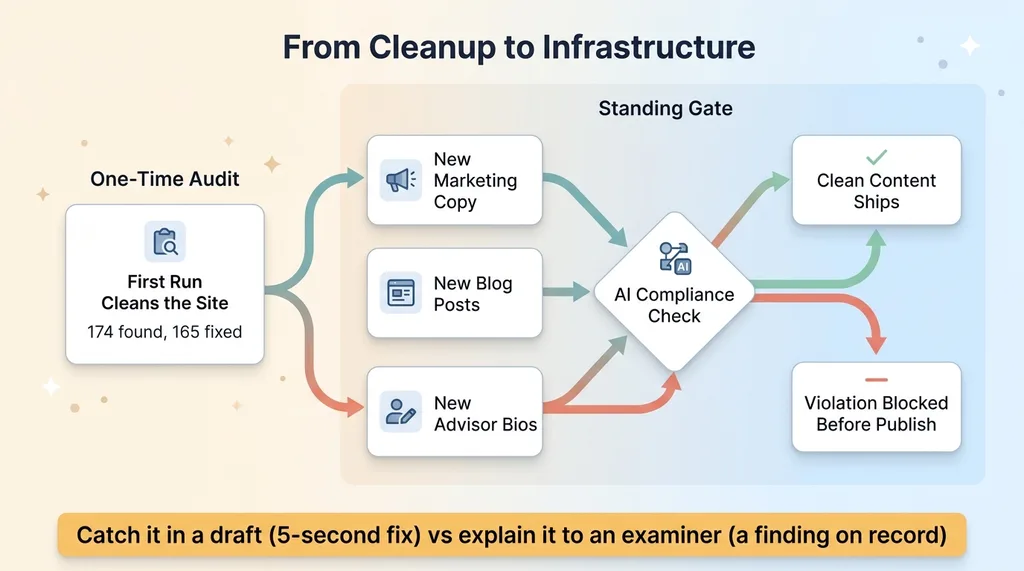 From One-Time Audit to Deploy Gate
The real value is making the audit a standing check. The same auditor that read 128 files and found 174 problems can run on every deploy. New marketing copy, new blog posts, new advisor bios, all of it gets checked against the rulebook before it goes live.
Think about how violations actually accumulate. Someone writes a blog post with a superlative in the headline. A marketer adds a testimonial without the disclosure. An advisor updates their bio with a forward-looking claim. None of it is malicious. It's just normal content production, and in a regulated business every piece of it is governed by rules nobody on the marketing team has memorized.
If you only audit once a year, those violations sit live for months until your next review, or worse, until an exam. If the auditor runs at the gate, they never go live at all.
That's the playbook for shipping content in a regulated industry. The audit isn't a project with an end date. It's a gate every piece of content passes through.
The mental model: it's far cheaper to catch a banned superlative before publish than to explain it to an examiner after the fact. One is a five-second fix in a draft. The other is a finding on your record.
This is the shift from cleanup to infrastructure. The first run cleans the site. Every run after that keeps it clean.
If Your Marketing Lives in a Regulated Box
Here's the honest summary. If you operate under a broker-dealer, or in any regulated vertical where your public copy is governed by rules you can be examined against, you almost certainly have violations live right now that nobody has read.
I don't say that to scare you. I say it because it's true at the scale most firms operate. The font sizes, the dynamic blog records, the advisor bios written years ago, somebody published all of it and nobody read every line against the rulebook. That used to be unaffordable to check thoroughly. The math only worked for the obvious stuff on the homepage.
Now it isn't unaffordable. That's the actual change.
What I do is build these auditors loaded with your actual rulebooks, not generic compliance knowledge. I run them across your whole site and database, the source files and the dynamic records both, and hand back line-level fixes you can apply without re-interpreting anything. Then I wire the auditor into your deploy so it stays clean going forward.
The first conversation is usually just this: how many of these are sitting on your site right now? Nobody knows the answer until they run it. And the number is almost always higher than anyone expects.
If you want to find out what yours is, that's a conversation worth having.
Ready to bring AI leadership into your company?
I work with a small number of companies at a time. If you're serious about AI, apply to work together and I'll review your application personally.
Get AI insights for business leaders
Practical AI strategy from someone who built the systems — not just studied them. No spam, no fluff.
Hodgen.AI
Ready to automate your growth?
Book a free 30-minute strategy call with Hodgen.AI.
Book a Strategy Call