Why One Word Can Cost a License
In supplement and health copy, supplement marketing compliance comes down to verbs. One word flips a legal structure/function claim into an illegal drug claim, and the difference isn't academic. It's the difference between copy that ships and copy that triggers FTC action.
Here's the thing that surprises people. "Supports immune health" is fine. "Prevents the flu" is a drug claim a supplement legally cannot make. Same product, same intent, two words apart, and one of them puts a license at risk.
For a longevity supplement brand I work with, the person on the hook isn't an abstract legal entity. It's the medical director, whose personal license is exposed alongside any FTC action against the company. When a piece of copy oversteps, that's the name attached to it.
Now scale that. A content team drafting dozens of pieces a week. An AI engine drafting even more. The standard advice everyone gives in this situation is "be careful with claims." That advice is useless. You cannot enforce "be careful" across a team of writers, and you definitely cannot enforce it on a model generating copy at volume.
So we did the only thing that actually works. We turned "be careful" into a concrete, enforceable filter that every piece of copy passes through before it ships. Not a vibe. Not a senior person's gut check at the end. A real gate with real rules.
This is part of how I think about shipping AI content in a regulated industry: the compliance logic has to live inside the pipeline, not get bolted on after the fact when everyone's already attached to the words.
In this article I'll walk through the banned-words list we built, the disclaimer rules most brands get wrong, and how the gate runs on every draft whether a human or an AI wrote it.
The Line Between a Supplement Claim and a Drug Claim
The legal framework is actually clear once you strip the lawyer language off it. The FTC and FDA draw a hard line, and that line is the basis for everything we built. This isn't my opinion. It's their published guidance.
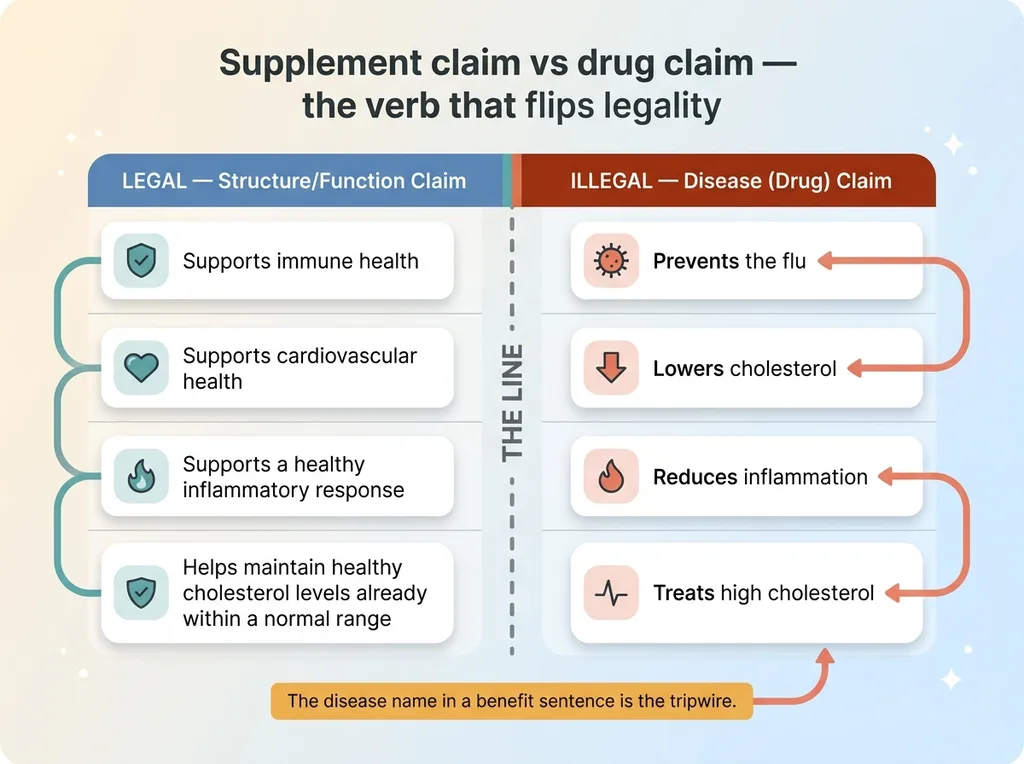 Supplement claim vs drug claim, the verb that flips legality
Dietary supplements can make structure/function claims. They cannot make disease claims. That's the whole game.
Structure/function claims you can make
A structure/function claim describes how a nutrient affects the normal structure or function of the body. It does not reference a disease. The approved vocabulary is narrow but workable:
- supports ("supports immune health")
- maintains ("helps maintain healthy blood pressure already within a normal range")
- helps promote ("helps promote restful sleep")
- contributes to ("contributes to bone health")
Notice what these have in common. They describe maintaining or supporting a normal function. They don't claim to fix something that's broken.
Disease claims you can't
The moment you claim to diagnose, treat, cure, or prevent a disease, you've made a drug claim, and a supplement legally cannot make one. The forbidden verbs:
- treats
- cures
- prevents [disease]
- reverses
- heals
The trap is subtle, and this is where most brands get burned. "Supports cardiovascular health" is fine. "Lowers cholesterol" is not, because high cholesterol is a disease state and lowering it implies treatment.
Same with "supports a healthy inflammatory response" (fine) versus "reduces inflammation" (implies treating an inflammatory condition).
The disease name is the tripwire. The second a disease shows up inside a benefit sentence, the copy implies the product is a drug, and you've crossed the line. The vocabulary is the law. We just had to make it enforceable.
The Three-Tier Word System We Codified
We don't ask writers to remember the rules. We codified them into three tiers, which turns a judgment call into a lookup.
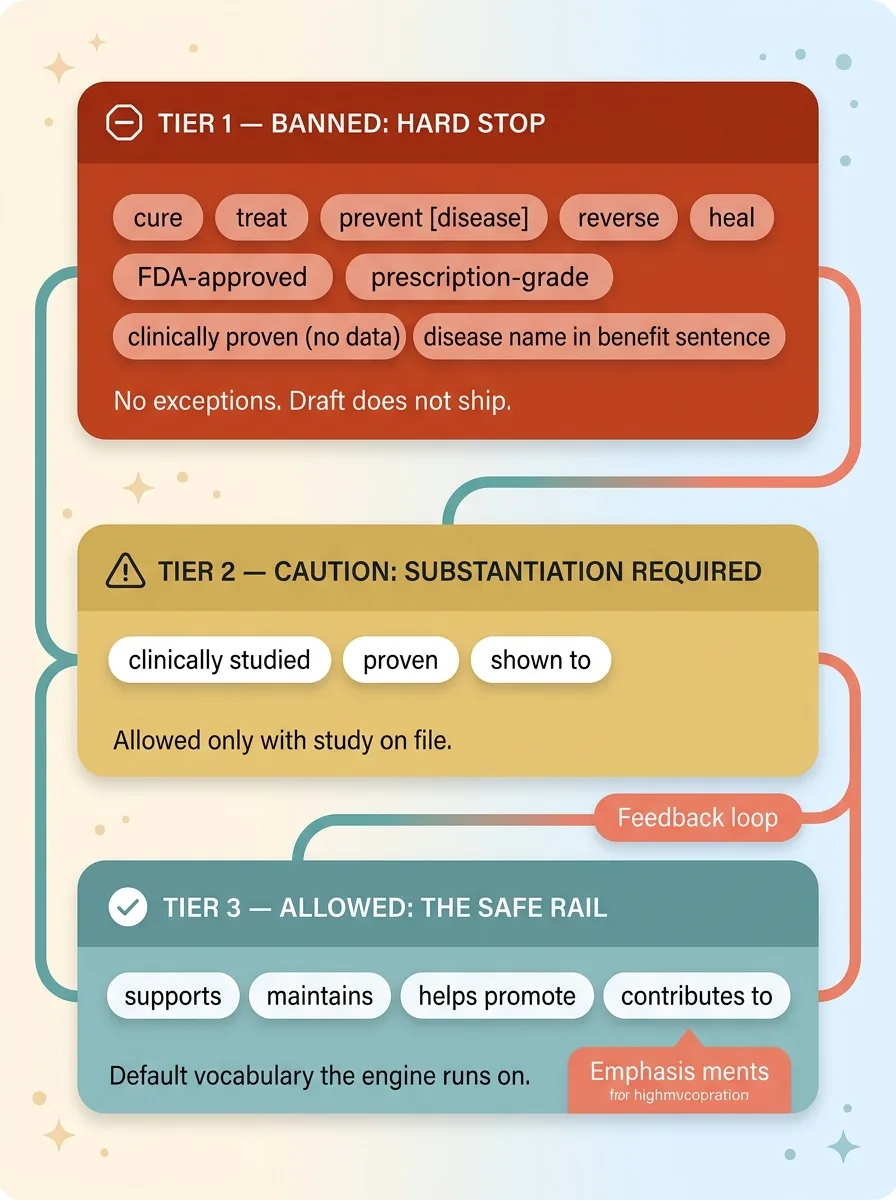 Three-tier banned-words system
Banned words: hard stop
Tier 1 is a hard stop. No exceptions, no context that saves them:
- cure, treat, prevent [disease], reverse, heal
- prescription-grade (implies pharmaceutical equivalence)
- clinically proven when the actual clinical data isn't on file
- FDA-approved (supplements are not FDA-approved, full stop)
- any disease name in a benefit sentence
If a draft contains one of these in the wrong frame, it doesn't ship. The gate holds it.
Caution words: substantiation required
Tier 2 is the gray zone where most teams get lazy. These words assert efficacy and require real substantiation on file before they can run:
- clinically studied
- proven
- shown to
"Clinically studied" is legal if you actually have the study. It's a violation if you don't. So the gate flags these and requires the substantiation reference before the copy clears. No study on file, no claim.
Allowed vocabulary: the safe rail
Tier 3 is the approved structure/function vocabulary the engine can use freely. Supports, maintains, helps promote, contributes to. This is the rail the copy runs on by default.
The point of the three tiers is that compliance stops being a debate. A writer or a model doesn't reason about whether "cures" is risky. It's banned. Lookup. Done.
And the obvious banned terms get caught before any model even reads the copy. We run regex first, a model second: a deterministic scan catches the hard-stop words instantly, cheaply, with zero false negatives on the things that are never acceptable. The model only handles the context-dependent calls. If you want the full mechanics, I broke down the banned-words system in detail separately.
The Disclaimer Rules Most Brands Get Wrong
This is the section that earns the article, because almost everyone gets disclaimers wrong, and the wrong version offers zero protection.
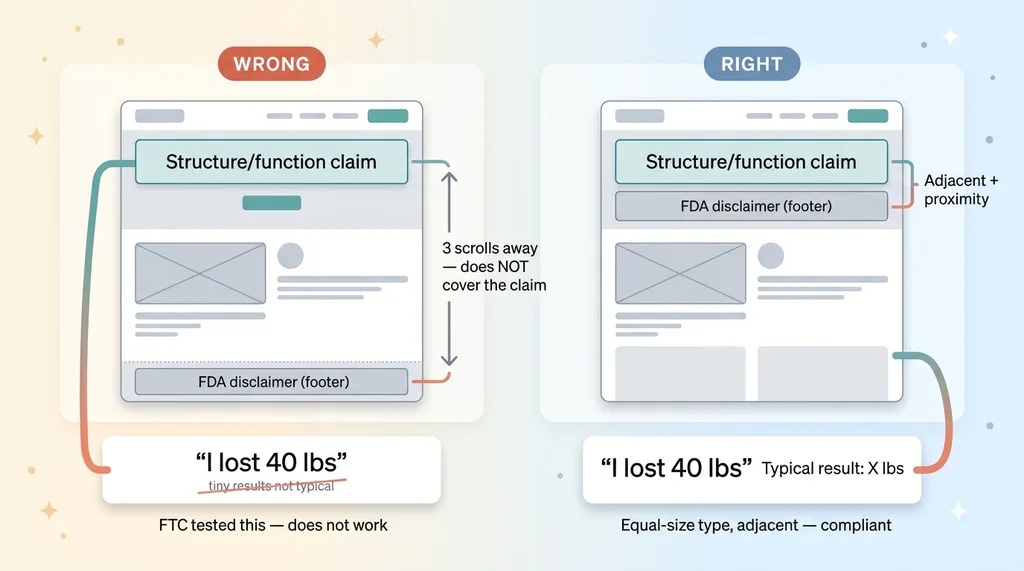 Disclaimer placement rules brands get wrong
Adjacent, not buried in the footer
The required FDA disclaimer reads: "This statement has not been evaluated by the FDA. This product is not intended to diagnose, treat, cure, or prevent any disease."
Most brands dump this in the website footer once and call it covered. That's not what the rule says. The disclaimer has to sit adjacent to the structure/function claim it modifies, not three scrolls away at the bottom of the page. A footer disclaimer doesn't cover a claim made in a hero banner.
So we codified placement into the gate. If a structure/function claim appears, the disclaimer has to appear near it. The engine checks for presence and proximity, not just existence somewhere on the page.
Why 'results not typical' doesn't work
Here's the FTC rule brands love to ignore, pulled straight from their guidance on testimonials.
"Results not typical" disclaimers empirically do not work to cure a misleading testimonial. The FTC tested this. The small print doesn't undo the impression the testimonial creates.
If you show a testimonial with an atypical result ("I lost 40 pounds"), you must state the generally expected result, in equal-size type, adjacent to the testimonial. Not in 8-point gray text. Equal size. Right there.
Brands think "results not typical" is a small-print escape hatch. It isn't. The FTC has been explicit that it doesn't protect you, and they've brought cases to prove it.
We encoded both rules. If a testimonial with a quantified outcome appears, the gate requires the expected-result statement at matching type size and adjacent placement. If it's missing or the type is too small, the draft is held. The escape hatch everyone relies on is the exact thing the regulators built a case around.
How the Gate Runs on Every Draft (Human or AI)
The principle is simple: every piece of copy passes through the same gate before it ships. Doesn't matter if a person wrote it or the content engine generated it. Same gate, same rules, no exceptions for the human.
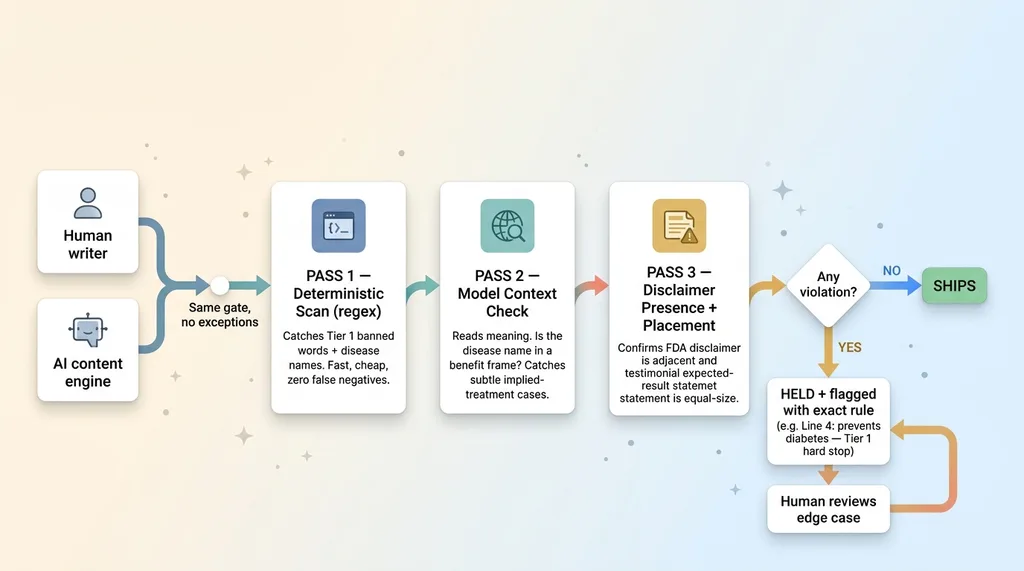 Three-pass compliance gate pipeline
This is the same architecture as a content machine where nothing ships until it passes compliance. The pipeline runs in three passes.
Pass one: deterministic scan. Regex hunts for the Tier 1 banned words and disease names. This is fast, cheap, and has no false negatives on the obvious stuff. "Cure" is "cure" whether a writer typed it or a model generated it. No reasoning required, so no reasoning errors.
Pass two: model context check. Now a model reads the copy and evaluates context. Is this disease name sitting in a benefit frame? Is "supports cardiovascular health" actually clean, or did the surrounding sentence imply treatment? This is the layer that catches the subtle stuff the regex can't, because it requires understanding meaning, not just matching strings.
Pass three: disclaimer presence and placement. The gate confirms the FDA disclaimer sits adjacent to its claim and that any testimonial carries the expected-result statement at the right type size.
If anything trips, the draft is held and flagged with the exact violation and the specific rule it broke. Not "this might be risky." The reviewer gets: "Line 4 contains 'prevents diabetes,' a Tier 1 disease claim, hard stop." Concrete. Actionable.
Here's the honest part. The model layer isn't perfect. It misses edge cases and occasionally flags clean copy. That's exactly why the deterministic layer runs first (so the unmissable stuff never depends on a model getting it right) and why a human still approves the genuine edge cases. The gate doesn't replace judgment. It removes the volume of obvious work so judgment goes where it matters.
What This Actually Lets You Say
The fear I hear most is that compliance guts the marketing. It doesn't. It channels it.
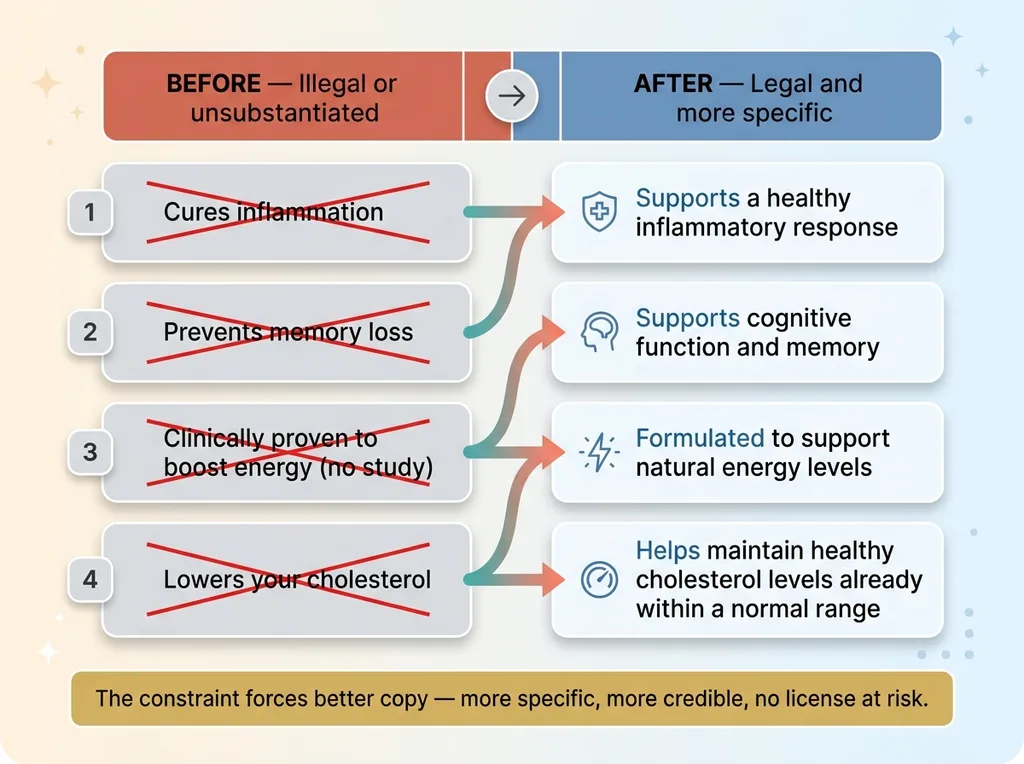 Before/after compliant copy rewrites
Watch what the system actually does with copy. These are anonymized, generic supplement examples, but they're representative of the rewrites the engine produces every day.
"Cures inflammation" becomes "supports a healthy inflammatory response."
"Prevents memory loss" becomes "supports cognitive function and memory."
"Clinically proven to boost energy" (no study on file) becomes "formulated to support natural energy levels."
"Lowers your cholesterol" becomes "helps maintain healthy cholesterol levels already within a normal range."
Look at what happened there. The marketing didn't disappear. It got more specific. "Cures inflammation" is a vague overpromise that also happens to be illegal. "Supports a healthy inflammatory response" is legal, and it's clearer about what the product actually does.
The constraint forces better copy. When you can't reach for the lazy disease claim, you have to articulate the real benefit, and the real benefit is usually more credible to a skeptical buyer anyway. Customers have learned to discount "cures everything" copy. Specific, measured language reads as more honest, because it is.
Compliance and conversion aren't enemies once the rules are explicit. They only fight when the rules are fuzzy and the team is guessing. Make the rules a filter, and the copy that comes out the other side is both legal and persuasive. I've watched this play out across hundreds of pieces. The clean version usually converts at least as well as the reckless one, and nobody's license is on the line.
Turning 'Be Careful' Into Infrastructure
Step back and look at how most regulated brands actually operate. They rely on a senior person's gut and a legal review that happens too late, after the copy is written, after the team is attached to the words, after the deadline pressure has set in.
That doesn't scale. A human reviewer can read maybe a few dozen pieces a week with real attention. Your content engine produces more than that. The gap between what gets reviewed and what gets published is exactly where the violations live, and that's where the medical director's license sits exposed.
The fix is to stop treating compliance as a final-stage hope and start treating it as infrastructure. Encode the rules once, as a filter, and let every draft pass through it automatically before a human ever looks at it. The human reviews the edge cases the gate flags, not all the copy. The obvious violations never make it that far.
This is how I build content engines for regulated clients. The compliance logic isn't a checkpoint at the end. It's woven into the pipeline so nothing ships dirty, whether it came from a writer or a model. Three tiers of vocabulary, a deterministic scan, a context check, and disclaimer enforcement, all running on every draft.
If you're shipping health or supplement copy and your only real safeguard is "be careful," you're one careless verb away from an FTC letter. That's not a strategy. It's a filter waiting to be built.
Get the next build note.
I write up each system I build, including what broke. Subscribe to my newsletter and I'll send you the next one.