Every CEO I talk to faces the same fork in the road: build vs buy AI. And most of them get it wrong on the first attempt — not because they're bad at decisions, but because they're getting advice from people with a financial interest in one particular answer.
Let me give you two examples.
The $200K Mistake Most CEOs Make With AI
A custom manufacturing client came to me after spending $180K on a custom AI system for production scheduling. Eighteen months of development. When I audited what they'd built, about 80% of the functionality was available in a $300/month SaaS tool they'd never evaluated. The remaining 20% — the part that was actually custom to their operation — could have been built as a lightweight integration layer for maybe $15K.
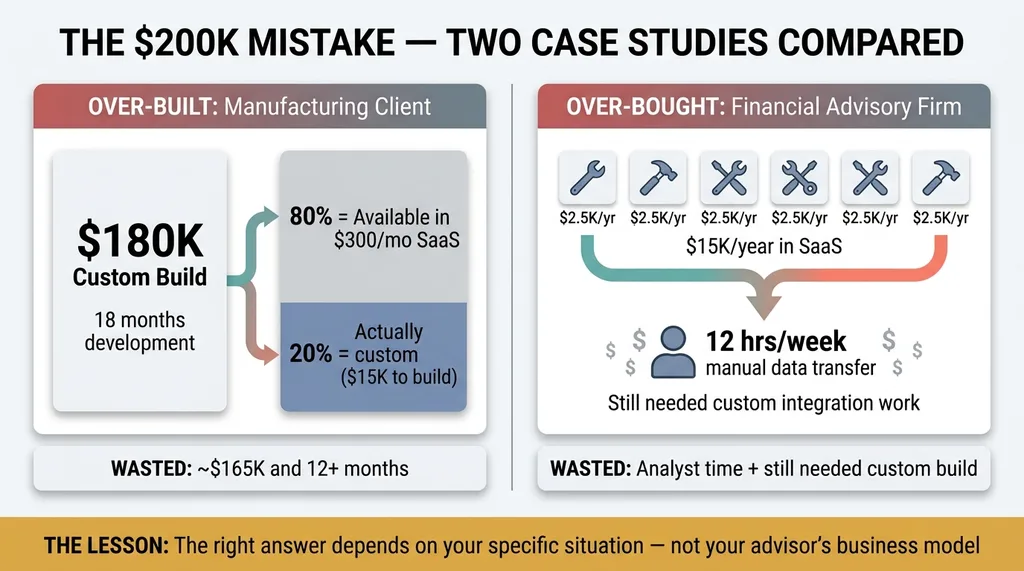 The $200K Mistake — Two Case Studies Compared
On the other end, a professional services firm had subscribed to six different AI SaaS tools at a combined $15K per year. Each tool did one thing reasonably well. None of them talked to each other. The firm had an analyst spending 12 hours a week manually exporting data from one tool, massaging it in spreadsheets, and importing it into the next. They ended up needing custom work anyway — just to get the tools they'd already paid for to function as a system.
The build vs buy AI decision isn't about which path is universally "better." It's about which is right for your situation, your data, your team, and your budget — right now. Not in theory. Not in a pitch deck. Right now.
Most CEOs default to whatever their most technical advisor recommends. If you're talking to engineers, they say build. If you're talking to vendors, they say buy. Neither is objective.
I've spent the last several years doing all three — buying, building, and advising — across DTC, finance, healthcare, and manufacturing. Here's the framework I use to make the decision. It comes down to four variables.
The Four Variables That Determine Your Path
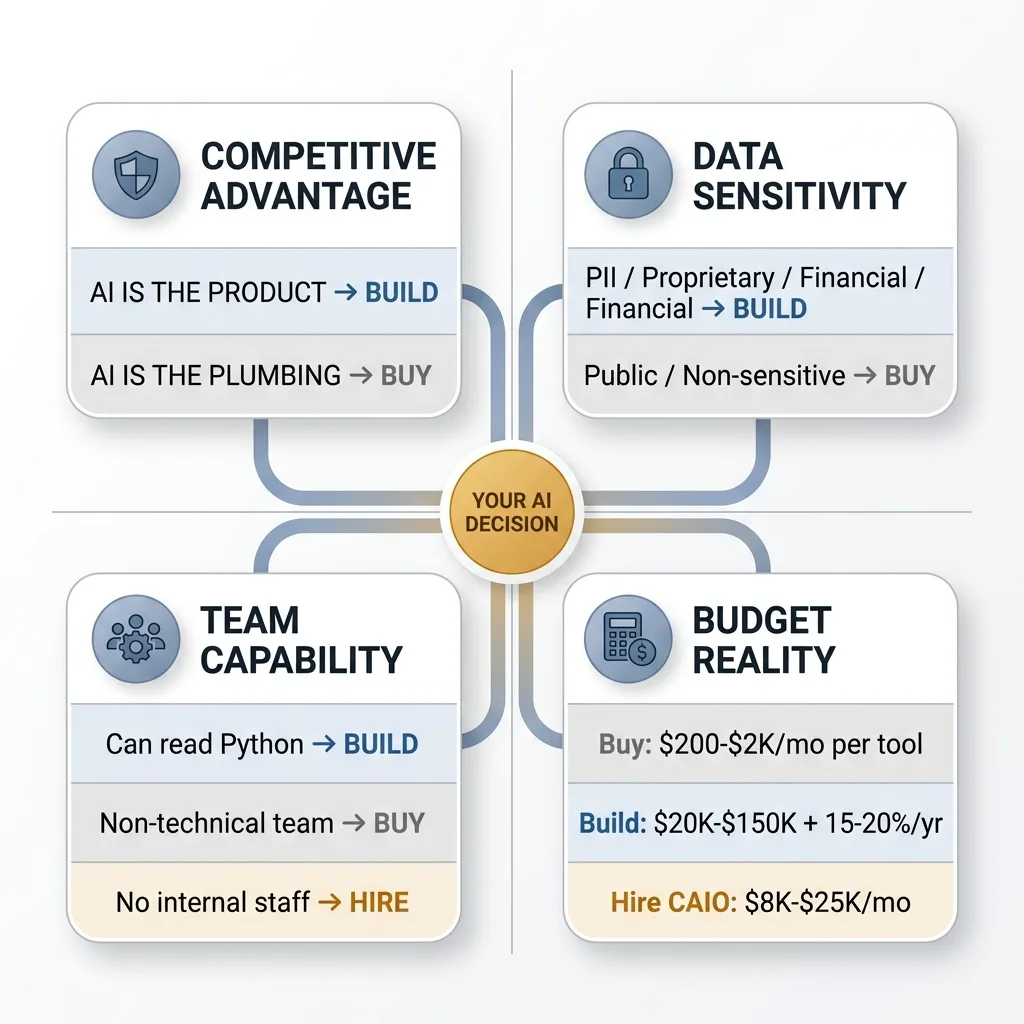 Four Variables Framework
Competitive Advantage: Is AI the Product or the Plumbing?
This is the single most important question. If AI directly drives your differentiation — a proprietary recommendation engine, a unique pricing model, a product creation system that competitors can't replicate — you build. If AI is operational plumbing — email triage, a basic support chatbot, scheduling automation — you buy.
In my DTC fashion brand, the product creation pipeline is a competitive advantage. It takes a concept from idea to live on the site in 20 minutes. That used to take 3-4 hours. No SaaS tool does this because it's deeply woven into my specific supply chain, photography workflow, and listing standards. I built it custom.
Accounting integration? That's plumbing. I bought it.
Data Sensitivity: What Can't Leave Your Walls?
Customer PII, health records, financial data, proprietary business logic — these push hard toward build. Not because SaaS tools are inherently insecure, but because every additional vendor with access to sensitive data is another attack surface, another compliance exposure, another data processing agreement to manage.
My dynamic pricing engine manages 564+ products with a 4-tier ABC classification system. The pricing logic encodes my actual cost structure — materials, labor time, margin targets by category. Handing that to a vendor means handing them the economics of my entire business. I built it in-house.
General marketing content, public-facing chatbots, social media scheduling — these are fine to buy. The data isn't sensitive, and the risk of exposure is low.
Team Capability: Who Maintains This at 2 AM?
I'll be blunt. If nobody on your staff can read Python, a custom AI build becomes a liability the moment the contractor finishes. The system doesn't just run forever untouched. Models get updated. APIs change. Data structures evolve. Someone has to maintain it.
Buy requires almost zero technical maintenance — the vendor handles everything. Build requires ongoing engineering investment. Hire splits the difference — you get someone who builds and maintains, without committing to a full-time engineering headcount you may not need.
Be honest about your team. Aspiration doesn't maintain production systems.
Budget Reality: Total Cost of Ownership, Not Sticker Price
SaaS looks cheap at $300/month until you're paying for 12 tools and they still don't integrate. Custom build looks expensive at $50K until you realize it replaces $4K/month in combined SaaS costs and manual labor — and pays for itself in 13 months.
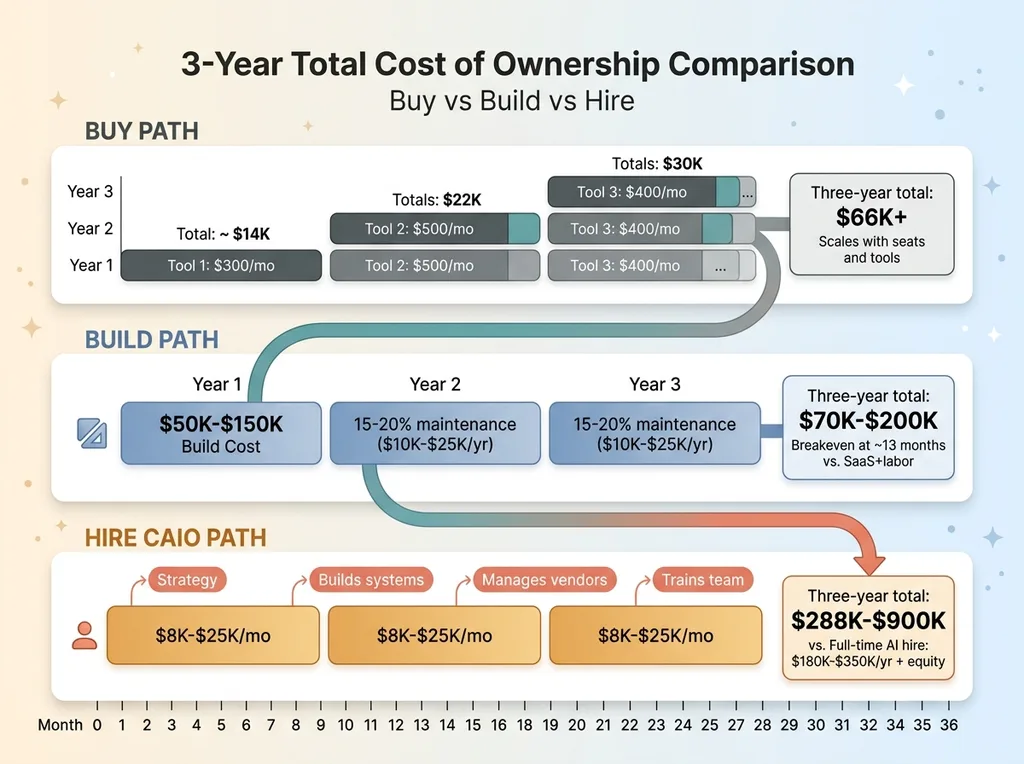 3-Year Total Cost of Ownership Comparison
Always calculate 3-year total cost of ownership:
- Buy: $200–$2,000/month per tool. Low upfront, but compounds across tools and scales with seats.
- Build: $20K–$150K upfront plus ongoing maintenance (budget 15-20% of build cost per year).
- Hire a Chief AI Officer: $8K–$25K/month. Gets you strategy, execution, and the judgment to know when to buy vs. build for each problem.
When to Buy: The SaaS AI Path
What 'Buy' Actually Looks Like
Buy is the right answer more often than most technical people want to admit. I say this as someone with 22,000+ lines of custom Python in production. Not everything needs to be custom.
Buy is right when:
- A well-established tool solves a well-defined problem. Customer support chatbot for a 15-person company? Intercom's AI features beat a custom build every time. You're running in days, not months.
- The function isn't a differentiator. Email marketing AI through Klaviyo, basic content generation through Claude or ChatGPT, scheduling through any decent tool — these are commodity capabilities. Buying them frees up budget and attention for what actually matters.
- You have no technical staff. If your team is entirely non-technical, buying is the only path that doesn't create a dependency on external developers for ongoing operations.
- Speed matters more than customization. Sometimes getting 80% of the solution live this week beats getting 100% of the solution live in four months.
The SaaS Trap to Watch For
The danger with buying is the "last 20%" problem. The tool does 80% of what you need, but that remaining 20% is where 80% of your actual value lives.
Signs you've outgrown buy:
- You're paying a developer to build workarounds for your SaaS tool
- You're exporting data, processing it elsewhere, and re-importing it
- The vendor's product roadmap doesn't align with your needs, and you're waiting on features that may never come
- You're duct-taping three tools together to approximate what one custom system could do cleanly
When these signs appear, it's time to evaluate the build path — not for everything, but for the specific capability that's outgrown SaaS.
When to Build: The Custom AI Path
What 'Build' Actually Requires
Build is right when AI is your competitive advantage, when your data is proprietary and sensitive, when no existing tool fits your workflow, or when you've conclusively outgrown SaaS.
Here's what building looks like in practice — from my own brand, not theory.
My product creation pipeline orchestrates multiple AI models in sequence: content generation, image processing, SEO optimization, pricing assignment, and listing publication. No SaaS tool does this because it's deeply integrated with my specific supply chain and handmade production process. It went from a 3-4 hour process to 20 minutes.
My dynamic pricing engine runs across 564+ products using a 4-tier ABC classification. Off-the-shelf pricing tools don't understand handmade economics — where labor is the dominant cost variable and scales differently than manufactured goods. I built it because no vendor could.
My multi-model architecture routes tasks to different AI models based on what each does best — Claude for content, Gemini for images, custom chaining for cost efficiency. No single vendor offers this kind of orchestration because it's inherently opinionated about tradeoffs.
This is 22,000+ lines of custom Python. 29 AI-powered automation modes in production. It took months and constant iteration. It's real engineering, not a weekend hack.
The Build Trap to Watch For
The biggest risk with building: scope creep and underestimating maintenance.
A custom AI system isn't a one-time project. It's a product that needs ongoing care. Models drift. Data changes. Business rules evolve. If you build, you need someone to maintain it — either internal staff or a long-term relationship with whoever built it.
The other trap: building what you should buy. I've seen companies spend $60K building a custom chatbot that's marginally better than a $200/month SaaS tool. The marginal improvement didn't justify 300x the cost.
If you're going the build route, start with the highest-impact systems first. I wrote a guide on the five AI systems every small business should build first — it's the prioritization framework I use with every engagement.
When to Hire: The Expert Path
The Spectrum of 'Hire'
Hire is the right answer when you don't know which of the above paths to take, when you need both strategy and execution simultaneously, or when you need to move fast without building a permanent team.
But "hire" isn't one thing. It's a spectrum:
- AI consultant — Strategy only, no implementation. $200–$500/hour. Delivers a PDF. You still need someone to execute.
- AI agency — Builds to spec but doesn't own outcomes. $50K–$300K per project. Quality varies wildly.
- Full-time AI hire — Expensive ($180K–$350K/year plus equity), hard to find, and often underutilized at companies under $20M revenue.
- Chief AI Officer — Strategy plus builds plus manages vendor relationships plus trains your team. Monthly retainer.
I've seen the full range. A real estate syndication client hired an AI consultant, got a 40-page strategy document, then had nobody to implement it. The document sat in a shared drive for six months. Another client hired me as their CAIO — within 30 days, they had three systems in production generating measurable ROI. The difference isn't advice. It's execution.
What Good Hiring Looks Like
The right hire can tell you when to build AND when to buy — because they're not biased toward either. They build working systems, not just recommendations. And they transfer knowledge to your team so you're not permanently dependent.
I wrote a detailed comparison of how a CAIO compares to consultants and in-house hires — worth reading if you're evaluating this path.
The Decision Tree: A 5-Minute Exercise
Walk through this right now for your most pressing AI opportunity:
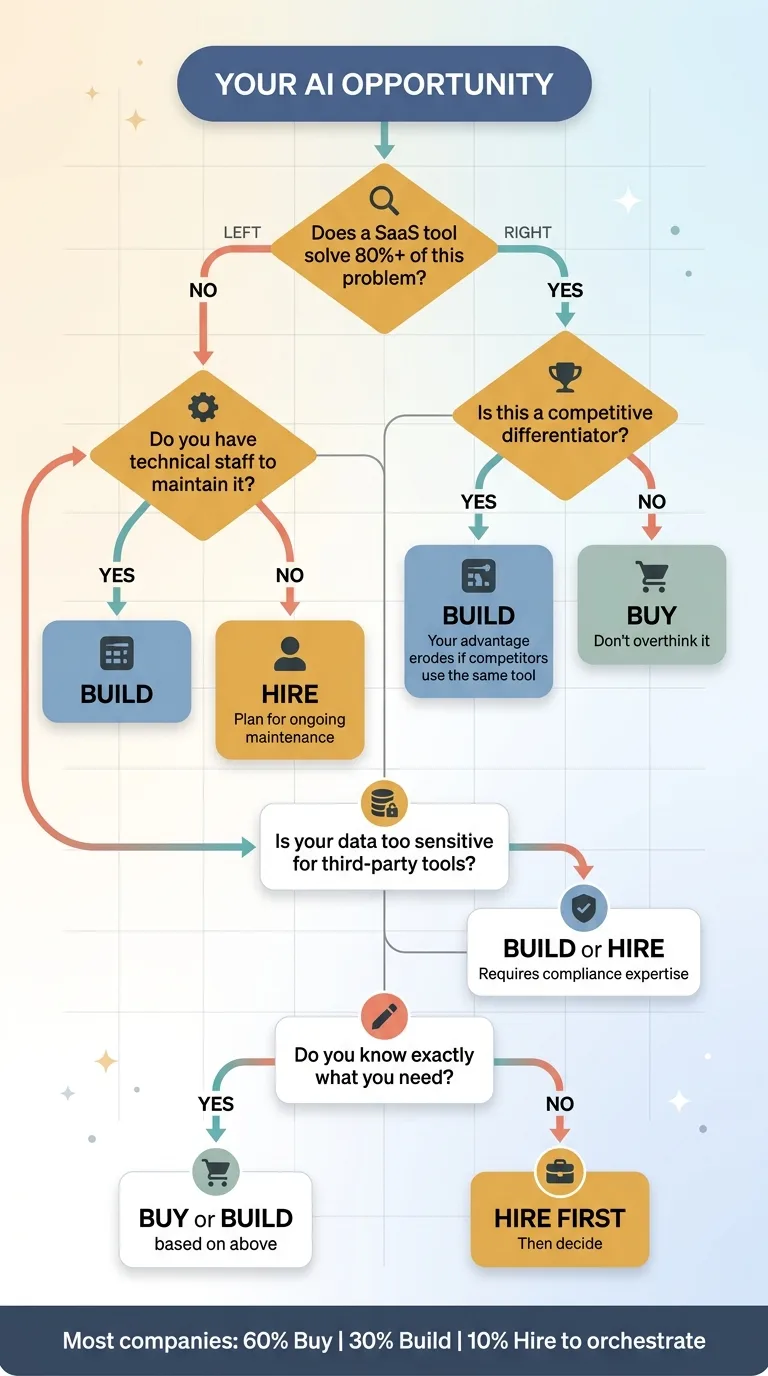 Build vs Buy vs Hire Decision Tree
1. Does a SaaS tool exist that solves 80%+ of this specific problem?
- Yes → Does this problem represent a competitive differentiator?
- No → Buy. Don't overthink it.
- Yes → Consider Build. Your advantage erodes if competitors use the same tool.
- No → Move to question 2.
2. Do you have technical staff to maintain a custom system?
- Yes → Build.
- No → Hire someone to build it (and plan for ongoing maintenance).
3. Is your data too sensitive for third-party tools?
- Yes → Build with appropriate security, or Hire someone who understands compliance.
4. Do you know exactly what you need?
- Yes → Buy or Build based on the above.
- No → Hire first to figure it out, then decide.
Here's the key insight most frameworks miss: you don't choose one path for everything. You choose the right path for each problem.
My own brand uses bought tools (Shopify, Klaviyo, standard SaaS), custom-built systems (product pipeline, pricing engine, SEO automation), and the expertise to tie them all together. The ratio for most companies I work with lands around 60% buy, 30% build, 10% hire to orchestrate.
How to Get the AI Make-vs-Buy Decision Right on the First Try
Here's the honest truth: most companies get this wrong initially because they don't have enough context to know what they don't know. The failure rate for AI projects sits around 88%, and a significant chunk of those failures trace back to choosing the wrong path — building when they should have bought, buying when they should have built.
The cost of getting it wrong isn't just the money spent on the wrong approach. It's the 6-12 months lost, the team's eroded confidence in AI, and the competitor who made the right call and is now ahead.
The fastest shortcut: talk to someone who's done all three paths across multiple industries. I've built 29 AI automation modes, evaluated dozens of SaaS AI tools, and walked companies through this exact AI build or buy decision in DTC, finance, healthcare, and manufacturing. Not because I have some magic formula — but because pattern recognition across enough situations makes the right answer obvious faster.
If you're staring at this decision right now, I'll walk through the framework with you in 30 minutes and tell you what I'd do in your situation. No charge for the conversation.
Get the next build note.
I write up each system I build, including what broke. Subscribe to my newsletter and I'll send you the next one.