Build a Business to Be Acquired: One Operator's Playbook
How an AI-native operator builds a business to be acquired: the supplier-lockup, concentration-risk dashboard, and buyer-story positioning that close a deal.
By Mike Hodgen
Most Small Businesses Never Get Strategy or Exit Work
If you want to build a business to be acquired, you need two things most small companies never get: real strategy work and real exit work. Both are priced out of reach.
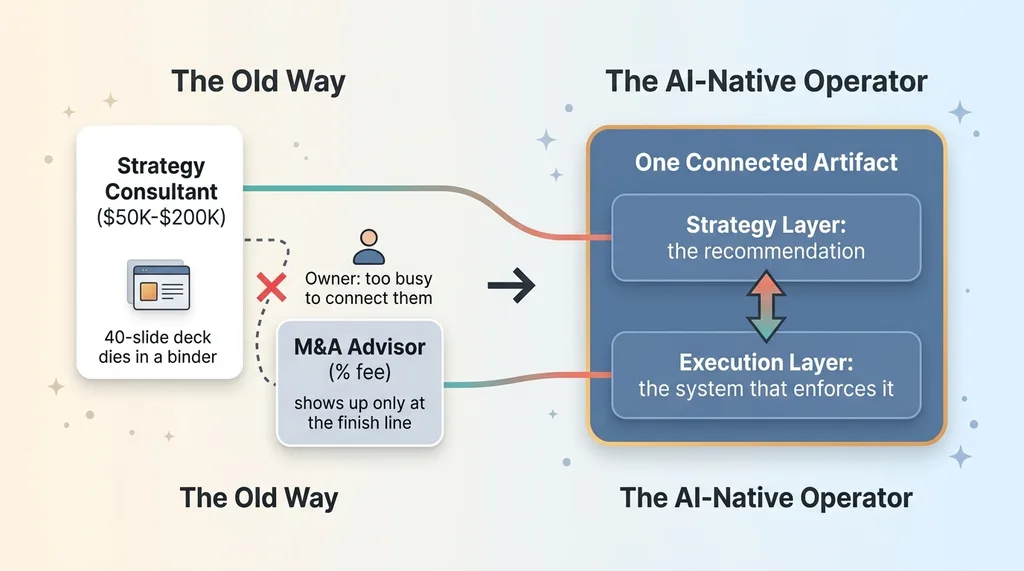 Strategy layer fused with execution layer into one artifact
A strategy consulting engagement runs $50,000 to $200,000. The good firms are worth it, in theory. But for a $3M to $15M distributor, that's a number that makes the owner laugh and hang up.
M&A advisors are worse for the early stages. They take a percentage, and they only show up near the finish line, when the deal is already on the table. They don't help you build toward the deal. They help you close one that already exists.
The work that's priced out of reach
So the small business owner gets neither. Or, on a good day, they scrape together the cash for one engagement and get a deck.
A beautiful deck. Forty slides. A two-by-two matrix. A "strategic roadmap."
And then nothing happens.
Why advice disconnected from execution dies in a binder
The deck dies in a binder because the owner is too busy running the business to turn a slide into a system. Strategy that isn't executed isn't strategy. It's an expensive opinion.
This is the gap I keep finding. The recommendation and the tool that enforces the recommendation live in two different worlds, owned by two different vendors, and the owner is the only one who can connect them. They never have time.
Here's my thesis, and the rest of this article is the proof: an AI-native operator can fuse the strategy layer and the execution layer into a single artifact. The recommendation and the tool that enforces it become the same thing. You don't get a slide that says "document your supplier relationships." You get a system that documents them, keeps them current, and hands a buyer the answer.
The Distributor Whose Whole Strategy Was Getting Acquired
I work with a small paper-packaging distributor. I'll keep the details vague because the whole point is discretion, but the shape of it matters.
The owner didn't want to scale forever. They'd built something solid, profitable, regional. And at some point they made a decision most owners avoid until it's too late: the endgame is an acquisition. The strategy is to get bought by a larger full-line distributor as a clean tuck-in.
One thesis that shaped every decision
That single thesis reframes everything.
The question stops being "how do I run this better." It becomes "what does a buyer pay a premium for, and how do I build toward it." Those are not the same question. A business optimized to run forever looks different from a business optimized to sell well.
A scale-forever business invests in headcount and infrastructure for a future the owner is going to capture. An exit strategy operator invests in the things that survive the transition and show up on a buyer's valuation: documented relationships, clean financials, transferable assets, manageable risk.
Why the ops tool was never the point
So I didn't start by building an ops tool. That's the mistake.
Most vendors would walk in, see a distributor, and start building an inventory dashboard or an order-management system, because that's what distributors "need." Useful, sure. But beside the point.
I started by asking what makes this specific company acquirable. Then I built the systems around that answer. The ops tooling came second, and it was shaped entirely by the exit thesis. Every dashboard, every document, every automation exists to make the company worth more on the day a buyer shows up.
That's the difference between building software for a business and building a business to be acquired.
Build the Moat a Buyer Actually Pays For
The first artifact we built was a supplier-lockup playbook.
Here's the thing about acquiring a distributor: the buyer isn't really buying inventory. Inventory is a line item they can replicate. They're buying relationships and access. They're buying the reason this distributor can get product, terms, and pricing that a new entrant can't.
The supplier-lockup playbook
The problem is that relationships in one owner's head are worth nothing in a deal. Worse than nothing. They're a risk, because the buyer knows the moment the owner walks away, those relationships might walk with them.
So we documented and systematized the whole thing. Supplier terms. Exclusivity arrangements where they existed. Volume tiers and the thresholds that triggered better pricing. Renewal cadences, so nothing lapsed quietly. Then we built tooling that made those relationships visible, transferable, and defensible.
Turning relationships into transferable assets
Picture the moment in diligence. A buyer leans across the table and asks: "What happens to your supplier pricing if you leave?"
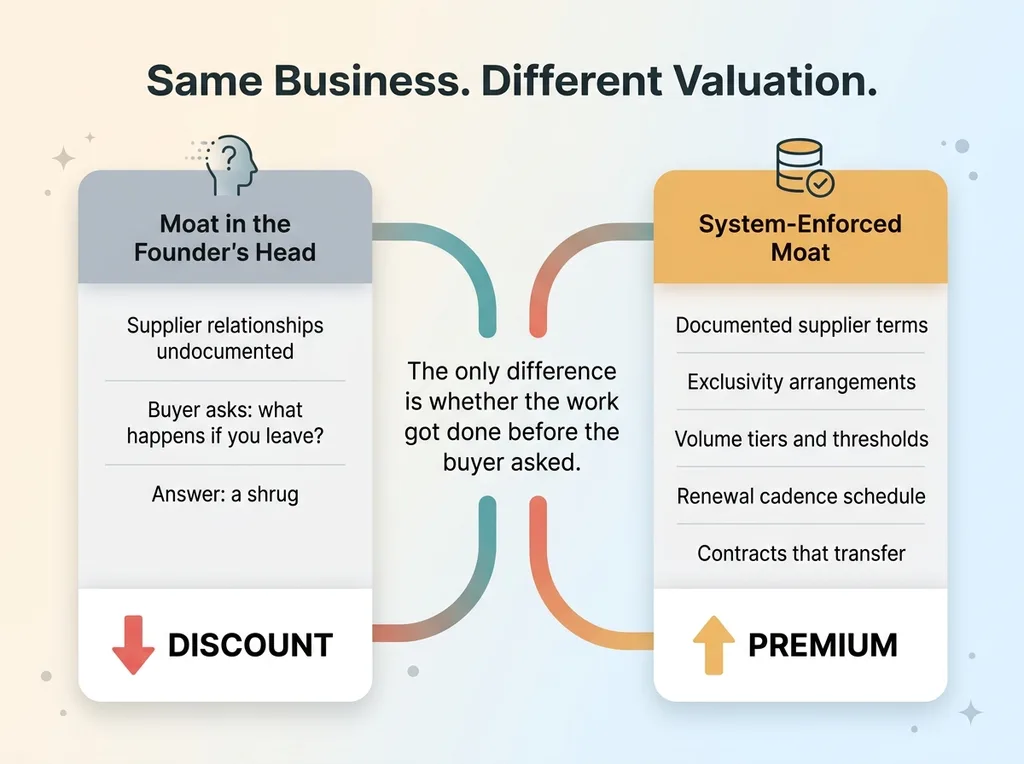 Memory-based moat vs system-enforced moat valuation impact
If the answer is a shrug, that's a discount. A big one. The buyer prices in the risk that the whole supplier advantage evaporates the day the founder cashes out.
If the answer is "it's all in the system, here are the contracts, here are the tiers, here's the renewal schedule, and here's why these terms transfer," that's a premium. You've converted a personal relationship into a transferable asset.
A moat that lives in someone's memory is a discount at the negotiating table. A documented, system-enforced moat is a premium. Same business. Different valuation. The only difference is whether the work got done before the buyer asked.
Make Your Risks Visible Before the Buyer Finds Them
The second artifact was a concentration-risk dashboard.
Buyers run diligence for one reason: to find the landmines. And the first landmine they look for in any distribution business is customer concentration. If a huge share of revenue comes from a handful of accounts, that's a valuation killer the moment they discover it.
The concentration-risk dashboard
The instinct most owners have is to bury it. Don't bring it up. Hope nobody asks.
That's exactly backwards.
We built a concentration-risk dashboard that flags it in real time, surfacing concentration by customer and by supplier. The owner can see it constantly, not just at deal time. Which means they can manage it down well before any conversation with a buyer, deliberately growing smaller accounts to dilute the big ones.
Why surfacing the bad news raises the price
Here's the counterintuitive part. When a small set of accounts is most of your revenue, showing the buyer that you already track and manage that risk is a trust signal that raises the price.
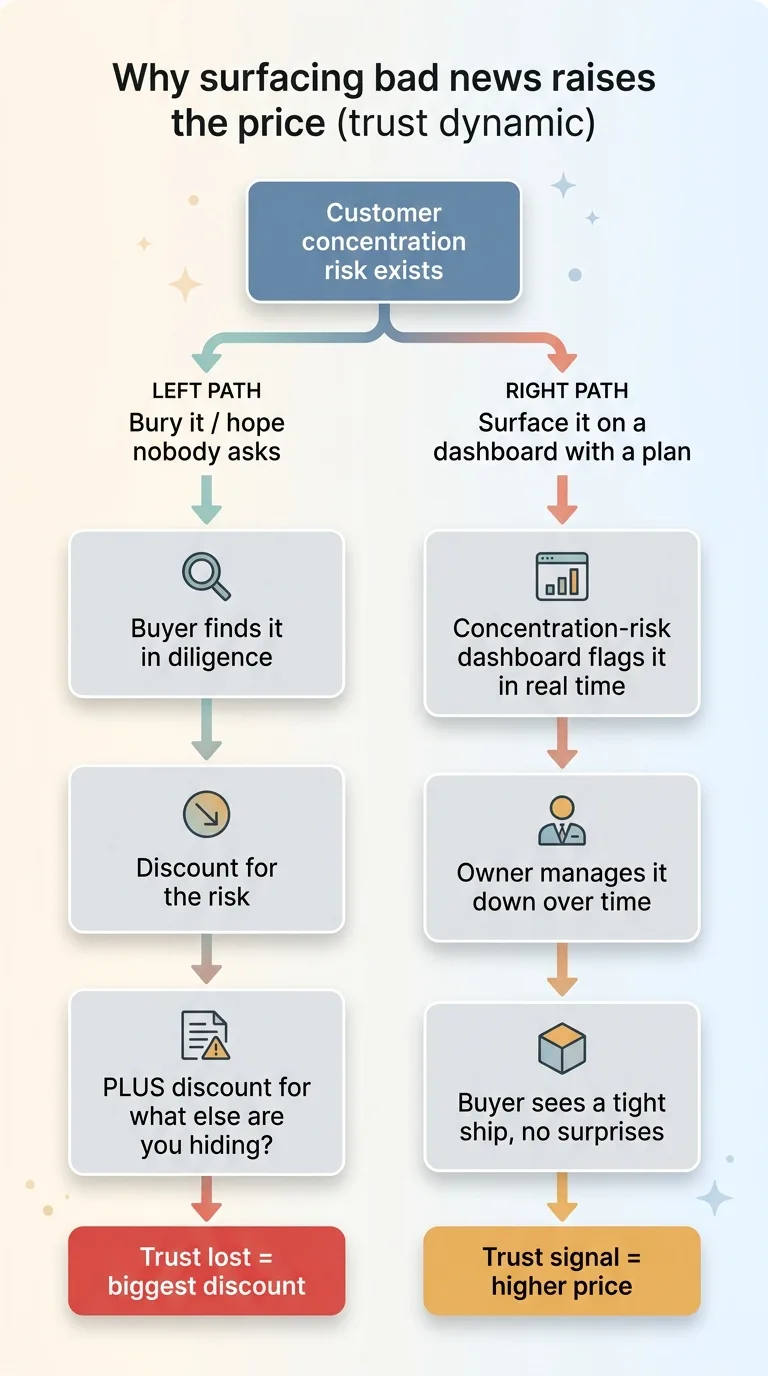 Why surfacing bad news raises the price (trust dynamic)
It tells them you run a tight ship. It tells them there are no surprises waiting in month three. It tells them you understand your own business at the level a buyer needs to underwrite a deal.
Hiding it and getting caught does the opposite. Now they don't just discount for the concentration risk. They discount for the concentration risk and they wonder what else you're hiding. Trust is the most expensive thing to lose in diligence.
Surfacing your own bad news, with a plan attached, is one of the highest-return moves an exit strategy operator can make.
Write the Buyer's Story So They Don't Have To
The third artifact was an acquirer-story positioning document.
The easier you make it for a buyer to justify the acquisition internally, the faster and the richer the deal. Most owners think the buyer just runs the numbers and decides. They don't. Someone inside the buyer has to champion the deal, defend it to their boss, and sell it to a committee.
The acquirer-story positioning doc
So we wrote the story for them. From the acquirer's perspective, not ours.
Here's the geography you gain. Here's the customer base that complements yours instead of overlapping. Here's the supplier access that strengthens your own buying power. Here's the clean integration path, with the operational realities mapped out so nobody discovers a mess after signing.
This is classic strategy-consultant and M&A-advisor work. The kind of positioning a small distributor would never normally afford, delivered by people who'd charge six figures and disappear.
Lowering the cost of saying yes
The reason I could produce it fast, and keep it living and accurate, is that it pulls from the same systems running the business. It's not a separate slide deck that goes stale the week after I write it.
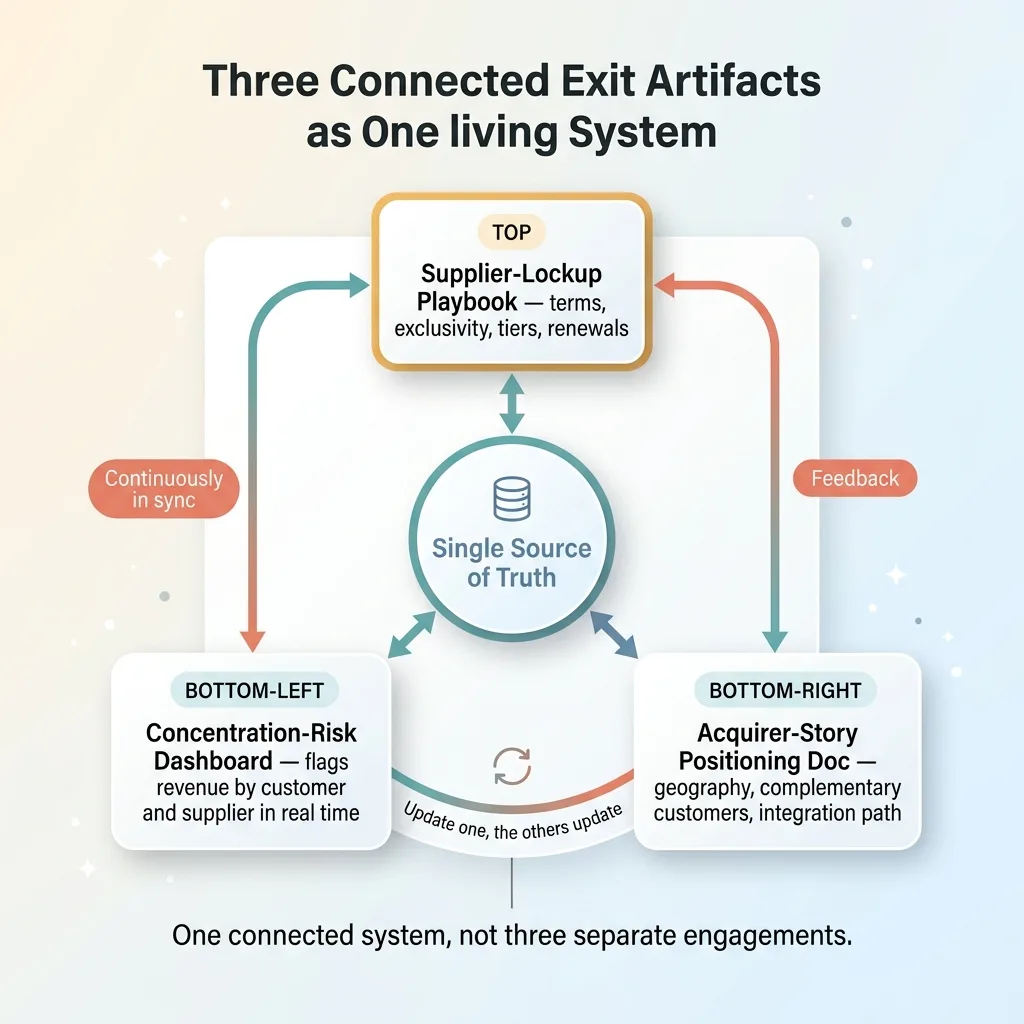 The three connected exit artifacts as one living system
When the supplier playbook updates, the positioning updates. When concentration shifts, the story reflects it. The strategy document and the operating reality stay in sync because they're wired into the same source of truth.
That's the operator advantage. The story isn't a sales pitch the owner has to remember to refresh. It's a byproduct of the systems already doing the work.
Can One Person Really Do Strategy and Exit Work?
Fair question. The obvious skepticism is that strategy, M&A positioning, and engineering are three different jobs done by three different kinds of people. How does one person credibly do all of it?
The answer is that AI collapses the distance between the strategy layer and the execution layer. I don't just advise on AI, I build it, which means the recommendation and the system that enforces it come from the same hands.
Operating at the altitude of three people
This is the difference between an operator and a consultant. A consultant tells you what to do. An operator builds it while telling you. AI lets one person have range across the whole problem, not depth in one slice, so the supplier playbook, the risk dashboard, and the acquirer story aren't three separate engagements. They're one connected system.
AI does the heavy lifting that used to require a team. The synthesis. The document drafting. The dashboard plumbing. The option modeling that compares "scale" against "sell" against "hold."
Where the human judgment still lives
But let me be honest about the limits, because anyone who isn't is selling you something.
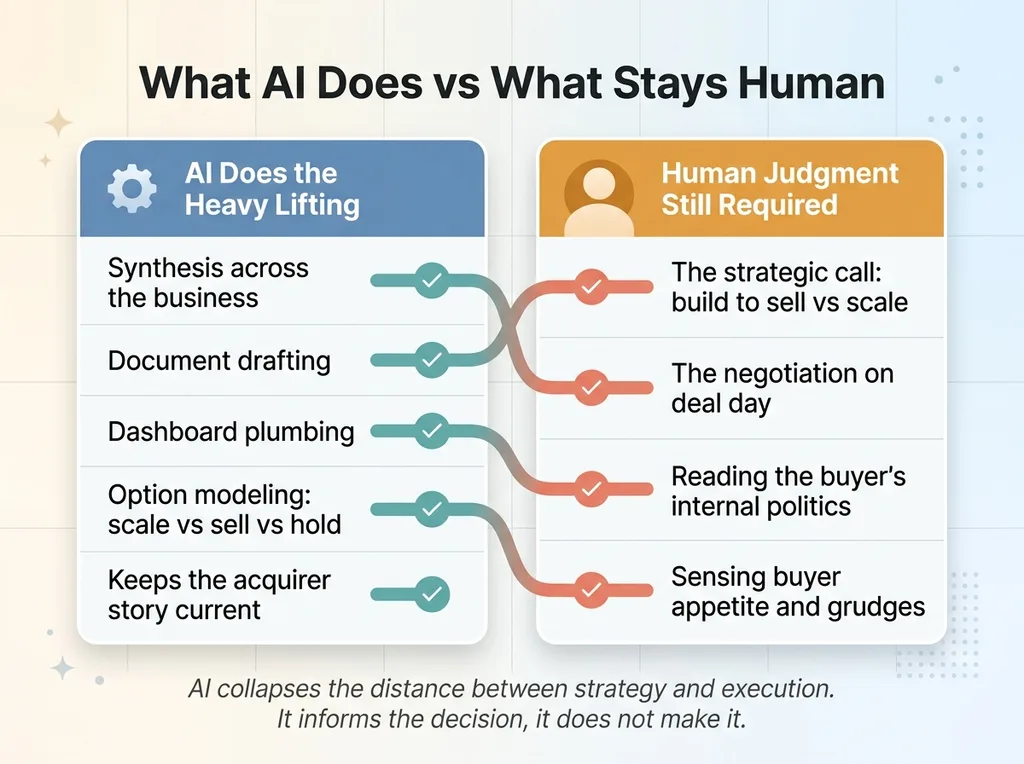 What AI does vs where human judgment still lives
The strategic call, that this company should be built to be acquired rather than scaled, is human judgment. It comes from the owner's goals, their appetite for risk, their age, their plans. AI doesn't decide that. It informs it.
And the negotiation itself still needs people. I'm not replacing the banker on the day of the deal. I'm making sure the company is worth more when that day comes.
There's also a real ceiling: AI can't read a specific buyer's internal politics or appetite. It can tell you what makes you generically attractive. It can't tell you that the VP at the acquiring company has a grudge against your category. That's still a human game.
What This Looks Like If Your Endgame Is an Exit
Most owners run the business and worry about the exit later. By the time "later" arrives, the value is already capped.
Capped by moats that live in the founder's head and walk out the door with them. Capped by concentration risk the buyer discovers in diligence instead of hearing about up front. Capped by a story the buyer has to assemble themselves, which they'll always assemble conservatively.
The alternative is to decide the endgame early and build every system to serve it. The ops tooling and the exit thesis become one artifact. You're not running the business and separately preparing to sell it. You're running it in a way that makes it more sellable every single day.
That's what M&A positioning for a small company actually looks like when it's done by someone who builds instead of someone who advises. Not a binder. A living set of systems that answer the questions a buyer will ask, before they ask them.
If your endgame is an acquisition, or even if you just want to keep the option open, this work should start now. Not when the offer arrives. By then the value is already decided.
Want to explore what AI could do for your business?
Book a free 30-minute strategy call. No pitch deck, no sales team, just a real conversation about your operations and where AI fits.
Get AI insights for business leaders
Practical AI strategy from someone who built the systems — not just studied them. No spam, no fluff.
Hodgen.AI
Ready to automate your growth?
Book a free 30-minute strategy call with Hodgen.AI.
Book a Strategy Call