AI Operator Strategy: Build the Company, Not Just the Tool
An AI operator strategy means building the whole company around its exit, not just shipping a CRM. Here's how one operator works at strategy and engineering altitude at once.
By Mike Hodgen
Most People Build the Tool. I Build the Thesis.
Here's how a typical AI engagement goes. The client says they want a CRM. A developer scopes it, builds it, ships it. The client gets a CRM. Everyone shakes hands. Engagement over.
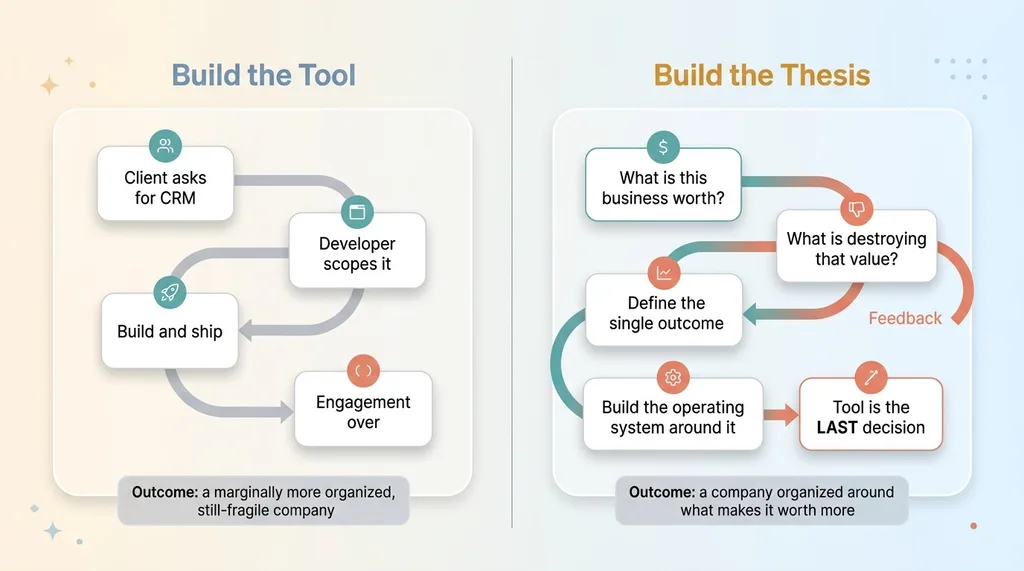 Tool-first vs Thesis-first approach to AI engagements
That's not how I work, and it's cost me some quick wins. But it's also why the work actually matters.
My approach to an AI operator strategy starts somewhere most engineers never look: what is this business actually worth, and what is quietly destroying that value right now? Then I work backward to the software. The tool is the last decision, not the first.
Let me give you a real example. I worked with a small regional distributor. Solid revenue, profitable, the owner ran a tight ship. On paper, healthy. They came to me wanting a CRM to organize their customer relationships. Reasonable ask.
But two things jumped out the moment I looked under the hood. Most of their revenue came through a handful of accounts. And they resold products from suppliers they had no contracts with. No supply guarantees. No price locks. Nothing.
Any competent developer would have built them the CRM. It would have worked. It would have made them marginally more organized. And it would have done nothing about the two facts that made their company fragile and cheap.
So I didn't ship a CRM. I built the company around its exit.
That's the difference an AI operator strategy makes. You don't start from a feature list. You start from the single outcome that changes what the business is worth, and you build the operating system around it.
The Diagnosis Came Before the Software
Before I wrote a line of code, I spent time understanding what this company actually was, not what the org chart said it was.
Three accounts, no contracts
Two things stood out, and they were both structural.
First, the revenue concentration. A large majority of sales flowed through three customers. Lose one and you don't lose a third of the business in any clean, proportional way. You lose a third of the revenue and most of the profit, because fixed costs don't shrink when a customer walks.
Second, the supplier situation. The products driving the business came from suppliers with no agreements behind them. No contracts locking in supply. No pricing protection. The whole operation rested on relationships that could change with a phone call.
Individually, each of these is a problem. Together, they're a structural weakness most owners never see because the business keeps running fine. Right up until it doesn't.
Why this is an acquirer's nightmare
Now look at this company through the eyes of a buyer doing due diligence.
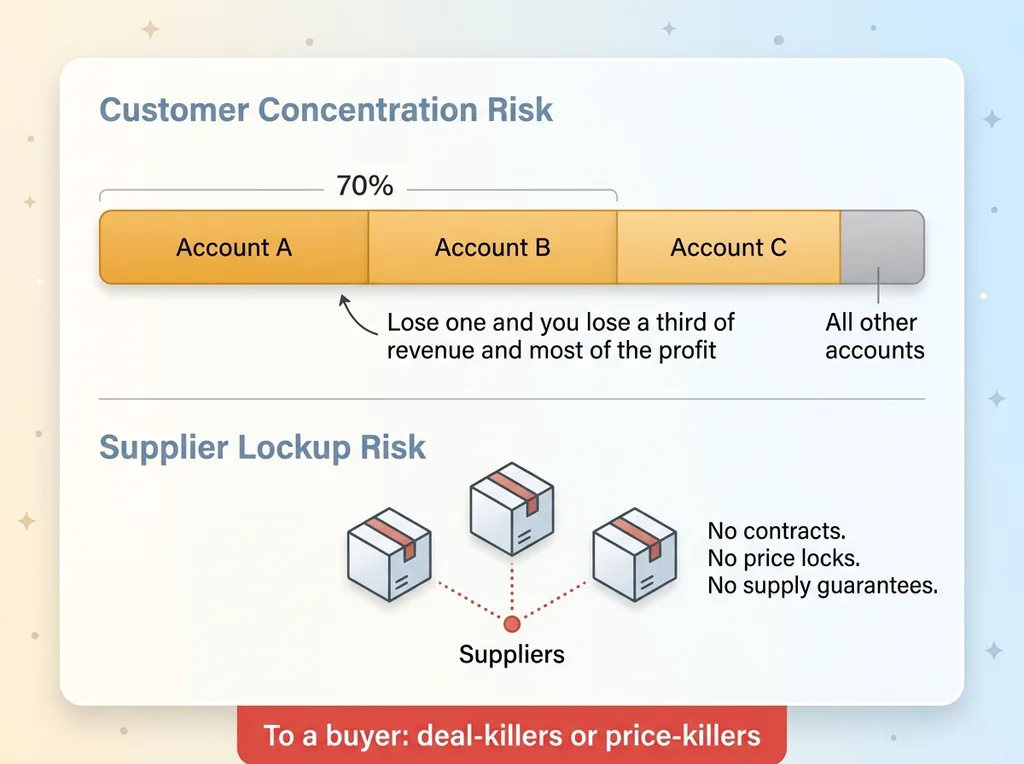 The two structural risks: revenue concentration and supplier lockup
Customer concentration risk is one of the first things a diligence team flags. If half your revenue depends on one of three relationships, the buyer assumes that relationship could break, and they price the business as if it might. That's a concentration discount, and it's brutal on small companies.
Supplier lockup is the other half. If a supplier can pull the product line or reprice it at will, there's no durable business to buy. There's a sales channel with no foundation under it.
To a buyer, these aren't minor. They're deal-killers or price-killers.
This is exactly where being a builder and a strategist at the same time matters. A strategy consultant would have told the owner the company was over-concentrated and handed them a slide deck. A dev shop would have built the CRM. Neither would have connected the diagnosis to the software. Because I don't just advise on AI, I build it, I could ask the better question: not how do we make this run smoother, but what does this company need to be worth more?
What an AI Operator Strategy Actually Looks Like
An AI operator strategy means building the operating system of a company around a single strategic outcome, not around a feature list. Everything I built for this distributor pointed at one thing: making the company more valuable to a buyer by proving the risks were shrinking.
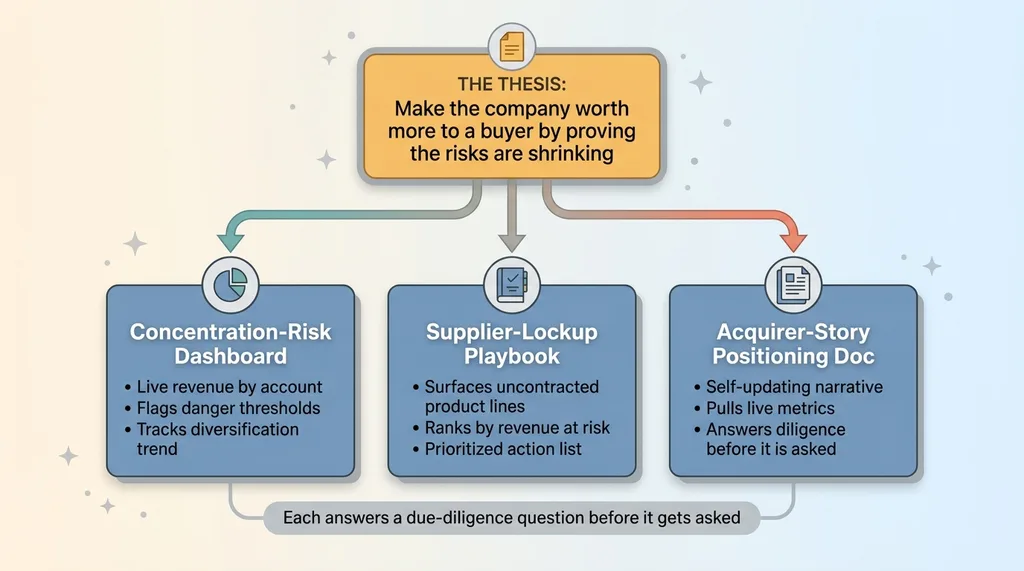 Three artifacts tied to one thesis
That turned into three artifacts. Each one answers a due-diligence question before it gets asked.
The concentration-risk dashboard
The first thing I built was a live view of revenue by account. Not a monthly report someone exports. A standing dashboard that always knows where the money is coming from.
It flags when any single customer crosses a danger threshold. If one account starts creeping toward too large a share, the owner sees it immediately, not at year-end when it's already a problem.
More importantly for an exit, it tracks the diversification trend over time. A buyer doesn't just want to see today's concentration. They want to see it improving. This is a dashboard that flags concentration risk automatically and shows the line moving in the right direction, which is the proof a buyer actually pays for.
The supplier-lockup playbook
The second artifact tackled the supply side. I built a system that surfaces which product lines have no contract behind them, then ranks them by revenue at risk.
This matters because you can't lock in every supplier at once. The playbook tells the owner exactly which supplier conversation to have first, the one protecting the most revenue, then the next, then the next.
It turns a vague anxiety ("we don't have contracts") into a prioritized action list ("lock in this supplier this quarter, it's protecting 30% of revenue"). And every contract signed is a number a buyer can verify.
The acquirer-story positioning doc
The third piece is the one most operators skip entirely. It's a living document that frames the company the way a buyer reads it.
Not a pitch deck. A standing narrative, partly AI-maintained, that pulls in the real metrics from the dashboard and the playbook. Concentration is down from X to Y. Supplier coverage is up. Here is the trend, here is the proof.
When a buyer's diligence team starts asking questions, the answers already exist, documented and backed by data. You're not scrambling to build the story under pressure. The story has been writing itself for months.
Three artifacts, one thesis. Each tied directly to the company's value at exit.
Working at Two Altitudes at Once
Here's the structural reason this kind of work is possible now, when it wasn't a few years ago.
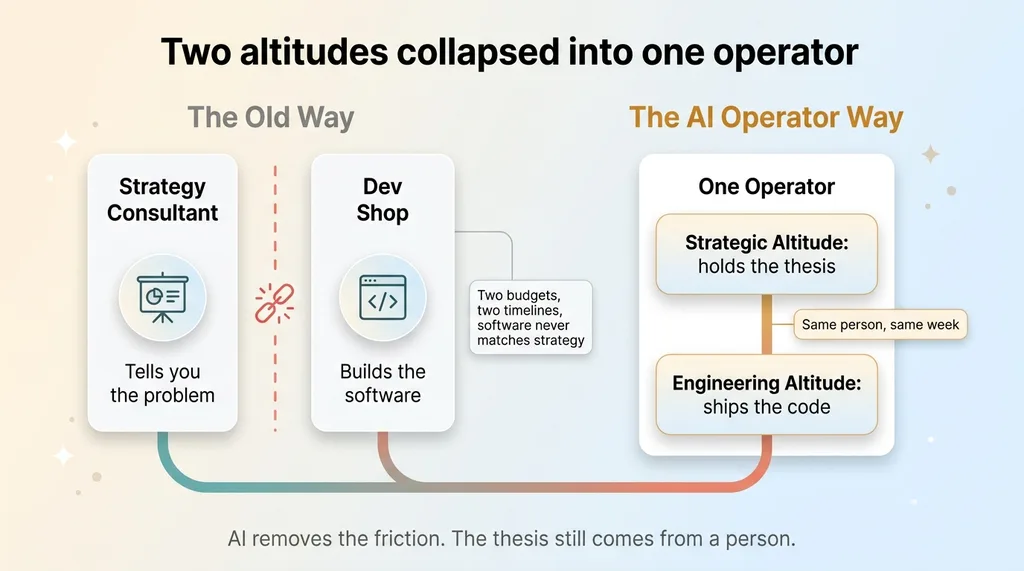 Two altitudes collapsed into one operator
Historically, this would have been two separate engagements. You'd hire a strategy consultant to tell you the company was over-concentrated and supply-exposed. Then you'd hire a separate dev team to build the software. Two budgets. Two timelines. Two firms that don't talk to each other, so the software never quite matches the strategy.
AI collapses that gap. One operator can do the strategic thinking and ship the engineering in the same week. Not because AI makes the strategic call, but because it removes the friction that used to force specialization.
I built the dashboard, the playbook, and the positioning doc as one coherent system because the same person held the thesis and wrote the code. The dashboard knew about the exit story because I knew about the exit story. The playbook prioritized by revenue at risk because that's what a buyer cares about, and I was the one thinking about the buyer.
This is the real shift in what AI actually replaces in a small business. It's not that AI replaces the strategist or the engineer. It's that AI lets one person work at both altitudes without dropping either one.
Let me be honest about the limit, because it matters. AI did not make the strategic call. I did. The decision to organize the whole system around the exit, the judgment that concentration and supply were the real problems, the choice of which artifacts mattered, that was me.
AI did the typing and the plumbing. Fast, cheaply, and well. But the thesis came from a person.
Why the Owner Could Actually Run It
There's an obvious objection here. Strategy artifacts are worthless if the owner can't actually use them.
I've seen plenty of beautiful dashboards die because they lived in someone's head or required a SQL query to update. The moment the consultant leaves, the system goes stale. Within three months it's lying to you.
So the entire thing got built into an AI command center a non-technical CEO can actually run. No SQL. No spreadsheets buried in some analyst's laptop. The owner opens it and reads the state of the company at a glance.
The dashboard tells them when concentration crosses a line. Plain language, clear flag, no interpretation required.
The playbook tells them which supplier call to make next. Not a list of 40 suppliers, but the one that matters most this week.
The positioning doc updates itself with the live numbers, so the acquirer story is always current. When a buyer shows up, the document is already true.
This is a design choice, not an afterthought. A system that proves the business is de-risking is only valuable if it stays current without a consultant babysitting it. The whole point is that the owner runs it themselves, indefinitely, and the data stays honest because the system maintains itself.
If I'd built something that needed me to keep it alive, I would have created a dependency, not a solution. The goal was to hand the owner a company that proves its own progress.
What This Costs You If You Skip It
Let me be direct about the stakes, because this is where it gets expensive.
If you build only the tool, you get a more efficient version of the same fragile company. The CRM works great. Operations run smoother. And the two things that actually determine what your business is worth haven't changed at all.
The fragility is invisible until it isn't. Until a customer leaves. Until a supplier reprices. Until a buyer's diligence team finds it and cuts the offer, or walks away entirely.
I'm not going to put a fake number on your specific situation. But the general pattern is well established. Customer concentration discounts and supply risk routinely knock seven figures off a small company's valuation. Sometimes they kill the deal outright, because the buyer decides the foundation is too shaky to underwrite.
Here's the part that surprises people. Fixing this didn't take a McKinsey engagement plus a dev shop plus a year. It was one operator, one clear thesis, and a few weeks of focused work. The cost of getting it right was a fraction of what the fragility was quietly costing in enterprise value.
Now the honest limitation. This only works when there's a real strategic question worth organizing around. Not every business has an exit on the horizon. Not every business is dangerously concentrated.
Some companies just need the CRM. If that's you, building an exit thesis would be overengineering, and I'd tell you so. The discipline is knowing which situation you're actually in before you start building.
How I'd Approach Your Business
Before I write any code for you, I ask one question: what does this company need to be worth more, not just run faster?
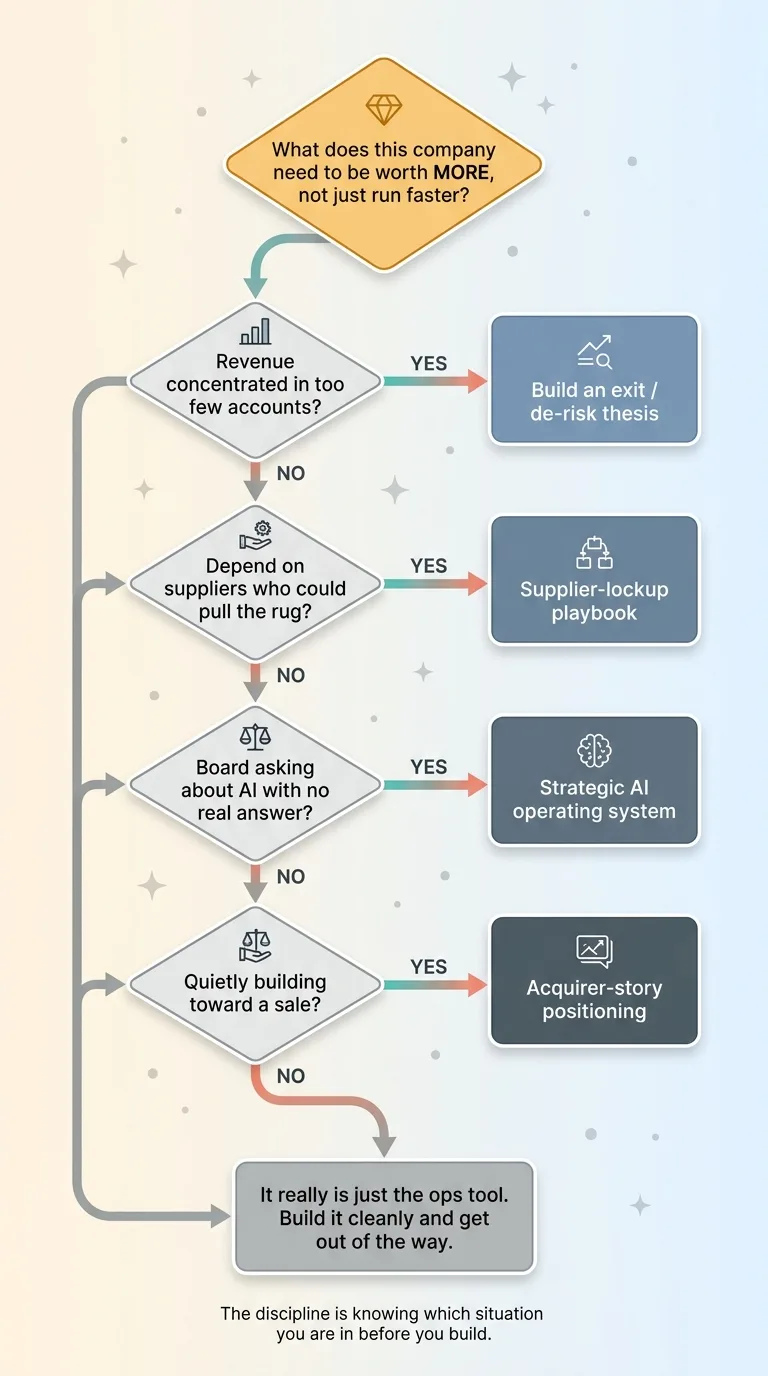 Decision: exit thesis vs just build the tool
Sometimes the answer is an exit thesis, like the distributor. Sometimes it's reducing dependence on a single channel or a single customer. Sometimes it's a supply problem hiding behind a sales problem. And sometimes, honestly, it really is just the ops tool, and the best thing I can do is build it cleanly and get out of the way.
The difference between me and a typical vendor is that I hold the strategy and build the system. The software serves the outcome because the same person defined the outcome and wrote the code. There's no handoff where the thinking gets lost.
That's the whole argument for an AI operator strategy. You're not buying a feature. You're buying a company that's organized around the thing that matters most, with software that proves it.
So here's when this conversation is worth having. If you've got revenue concentrated in too few accounts. If you depend on suppliers who could pull the rug. If your board is asking about AI and you don't have a real answer. Or if you're quietly building toward a sale and want the business to read clean when a buyer shows up.
Any of those, and we should talk.
Ready to bring AI leadership into your company?
I work with a small number of companies at a time. If you're serious about AI, apply to work together and I'll review your application personally.
Get AI insights for business leaders
Practical AI strategy from someone who built the systems — not just studied them. No spam, no fluff.
Hodgen.AI
Ready to automate your growth?
Book a free 30-minute strategy call with Hodgen.AI.
Book a Strategy Call