The Screenshot That Started It
A finance leader at a large manufacturer sent me a screenshot last quarter. Nineteen open requisitions, color-coded, a hiring plan he was about to sign off on. One line in the message: "How many of these do I not need if we deploy AI?"
That is the question. Every CFO is asking it, even when they dress it up as "AI strategy" or "digital transformation" in a board deck. Strip away the language and it comes down to math. Will AI replace jobs, and if so, which ones, and how much does that change my hiring plan.
Most people answer that question badly. The hype crowd says "all of them" because fear sells consulting hours. The skeptics say "none of them" because they got burned by a vendor who promised the moon and shipped a chatbot. Both answers are comfortable. Both are wrong.
The honest answer lives in the middle, and it is more useful than either extreme.
I am not answering this from a McKinsey slide. I run a DTC fashion brand, handmade in San Diego, on top of 15-plus AI systems and 29 automation modes running in production. I have actually sorted real work into "AI does this now" and "AI cannot touch this yet." When I tell a CFO which roles get replaced, I am telling him what I have measured in my own operation, not what a model predicts in a vacuum.
So I sent his 19 requisitions back to him sorted into tiers, with numbers he could defend to his board. Here is how I did it, and how you can run the same analysis on your own org chart.
Why "Will AI Replace Jobs" Is the Wrong First Question
Replace implies a clean swap
The word "replace" hides the actual mechanics. It implies you swap a person out for a piece of software, the way you swap a printer. That almost never happens. A role is not a single function. It is a bundle.
The unit that matters is the task, not the title
Most jobs are 8 to 15 distinct tasks stitched together under one title. A coordinator schedules, drafts, follows up, reconciles, fields questions, escalates, and reports. AI rarely eats the whole bundle. It eats specific tasks inside it.
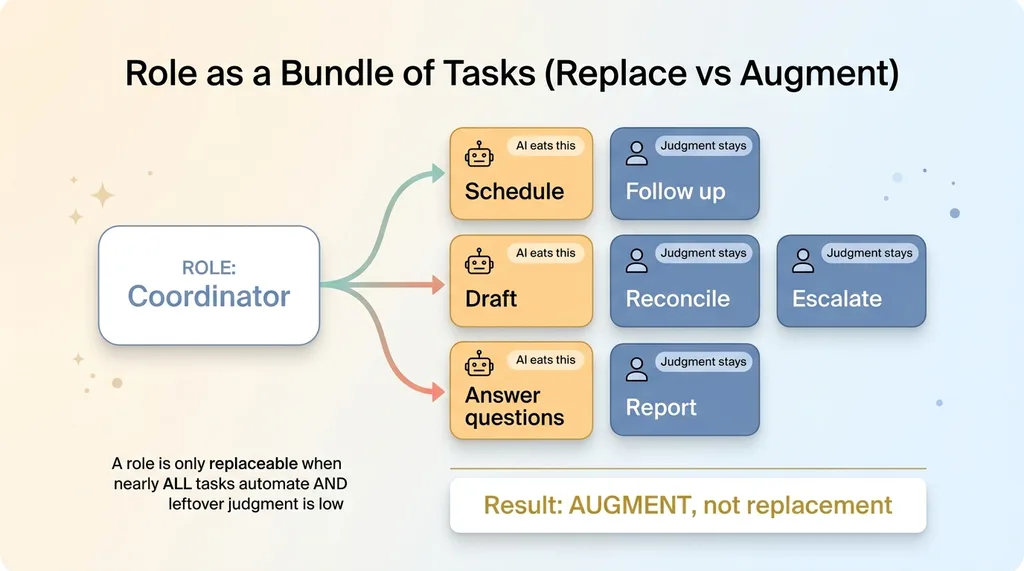 Role as a Bundle of Tasks (Replace vs Augment)
A role is only genuinely replaceable when nearly all of its tasks are automatable AND the leftover judgment is low. Both conditions. Miss either one and you have an augment, not a replacement.
Here is what that looks like in my own brand. My product creation pipeline used to take 3 to 4 hours per product. Concept, copy, image direction, pricing, SEO, listing. Now it takes 20 minutes. That is a massive change. But it did not eliminate a person. It eliminated the typing.
The judgment stayed. Someone still decides which products are worth making, what the brand voice is, whether the image is right. AI replaced the typing, not the thinking. One person now does what used to take several, but the person is more valuable, not gone.
The numbers back this up. After deploying AI across the brand, revenue per employee went up 38 percent and manual operations time dropped 42 percent. Look at the shape of that. I did not remove heads. I multiplied output per head. That is the real pattern, and it is almost always the pattern. The question is not "how many people does AI replace." It is "how much more can each person produce."
The Tiered Framework I Sent Back
I took his 19 roles and sorted every one into three tiers. This is the core of the analysis, and it is the part a CFO can actually act on.
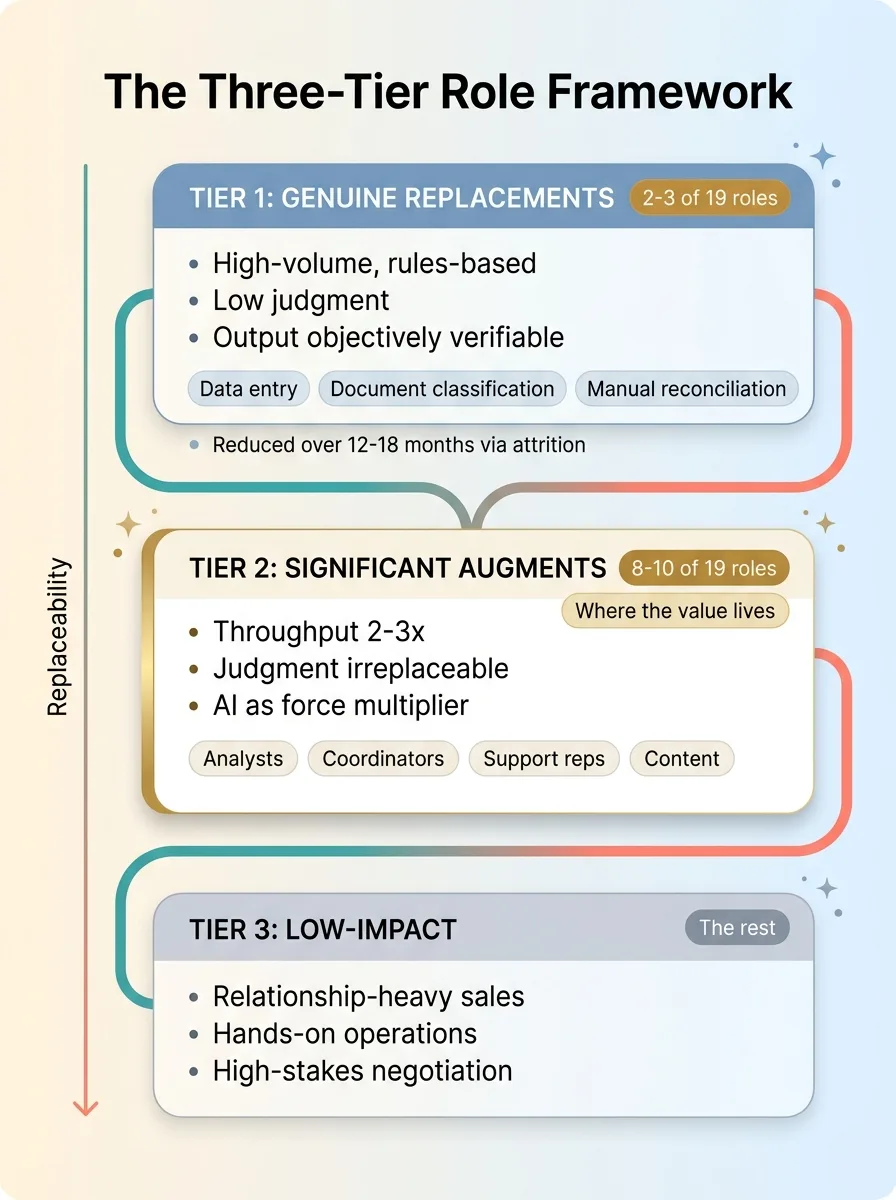 The Three-Tier Role Framework
Tier 1: Genuine replacements
These are the roles where AI produces a real net headcount reduction. The work is high-volume, rules-based, low-judgment, and the output is objectively verifiable. Repetitive data entry. First-pass document classification. Manual reconciliation where the answer is right or wrong and a human rarely has to defend a gray-area call.
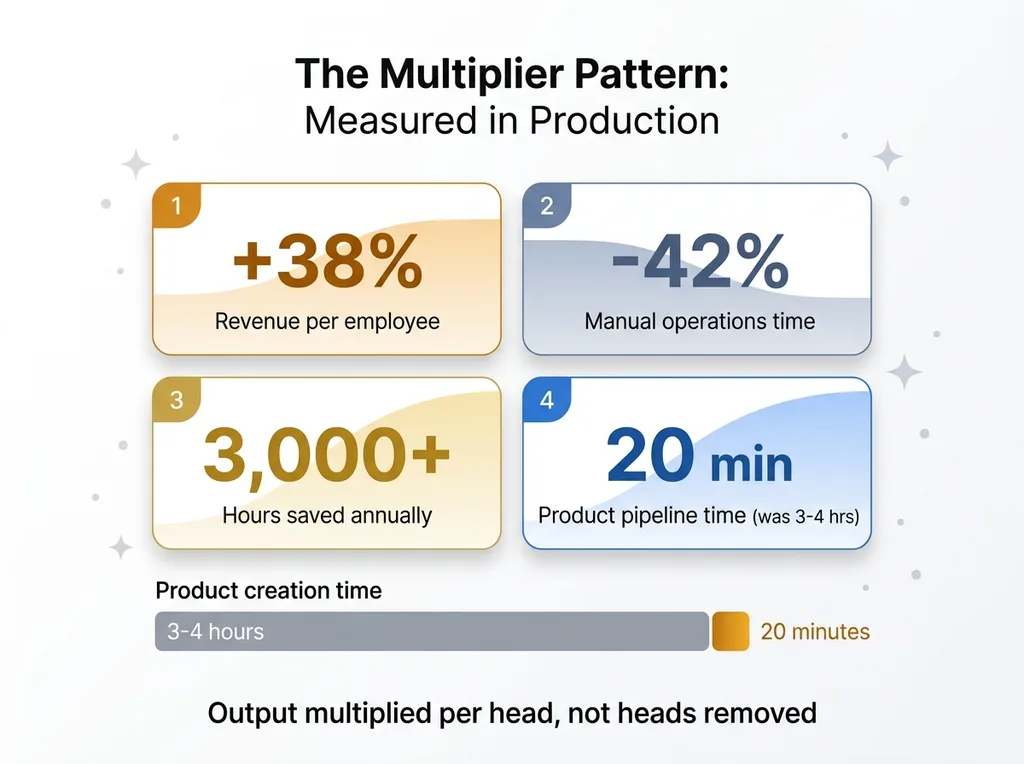 Output-Per-Head Multiplier Results
Of his 19 roles, this was 2 to 3. Not zero. Not ten. A small handful.
And the timeline matters. These reductions happen over 12 to 18 months, slowly, and almost always through attrition rather than layoffs. You stop backfilling. You do not march people out the door. The work genuinely shrinks, but it shrinks at the pace your systems mature.
Tier 2: Significant augments
This was the largest group, roughly 8 to 10 of the 19. Knowledge workers whose throughput doubles or triples with the right AI tooling, but whose judgment is irreplaceable. Analysts. Coordinators. Support reps. Content people.
AI is a force multiplier for knowledge workers here, not a substitute. An analyst who used to produce three reports a week produces nine, and the nine are better because the model handles the assembly and the human handles the interpretation. You do not cut these roles. You make each one worth two or three of what it was.
This is where almost all the value lives. Not in the roles you remove, in the roles you multiply.
Tier 3: Low-impact
The rest. Roles where AI barely moves the needle today. Relationship-heavy sales where the deal turns on trust. Hands-on operations. Anything requiring physical presence or high-stakes negotiation.
I am honest with clients that Tier 3 is real and often large. If half your org is Tier 3, AI is not your biggest lever this year, and any vendor telling you otherwise is selling you something.
The headline I gave him: of 19 roles, maybe 2 to 3 are true replacements. The actual return is in multiplying the other 10. This connects to the broader question of which jobs AI actually replaces, and the answer is always more specific than the headlines suggest.
The Lead Recommendation Was Not a Layoff
Here is the part that surprised him. My top recommendation was not "cut three roles." It was a single quick win.
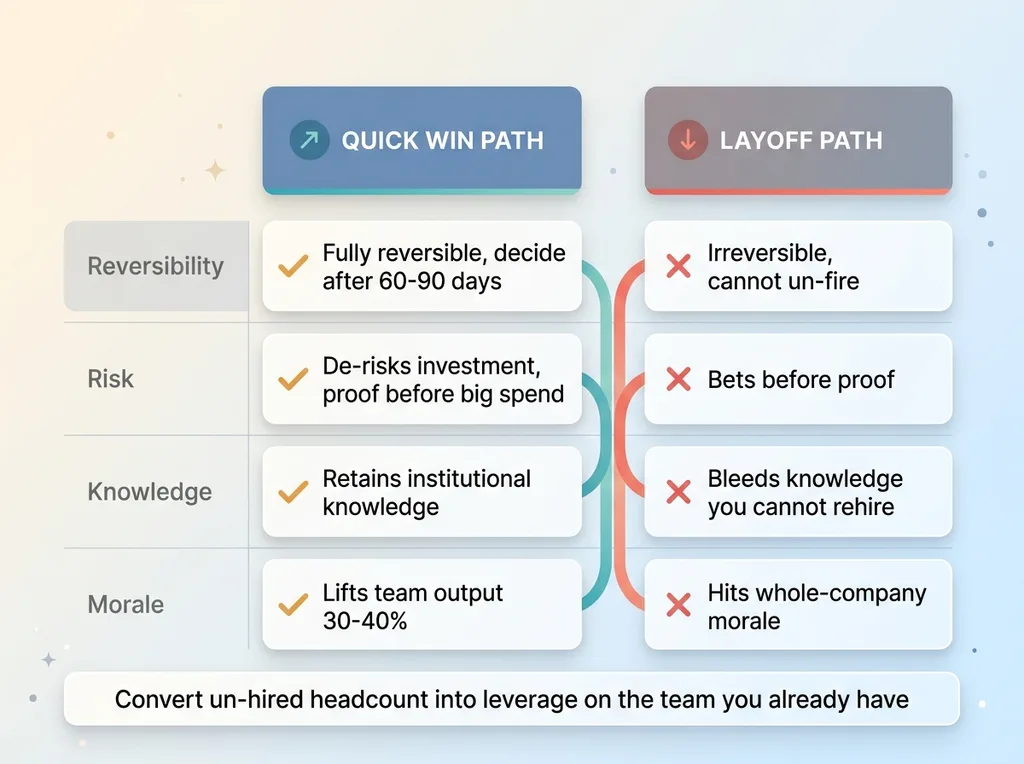 Quick Win vs Layoff Path Comparison
Take one Tier 2 function. Give it AI tooling first. Measure the throughput gain over 60 to 90 days. Then decide on hiring.
The logic is pure CFO. A quick win that lifts an existing team's output 30 to 40 percent does two things at once. It de-risks the larger AI investment because you have proof before you spend big. And it pays for itself, because that output gain offsets the next hire you were about to make.
Now contrast that with the layoff path. Layoffs are irreversible. You cannot un-fire someone in week six when you realize the system was not ready. They hit morale across the whole company, not just the people who leave. And they bleed institutional knowledge you cannot rehire at any price, because the person who knew why you do it that way is gone.
So the right move on his 19 requisitions was not firing anyone. It was pausing some of the reqs, the 2 to 3 trending toward Tier 1, and reallocating that hire budget into building the systems that multiply the rest. You convert headcount you have not hired yet into leverage on the headcount you already have.
I know this compounds because I have watched it. Across my own operation, the systems save more than 3,000 hours annually. That number did not come from one big cut. It came from dozens of augments stacking on top of each other, each one freeing time that got pointed at higher-value work. The multiplier compounds. The layoff is a one-time event you can never take back.
How to Tell a Replacement From an Augment
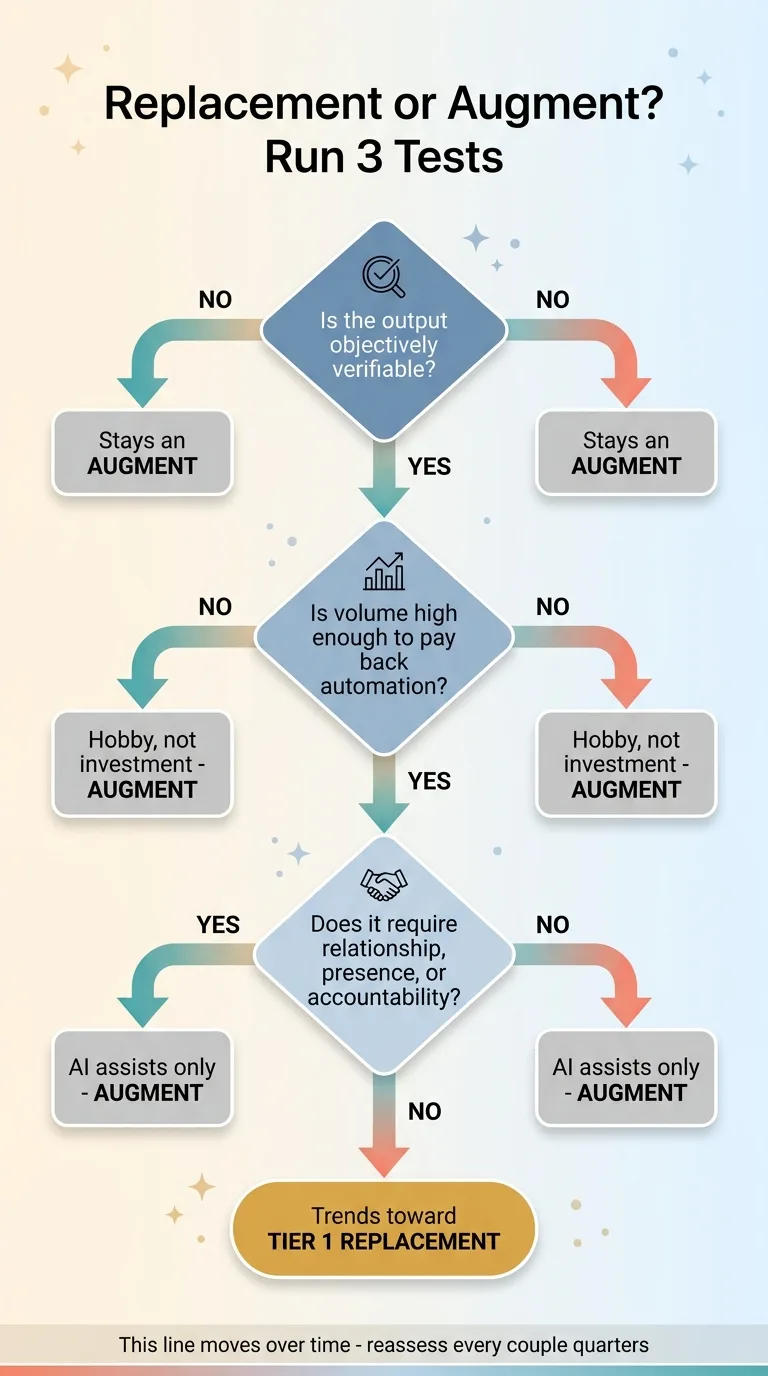
You can run this filter on your own org chart today. Take any task and run three tests.
The three tests
One. Is the output objectively verifiable, or does it require judgment a human will be blamed for? If the work is right-or-wrong and a machine can check it, it trends toward replacement. If a human has to own the call when it goes wrong, it stays an augment.
 The Three-Test Filter for Replacement vs Augment
Two. Is the volume high enough that automation pays back? Automating something you do twice a month is a hobby, not an investment. Tier 1 work is high-frequency.
Three. Does the work require relationship, physical presence, or accountability? If yes, AI assists but does not replace. Trust does not automate.
A task that is mostly verifiable, high-volume, and presence-free trends toward Tier 1. A task where judgment and accountability dominate is Tier 2 at most, no matter how much the vendor wants to sell you on it.
Where the line moves over time
Be honest with yourself: this line moves. Tasks that are firmly Tier 2 today drift toward Tier 1 as models improve. Document review that needed a human last year needs a spot-check this year. So this is not a one-time audit. It is a rolling reassessment you run every couple of quarters.
The only way to do that well is to measure. Before any headcount conversation, you want to track the ROI in numbers a CFO trusts. Hours saved, throughput per person, error rates. Without those numbers you are guessing, and guessing about people is how you make the irreversible mistake.
What the Honest Answer Costs You to Hear
The honest answer is uncomfortable, and that is exactly why most people will not give it to you.
The hype crowd tells a CFO that AI replaces everything, because the dream sells. The skeptics tell you it replaces nothing, because they got burned and now they are protecting themselves. Both are selling you comfort. One sells the fantasy of slashing payroll, the other sells permission to do nothing.
The truth is messier. A few roles really do go. Most get multiplied. And the biggest mistake you can make is acting on either extreme. Gut the org based on the hype and you lose knowledge you cannot rebuild. Dismiss the whole thing as a fad and a competitor with 40 percent more output per head eats your margin.
I will also tell you plainly what AI still does not do well, because pretending otherwise is how vendors lose trust. It does not own accountability. When the number is wrong, a model does not get fired, a person does. It does not negotiate a hard deal across a table. And worst of all, it fails silently. It will tell you it succeeded while quietly producing garbage, which is exactly why monitoring is non-negotiable in everything I build. A system you cannot watch is a system you cannot trust.
This honesty is the whole point. The CFO who controls the budget does not trust the person who oversells. He trusts the person who tells him which 3 roles, not all 19, and refuses to round up.
How I'd Run This Analysis on Your Org
The engagement is simple. I sit with your real roles and real workflows, not job descriptions, the actual work. I run the three tests against each one. I hand you back a tiered map and the single quick win worth building first.
The difference between me and a consultant is that I do not stop at the map. I build the systems, not just advise on them. The deliverable is working software that produces the throughput gain, measured, in your environment. Not a slide deck with a roadmap you have to go find someone else to execute.
If your board is asking which jobs AI replaces and you want a number you can actually defend, a number sorted into replacements, augments, and noise, this is the analysis I do. You walk into that meeting with a tiered map and a quick win already in motion instead of a shrug.
The answer is rarely a layoff. It is almost always a multiplier. The companies that understand that pull ahead of the ones still guessing at both extremes.
Get the next build note.
I write up each system I build, including what broke. Subscribe to my newsletter and I'll send you the next one.