AI Content Engine for Regulated Industries: The Gate
How I built an AI content engine for regulated industries that publishes daily. The compliance gate, not the writer, is the product. Real numbers inside.
By Mike Hodgen
Why Most AI Content Engines Are Solving the Wrong Problem
Every AI content story you read is about generation. Look at the demos. Look at the pitch decks. They all show the same thing: a prompt goes in, three articles come out, the founder smiles. That's an AI content engine for regulated industries the way a steering wheel is a car.
The generator is the easy 20%
Generating 3 to 5 publishable articles a day is trivial now. A good model writes clean, on-brand copy faster than any human team. I can spin up a writer that hits brand voice, cites sources, and reads well in about twenty minutes of setup.
The writing is the easy part. It always was. The hard part is what happens after the draft, and almost nobody writes about it.
What changes when you're regulated
I'm a technical cofounder of a longevity and telehealth brand. In that world, one sentence can end you.
A single efficacy claim ("reverses aging"), one disease-cure implication, one accidental dosing instruction, and you've put an independent prescribing physician's license at risk and exposed the company to an FTC action. That's not hypothetical. That's the cost of one bad line in one of 300 articles.
A lawyer reviewing every draft by hand works fine when you publish twice a month. It collapses the moment you want to publish daily. No human reads 1,500 sentences a month and catches the one that's quietly radioactive. They miss it. Everyone misses it eventually.
So here's my thesis, plain: the gate is the product, not the writer. The valuable thing isn't the model that produces copy. It's the system that decides what is allowed to go live. I wrote more about the broader problem in my shipping AI content in a regulated industry playbook, but this piece is about the part that actually keeps you out of trouble.
What's Actually at Stake When Regulated Content Goes Wrong
Let me answer the question every regulated business owner is actually thinking: will AI-generated content get me sued or shut down?
It can. So let's be precise about how.
The sentences that get you sued
In a health vertical, a specific set of language is forbidden, and most of it is subtle.
- Efficacy claims: "reverses aging," "eliminates inflammation," "cures."
- Disease-cure implications, even when phrased softly.
- "FDA-approved" when the thing in question is not.
- Dosing instructions of any kind.
- Brand-endorsement language that implies a guarantee.
- Anything that resembles protected health information.
None of these need to be the headline. They show up mid-paragraph, in a sentence that otherwise reads great. The article looks helpful and professional. It's the third clause of the eleventh sentence that gets you a letter.
Why volume makes it worse
Here's the math problem nobody wants to do.
A human reviewer can read one article carefully and catch the bad line. Give them one article, full attention, and they're reliable. Now give them the 40th article of the month, the 1,500th sentence, on a Friday. Attention degrades. The misses aren't a character flaw. They're statistics.
Volume is the enemy of careful review. The more you publish, the more certain it becomes that something slips.
And regulators do enforce. I've written before about a $9M fine over a tracking pixel, which was a company that wasn't even trying to make claims. They just had the wrong code on their site. If a pixel costs nine million, imagine what a published efficacy claim under a physician's name costs.
The risk isn't theoretical. It's a license and an FTC action, and it's triggered by a single sentence you didn't catch.
The Pipeline: Ideate, Draft, Gate, Publish
Here's the actual architecture I run. Four stages, and the interesting one isn't the one you'd guess.
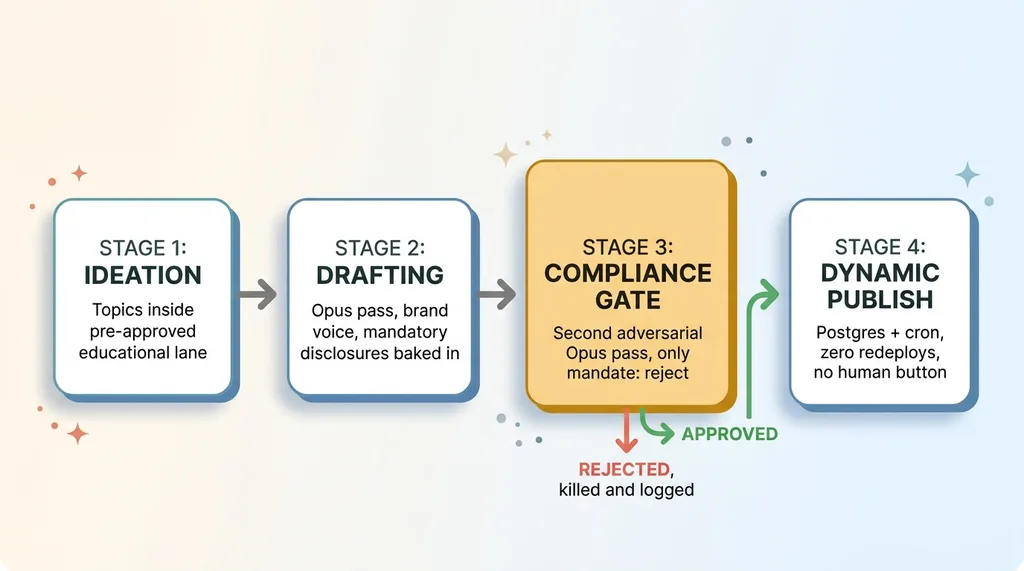 Four-stage content pipeline architecture
Stage 1: ideation with topic guardrails
Topics get generated inside a pre-approved educational lane. No treatment recommendations, no product claims, no "here's how to dose X." The model can write about the science of sleep, the biology of inflammation, how a class of compounds is studied. It cannot wander into "this is what you should take."
The lane is defined up front. The ideation step can only propose topics that live inside it.
Stage 2: drafting with mandatory disclosures
One Opus pass writes the article in brand voice, cited, with mandatory disclosure blocks baked directly into the prompt. The model isn't asked to remember the disclaimer. The disclaimer is structurally required, so it can't ship a draft without it.
This pass is optimized for one thing: produce a good, on-topic, well-written article. That's its whole job. It is, deliberately, a little eager.
Stage 3: the compliance gate
Now a second Opus pass reads the draft as a strict adversarial reviewer. Not the same model checking its own work. A fresh pass whose only mandate is to find reasons to reject.
This is the heart of it, and it's a pattern I use everywhere. I wrote about an AI that rejects its own bad work because the separation of concerns is the entire trick. The writer is incentivized to produce. The gate is incentivized to reject. You never let the same model do both, because a model that wrote something will defend it.
Stage 4: dynamic publish, zero redeploys
Approved articles land in Postgres and serve dynamically. A cron job publishes the green-lit pieces on a schedule. No redeploys, no engineer in the loop, no "ship it" button anyone has to press at 11pm.
This is compliance-gated content generation as a closed loop: ideas in the lane, drafted with disclosures, gated hard, published automatically. The volume runs itself. The gate is what makes that safe.
Inside the Compliance Gate: How It Decides to Kill an Article
This is the part worth understanding, because the gate is where all the value lives.
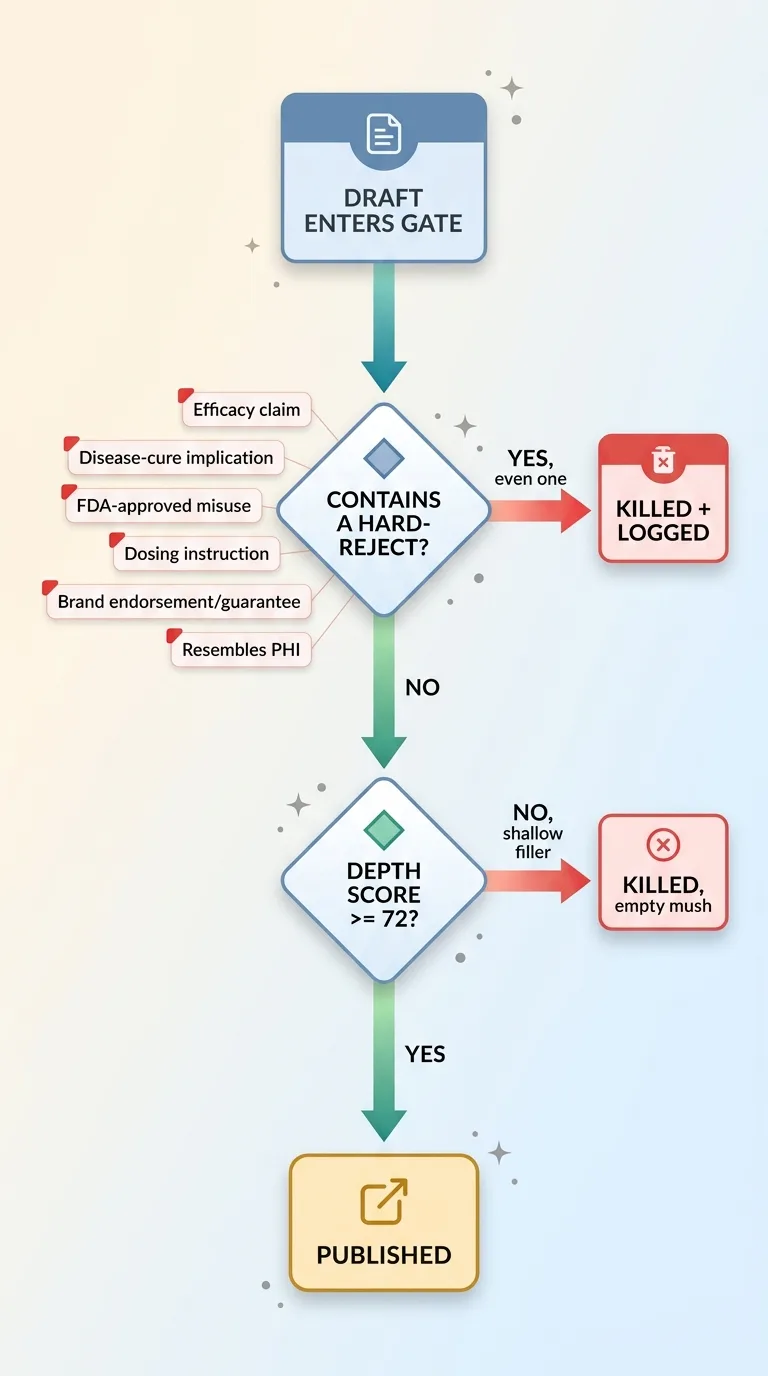 How the compliance gate decides to kill an article
The rejection categories
The gate rejects any article containing an efficacy claim, a disease-cure implication, "FDA-approved" language used incorrectly, a dosing instruction, brand-endorsement language, or anything resembling PHI. These are hard rejections. One instance and the article dies. It doesn't get edited, it doesn't get a warning, it gets killed and logged.
The depth score floor
The gate does more than compliance. It also enforces a depth and quality score with a floor of 72. Shallow filler gets rejected even when it's perfectly compliant.
I added this because a content engine that only checks for legal risk will happily publish 300 articles of safe, empty mush. That's its own kind of failure. It tanks your SEO and bores your readers. So the gate kills both the dangerous and the useless. An article has to clear compliance and clear 72 to go live.
Why a second model, not a longer prompt
The obvious objection: why not just add the rejection rules to the writer's prompt? One model, one pass, more instructions.
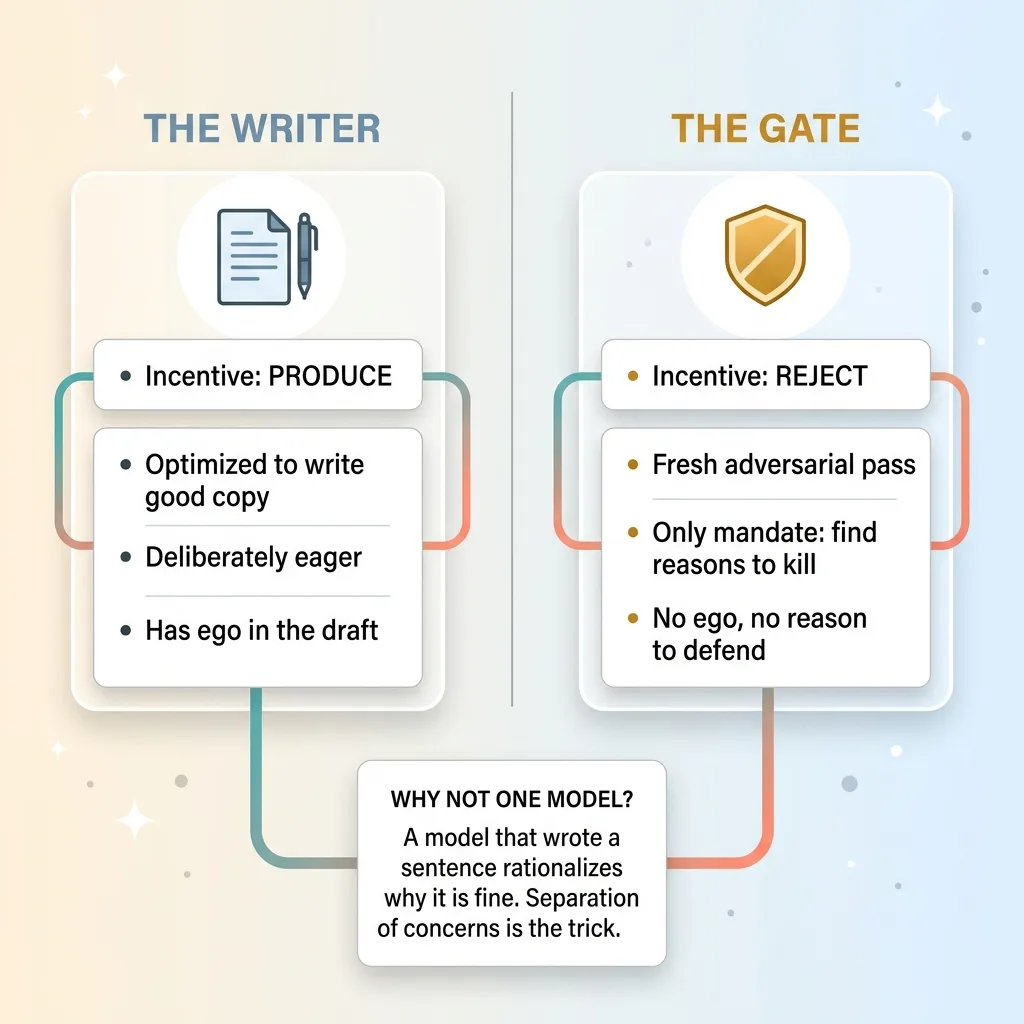 Two-model separation: writer vs adversarial gate
Because a model asked to both write and police itself rationalizes. It wrote the sentence, so it finds a reading where the sentence is fine. I've watched it happen. You add "do not make efficacy claims" to the writing prompt, and the model makes a soft one anyway, then explains to itself why it's technically educational.
A clean adversarial pass that has only seen the rejection mandate is harsher. It has no ego in the draft. It didn't write the thing, so it has no reason to defend it. That asymmetry is the whole point.
The gate has to be allowed to say no, and most of its job is saying no. A gate that approves everything isn't a gate. It's a rubber stamp with extra steps.
The Verified Run: 4 Published, 3 Correctly Killed
Let me show you a real run instead of describing the theory.
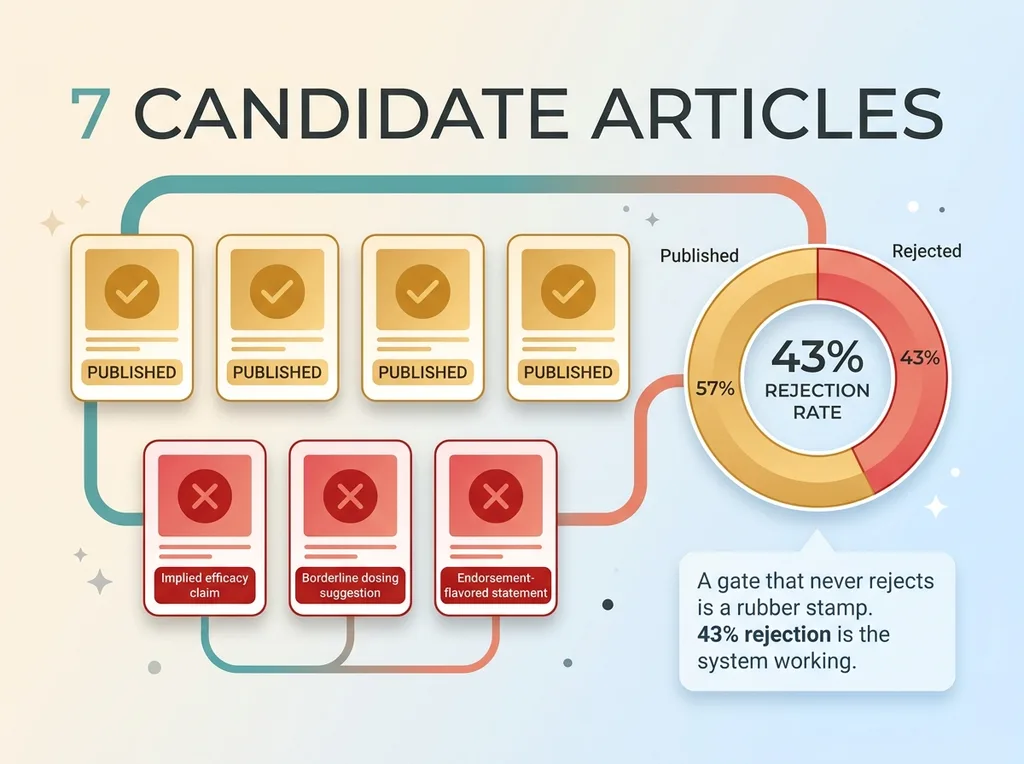 Verified run results: 4 published, 3 killed
The pipeline produced 7 candidate articles. The gate published 4 and rejected 3.
The three it killed were killed correctly. Each one contained language that would have created real exposure. To anonymize the specifics: one had an implied efficacy claim buried in an otherwise solid piece. One drifted into a borderline dosing suggestion. One made an endorsement-flavored statement that read fine to a casual eye and would have read very differently to a regulator.
None of those three were obviously bad. That's the point. They were good articles with one disqualifying line each. A tired human reviewer waves those through. The gate didn't.
A roughly 43% rejection rate is the system working, not failing. If the gate published 7 out of 7 every time, I wouldn't trust it. A gate that never rejects isn't protecting anything.
Here's the honest limitation: the gate is conservative, and it will sometimes kill a perfectly fine article. It's strict enough that some false rejections are guaranteed.
I tuned it that way on purpose. In this vertical, a false rejection costs me one article I have to regenerate. A false approval costs a physician their license and the company an FTC action. Those are not symmetric. When the downside is that lopsided, you bias hard toward rejection and you eat the occasional good article you lose.
Where the Human Still Sits in This Loop
The obvious objection: so you let AI publish to a regulated business with no human reading it?
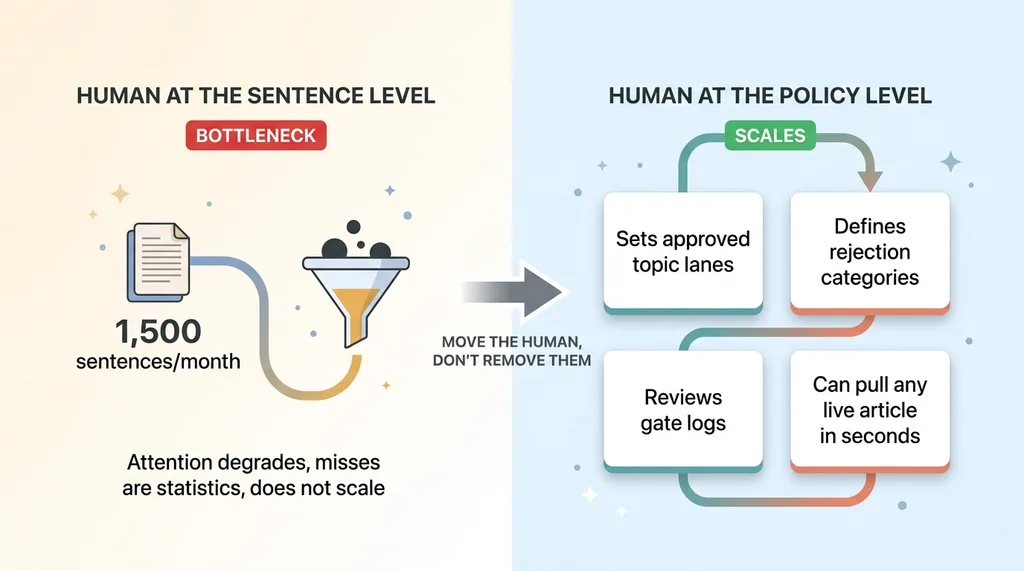 Human-in-the-loop at policy level vs sentence level
No. I moved the human, I didn't remove them.
The gate handles per-article volume a human never could. But humans set the approved topic lanes. Humans define the rejection categories. Humans review the gate's logs, including every article it killed and why. And anyone with access can pull a live article down in seconds.
This is human-in-the-loop at the policy level, not the per-sentence level. That distinction is the only reason daily publishing is possible. A human deciding the rules and auditing the outcomes scales. A human reading the 1,500th sentence of the month does not.
It's the same principle behind every AI system I ship stops for a human. The human is always in control. The question is just where. Put them at the sentence level and you have a bottleneck. Put them at the policy level and you have a system.
Let me be honest about why this works: the lane is narrow and the gate is strict. This is not "point AI at any topic and publish whatever it makes." It works precisely because we constrained the inputs hard and made the gate unforgiving. Loosen either one and the whole thing stops being safe.
What This Means If You're Publishing in a Regulated Vertical
If you're in health, finance, legal, or supplements, here's the lesson worth taking.
The value of an AI content engine for regulated industries isn't the writing speed. The writing was never the hard part. The value is the gate that makes the speed safe to use.
If you're sitting on a content backlog because compliance review is your bottleneck, more writers won't fix it. One overworked reviewer won't fix it. Either you publish slowly and stay safe, or you publish fast and gamble. Both are bad.
The way out is a system where generation is cheap and disposable, and the gate is the asset you actually own and tune. Articles are commodities. The thing that decides what's allowed to exist is the durable, valuable part. Build that, and speed stops being a liability.
This is the kind of system I build as a Chief AI Officer. The unglamorous plumbing that lets a regulated business move fast without a lawyer reading every word. It's not a chatbot demo. It's the gate, the lanes, the logs, the second adversarial model, and the dynamic publish loop that runs without anyone pressing a button.
If your compliance review is the thing standing between you and the content volume you actually need, that's a solvable problem. Usually in weeks, not quarters.
Want to explore what AI could do for your business?
Book a free 30-minute strategy call. No pitch deck, no sales team, just a real conversation about your operations and where AI fits.
Get AI insights for business leaders
Practical AI strategy from someone who built the systems — not just studied them. No spam, no fluff.
Hodgen.AI
Ready to automate your growth?
Book a free 30-minute strategy call with Hodgen.AI.
Book a Strategy Call