Let me save you the 45-minute sales call that most AI consultancies require before they'll talk numbers.
The fractional CAIO cost for mid-market companies in 2026 ranges from $5,000 to $30,000 per month. That's a wide range, so let me break down what drives it.
Two tiers, roughly:
- $5K-$15K/month for companies doing $1M-$10M in revenue. This covers strategy, system buildout, and ongoing optimization — typically 2-4 production-ready AI systems deployed per quarter.
- $15K-$30K/month for companies in the $10M-$50M+ range, where the complexity multiplies: more departments, more data sources, more integration points, more stakeholders who need to be aligned.
But company size alone doesn't determine where you fall. A $3M e-commerce brand with 200 SKUs, five sales channels, and a warehouse operation might need more AI infrastructure than a $20M B2B company with one product line and a straightforward sales motion. Scope drives price, not revenue.
These numbers reflect 2026 market rates based on what I'm seeing across my own engagements and the broader industry. They're also the transparent pricing breakdown that most consultancies won't publish because they'd rather get you on the phone first. I'd rather you read this, know whether the math works for your situation, and only reach out if it makes sense.
What a Full-Time Chief AI Officer Actually Costs
Before we talk about what a CAIO engagement costs, you need to understand the alternative. If you're unsure about what a Chief AI Officer actually does, start there — but here's the financial picture.
Base Salary and Total Compensation
The chief AI officer salary for a qualified candidate in 2026 sits between $300K and $500K base. Total compensation — equity, bonus, benefits — pushes that to $400K-$700K+ at established companies. These roles are pulling comp packages comparable to CTOs and VPs of Engineering because the talent pool is shallow and the demand is intense.
That's the number if you can find someone. The market for people who actually understand both AI systems and business operations — not just one or the other — is brutally competitive. Data scientists who can talk to your CFO and your warehouse manager in the same meeting aren't exactly flooding LinkedIn with "Open to Work."
The Hidden Costs Nobody Mentions
The salary is the easy part to budget. The harder costs:
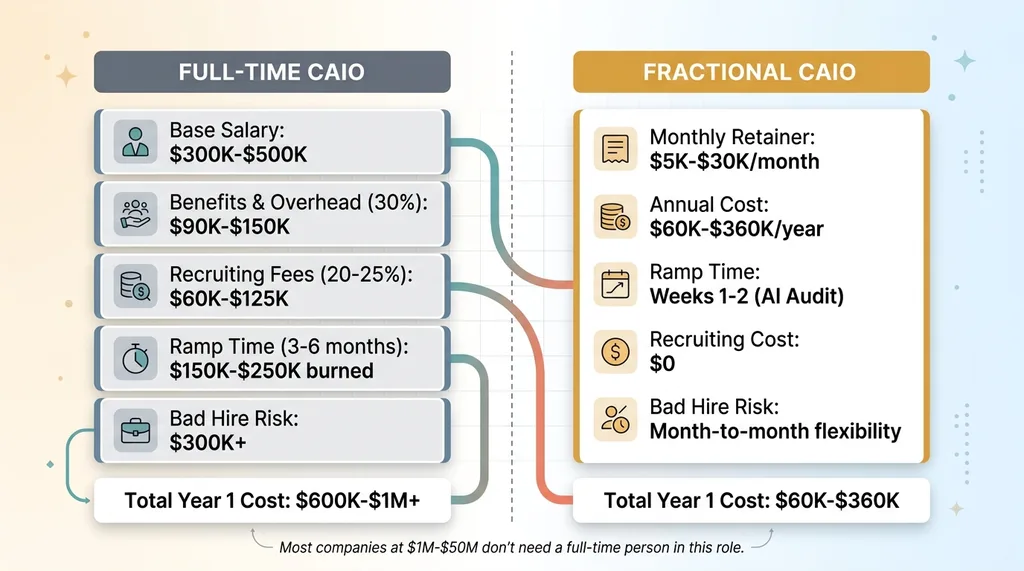 Full-Time CAIO vs. Fractional CAIO Cost Comparison
- Recruiting fees: 20-25% of first-year salary. That's $60K-$125K before they start.
- Ramp time: 3-6 months before they're fully productive. They need to learn your business, your data, your team, your tech stack. During that time, you're paying full comp for partial output.
- Bad hire risk: At this salary level, a wrong hire costs you $300K+ when you factor in recruiting, salary burn, severance, and starting over. And the wrong hire doesn't just cost money — they cost you 6-9 months of momentum.
- Benefits overhead: Add 25-35% on top of base for health insurance, 401(k), payroll taxes, and the rest.
Here's the thing most companies in the $1M-$50M range need to hear: you probably don't need a full-time person in this role. The same way most companies at this stage don't need a full-time CFO. The work is intensive during the build-out phase — auditing, architecting, deploying systems — but it shifts to maintenance and optimization over time. Paying $500K+ per year for someone who's running at 40% capacity eight months in is a bad use of capital.
Why Hourly Billing Is Wrong for AI Leadership
This is a strong opinion, and I'll stand behind it: hourly billing creates a fundamental misalignment for strategic AI work.
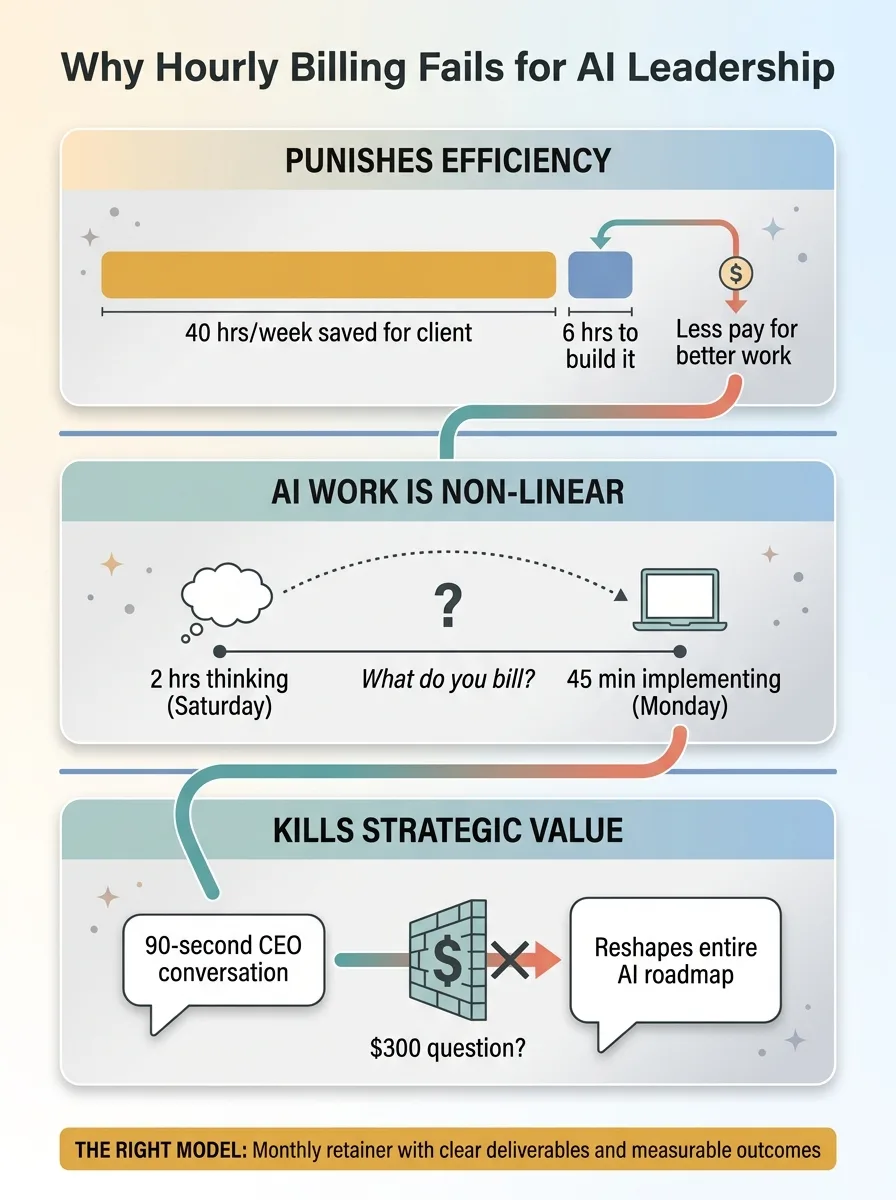 Why Hourly Billing Fails for AI Leadership
Problem one: it punishes efficiency. If I build an automation that saves your team 40 hours per week, and it takes me 6 hours to build it, hourly billing means I earned less by being better at my job. That's backwards. You want your CAIO to be ruthlessly efficient, not padding hours.
Problem two: AI work is non-linear. I might spend two hours on a Saturday thinking through system architecture while walking my dog. Then 45 minutes on Monday implementing it. Billing for 45 minutes undervalues the work. Billing for 2:45 feels dishonest. The thinking is the work — and it doesn't happen on a timesheet.
Problem three: it kills the strategic relationship. When you're paying someone by the hour, you start second-guessing whether to call them about a quick question. "Is this worth $300 to ask?" Those quick questions are often where the highest-value insights surface. A CEO mentions in passing that their biggest customer just asked about a capability they don't have — that 90-second conversation might reshape the entire AI roadmap.
Monthly retainer with clear deliverables and measurable outcomes is the right model. That's how I structure my own engagements, and it's how the CAIO pricing conversation should work across the industry.
What You Actually Get for $5K-$15K Per Month
Let me make the value concrete. Because "AI strategy" means nothing without specifics.
Strategy and Roadmapping
The engagement starts with an AI audit: what exists in your current stack, what's possible given your data and operations, and what to prioritize. Then we build an implementation plan — not a 60-page deck that collects dust. A working document that maps each system to a dollar value and a timeline, and changes as we learn what works.
This includes vendor and tool selection, build-vs-buy decisions for each system, and an honest assessment of what your team can maintain without me. I make these calls based on experience across dozens of deployments, not vendor partnerships or affiliate deals.
Building Systems That Run Without You
Strategy without execution is a consulting engagement. What I do is build.
On my own DTC fashion brand, I built an AI pipeline that creates products in 20 minutes — concept to live on the site. That same process used to take 3-4 hours. I deployed dynamic pricing across 564 products using a 4-tier ABC classification system. I built AI-assisted SEO management across 313 blog articles. These aren't prototypes or proof-of-concepts. They're production systems running right now.
At the mid-market tier, expect 2-4 production-ready AI systems deployed per quarter. Not slides about systems. Working systems.
The Compound Effect
This is where the math gets interesting, and it's what separates a CAIO engagement from a consultant engagement.
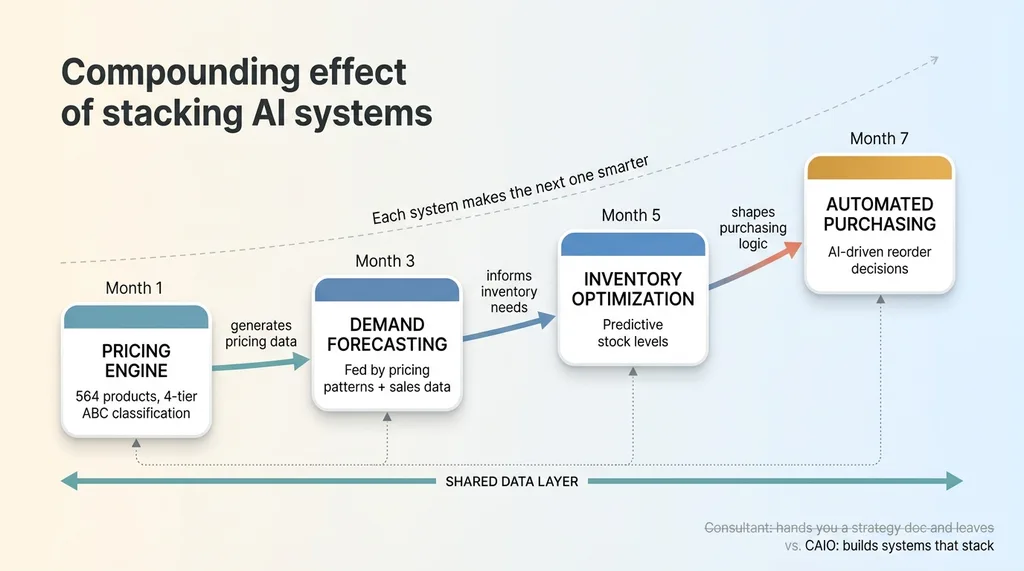 The Compound Effect of Stacking AI Systems
A consultant hands you a strategy doc and leaves. A CAIO builds systems that stack. Month 1's pricing engine generates data that feeds Month 3's demand forecasting model, which informs Month 5's inventory optimization, which shapes Month 7's automated purchasing decisions.
After 6 months, you're not paying for AI leadership. You're maintaining a competitive advantage that compounds. Each system makes the next one more accurate and more valuable, because they share data and context that no off-the-shelf tool can replicate.
If you want to see how this plays out in practice, I've mapped out what a CAIO actually delivers week by week — the real cadence, not a theoretical timeline.
The Real Comparison: CAIO Cost vs. the Cost of Waiting
Let me flip the framing. The question isn't "can we afford AI leadership?" It's "what's it costing us not to have it?"
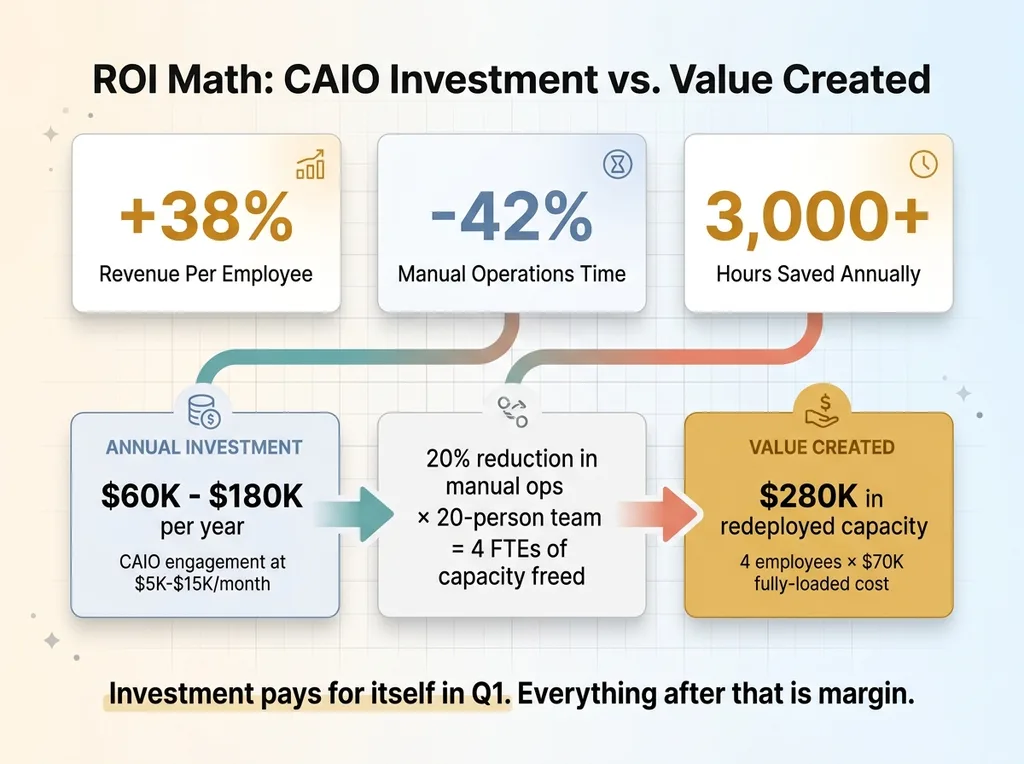 ROI Math: CAIO Investment vs. Value Created
On my own brand, the numbers after deploying AI systems:
- +38% revenue per employee
- -42% manual operations time
- 3,000+ hours saved annually
Let's run the math for a hypothetical mid-market company. You're paying $5K-$15K/month for a CAIO engagement — that's $60K-$180K per year. If the result is even a 20% reduction in manual operations for a 20-person team, that's the equivalent of freeing up 4 full-time employees' worth of capacity. At an average fully-loaded cost of $70K per employee, that's $280K in capacity you've either redeployed to growth work or avoided hiring.
The investment pays for itself in Q1. Everything after that is margin.
There's a competitive angle too, and it's worth being direct about. Every month you wait, a competitor deploying AI is widening the gap. This isn't fear-mongering. It's the same dynamic that played out with e-commerce adoption in the 2010s. The early movers didn't just get a head start — they got compounding advantages in operations, customer data, and market position that made it exponentially harder for laggards to catch up.
I'll be honest: AI leadership isn't right for every company at every stage. Some businesses aren't ready, and pushing AI into an organization without the right foundation wastes money. If you're weighing the options, I've written a detailed comparison of CAIO vs. consultant vs. hiring in-house that lays out where each model fits.
How to Evaluate Whether the Investment Makes Sense for Your Business
Three Questions to Ask Before You Hire Anyone
Before you talk to me or anyone else about AI leadership, answer these honestly:
1. Do you have at least 3 manual processes that eat more than 10 hours per week each?
If yes, there's likely $100K+ in annual savings sitting on the table. Think about order processing, content creation, pricing updates, customer support routing, inventory management, reporting. The hours add up faster than most CEOs realize because no single person feels the full weight — it's distributed across the team.
2. Is your team spending time on repetitive decisions that follow clear logic?
Pricing adjustments. Content scheduling. Customer ticket routing. Inventory reorder points. If a human is making the same type of decision 50+ times a day based on patterns they could articulate, an AI system can handle it — faster, more consistently, and at scale.
3. Are you losing deals or customers to competitors who move faster?
If a competitor is launching products faster, responding to market changes quicker, or personalizing at a level you can't match manually, that's a signal.
If the answer to 2 or more of these is yes, the ROI on AI leadership will likely exceed the fractional CAIO cost within the first quarter. If none of these apply, you probably don't need a CAIO yet. Any honest one will tell you that.
I turn away companies that aren't ready. A bad-fit engagement hurts both sides — it burns your budget and my reputation.
What the Right Engagement Structure Looks Like
Here's how an effective CAIO engagement works in practice, not theory.
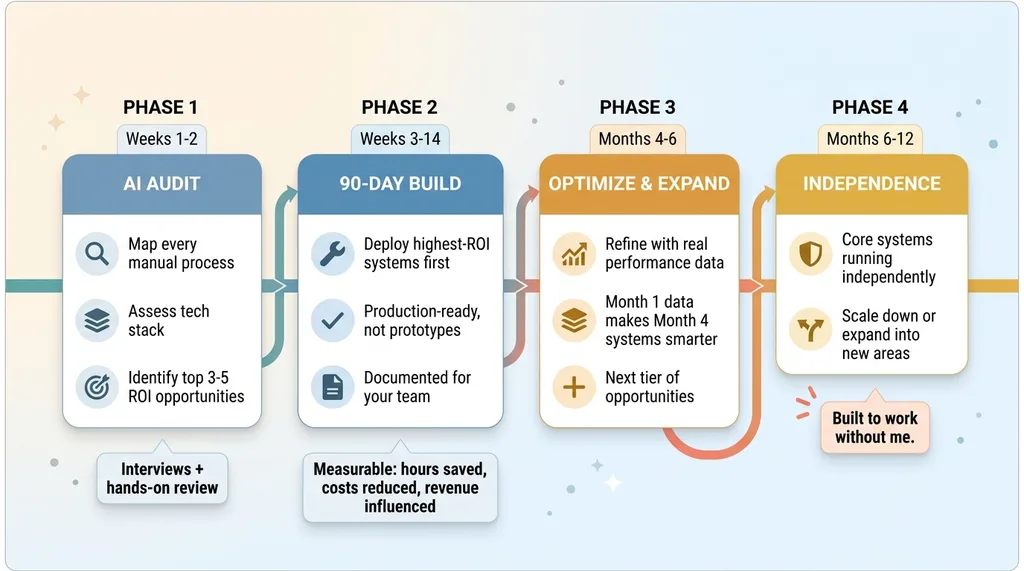 CAIO Engagement Timeline and Phases
Weeks 1-2: AI Audit. I dig into what exists — your tools, your data, your workflows, your team's capabilities. I map every manual process, assess your tech stack, and identify the 3-5 highest-ROI opportunities. This isn't a questionnaire. It's interviews with your team, hands-on review of your systems, and an honest assessment of where you are versus where AI can take you.
Weeks 3-14: 90-Day Build Phase. We deploy the highest-ROI systems first. Real, production-ready tools — not prototypes. Each system gets tested, refined, and documented so your team can operate it. By the end of 90 days, you should have measurable results: hours saved, costs reduced, revenue influenced.
Months 4+: Optimization and Expansion. The first systems are running. Now we optimize them with real performance data and expand into the next tier of opportunities. The systems we built in Month 1 are generating data that makes Month 4's systems smarter.
The goal is that after 6-12 months, the core systems are running independently and the engagement can either scale down or expand into new areas. This is the opposite of a consultant engagement designed to never end. I build things that work without me, and I'm straightforward about when you don't need me anymore.
That said, most companies find that once AI systems start generating results, they want to go deeper. The first wins create appetite for more, because the ROI becomes undeniable.
Get the next build note.
I write up each system I build, including what broke. Subscribe to my newsletter and I'll send you the next one.