Custom Software in Days: The New Build Timeline
Custom software used to take a quarter and six figures. Here's how AI compresses the build to days, and what still doesn't compress.
By Mike Hodgen
The old timeline you're still budgeting against
If you've ever bought custom software, you know the clock. It goes like this. First a discovery phase that eats a few weeks of meetings and questionnaires. Then a statement of work that takes more weeks to draft, revise, and sign. Then a quarter or two of actual build. Then a six-figure invoice lands on your desk. The whole thing, from "we should build this" to "it's live," ran six to nine months. The idea that you could get custom software in days would have sounded like a sales pitch from someone who'd never shipped anything.
That clock was real. I'm not making fun of it. For twenty years it was the honest cost of building software the old way.
The problem is that most executives are still budgeting against it.
Here's what that does to your decisions. Because you expect a quarter of calendar time and $150K-plus of cash, you do two things without realizing it.
You under-ask. You only request the big, obvious thing that can justify the expense. The smaller tools, the ones that would save your ops team ten hours a week, never get proposed because they don't clear the budget bar.
And you over-wait. You delay the project because the cost is daunting and the timeline is long. You tell yourself you'll do it next year, after the busy season, when there's budget.
The issue isn't that software is hard to build. It's that your mental model is calibrated to a process that no longer exists. You're pricing a flight at horse-and-buggy rates and then deciding not to travel.
That miscalibration is expensive. Not because of what you spend, but because of what you don't build.
What the new timeline actually looks like
Let me be concrete about the new clock, because "faster" is a useless word.
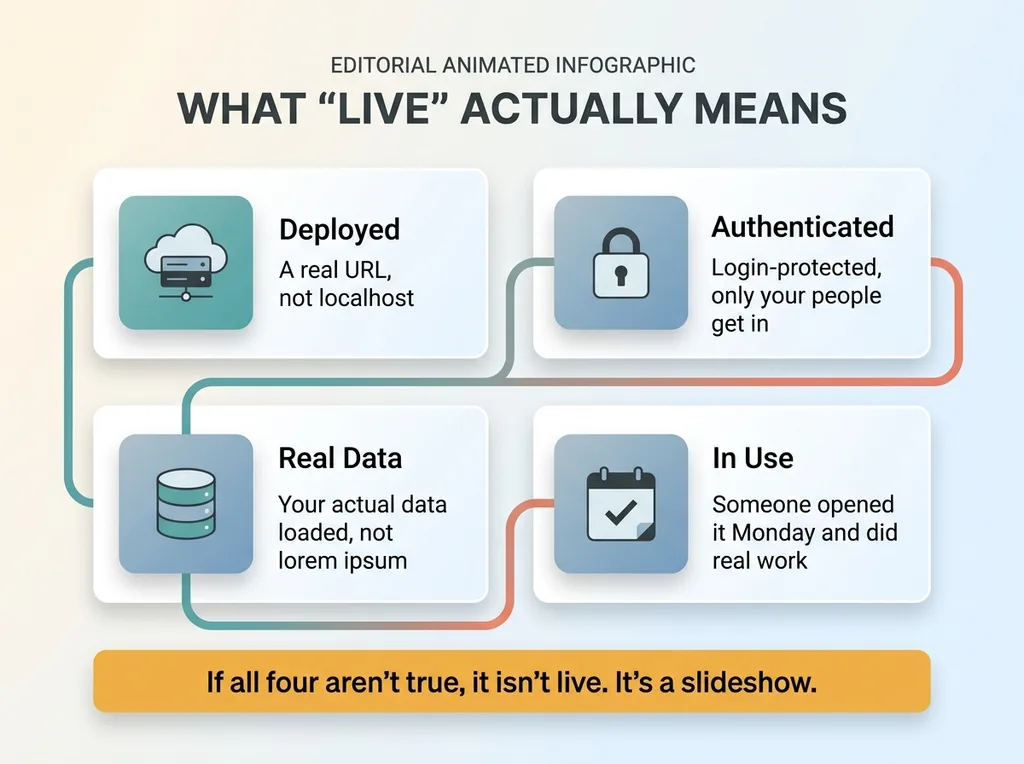 What 'live' actually means, the four-part bar
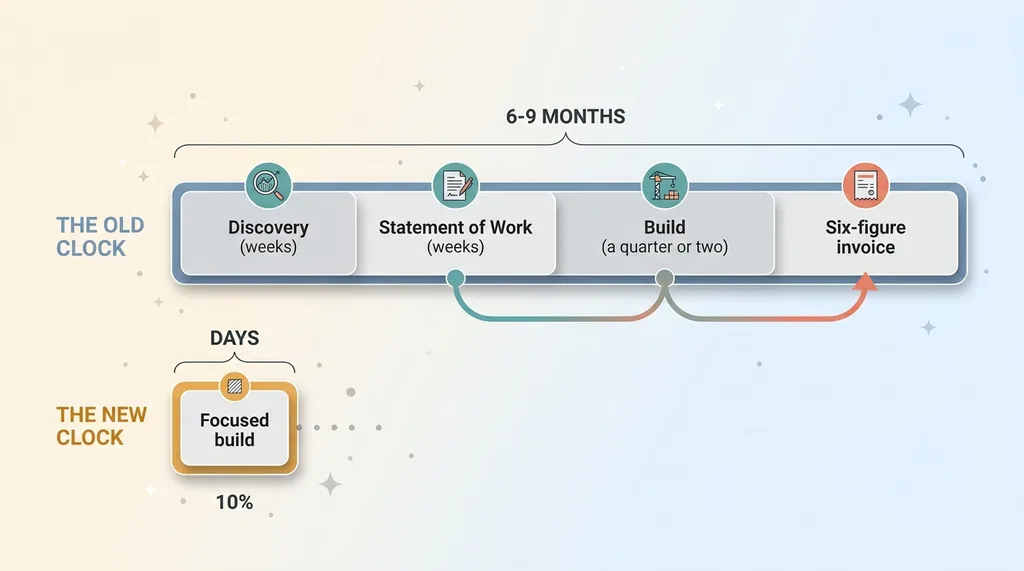 Old timeline vs new timeline for custom software
I worked with a security-staffing company that needed an internal tool. The gap between the conversation about what they needed and the thing being live was days, not a quarter. Not a demo. Live.
A paper-packaging distributor had an internal process tool. The first call was on a Friday. The following week they had a working, login-protected app with their real data in it, in actual use by their team.
So when I say "live," let me tell you exactly what I mean, because this is where most "rapid custom software development" pitches get slippery.
Live means deployed to a real URL. It means login-protected, so only your people get in. It means their actual data loaded, not demo seeds or lorem ipsum. It means someone on the team opened it Monday morning and did real work in it.
That's the bar. Deployed, authenticated, real data, in use. If those four things aren't true, it isn't live, it's a slideshow.
Now, the honest framing. This is days for a focused tool. One clear workflow, one team, a defined job to be done. It is not days for a multi-quarter platform with twelve integrations and a compliance review. When people ask me how fast can AI build an app, the real answer is: a focused one, fast. A sprawling one, slower, because the complexity is real and you can't fake your way through it.
The development velocity behind this is not theoretical. My own toolkit runs past 800 commits and 22,000-plus lines of custom Python, built and refined exactly this way, fast loops, real software, no slide decks. The same engine that built my own systems builds client tools.
The contrast that matters isn't any one client's numbers. It's days versus quarters. Once you've seen a working app in a week, you stop believing the six-month estimate was ever about the software.
What actually compresses: the build
So what collapsed? The build. Mechanically, specifically, the build.
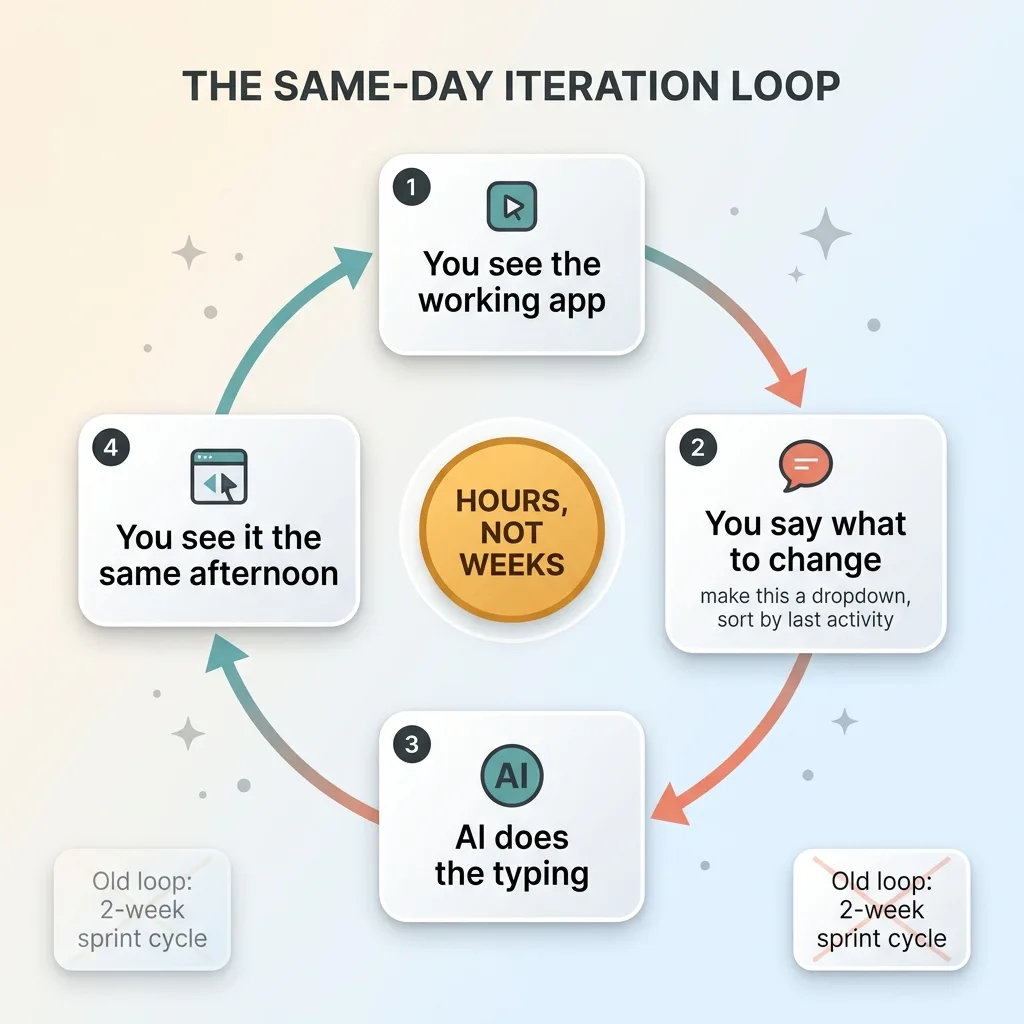 The same-day iteration loop
In the old model, the bulk of the billable hours went to typing. Wiring up authentication. Building the create-read-update-delete screens. Connecting a database. Writing the logic to import messy real-world data. Configuring deployment. None of this was glamorous, and all of it was slow, and you paid for every hour.
AI does that typing now. Not the thinking, the typing. The scaffolding that used to consume a developer for two weeks gets generated and refined in an afternoon. Auth that was a multi-day setup is now a known pattern executed fast. The CRUD screens that were pure labor are mostly produced and then corrected, not hand-built from zero.
I see this every day in my own work. My product pipeline for my DTC brand used to take three to four hours to take a concept to a live product page, copy, images, pricing, SEO, the works. It now takes 20 minutes. Same output, same quality bar, a fraction of the time. That compression isn't a fashion thing. It's a software thing, and it applies to custom apps the same way.
The iteration loop is where this really shows up. In the old world, "can you change how this screen works" meant a two-week sprint cycle. You'd file the request, wait for the next sprint, see it, then realize it wasn't quite right and wait again.
Now that loop is same-day. You look at the working app, you say "that field should be a dropdown and the list should be sorted by last activity," and you see it that afternoon. Sometimes within the hour.
This is the part where the quarter becomes days. The slow, expensive, labor-heavy middle of the old project, the actual construction, is the part that compressed hardest. It's why I build the software instead of just advising on it. The advice is cheap. The build used to be the cost. Now it isn't.
What does NOT compress: getting the requirements right
Here's the part the hype merchants skip, and it's the part that actually determines whether you get a useful tool or an expensive mistake.
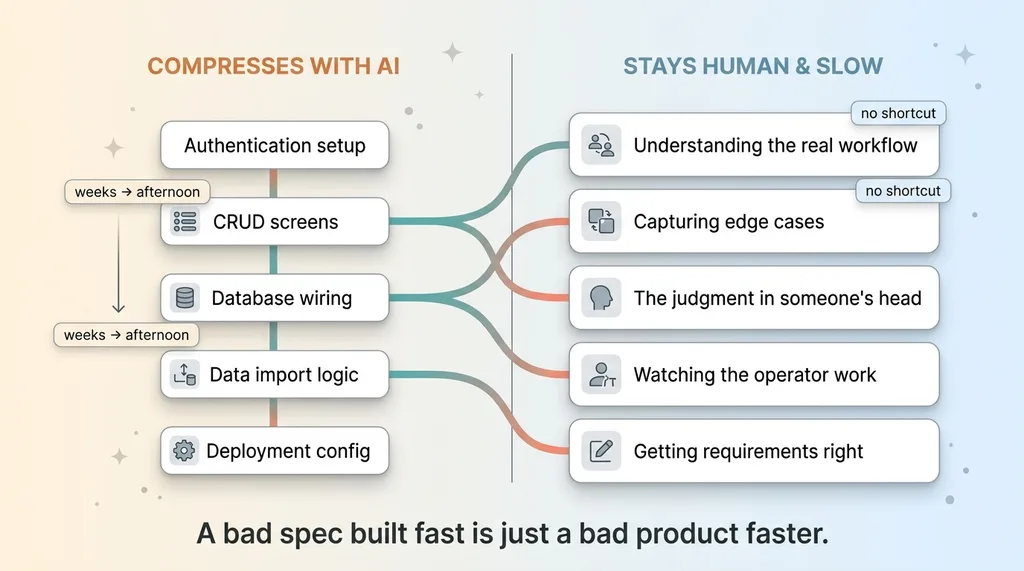 What compresses (the build) vs what does not (requirements)
The build is fast. Figuring out what to build is not.
The real requirements, the edge cases, the actual workflow, the thing the operator does in their head that nobody ever wrote down, those take real conversation and real observation. That part does not get faster with AI. It can't, because the knowledge lives in people, not documents.
I had a quoting tool project where this was the whole ballgame. On paper the logic looked simple. In reality, the actual pricing rules lived entirely in one person's head. The "spec," such as it was, captured maybe sixty percent of what she actually did. The other forty percent was judgment she made on the fly based on the customer, the order size, the season, and a dozen things she'd never thought to articulate because she'd never had to.
If I'd built fast against the written spec, I'd have shipped the wrong tool in days. That's the trap. Compressing the build does not save you from skipping the requirements. It just means you ship the wrong thing faster.
This is why I listen before I automate. I sit with the person who does the job. I watch them work. I ask why they did the thing they just did. The answer is usually something that was never in any process doc and never would have been.
A bad spec built fast is just a bad product faster. That's the line that separates serious work from vibe-coded throwaways. Anyone can generate a slick app from a vague prompt now. Getting the app to match how the business actually runs is still slow, still human, and still where most of the real value gets made or lost.
So when I quote a timeline, the build is the short part. The requirements work is the part I take seriously.
What it should cost now
Now the cost question, because it's the other half of the doubt in your head.
That six-figure agency invoice was overwhelmingly labor hours. It was the discovery meetings, the SOW drafting, and mostly the slow, manual build. You weren't paying for genius. You were paying for time. Hundreds of billable hours against the construction work I described above.
When the build compresses, the labor cost compresses with it. You cannot type for two weeks and bill for two weeks if the typing now takes two days. The math changes because the work changed.
I won't print client dollar figures, but the pattern is consistent: the focused tool that used to be a six-figure quarter-long project is now a fraction of the cost and a fraction of the time. Not a discount. A different cost structure entirely.
This is where you should reframe the question you're asking. Stop asking "can I afford a quarter-long six-figure project." That's the wrong question because it's calibrated to the old clock. Ask instead: "what would this specific tool actually take to build now."
The answer reshapes your build-versus-buy thinking too. When custom was a six-figure ordeal, you bought the off-the-shelf SaaS and lived with the seventy-percent fit. When custom drops to a fraction of that, the math tilts. The thing built exactly for your workflow stops being a luxury.
And the real unlock, the one most people miss: you can finally afford the small tools you've been living without. The ten-hour-a-week annoyance that never justified a six-figure project absolutely justifies a few-days build. Those are the tools that quietly add up.
How to recalibrate what you ask for and expect
So how do you actually operate differently? Two changes.
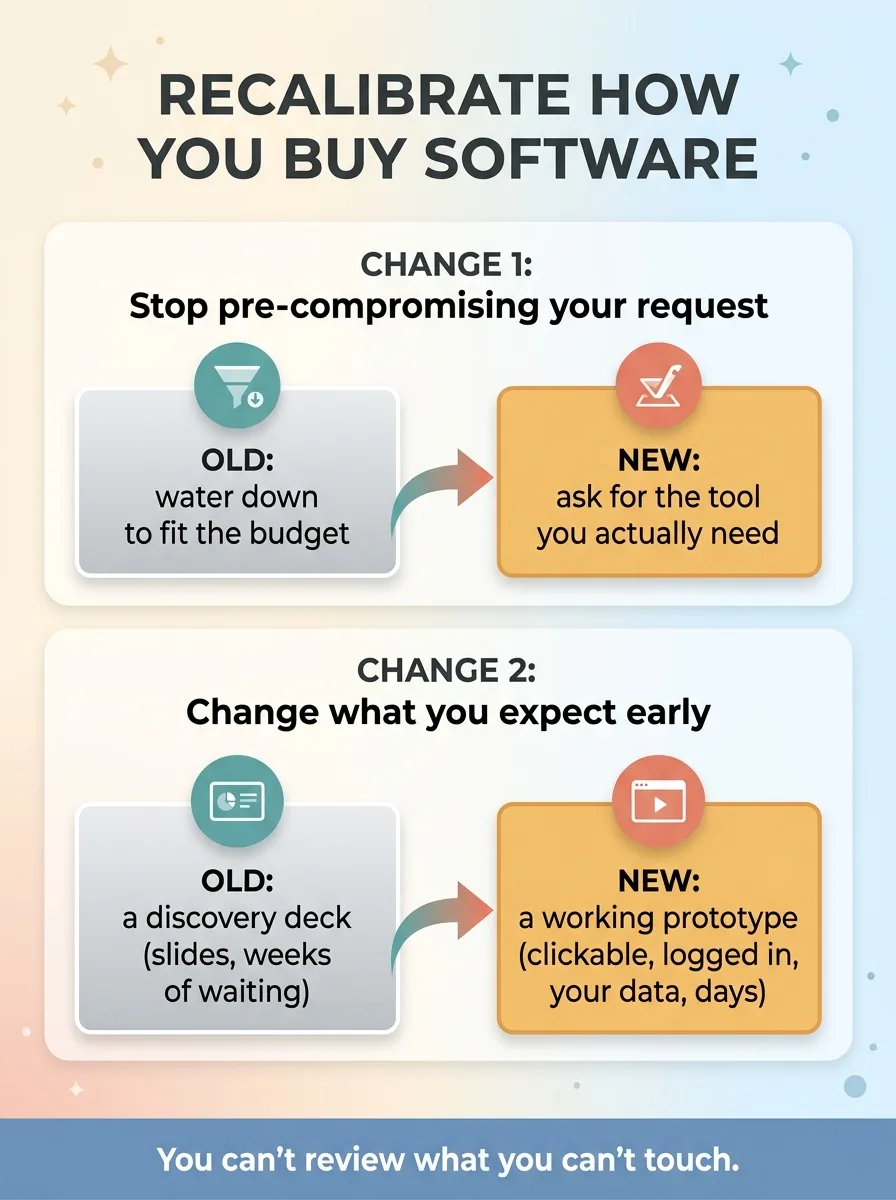 How to recalibrate: two operating changes
First, stop pre-compromising your request. You've been trained to water down what you ask for so it fits the old budget. You ask for the stripped-down version because the full version felt unaffordable. Stop doing that. Ask for the tool you actually need. Describe the real workflow, the real annoyance, the real thing you wish existed. Let the build cost get sorted out against reality, not against your outdated assumptions.
Second, change what you expect to receive early. In the old model, the first deliverable was a discovery deck. Slides. Diagrams. A roadmap. You waited weeks to see anything you could touch.
Demand a working prototype instead. Clickable. Logged in. Your data in it. Within days, not weeks.
Here's why this matters beyond speed. A working prototype surfaces the requirements you couldn't articulate up front. The moment you click through a live tool, you see the gaps. "Oh, it also needs to handle the case where the order gets split." "Wait, this field should pull from the other system." Seeing it live exposes the missing requirements faster than any spec doc ever could. You can't review what you can't touch.
So the engagement should look like short feedback loops with real software in hand early, and your judgment getting refined against something concrete. You react to a thing, not a description of a thing.
One caution. Fast does not get to mean fragile. This is where the discipline matters, real review, human-in-the-loop checks, actual testing against your data. The speed comes from the build collapsing, not from cutting the quality corners that keep the thing from breaking on a Tuesday. Anyone who tells you fast and careful are opposites is selling you one or the other.
Reset your clock before your competitor does
Here's the whole picture in three lines. The build became days. The requirements and the judgment stayed human and stayed slow. The cost dropped with the labor, because the labor was always most of the cost.
The risk in front of you isn't moving too fast. It's continuing to budget against a timeline that no longer exists. While you postpone the tool because it feels like a six-month, six-figure decision, a competitor with a more current mental model ships it in a week and starts compounding the advantage.
That's the real cost of the outdated clock. Not the money you'd spend. The tools you keep not building.
Because I build the software instead of just advising on it, I can usually tell you in one conversation whether your idea is a days-long build or a genuinely hard problem. And just as important, I can tell you what the real requirements work will look like, the part that doesn't compress, so you know where the actual effort lives before you commit a dollar.
No deck. No discovery phase to bill you for. Just a straight read on what your thing actually takes now.
Thinking about AI for your business?
If this resonated, let's have a conversation. I do free 30-minute discovery calls where we look at your operations and find where AI could actually move the needle, not in theory, in working software.
Get AI insights for business leaders
Practical AI strategy from someone who built the systems — not just studied them. No spam, no fluff.
Hodgen.AI
Ready to automate your growth?
Book a free 30-minute strategy call with Hodgen.AI.
Book a Strategy Call