The Obvious Move I Didn't Make
I'm building a memory-book product right now. Physical printed spreads, each one carrying a small QR badge that resolves to a media page. The obvious feature, the one any product manager would have penciled in on day one, was AI text-to-speech narration on every page.
It would have been cheap. Fractions of a cent per generation. No friction, no upload step, instant scale across thousands of books. And here's the part that should make you raise an eyebrow: I had already built the engine to support it. The architecture was sitting there, ready.
I shipped without it. On purpose.
This is not an anti-AI article. I've built 15+ AI systems across my own businesses and for clients. I run 29 automation modes in production. I've saved over 3,000 hours a year by handing the boring work to machines. I am, by any reasonable definition, an AI maximalist in practice.
But the skill that actually separates good AI work from bad AI work is not knowing how to add it. It's knowing when not to use AI. That's the muscle almost nobody talks about because almost nobody selling AI is incentivized to develop it.
Here's my thesis, stated plainly: when the emotional payload of a product is someone's actual voice, the synthetic version is worse even though it costs nothing. The cheaper option destroys the thing the customer is buying.
Restraint, in this case, is a feature. Not a limitation, not a budget compromise, not a "we'll add it in v2." A deliberate design choice that the product is better off for.
Most people building with AI right now are sprinting in the opposite direction, jamming it into every corner because they can. I want to show you why I walked the other way, and how you can spot the same situation in your own business.
What the Product Actually Sells
Let me describe the product without naming anyone involved.
It's a memory book. Printed spreads, real paper, the kind of thing that sits on a shelf or a coffee table. Each spread carries a small QR badge. Scan it, and you land on a media page. That media is real human voice clips and short video, captured from the people who matter to whoever owns the book.
So what is the customer actually paying for here? It's tempting to write it on the spec sheet as "a book with audio." That's the wrong description, and the wrong description leads straight to the wrong product decision.
The customer is paying to hear a specific person's actual voice.
A grandparent reading a bedtime story. The particular way someone laughs before they finish a sentence. The accent, the pauses, the slightly-off pronunciation of a family nickname. These are not interchangeable audio assets. They are the entire point.
Now imagine the AI version. I generate a synthetic voice that reads the same words. It's clear, it's well-paced, it might even be technically beautiful. And it is the exact opposite of the value.
Because the product's whole reason to exist is authenticity. The customer isn't buying narration. They're buying proof that this real person, this real moment, existed and sounded like this. An AI clone, even a flawless one, severs that. It replaces the irreplaceable thing with a competent fake.
This is the cleanest way I know to learn when not to use AI: ask what the customer is actually paying for. Not what the product does. What it's for. The moment you answer that honestly, some "obvious" AI features reveal themselves as quietly corrosive.
Why the AI Version Is Worse Even Though It's Cheaper
The cost math points the wrong way
Let me make the case against myself, honestly, because the numbers are real.
AI text-to-speech costs fractions of a cent per generation. There's no capture friction. Nobody has to record anything, sit a relative down with a microphone, fumble with an upload. It scales instantly to every page of every book with zero marginal human effort. By every metric a spreadsheet can hold, AI wins this decision in a landslide.
I want to be clear that for most product decisions, cheaper-and-faster is exactly the right call. I've made that call a hundred times. My product pipeline takes a concept to a live listing in 20 minutes, down from 3 to 4 hours. My pricing engine dynamically prices 564+ products across a 4-tier classification. I do not get sentimental about workflow.
But the spreadsheet is the wrong tool for this particular decision, and here's why.
Emotional payload doesn't survive synthesis
The value in this product is non-fungible. You cannot substitute one unit for another without destroying it.
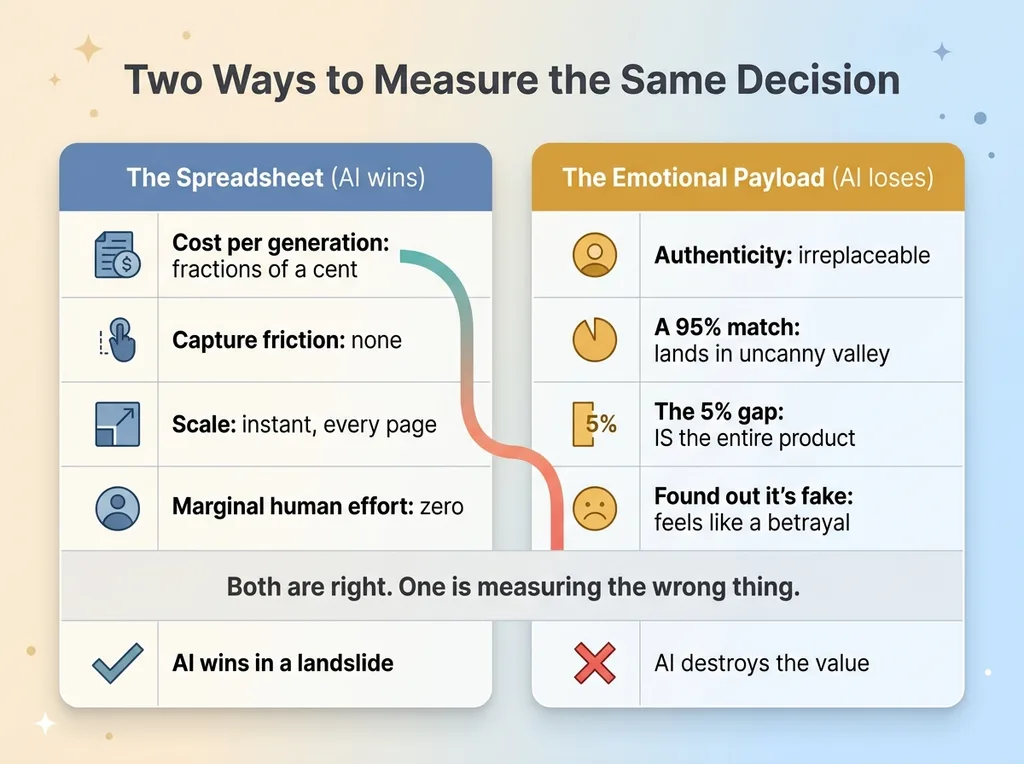 Spreadsheet metrics vs emotional payload, measuring the wrong thing
A synthetic voice that sounds 95% like grandma is not 95% as good. It's worse than nothing. It lands in the uncanny valley, where "almost her" reads as "not her, and trying to trick me." That 5% gap isn't a rounding error you optimize away later. The 5% gap is the entire product.
This is the heart of the human vs ai content question that everyone's arguing about, applied to one concrete case. AI content wins where the value is information, speed, or volume. It loses, badly, where the value is a specific human being.
The maximalist who automates everything destroys value in exactly the places where authenticity is the product. They can't see it because their only instrument measures cost and speed, and on those axes they're always right. They're just measuring the wrong thing.
Building the Engine, Then Leaving It Off
Capture-agnostic by design
Here's the part that I think actually signals real judgment, and it's the part a thoughtful buyer should care about most.
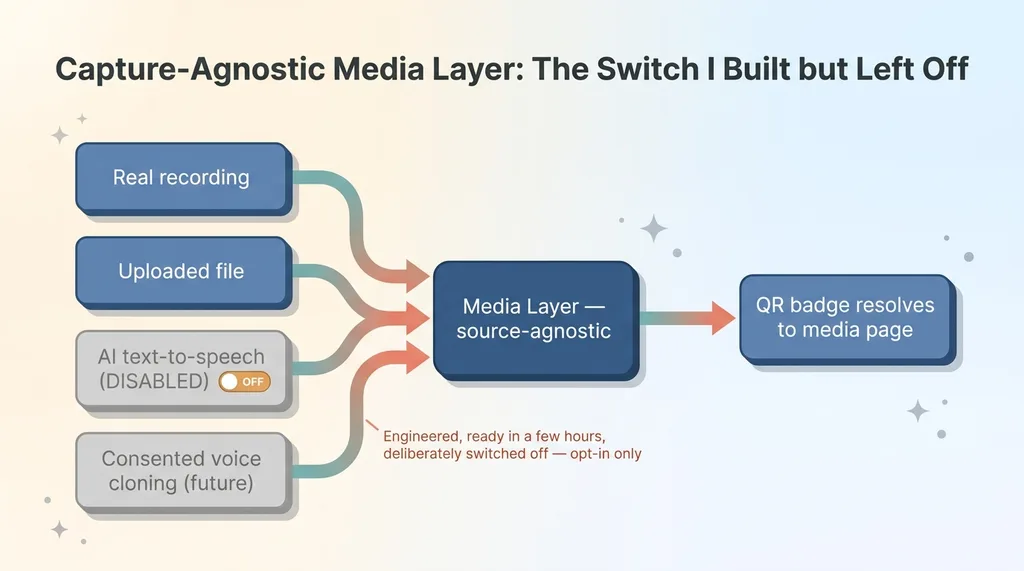 Capture-agnostic media architecture with the AI switch disabled
I didn't skip AI narration because I couldn't build it. I built the architecture to be capture-agnostic from the start. The media layer doesn't care where the audio comes from. A real recording, an uploaded file, AI text-to-speech, consented voice-cloning down the road. To the system, it's all just audio resolving to a page.
Adding synthetic voice later is trivial. A few hours of work, most of which is already done.
The switch exists, it's just disabled
So this was never "we can't." It was "we chose not to." That distinction matters enormously, and most people can't tell the two apart from the outside.
A product that lacks AI narration because the team hit a wall is a product with a gap. A product that lacks AI narration because the builder deliberately disabled a feature he'd already engineered is a product with a point of view.
This is the same pattern I follow everywhere I ship. I design the off-switch in on purpose. It's the broader discipline I wrote about in where I pull the plug on AI: the best AI systems are the ones where you've decided, in advance, where the machine doesn't get to operate.
And to be fair, I left the door open for legitimate future cases. Someone who has lost their voice and wants narration restored. Accessibility needs for the visually impaired. The consented reproduction of a deceased loved one's voice, requested by the family. Those are real, and they matter.
But every one of them is opt-in, surfaced as a deliberate choice with informed consent. Never the silent default. The default has to protect the thing the product exists to deliver.
How to Tell When Not to Use AI
You can turn all of this into a portable test. Here's the framework I actually use when I'm deciding whether a feature should be AI-powered or hands-off.
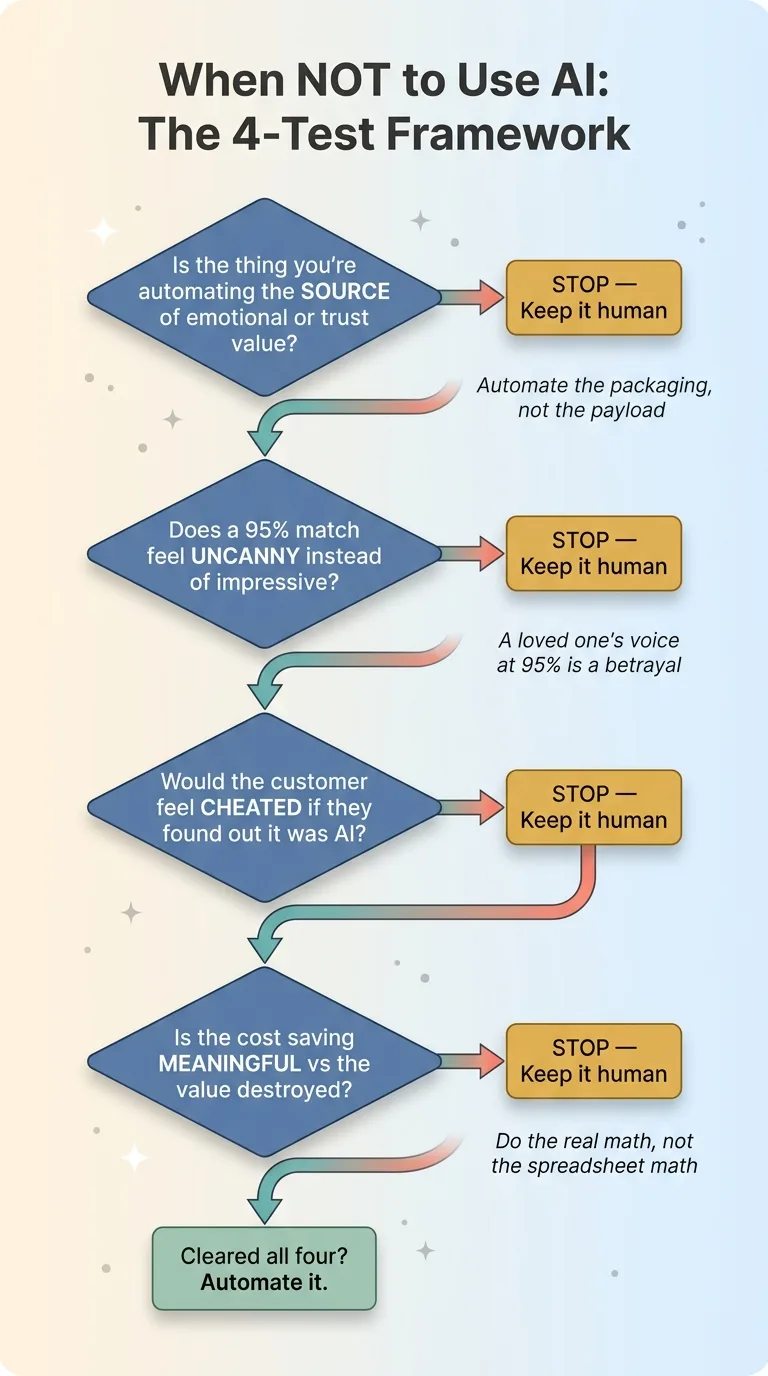 The 4-Test Framework for When Not to Use AI
Ask what the customer is paying for
Test 1: Is the thing you're automating the source of the emotional or trust value? If the automation target is also the reason customers buy, be very careful. Automate the packaging, not the payload.
Test 2: Does a 95% match feel uncanny instead of impressive? For some things, 95% is a miracle. For a loved one's voice, a financial advisor's judgment, a doctor's bedside manner, 95% is a betrayal. If "almost right" reads as "fake," AI is the wrong call.
Ask whether 'good enough' is actually good enough
Test 3: Would the customer feel cheated if they found out it was AI? Run the thought experiment. If discovering the AI behind the curtain would make someone feel deceived rather than delighted, you've found a line you shouldn't cross.
Test 4: Is the cost saving meaningful relative to the value destroyed? Fractions of a cent saved against a product that no longer does its one job is a catastrophic trade. Do the real math, not the spreadsheet math.
Now the contrast, because I don't want this to sound like AI skepticism. Look at where AI is obviously, unambiguously right in my own work. The product pipeline. The pricing engine across 564+ products. Content drafting for 313 blog articles. SEO. Image optimization through a multi-LLM setup. In every one of those, AI does the typing and the grunt work, and it does it brilliantly.
That's the line. AI does the typing. It does not get to be the soul of the product. I wrote a whole piece on this, AI replaced the typing, not the strategy, because it's the single most useful frame I've found. Automate the labor. Keep the judgment and the authenticity human.
Why Restraint Signals Better Judgment Than Hype
If you're a CEO, you are being pitched AI for everything right now by people whose only move is more AI.
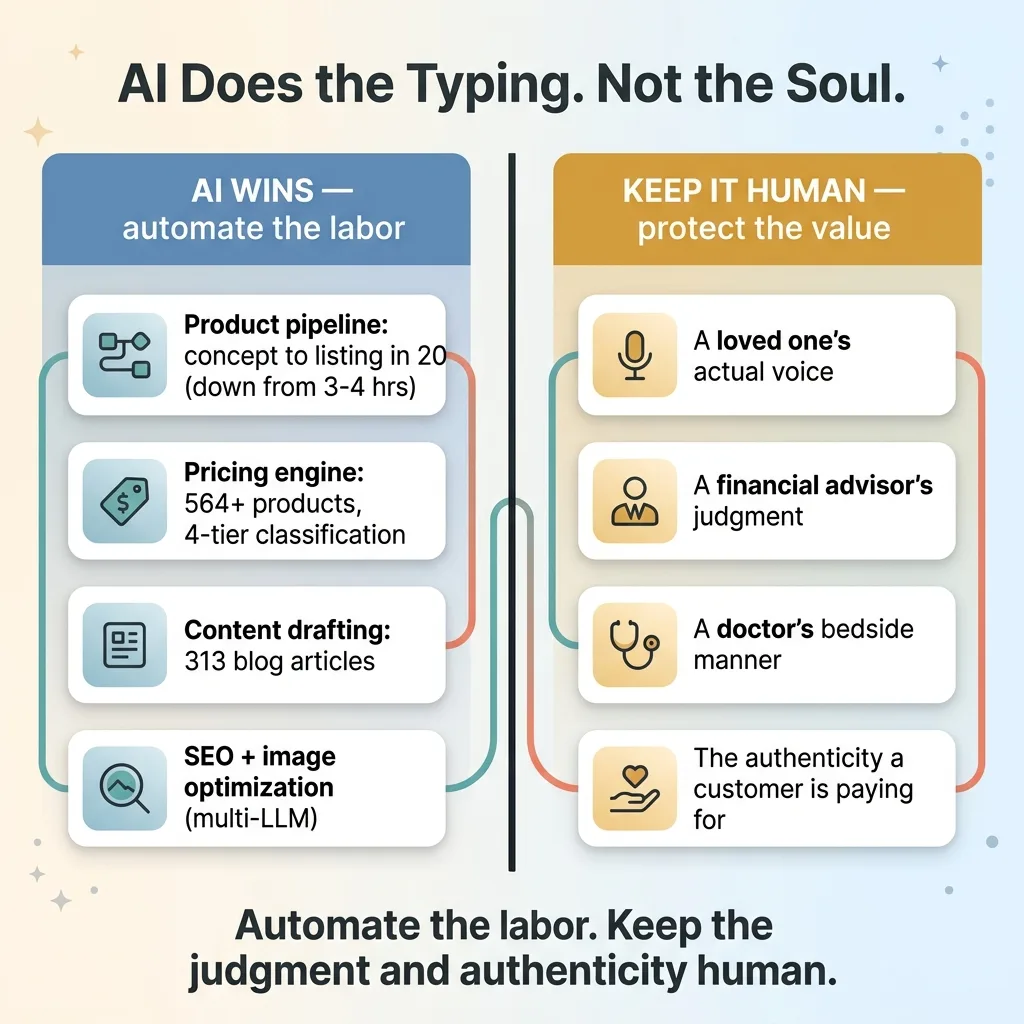 Where AI does the typing vs where it must stay human
I want you to distrust that reflexively. Not because AI is bad, but because the person whose entire offering is "add AI here" has no incentive to ever tell you no. Their invoice grows with the scope. The maximalist isn't optimizing for your outcome. They're optimizing for theirs.
The builder who tells you where not to use AI is the one worth hiring. That's a strange thing to claim, so let me ground it.
I've shipped 29 automation modes. I've cut manual operations time by 42%. I've pushed revenue per employee up 38%. I am not someone who's afraid of AI or hedging because I can't execute. I deploy this stuff at scale, in production, every single day.
And I still kill AI features on purpose when they make the product worse. The memory book is one example. There are others across my systems where the honest answer to "should we automate this" was no, and I designed accordingly.
That's the exact same judgment I bring to a client engagement. The answer to "should we add AI here" is sometimes a flat no, and a good advisor will say that out loud, early, before you've spent six figures discovering it yourself.
Hype is easy. Anyone can say yes to more AI. Restraint requires you to understand the product well enough to know what would break.
The Decision Most AI Vendors Won't Make for You
Here's the meta-lesson, and it's the whole reason I wrote this.
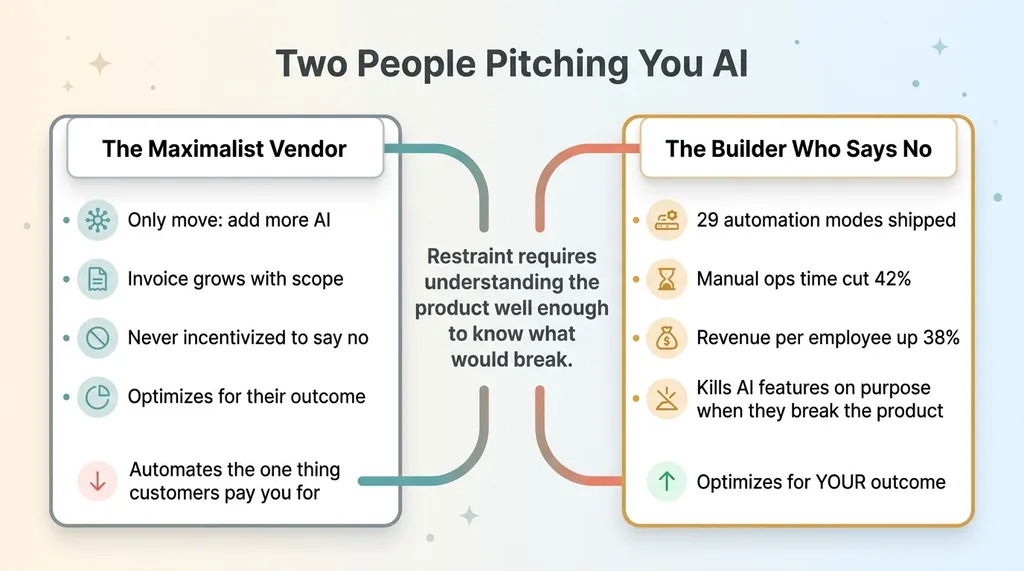 The maximalist vendor vs the restraint-driven advisor
The value of a Chief AI Officer is not pushing AI into every corner of your business. It's knowing which corners to leave alone, and being able to explain exactly why.
Most vendors are paid to say yes. Their economics depend on it. I'm in a different position because I'm building products and deploying systems where the right answer is sometimes a deliberate, well-reasoned no. I've felt the cost of getting that call wrong, and I've felt the quiet payoff of getting it right.
If you're being pitched AI for everything, and some part of your gut says a few of those features would actually make your product worse, that instinct is probably correct. The problem is you need someone who can tell the difference and prove it, not someone who'll cheer you into automating the one thing your customers actually pay you for.
That's the work. It comes from building, not theorizing, which is exactly the point I make in I don't just advise on AI, I build it. You only develop the instinct for when not to use AI by shipping enough of it to feel where it breaks.
If that's the kind of judgment you want in the room, let's talk.
Get the next build note.
I write up each system I build, including what broke. Subscribe to my newsletter and I'll send you the next one.