Most Personas Are Fan-Fiction Written Before the Product Exists
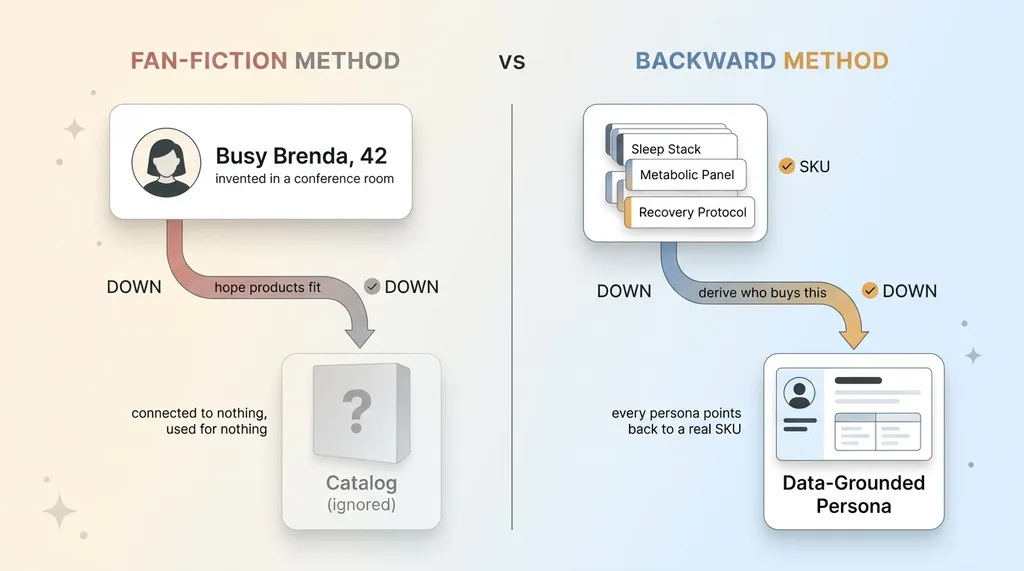
Here is how most companies build a marketing persona. Someone in a conference room invents "Busy Brenda, 42, loves yoga, drinks oat milk, struggles to find time for self-care." They give her a stock photo. They write three paragraphs of imagined inner life. Then they pin it to a wall and never look at it again.
 Forward vs Backward Persona Building
Brenda is fan-fiction. She was invented before anyone looked at the catalog, before a single real buyer placed an order, before there was any data to ground her in. She floats free of the actual products. And because she's connected to nothing, she gets used for nothing.
I think this is exactly backwards. So when I built ai customer personas for content for a longevity and telehealth brand (supplements, lab panels, peptide protocols, described generically here), I started from the only thing that was actually real: the catalog.
The brand already sold things. Every SKU solved a specific problem for a specific person. A sleep stack. A metabolic panel. A recovery protocol. The buyer wasn't a mystery I needed to invent. The buyer was implied by what the product fixed.
So instead of guessing who the customer was and hoping the products fit, I derived the personas from what the brand actually sells and what each SKU actually solves. The catalog came first. The people came second.
This matters because generic AI content is written for no one. And content written for no one converts no one. When you ask a model to "write a blog post about better sleep," you get mush that addresses an empty room. When you ask it to write for a specific person with a specific objection holding a specific product, you get copy that lands.
The difference isn't the model. It's whether you gave it a real target.
Why I Built 40 Personas Backwards From the Catalog
The method is simple to describe and harder to execute well. I built the personas backwards from the catalog instead of forward from imagination.
Start with what you actually sell
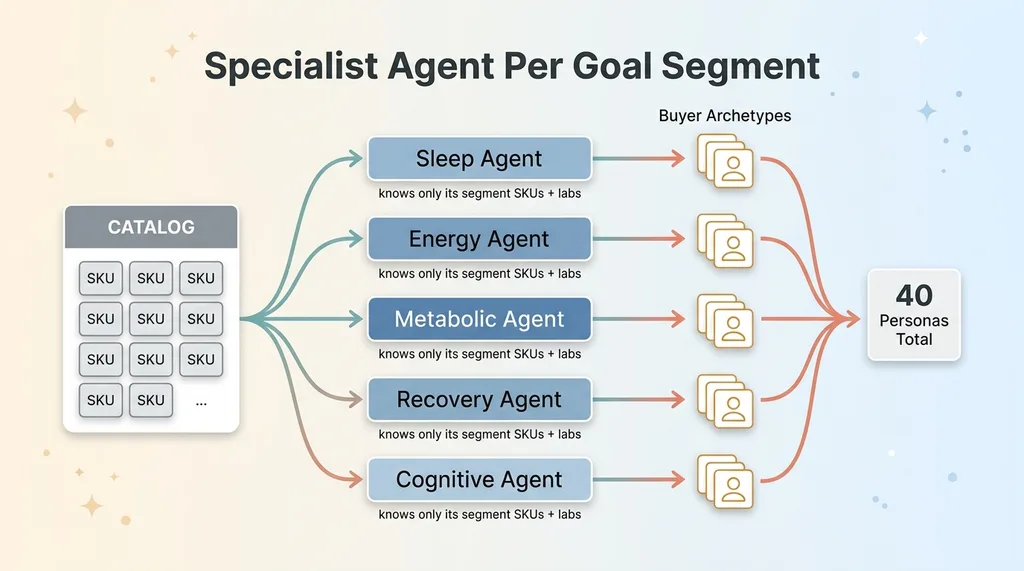
The catalog already organized itself into goal segments. Sleep. Energy. Metabolic health. Recovery. Cognitive performance. These weren't invented. They were the buckets the products already fell into because that's why people bought them.
 Specialist Agent Per Goal Segment
I assigned one specialist agent per goal segment. Each agent's only job was to generate buyer archetypes grounded in the real target_products and suggested_labs for that segment. The sleep agent only knew about sleep SKUs and sleep panels. The metabolic agent only knew metabolic ones.
That constraint is the whole trick. The personas couldn't drift into fantasy because they were built on top of inventory that actually existed and revenue that actually came in.
Tie every persona to real SKUs and objections
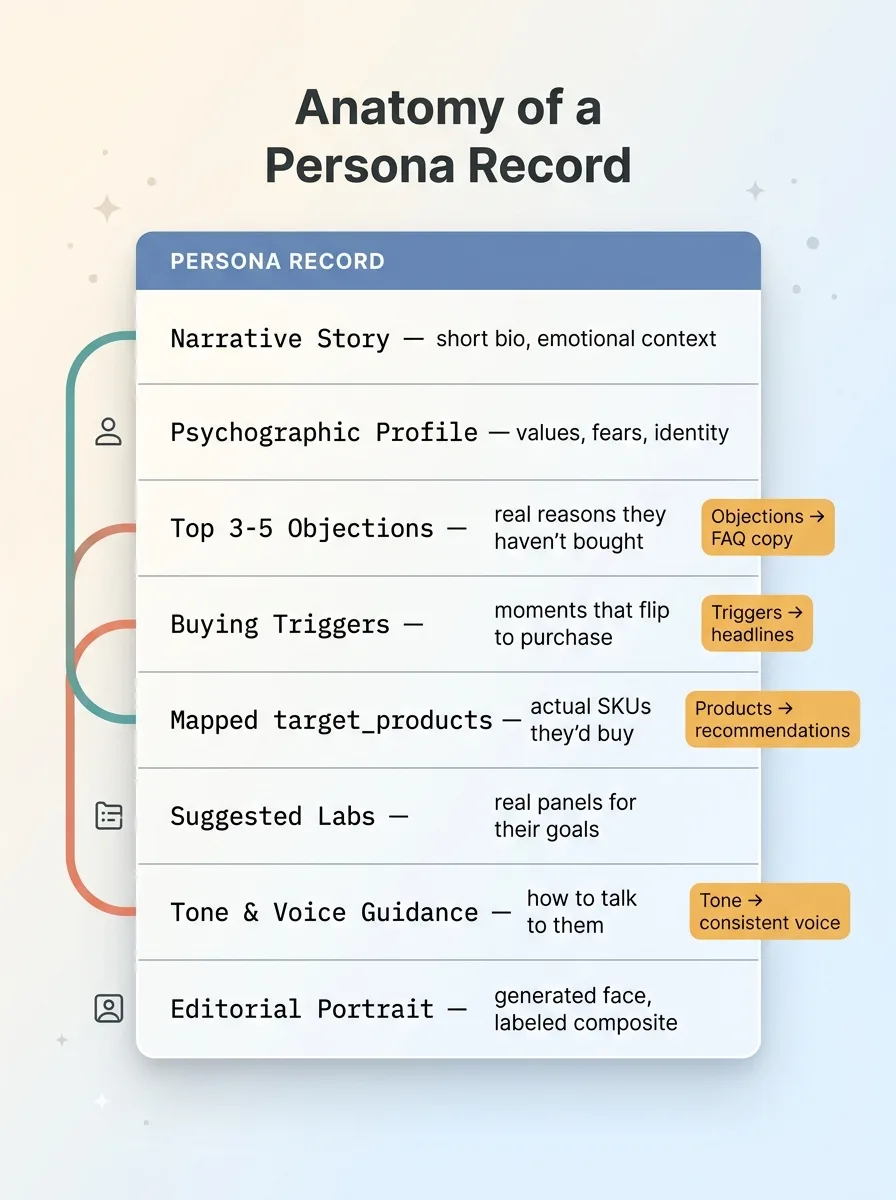
A persona in my system isn't a vibe. It's a record. It has a narrative story, a psychographic profile, a list of real objections, the buying triggers that move that person, the actual products they'd buy, the labs they'd run, and tone preferences for how to talk to them.
Forty personas total, spread across the goal segments.
This is the line between data-grounded buyer personas and invented ones. Brenda-the-fan-fiction connects to nothing. My personas connect to specific SKUs you can sell and specific objections you can answer. When a persona says "I've tried three sleep supplements and none worked," that objection maps to a real product the brand can recommend as the better option.
That's what makes this icp targeting ai that's actually anchored to revenue, not a creative-writing exercise. Every archetype points back at something you can put in a cart.
What Each Persona Record Actually Contains
If you want to copy this, here's the structure of a single persona as stored data. Not a slide. A record with fields, because fields are what a content engine can read.
 Anatomy of a Persona Record
- Narrative story. A short biography of who this person is and what brought them to the problem. This sets emotional context.
- Psychographic profile. Values, fears, identity. Not "age 42" demographics, but how they think about their own health.
- Top three to five objections. The real reasons this person hasn't bought yet. "Supplements are a scam." "I don't have time for lab work." "I've been burned before."
- Buying triggers. The moments that flip them from browsing to purchasing. A bad night of sleep. A scary biomarker. Turning 40.
- Mapped target_products. The actual SKUs this person would buy, pulled straight from the catalog.
- Suggested labs. The real panels that make sense for their goals.
- Tone and voice guidance. How to talk to this specific person without sounding like a brochure.
- An editorial portrait image. A generated face, clearly labeled as composite, so the team can picture who they're writing for.
Here's why each field earns its place. The objections become FAQ copy and rebuttal sections. The triggers become headline hooks. The mapped products give the article something concrete to recommend instead of vague advice. The tone guidance keeps the voice consistent, which matters because I'd already matched the brand's voice from real transcripts and the personas had to stay inside that voice.
A persona without these fields is decoration. A persona with them is an instruction set the content engine can actually follow.
Pointing the Content Engine at the Personas
Building 40 good personas is worthless if your content doesn't use them. So I wired them directly into the production system.
 Persona-Driven Content Pipeline with Feedback Loop
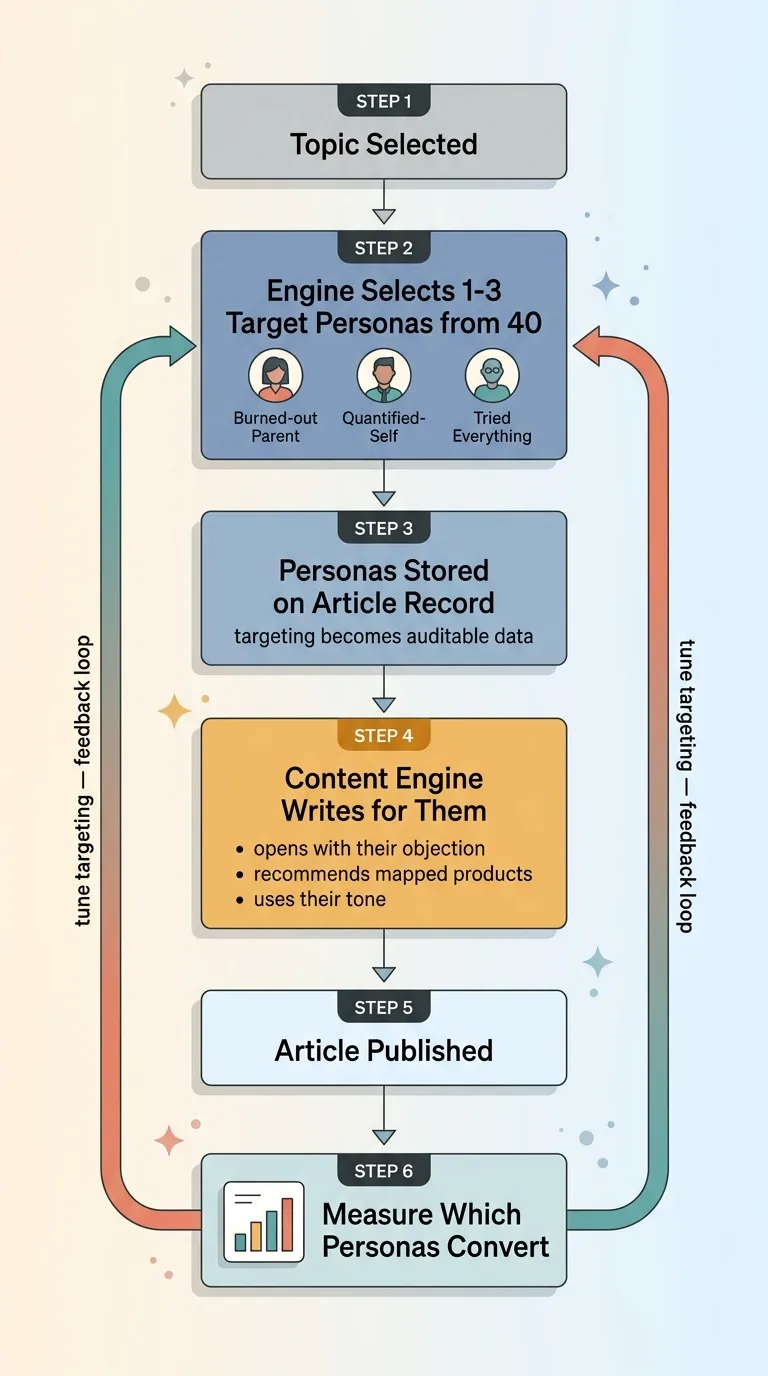
Selecting one to three target personas per topic
For every topic the content engine takes on, it first selects one to three target personas from the 40. Not "general audience." Specific people. A sleep article might target the burned-out parent, the data-obsessed quantified-self type, and the person who's tried everything.
Then it stores the selected personas on the article record itself. That's the part most teams skip. Targeting becomes auditable data, not a vibe someone had on a Tuesday. I can pull up any published article and see exactly which buyers it was written for.
Writing directly for them, not for everyone
Once the personas are selected, the content engine that won't ship until it passes compliance writes directly for them.
The article opens with that persona's actual objection, in their language. It recommends the products mapped to that persona, not a random grab-bag. It uses their tone preferences. The result reads like it was written for a specific human, because it was.
This is persona-driven content marketing working as a system instead of a workshop exercise. Contrast it with generic AI output that opens with "In a world where wellness matters more than ever" and addresses absolutely no one.
And because the targeting is stored as data, I can do something most content operations can't: analyze which personas drive which performance. If the burned-out-parent persona consistently produces articles that convert and the quantified-self persona doesn't, that's a measurable signal. That's where content personalization stops being a buzzword and becomes a feedback loop you can actually tune.
The Internal Explorer That Made the Team Trust It
Personas stored as JSON are useless if nobody on the team ever looks at them. Data sitting in a table doesn't change how people write.
So I built an interactive internal explorer. The team can browse all 40 personas, read the stories, see the mapped products, look at the portraits, scan the objections. It turned an abstract data structure into something marketers actually opened before planning content.
That sounds small. It wasn't. Before the explorer, the personas existed only inside the pipeline, and the humans didn't trust what they couldn't see. After it, the marketing team started using the personas to plan campaigns and to sanity-check what the engine produced.
Here's the honest part. A persona system only works if humans use it to check the machine. The engine selects personas and writes for them, but a person still needs to look at the output and ask, "Does this actually sound like someone we'd sell to?" The explorer is the human-in-the-loop layer for content strategy.
The AI does the volume. The team does the judgment. The explorer is what connects them. Without it, I'd have built a very sophisticated system that nobody believed in, which is the same as building nothing.
The FTC Trap: Personas Are Not Patients
This is the part that keeps me up at night, and it should keep you up too if you're in any regulated space.
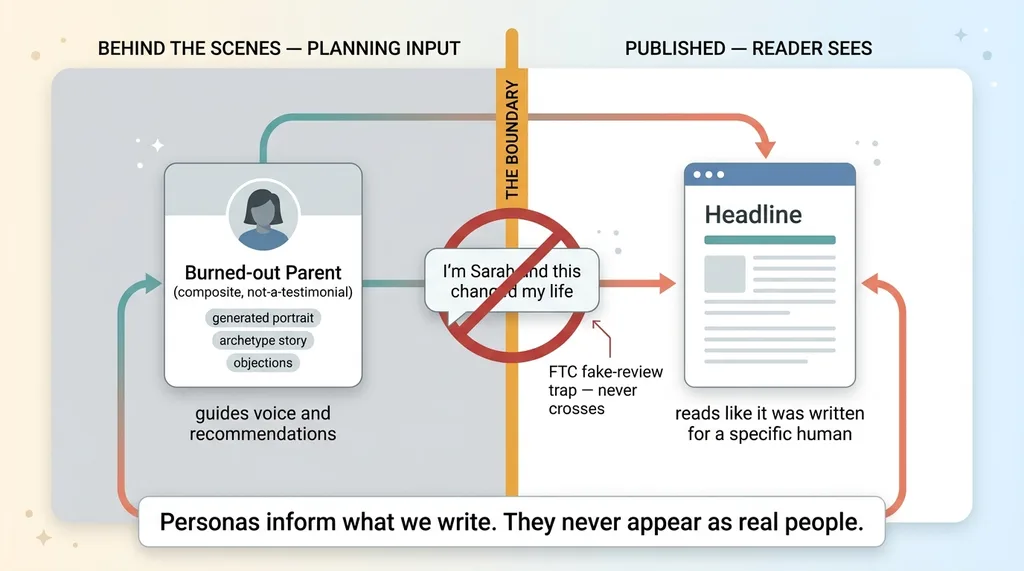 The FTC Boundary: Planning Input vs Publishing Output
Every persona in the system is explicitly labeled as composite and not-a-testimonial in the data itself. The portrait is generated, not a real face. The story is an archetype, not a case study. And critically, no persona ever surfaces in published copy as a real customer or patient.
In a longevity and telehealth context, this is not optional. A fictional buyer archetype that reads like a genuine patient testimonial is an FTC fake-review trap waiting to spring. The FTC's rule on fake and deceptive reviews doesn't care that you "meant it as a persona." If it reads to a consumer like a real person endorsing a product, you have a problem.
So the design discipline is strict. Personas inform what we write. They never appear in what we publish as real people. The burned-out-parent persona shapes the angle and the objections we address. She does not show up in the article saying "I'm Sarah and this product changed my life."
The line is clean: personas are a planning input, not a publishing output. They live behind the scenes, guiding the voice and the recommendations. The reader never meets them.
This is the boring discipline that keeps you out of trouble. It's also exactly the kind of thing that gets skipped when someone bolts AI onto a marketing team without thinking about how the outputs get regulated. The persona that makes your content better can become the testimonial that gets you fined, if you're not careful about the boundary.
Making AI Content Speak to Your Buyers Instead of No One
Here's the question every CEO eventually asks me: how do I make AI content actually speak to my buyers instead of producing generic filler?
The answer is targeting, and targeting has three requirements. It has to be grounded in real products and real objections. It has to be stored as data, not living in someone's head. And it has to be selected per article, so each piece is written for specific people instead of an imaginary average.
The reverse method is what makes this repeatable. Start with the catalog or the service line you actually have. Derive the personas from what you sell and what each thing solves. Wire those personas into the content engine. Then let humans sanity-check the output.
This works for any business with a real catalog or a real service line. A supplement brand. A financial advisory firm. A manufacturer with a product line. If you sell something specific to someone, you can build personas backwards from it. The fan-fiction approach (invent the buyer, hope the products fit) is the only version that doesn't transfer, because it was never grounded in anything to begin with.
I build these targeting systems for brands whose content reads like it was written for everyone, which means it converts no one. The work isn't glamorous. It's catalog analysis, persona records, engine wiring, and compliance discipline. But it's the difference between AI content that fills a blog and AI content that fills a cart.
Get the next build note.
I write up each system I build, including what broke. Subscribe to my newsletter and I'll send you the next one.