The post that won the internet and lost the ad account
I run a DTC fashion brand out of San Diego, handmade stuff, and a while back we posted a meme that took off. Roughly 15,000 likes. For context, our meme posts average about 2,868 in engagement, which is already around 10x everything else we put out. This one blew past even that.
So I did what every marketer's gut tells them to do. I threw ad budget behind it.
It bombed. Not "underperformed" bombed. Lit-money-on-fire bombed.
The reason was obvious in hindsight: the post didn't show a single product. It was funny. It was relatable. It got shared. And none of that gave a cold or warm buyer any reason to click and pull out a credit card. The post was great at being a meme and terrible at being an ad, because those are two completely different jobs.
That's the trap with Instagram content for paid ads. Your best organic post is optimized for the algorithm's reward, which is attention, not purchase intent. The instinct to "boost the winner" is exactly the instinct that drains budgets.
So which of your organic content should you actually put ad dollars behind? Most people answer that with a gut feel, and the gut almost always points at the wrong thing.
I stopped guessing. I built a framework that scores every post on two separate axes and tells me precisely which content deserves paid spend and which content should stay organic. Here's how it works and what the data actually showed.
Why I scored 58 posts on two separate axes
Engagement is not ad potential
I took every Instagram post my brand published from February through May 2026. Fifty-eight posts. Then I scored each one on two completely separate axes.
The first axis is engagement: likes, comments, saves, reach. How well did it perform organically?
The second axis is ad potential. Three questions. Does it show the product? Is there a clear value proposition? Can it carry a call to action without feeling forced?
Here's the thing most brands miss. These two scores are not the same measurement, and treating them as one number is where the money disappears. A post that wins organically is engineered for entertainment and relatability, because that's what the feed algorithm rewards with reach. A post that converts paid traffic needs to show what you sell and give someone a reason to buy.
The two-axis scorecard
The reason I built a scorecard instead of trusting instinct is simple. Gut feel only ever says one thing: "the post that got the most likes is your best post, so put money behind it." That sentence sounds obviously true and is usually wrong.
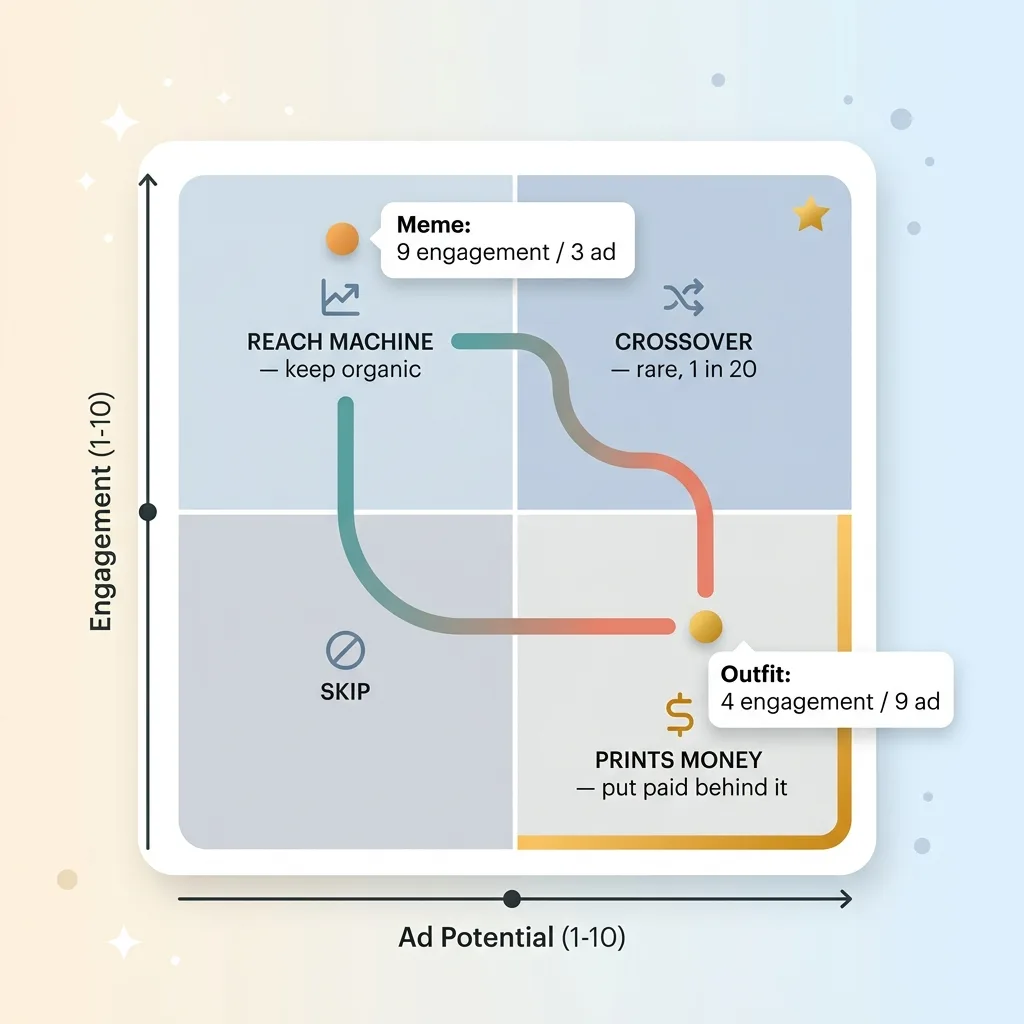 Two-axis scoring matrix: engagement vs ad potential
When you separate the axes, you can see a post that scores a 9 on engagement and a 3 on ad potential. That's a reach machine, not an ad. You can also find a quiet post that scored a 4 on engagement but a 9 on ad potential. That's the one that prints money when you put paid dollars behind it.
The scorecard forces the question gut feel skips: what is this post actually good at? Once you ask it for every post, the organic vs paid creative decision stops being an argument and becomes a lookup. You stop debating which content to boost and start reading it off a spreadsheet.
The data: memes win reach, outfits win ads
The numbers side by side
When I split the 58 posts by type and averaged the scores, the pattern was almost comically clean.
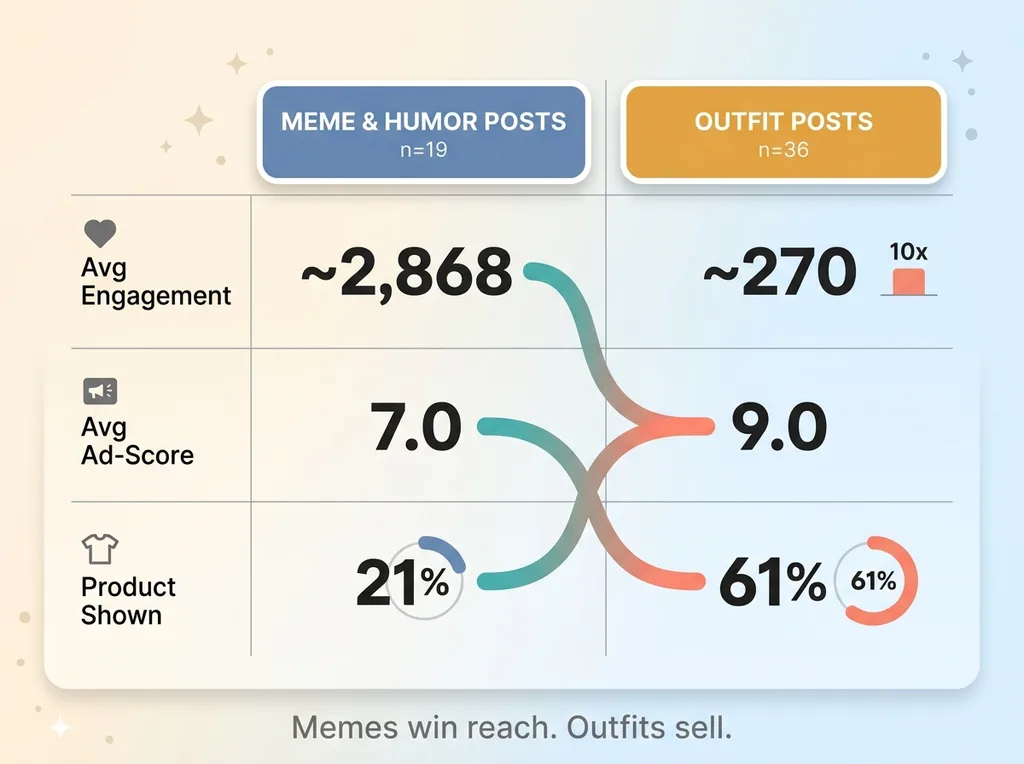 Memes vs Outfits data comparison
- Meme and humor posts (n=19): ~2,868 average engagement, 7.0 average ad-score, product shown only 21% of the time
- Outfit posts (n=36): ~270 average engagement, 9.0 average ad-score, product shown 61% of the time
Read those two lines twice. The memes pulled roughly ten times the engagement. The outfits scored dramatically higher on ad potential and actually showed the product most of the time.
Why they barely correlate
The two axes barely correlate. That's the whole insight. If high engagement predicted high ad potential, these numbers would track together. They don't. They move almost independently.
The reason is that they're two different products serving two different jobs. The meme is an entertainment product. Its job is to earn cheap attention and get shared into feeds that have never heard of my brand. The outfit post is a sales product. Its job is to show the thing, communicate why it's worth buying, and survive a call to action.
I'm fairly confident this pattern holds for most DTC brands, not just fashion. Whatever your equivalent of a meme is (the relatable joke, the trend hop, the "tag your friend" post), it will win reach and lose conversions. Your product shots, demos, and before-afters will be the reverse.
There is one rare exception worth watching for: the crossover post. A meme that also clearly shows product and scores a 9 or higher on ad potential. Those exist, maybe one in twenty. When you find one, it's the best of both worlds and worth real money. But you can't plan around the exception. You plan around the pattern, and the pattern says memes reach, outfits sell. This is the same organic-paid split I use across content.
The rule that fell out of the data
Once you see the data, the operating rule writes itself. Here it is in one breath:
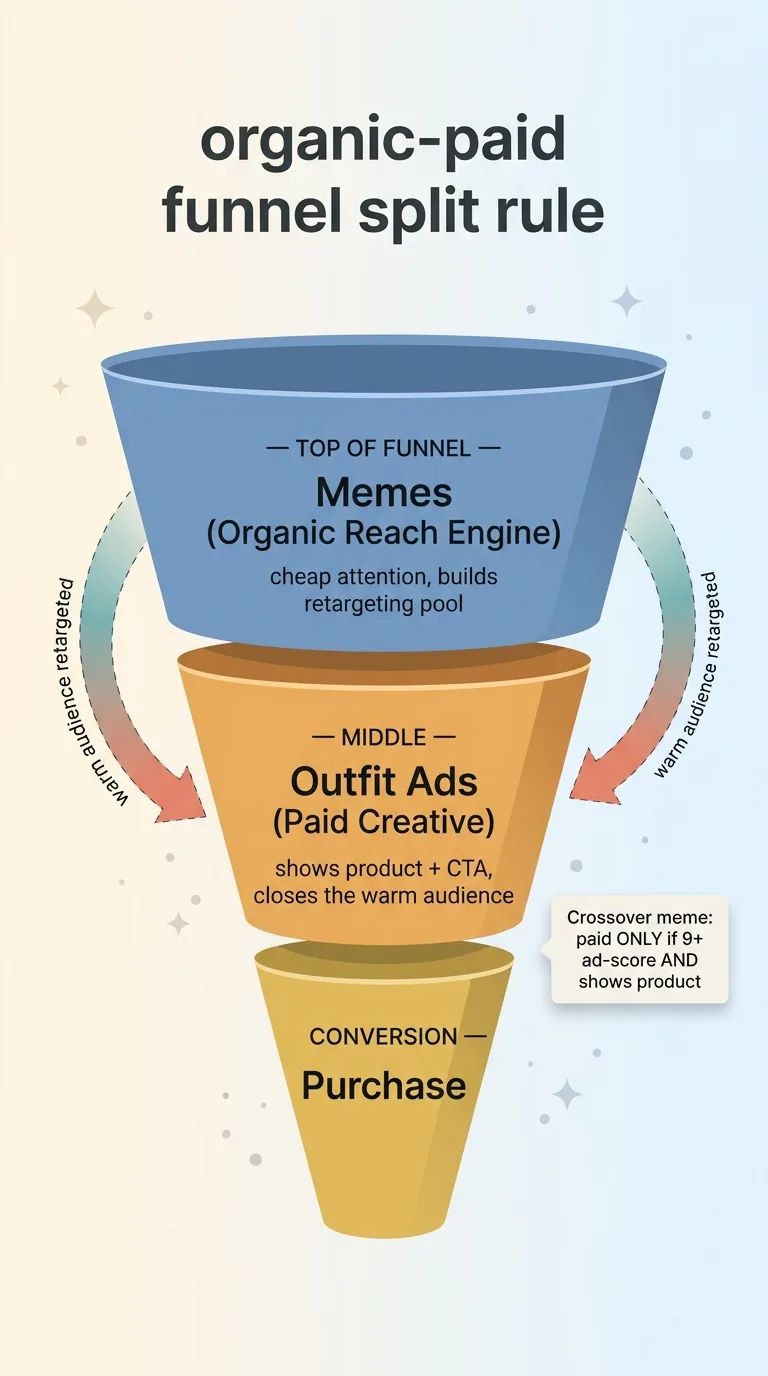 The organic-paid funnel split rule
Memes are the organic reach engine and the retargeting pool. Outfits are the paid creative. Paid dollars go behind outfits, plus the rare crossover meme that scores 9 or higher AND shows product. Organic keeps the memes for top-of-funnel reach and for building a warm audience you can retarget later.
That's the whole rule. You could stick it on a sticky note.
The logic underneath it is what makes it work, though. A meme earns cheap reach. That reach isn't just vanity likes, it's seeding a retargeting pool. Every person who engages with a meme is a warm audience member you can come back to later. So the meme does real work, just not the work most people assign it.
Then you hit that warm pool with outfit ads. The ones that actually show product and carry a CTA. The meme softened the audience for free; the outfit closes them for paid. You're not asking a cold stranger to buy off a joke. You're asking someone who already smiled at your brand to look at the thing you sell.
This is why "boost the winner" is so destructive. It takes your cheapest, most efficient reach generator and pours expensive ad budget into it, asking an entertainment product to do a sales job it was never built for. You burn the budget and you don't even get the reach you'd have gotten organically, because boosted memes rarely outperform their organic ceiling anyway.
The split respects what each piece of content is good at. Memes top of funnel, organic. Outfits middle and bottom, paid. The crossover meme gets paid treatment only when it earns a 9 on both axes.
Building an autopilot that can't accidentally boost a meme
Sourcing only from the curated asset library
The rule is easy to state and hard to remember at 11pm when a meme is going viral and your fingers are itching to hit boost. So I didn't make it a rule someone has to remember. I made it part of the architecture.
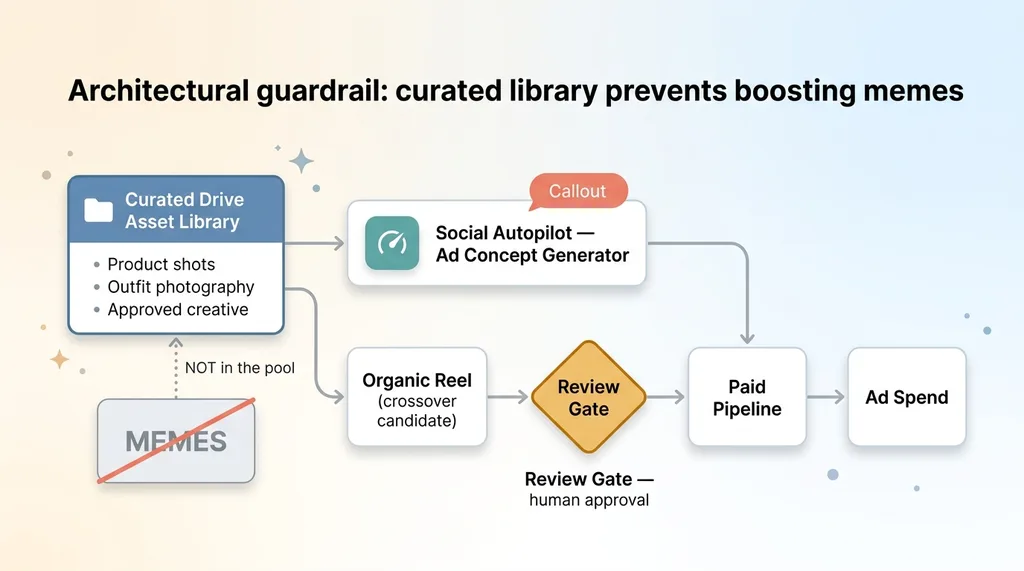 Architectural guardrail: curated library prevents boosting memes
My brand's social autopilot generates ad concepts only from a curated Drive asset library. That library contains product shots, outfit photography, and approved creative. It does not contain memes.
Which means memes are unboostable by construction. Not by policy, not by discipline, by design. The autopilot literally cannot put budget behind a meme because the meme was never in the candidate pool to begin with. You can't pick the wrong thing if the wrong thing isn't on the menu.
This is the same philosophy behind the AI that plans my brand's Instagram week. The system makes good decisions because the inputs are constrained, not because it's being constantly supervised.
A review-gated path for organic reels
Now, sometimes an organic Instagram reel genuinely does have ad potential. A crossover. So I built a path for that, but a deliberate one.
When a reel qualifies, it doesn't get boosted as-is. It enters the paid pipeline as an explicit, varied-angle video concept, and it goes through a review-gated step where a human approves it before any spend happens. The reel becomes the raw material for a proper ad, reworked for the job, not the ad itself.
The broader point matters more than the specific mechanism. The safest guardrail is architectural, not procedural. A rule that says "don't boost memes" depends on a tired human remembering it. A system that physically cannot source a meme into the ad pool doesn't depend on anyone. Once a concept clears that review gate, it flows into how I run ad optimization toward profit, where the spend gets pointed at the metric that actually matters.
The bug that quietly killed the whole thing for a week
Here's the part where the system embarrassed me.
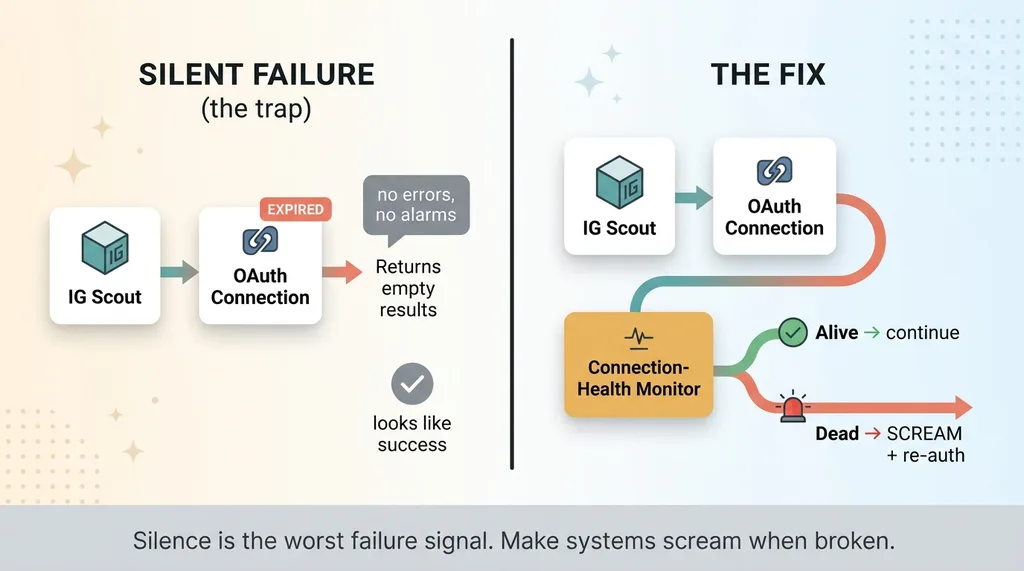 Silent failure mode: scout went dark with no errors
The IG scout that pulls post performance, the thing feeding the entire scorecard, runs on an OAuth connection. That connection silently expired. And expired connections can't self-refresh, so the scout just went dark. It returned nothing. It reported no errors.
That's the dangerous failure mode. It didn't crash. It didn't throw a red alert. It quietly returned empty results while looking exactly like a system that had nothing to report. Silence looked like success.
Nobody noticed for days. Why would we? No errors, no alarms, just a scout that had stopped doing its job and was very calm about it.
The fix was explicit connection-health monitoring plus re-auth. Now the system checks whether the connection is actually alive, not just whether the last call technically completed without throwing.
The lesson generalizes to every automation you'll ever build: it needs to scream when it's broken, not go quiet. Silence is the worst possible failure signal because it's indistinguishable from things working. I wrote up a silent token expiry that killed a pipeline in more detail, because this exact category of bug is one of the most common and most expensive in production AI systems.
How to find your own split before you spend another dollar
You don't need my codebase to start. You need a spreadsheet and an afternoon.
Pull your last 50 to 60 Instagram posts. For each one, write down two numbers. The first is engagement, just total it up from likes, comments, saves. The second is ad potential, scored one to ten, answering two questions: does it show the product, and can it carry a CTA without feeling forced?
Then sort by each column and look at where the high-engagement posts and the high-ad-potential posts actually overlap. For most brands, they barely do. That gap is the entire point.
The answer to "which organic content should I put ad dollars behind" is almost never your top organic performer. Your top performer is usually optimized for reach, which means it's optimized for entertainment, which means it's bad at selling. Boost it and you'll find out the expensive way, like I did.
This is the kind of work I do as a Chief AI Officer for brands. The two-axis scoring, the autopilot that enforces the split by architecture so nobody can accidentally torch budget on a meme, the monitoring that screams when a scout goes dark. If you're already spending on ads but guessing at creative, that's not a mysterious problem. It's a fixable one, and the fix usually pays for itself fast.
Get the next build note.
I write up each system I build, including what broke. Subscribe to my newsletter and I'll send you the next one.