Why AI Content Reads Generic (The Real Problem)
Most AI content reads like AI content because the model only knows what everyone knows. That's the whole problem in one sentence. If you want AI content with domain knowledge that sounds like an expert wrote it, you have to understand why the default output sounds like nobody in particular.
The model only knows what everyone knows
A base LLM was trained on the public internet. So when you ask it to write about anything, it gives you the statistical average of everything ever written on that topic. That's why AI marketing content is interchangeable. It's not bad, exactly. It's just the middle of the bell curve, every time.
I saw this clearly with a high-touch home and family services marketplace I co-founded. Ask a generic model to write about preparing for a home birth and you get: "When preparing for a home birth, consider your support options and consult your provider."
That sentence is true. It's also useless. It could appear on any of ten thousand sites.
SEO mush vs. content that names names
Now here's what an actual expert in that market would write. They'd reference the specific regional hospital and its transfer policies. They'd name which local insurers cover which services. They'd mention the actual providers a customer in that area would recognize by name.
The gap between those two versions isn't writing quality. Both are grammatically fine. The gap is knowledge. One version knows the market. The other is guessing at the average.
This is exactly why generic AI fails in expertise-heavy niches. I've seen the same pattern building a content machine for a regulated firm, where saying the wrong thing or the vague thing costs you credibility instantly.
So the real question every CEO asks me is simple: how do I make AI sound like it knows my business, not filler anyone could generate. Here's how I actually solved it.
The Two-Part Fix: A Knowledge Brain and a Content Studio
The fix is two systems, not one. I call them the Knowledge Brain and the Content Studio. Keeping them separate is the part most people get wrong.
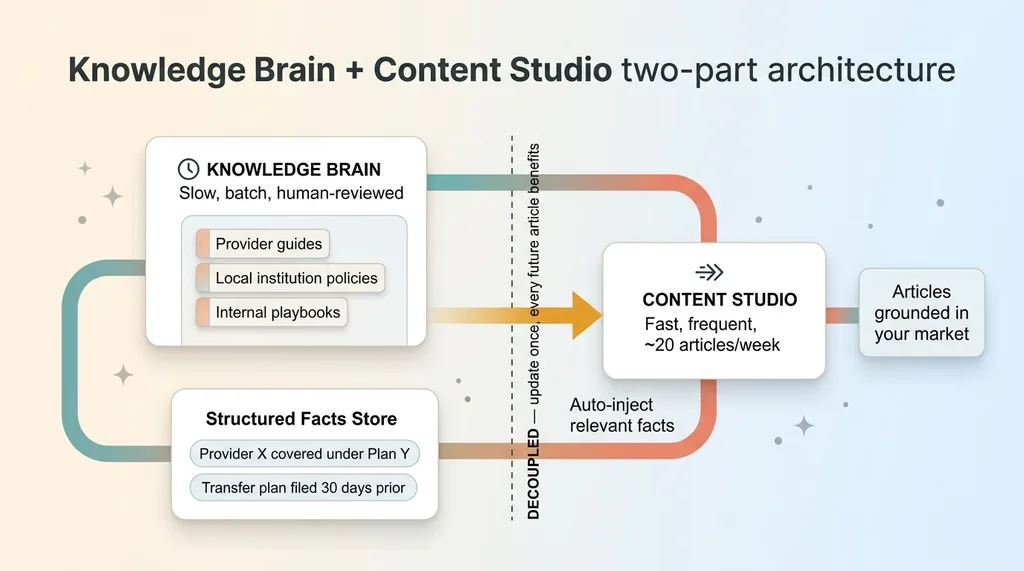 Knowledge Brain + Content Studio two-part architecture
What each piece does
Part one is the Knowledge Brain. It's an admin tool where someone uploads domain documents: provider guides, local institution policies, internal playbooks, the stuff that actually makes your business different. The Brain extracts structured knowledge from those documents and stores it so it can be queried later. This is the same foundation I describe in a knowledge base with AI search.
Part two is the Content Studio. It generates long-form articles, and for every article it automatically pulls relevant extracted knowledge from the Brain into the writing context. The writer never starts from a blank, average-of-the-internet position. It starts knowing your market.
Why separating them matters
Knowledge collection and content generation move at completely different speeds. You load documents into the Brain occasionally, in batches, often with a human reviewing the extraction. That's a slow, careful task.
Content generation is the opposite. It's fast and frequent. You might write twenty articles a week.
If you fused these into one workflow, you'd be re-uploading the same provider guide every time you wanted a new blog post. That's insane. By decoupling them, the writer always has the latest knowledge without anyone re-uploading anything. Update the Brain once, and every article from that point forward knows the new fact.
This is RAG for content generation in practice. But I didn't just dump raw documents into the model's context window and hope. There's a reason for that, and it's the next section.
How Gemini Vision Extracts Structured Knowledge From Documents
Real business documents are messy. Scanned PDFs, screenshots, tables, forms, policy sheets where the layout itself carries meaning. If you run plain text extraction across those, you lose half the information.
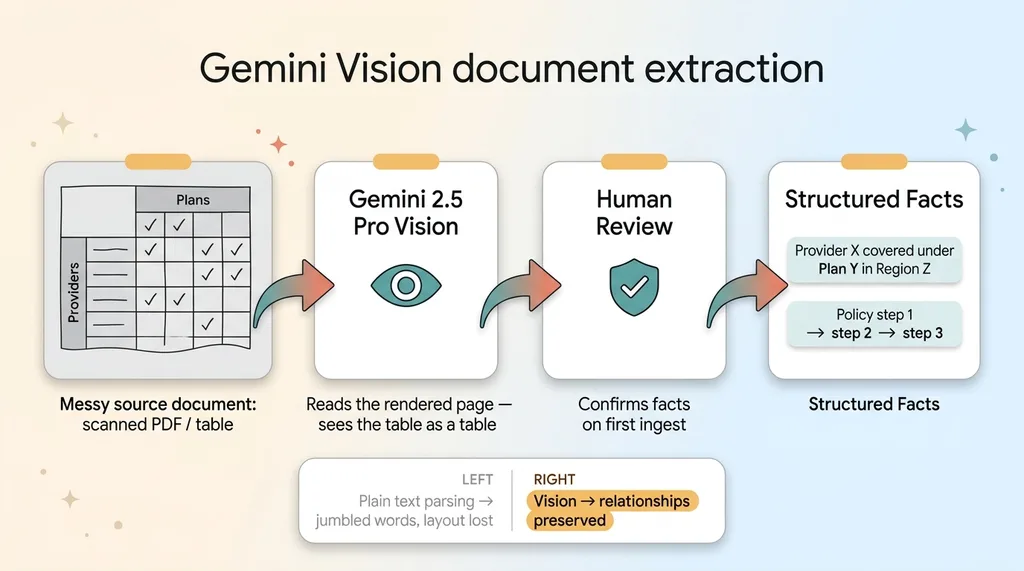 Gemini Vision document extraction pipeline (PDF to structured facts)
Why vision, not just text parsing
Take a coverage table from an insurer. The whole point of that table is the relationship between the rows and columns. Provider on the left, plan across the top, a yes or no in each cell. Strip it to plain text and you get a jumbled list of words with no structure. The meaning lives in the layout, and text parsing throws the layout away.
So I used Gemini 2.5 Pro vision to read the actual rendered document, the way a person looking at the page would. This is gemini vision document extraction doing real work. The model sees the table as a table. It sees that a checkmark sits in the cell connecting this provider to that plan, and it understands what that means.
Turning a PDF into structured facts
The output isn't a wall of text. That's the key. Instead of a blob, the Brain stores organized facts: institution names, coverage rules, process steps, the local specifics that make a market unique. Structured knowledge that can be queried and injected cleanly into a writing prompt later.
A coverage sheet becomes a set of statements like "Provider X is covered under Plan Y in this region." A policy PDF becomes a sequence of process steps. That's the form knowledge has to take if you want to inject it precisely instead of flooding the context with noise.
Now the honest part. Vision extraction isn't perfect. It can misread a badly scanned table or a low-resolution screenshot. So I keep a human review step before any extracted knowledge gets stored in the Brain. Someone confirms the facts are right on first ingest.
This is the same human-in-the-loop pattern I use across every system I build. The AI does the heavy lifting of reading and structuring. A person catches the errors before they become permanent. Garbage facts stored once will poison every article you generate afterward, so the review step pays for itself fast.
Injecting Knowledge Into Generation (So the AI Actually Uses It)
Here's the mistake I see constantly. A company builds a knowledge base, feels good about it, and then never wires it into the thing that actually writes. The knowledge just sits there. The content stays generic.
Pulling the right knowledge into context
In my setup, the Content Studio automatically pulls relevant extracted knowledge into the generation context for every single article. You don't manually paste anything. The system looks at the topic, finds the matching facts in the Brain, and injects them before a single word gets written.
That's the difference between an AI that writes and an AI that knows. I went deep on that distinction in teaching an AI about a specific domain, and it's the whole game here too. Writing is a commodity. Knowing your market is not.
Three generation modes
The Studio runs three modes, and each one uses the Brain differently.
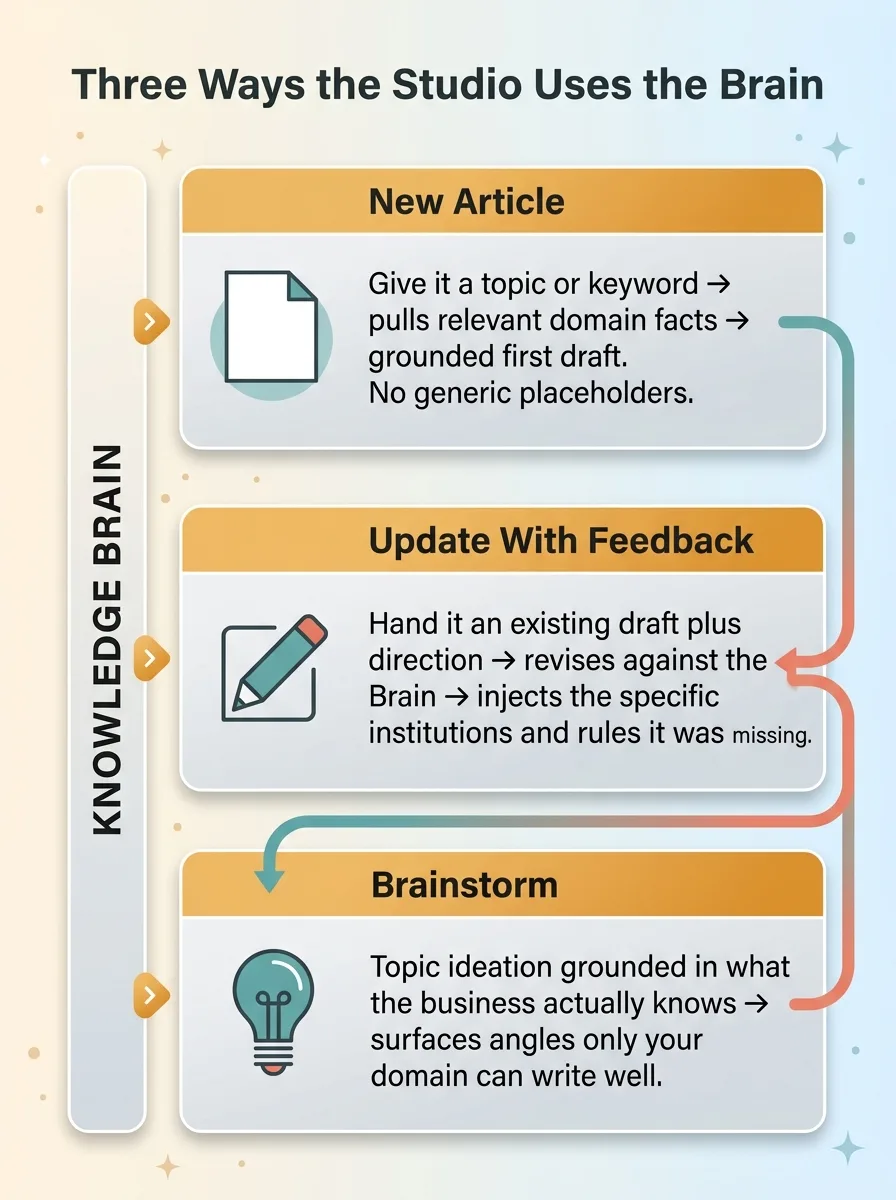 Three generation modes of the Content Studio
New article from a topic or keyword. You give it a subject. It pulls the relevant domain facts and writes a piece grounded in them from the first draft. No generic placeholder paragraphs to fix later.
Update with feedback. You hand it an existing draft plus direction, and it revises the draft against the knowledge in the Brain. Useful when you have decent content that just doesn't reference the specific institutions or rules it should.
Brainstorm mode. Topic ideation grounded in what the business actually knows. Instead of generic title suggestions, it surfaces angles based on your real domain facts, the things only your business can write about well.
The result across all three: articles that reference specific local institutions and real domain facts. Hospital-specific, insurance-aware, true to the market, instead of SEO mush.
If you want to see how the generation side runs at scale, I broke it down in automated blog writing with AI agents. But the principle stands on its own. Knowledge injection is what separates an AI that writes from an AI that knows.
What This Looks Like in Output (Before and After)
Let me make this tangible without naming the real brand or niche.
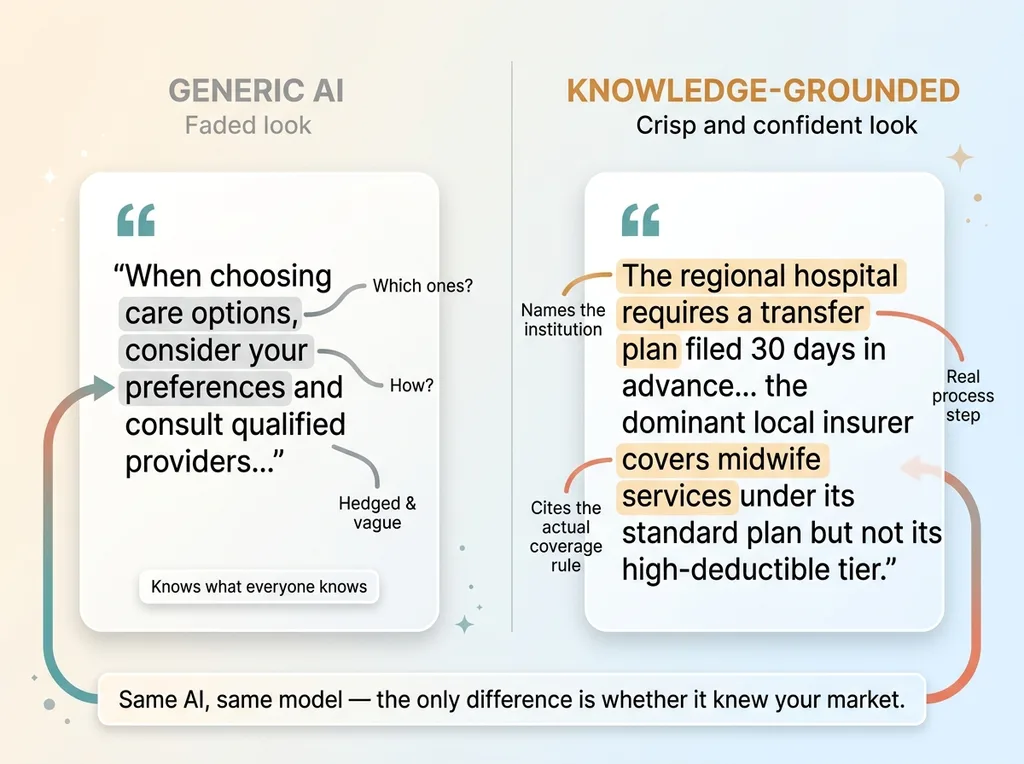 Generic vs knowledge-grounded content output (before/after)
Here's the generic version, the kind any ChatGPT prompt produces:
"When choosing care options, it's important to consider your preferences and consult with qualified providers. Many families find it helpful to research their insurance coverage and explore available support in their area."
Hedged. Vague. "Consult with qualified providers." Which ones? "Research your insurance coverage." How? It says nothing because it knows nothing.
Now the knowledge-grounded version, with everything anonymized:
"The regional hospital requires a transfer plan filed 30 days in advance for anyone planning a home birth, and the dominant local insurer covers midwife services under its standard plan but not its high-deductible tier. The recognized providers in that market typically coordinate this paperwork directly, so confirm yours does before your third trimester."
See the difference. The second version names the specific institution. It cites the actual coverage rule. It references the real process step that's true in that market. This is what expert AI content looks like when the knowledge is wired in correctly.
And this is where the ROI shows up. Locally-specific content ranks better for local intent because search engines reward pages that actually answer the specific question. It builds trust faster, because a reader who knows the market can tell the writer does too. And it reads like it came from someone who's done the work, because, through the Brain, it did.
That's the entire payoff. Same AI, same writing model. The only thing that changed is whether it knew your market before it started writing.
Where This Breaks and What I'd Tell You Before Building It
I'd be doing you a disservice if I sold this as magic. Here's where it breaks.
The knowledge has to be real
This system doesn't fix bad source material. Garbage documents in, garbage facts out. If your provider guide is three years out of date, the Brain will confidently inject three-year-old facts into every article. The extraction is only as good as what you feed it.
That's why the vision extraction needs human review on first ingest, every time. The model reads the document well, but someone who knows the domain has to confirm the facts are right before they get stored. Skip that and you're industrializing your own mistakes.
Maintenance and freshness
Knowledge goes stale. A hospital changes its transfer policy. An insurer drops coverage for a service. The moment that happens, every article referencing the old fact is now wrong, and wrong content is worse than vague content.
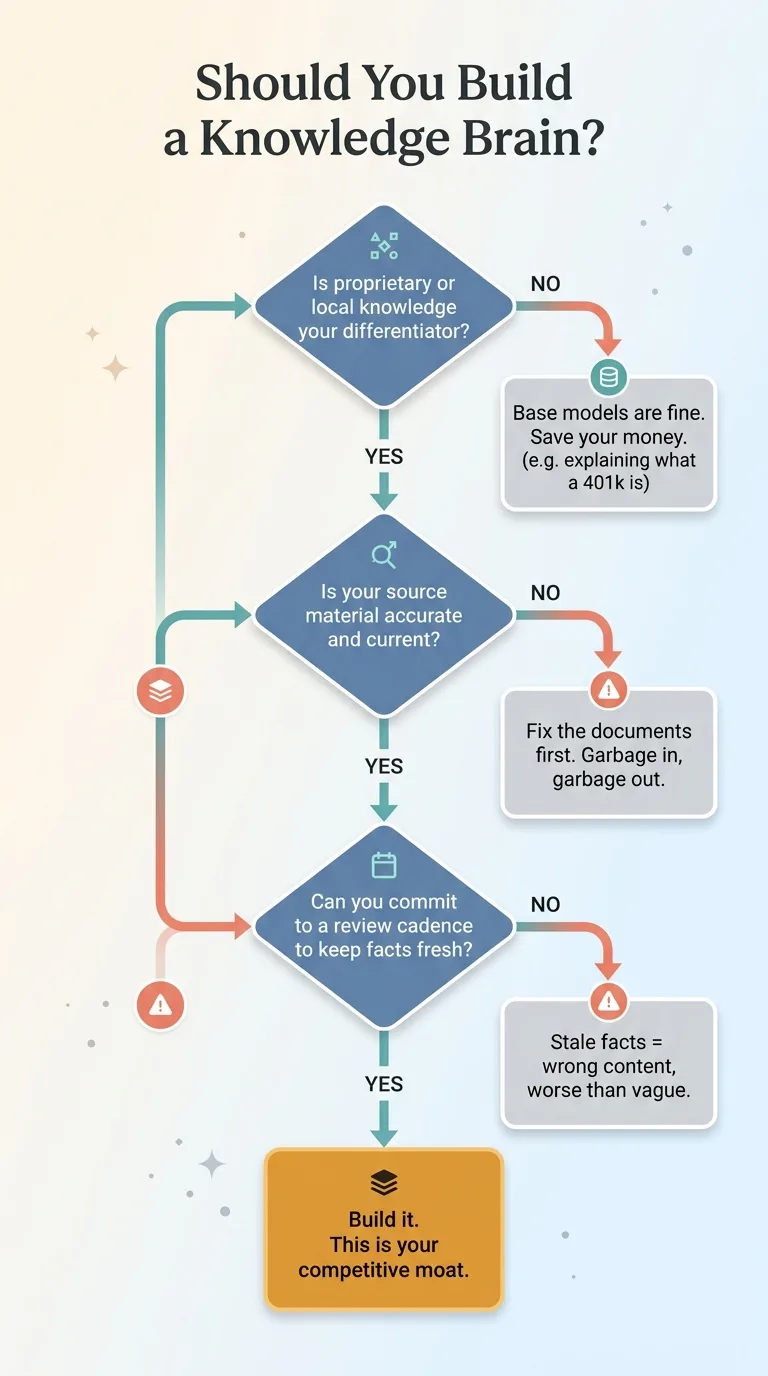 When this system is worth building (decision guide)
So the Brain needs an update cadence, not a one-time load. Treat it like a living asset. I'd set a review schedule based on how fast your domain actually changes. Some niches shift quarterly. Some barely move in a year.
And here's the honest scope. This only matters in niches where proprietary or local knowledge is the differentiator. If you're writing about purely commodity topics, base models are fine. You don't need a Knowledge Brain to explain what a 401k is.
Where this earns its keep is expertise-heavy or hyper-local niches, businesses where "sounding like you know the market" is the entire competitive advantage. If that's you, generic AI content is actively hurting you, and this fixes it. If you sell a commodity, save your money.
Turning Your Knowledge Into Content That Sounds Like You
Here's the takeaway I want you to leave with. The moat isn't the AI writer. Every competitor has access to the same models you do. The moat is the knowledge you feed it.
Most businesses have this knowledge already. It's just locked away. Trapped in PDFs nobody opens, playbooks in a shared drive, and the heads of your most experienced people. The work isn't generating content. It's extracting that knowledge cleanly and wiring it into the generation step so every article carries it.
I built this two-part system, the Knowledge Brain plus the Content Studio, end to end for a real marketplace. Documents go in, get read by vision, get reviewed by a human, become structured facts, and then show up automatically in every article the Studio writes. The pattern transfers to any business with proprietary or local expertise.
If your content reads like everyone else's, it's because the model only knows what everyone knows. That's not a writing problem. It's a knowledge problem, and it's fixable.
Get the next build note.
I write up each system I build, including what broke. Subscribe to my newsletter and I'll send you the next one.