Marketing to CRM Lead Handoff: Stop Re-Asking for Data
Most marketing-to-CRM lead handoff loses conversions by re-asking for data. Here's the single lead-of-record model I built so a lead becomes a patient instantly.
By Mike Hodgen
Why Your Leads Stall the Moment They Try to Convert
A longevity and telehealth startup I worked with had a waitlist that was working. People were signing up. The marketing funnel was doing its job. And then conversions died at the exact moment someone said yes.
Here is what happened. The waitlist captured one thing: an email. That was the whole record. The day a lead decided to actually become a patient, the clinical platform's patient API demanded name, date of birth, sex, height, weight, state, and a signed consent. None of that had ever been collected.
So the customer, who had already said yes, hit a second wall of forms. They had to fill out everything from scratch. That double-collection is where the marketing to CRM lead handoff falls apart, and it is where conversions go to die.
The data on form friction is brutal. Every extra field you add drops completion. But re-asking for data the customer already gave you is worse than a fresh form. A new form reads as a process. Re-collection reads as incompetence. The customer thinks, did you lose my information, and that doubt is fatal at the highest-intent moment of the entire relationship.
The deeper issue is sequencing. Most companies build the funnel first and figure out the backend later. They treat the handoff from marketing to clinical (or marketing to CRM, or marketing to whatever holds the real customer record) as a step you bolt on at the end.
It is not a step. It is a chasm. And you cannot bridge a chasm by adding more forms on the far side.
The mistake almost always traces back to building before understanding what the backend actually needs. I have written before about why most AI projects start at the wrong end, and this is the same disease in a different organ. You have to know the destination before you design the road.
The Marketing-to-CRM Lead Handoff Problem Nobody Plans For
This is not a telehealth problem. It is a stack problem, and almost every company over $1M in revenue has it.
The typical setup: a marketing tool collects an email into one system. A CRM or platform holds the real customer record in another system. The two never share a schema. They were bought by different teams in different years to solve different problems, and nobody ever made them speak the same language.
When a lead converts, someone has to re-ask for everything. Sometimes it is a sales rep on a call. Sometimes it is a second form. Either way, the customer pays a tax they should never see.
The double-collection tax
The first cost is conversion friction at the worst possible moment. A lead who has decided to buy is at peak intent. That is the moment you want zero resistance. Instead, re-collection drops a wall of effort right when you should be rolling out the carpet.
I have watched conversion rates sag by double digits at this exact handoff. Not because the offer was wrong. Because the experience said, start over.
The audit risk hiding in re-collection
The second cost is quieter and more dangerous. For a regulated brand, re-collecting consent means you now have two consent records with two different timestamps and no clear chain of custody.
Which one is authoritative? When did the customer actually consent? If a regulator asks, you are holding contradictory evidence about your own process. That is not a marketing problem. That is a legal exposure you created by accident.
The fix starts with a mental shift. The lead and the customer are the same person. They should be the same row in the same table from the very first touch. Everything I have learned about shaping every signup around the clinical backend comes down to that one idea.
The Fix: Design the Lead Record as a Superset of the Patient Model
Here is what I built for that telehealth startup, and the principle generalizes to any business with a marketing CRM integration problem.
I designed a single lead-of-record table that is a strict superset of the clinical platform's createPatient input. Every field the patient API would eventually require had a home in the lead row from day one, even if it started empty. On top of that, I added audit-grade consent fields and first-touch source.
One table, two lives
A marketing lead and a patient are not two different things. They are the same record at two different stages of completeness.
A lead is a patient record that is mostly empty. A patient is a lead record that finally filled up. Stop thinking "lead table" and "customer table" as separate worlds. Think one record that fills over time.
When the lead was ready to convert, the platform's patient API got handed a row that already contained everything it needed. Name, DOB, sex, height, weight, state, consent. Nothing was re-collected. The handoff went from a wall of forms to a single state change.
Superset, not subset
The word "superset" is doing real work here, so let me be precise.
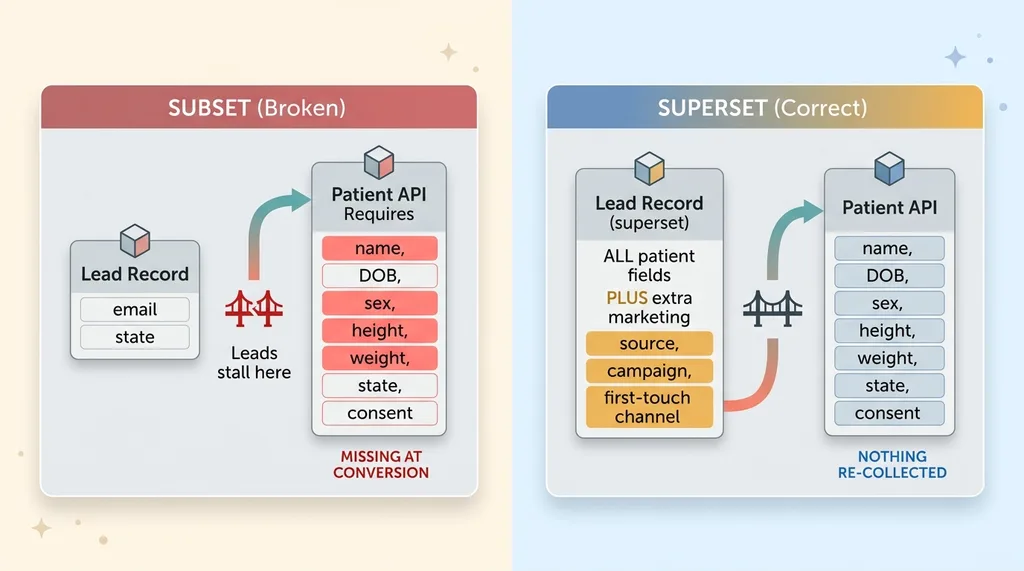 Subset vs Superset Lead Record
If your lead record is a subset of the patient model, you are guaranteed to be missing fields at conversion time. That is the default state of most stacks, and it is exactly why leads stall.
If your lead record is a superset, the patient API can never ask for something the lead row cannot already hold. The backend's data contract becomes a floor, not a surprise. You collect everything the backend will ever need, plus the marketing metadata the backend does not care about (source, campaign, first-touch channel) but you absolutely do.
This is the part that requires discipline. You have to read the backend's data contract before you design the form. That feels backwards to most marketing teams. It is the single most important sequencing decision in the whole system, and I cover the companion logic in shaping every signup around the clinical backend.
Progressive Profiling: One Capture Endpoint for Every Surface
A superset table only works if you can fill it gradually. Nobody hands you their height and weight on the first popup. That is where progressive profiling comes in.
The shared capture endpoint
Every surface that touches a visitor feeds the same shared capture endpoint, which writes into the same row. The quiz, the popups, the content downloads, the waitlist signup. All of them point at one door.
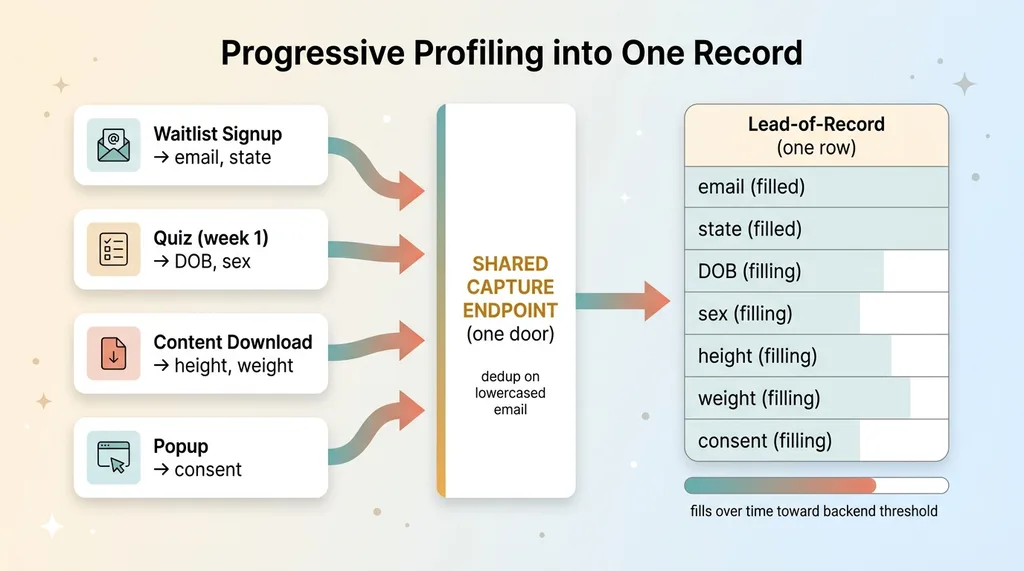 Progressive Profiling into One Record
First contact might give you an email and a state. The quiz adds DOB and sex a week later. A later content download adds height and weight. Each interaction fills in more of the same record instead of starting a new fragment somewhere else.
The customer is never asked twice for the same field. And you are never holding pieces of one person scattered across five tools that cannot reconcile them.
Update-on-conflict enrichment
Mechanically, each write is an update-on-conflict against the existing record. If the email already exists, you enrich the row. If it does not, you create it. The endpoint does not care whether this is the first touch or the fifth.
The dedup happens on a lowercased email. This sounds trivial. It is not. "Mike@example.com" and "mike@example.com" are the same human and a different string. Without normalization, you create two records for one person, and now your superset is split in half across two rows that each look incomplete.
That one detail, lowercasing the email before you match, prevents a whole category of duplicate-record chaos that I have seen sink otherwise clean systems.
The progressive part is what makes this humane. You ask for one or two things at each touch, the completion rate stays high, and the record quietly fills toward the threshold the backend requires. I went deep on the enrichment mechanics, including why you do not need a column-mapping wizard to make this work, in progressive enrichment without a column-mapping wizard.
The RPC That Protects the Lead Record
If anything can write to your lead table, then your business rules live nowhere. So every write goes through one door.
Insert-or-enrich through a single door
I built a single SECURITY DEFINER insert-or-enrich function. No surface touches the table directly. The quiz, the popups, the conversion handoff, all of them call the same function, and the function enforces the rules.
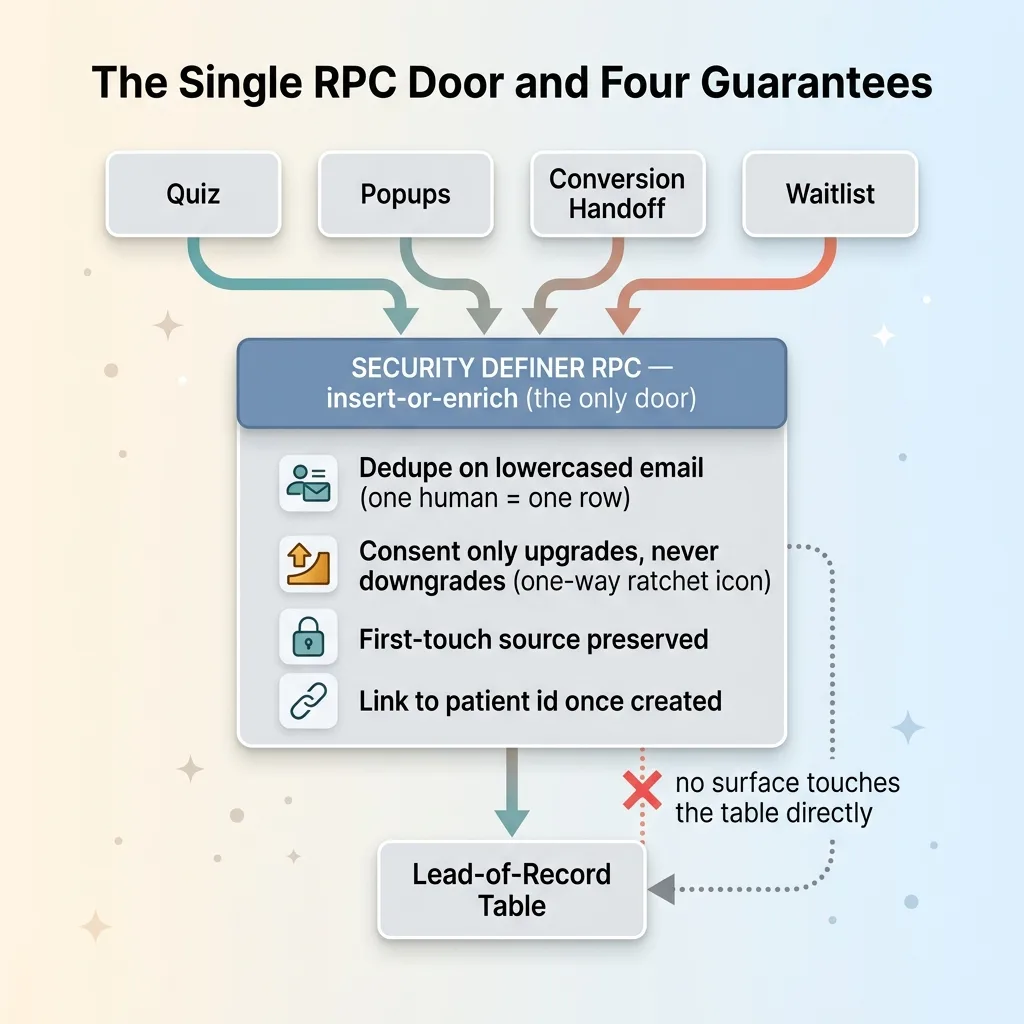 The Single RPC Door and Four Guarantees
This matters because business rules that live in application code get duplicated, drift, and eventually contradict each other. When five different surfaces each implement their own version of "should I update this field," you have five places for bugs to hide. One door means one place where the truth lives.
The function enforces four things every single time:
- Dedupe on lowercased email, so one human is always one row.
- Consent only upgrades, never downgrades.
- First-touch source is preserved and never overwritten by a later touch.
- Link to the eventual patient id once the clinical platform creates the patient, so the lead and the patient stay the same record.
Consent only upgrades, never downgrades
The consent rule deserves its own attention. A later "I consent" can flip an empty field to true. But no code path can flip a true consent back to false.
In a regulated context, consent that can be silently downgraded is a liability waiting to happen. If a bug or a careless write can clear a consent flag, you cannot prove what the customer agreed to or when. The one-way ratchet removes that risk entirely. Consent goes up or stays put. It never quietly disappears.
Worth noting: the consent you capture at marketing is not the same thing as treatment consent, and conflating them is its own mess. I unpack that in marketing consent and treatment consent are not the same thing.
The first-touch rule protects your money. The channel that originally brought the lead in is your attribution truth. If a later email click overwrites "organic search" with "email," your marketing ROI math is now lying to you. Preserving first-touch source keeps your spend decisions honest all the way to the closed customer.
The RPC is where the business rules live. Not in the form, not in the marketing tool, not in the seventeen places a developer might touch the data. One door, four guarantees.
What This Buys You: Zero Re-Collection and a Clean Audit Trail
Let me tie this back to the two questions every operator asks me.
Why do leads stall at conversion? Because the conversion step demands data you never collected. The fix is to collect it progressively into a record the backend can already consume. The wall of forms disappears because there is nothing left to ask.
How do you stop re-asking? Make the lead row a superset of the customer record. Then the handoff is a state change, not a re-entry. The patient API receives a row it can use as-is.
The payoffs are concrete:
- Conversion friction at the highest-intent moment drops to near zero. No second wall of forms, no "start over" experience right when the customer is ready to buy.
- You hold a single audit-grade consent record with a clean timestamp chain. Not two conflicting records you cannot reconcile.
- First-touch attribution survives all the way to the closed customer. Your spend decisions stay grounded in truth.
I will be honest about the cost. This requires understanding the backend's data contract before you build the funnel. That is the opposite of how most teams sequence the work. Most build the funnel, launch, watch leads stall, and only then go read the patient API docs.
Doing it in the right order is not harder. It is just earlier. And earlier is cheap.
Start With the Backend, Then Build the Funnel
The lesson here is not "build a fancier lead table." It is that the marketing to CRM lead handoff is a data-model decision, not a marketing decision. And it has to be made before the first form ships.
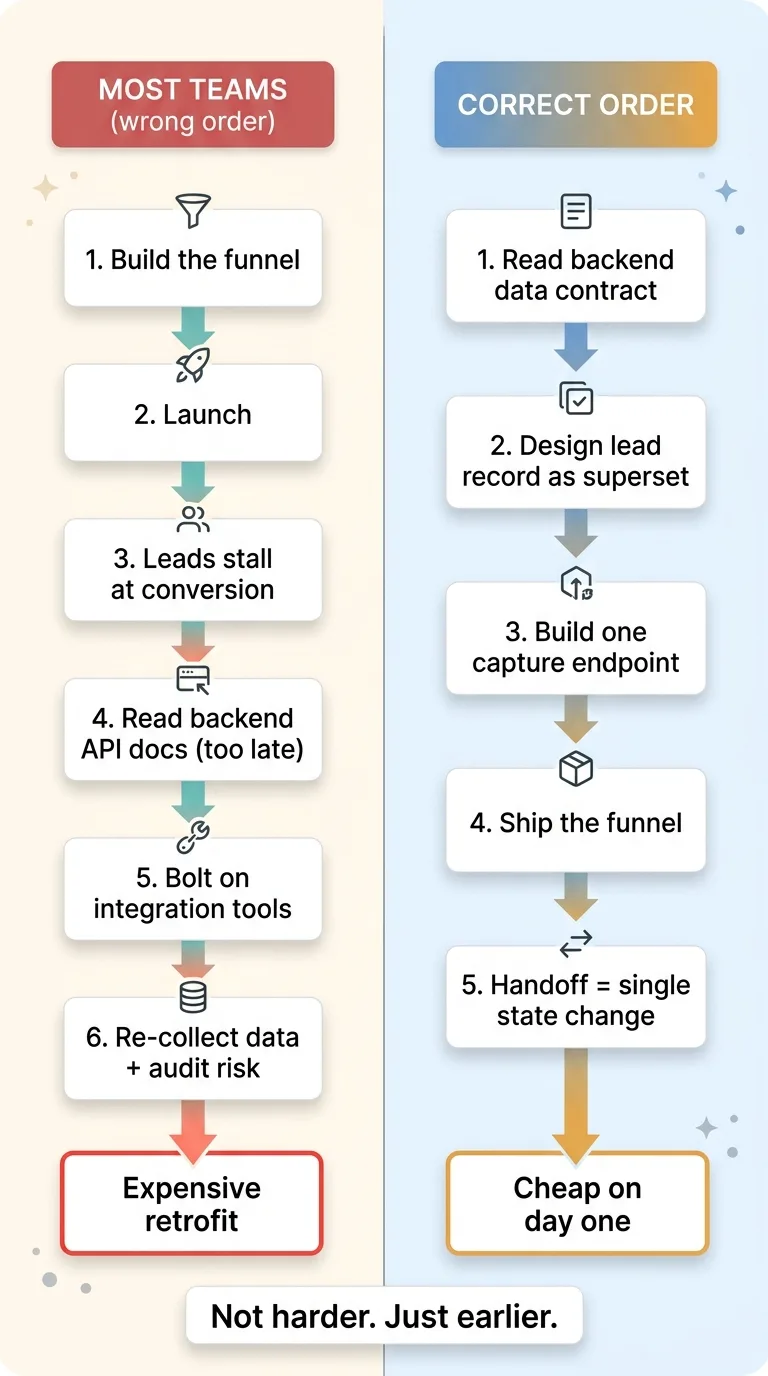 Wrong vs Right Build Sequence
Most teams discover this the hard way. They launch, their leads stall at conversion, and they react by bolting on integration tools that re-collect data and create the exact audit risk they were trying to avoid. The bolt-on costs more than the original design would have, and it never fully fixes the problem because the foundation is wrong.
I design the data model first and let every surface inherit it. The quiz, the popups, the waitlist, the conversion handoff, all of them write into one record through one door, governed by rules that protect consent and attribution. The funnel becomes the easy part because the hard part was decided correctly at the start.
This is a decision that is cheap to make on day one and expensive to retrofit later. It is exactly the kind of thing I look at first when I come in as a company's Chief AI Officer, because getting the data model right is what makes everything downstream actually work.
If your leads are stalling at conversion, or you are about to build a funnel and you have not yet read your backend's data contract, that is worth a conversation.
Want to explore what AI could do for your business?
Book a free 30-minute strategy call. No pitch deck, no sales team, just a real conversation about your operations and where AI actually fits.
Get AI insights for business leaders
Practical AI strategy from someone who built the systems — not just studied them. No spam, no fluff.
Hodgen.AI
Ready to automate your growth?
Book a free 30-minute strategy call with Hodgen.AI.
Book a Strategy Call