Sell Instagram Drops Shoppable in One Tap
How I replaced Instagram DM chaos with a phone-native tool that turns a photo into a live shoppable drop, label, and story card. The way to sell drops shoppable.
By Mike Hodgen
The DM Mess Nobody Admits Is Costing Them Orders
Here is a scene from my DTC fashion brand in San Diego. We make handmade pieces, and a lot of them are one-offs or tiny limited runs. There is exactly one of the thing. For a long stretch, that meant we sold those items entirely through a social app's DMs.
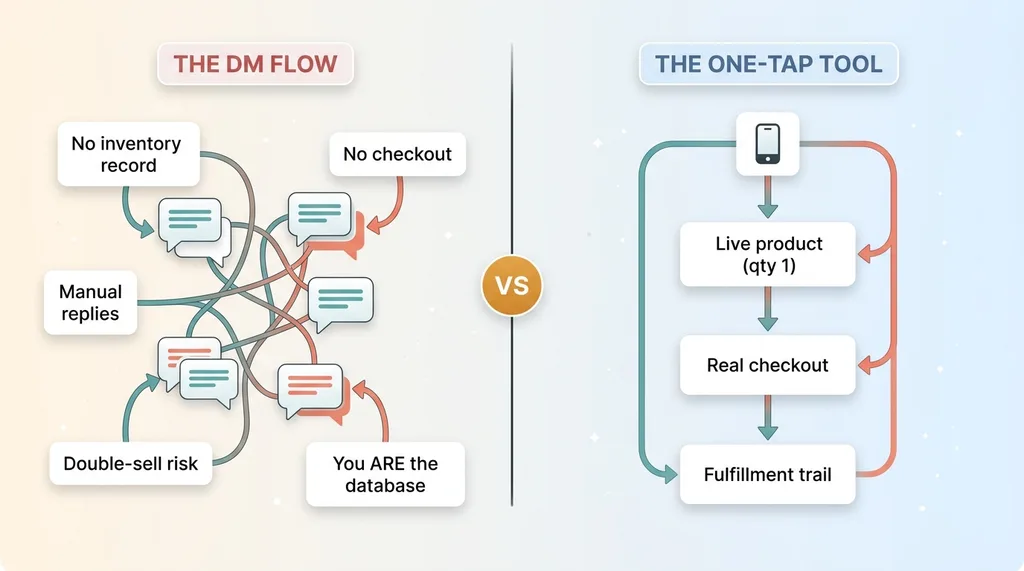 DM Chaos vs One-Tap System (Before/After)
You can guess how that goes. One customer asks the price. Another asks the size. A third asks if it is still available, three hours after it actually sold. Two people accidentally got promised the same item because nobody had a single source of truth.
No inventory record. No checkout. No fulfillment trail. Just a supervisor on the floor trying to remember which message thread was real and which one had gone cold.
That is the part nobody admits out loud. Every DM thread is a manual transaction with no system behind it. You are the inventory database. You are the checkout. You are the order confirmation. And you are doing all of it one slow reply at a time.
When you want to sell Instagram drops shoppable, the math turns against you fast. Slow replies lose orders to whoever else the customer is browsing. Back-and-forth eats hours that should go to making product. And the double-sell is the worst of all, because now you are refunding someone and apologizing for a system you never built.
Here is the doubt I hear from founders, and the one I had myself. They wonder if social selling can ever be "real" without forcing everything onto a big marketplace platform that takes a cut and owns the customer.
I did not want to do that. So I built a tool to answer the question. It runs on the phone my supervisor is already holding, and it turns the DM mess into one tap. Let me walk you through what it actually does.
What a Phone-Native Drop Tool Actually Does
Before the mechanics, here is the plain version.
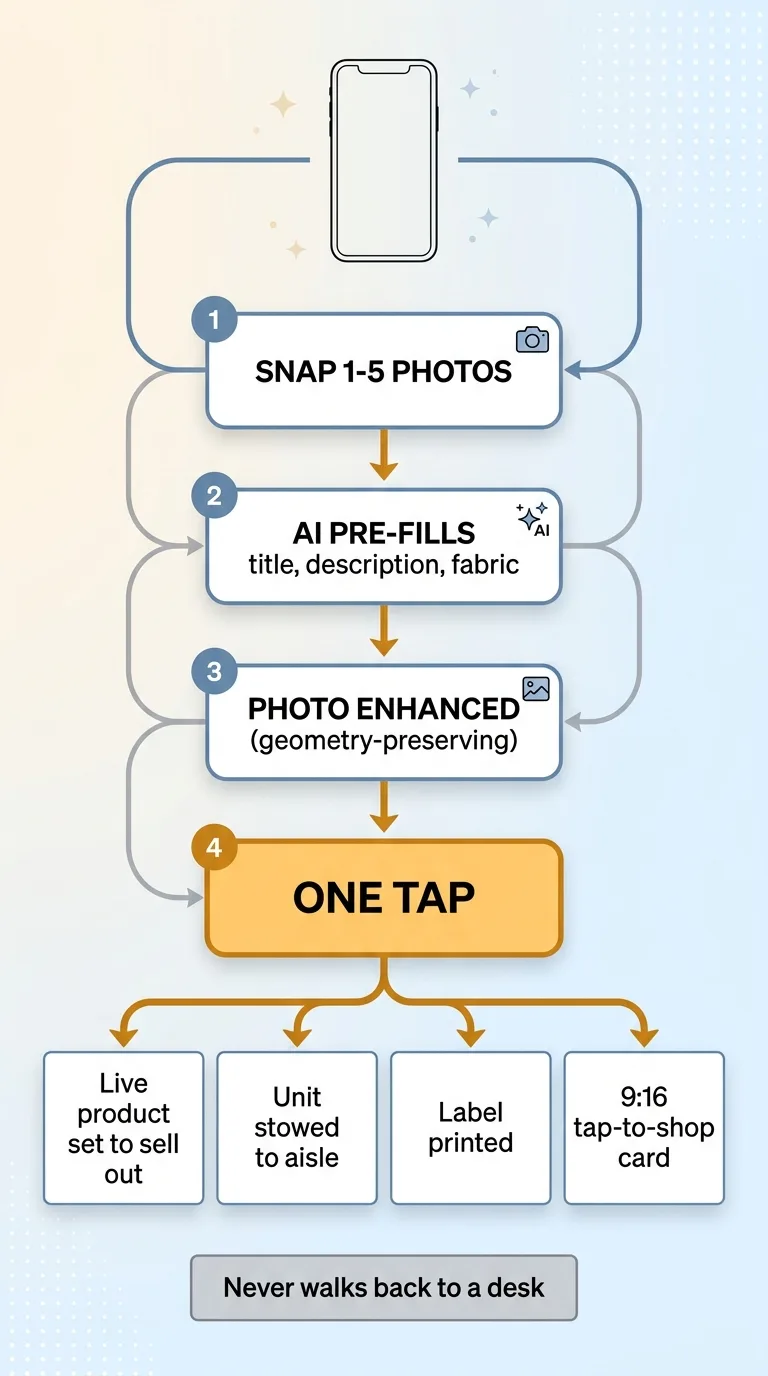 The One-Tap Loop (Snap to Post)
A supervisor on my team is standing on the warehouse floor. She has a one-off item in her hands. She opens the tool on her phone, snaps 1 to 5 photos, and the AI pre-fills the title, the description, and the fabric. The shots get enhanced. Then one tap creates a live product set to sell out, stows the physical unit to a dedicated aisle, prints a label, and hands her a 9:16 tap-to-shop card ready to post.
The whole loop happens on the phone she is already holding. She never walks back to a desk.
That last part is the entire point. A laptop-based product creation flow sounds fine in a planning meeting. Nobody on a warehouse floor will ever use it. The friction of "go to the computer, log in, find the right screen, type everything" is exactly the friction that pushed us into DMs in the first place.
Phone-native is not a nice-to-have here. It is the difference between the tool getting used and the tool getting ignored. If it does not work in the supervisor's hand while she is holding the item, it does not exist.
This is a different animal from my 20-minute product pipeline, and I want to be clear about that. The pipeline is for planned products, the stuff we know we are making, where we batch and schedule. This drop tool is for the unplanned one-off. The thing that exists once, that a customer might want right now, that has no place in a planned catalog.
Phone native ecommerce ops is the category I would put this in. The work happens where the work happens, not where the software wishes it happened.
Snap, AI Pre-Fills, and the Photo Gets Honest Enhancement
Let me get specific about the intake, because the details are where this earns its keep.
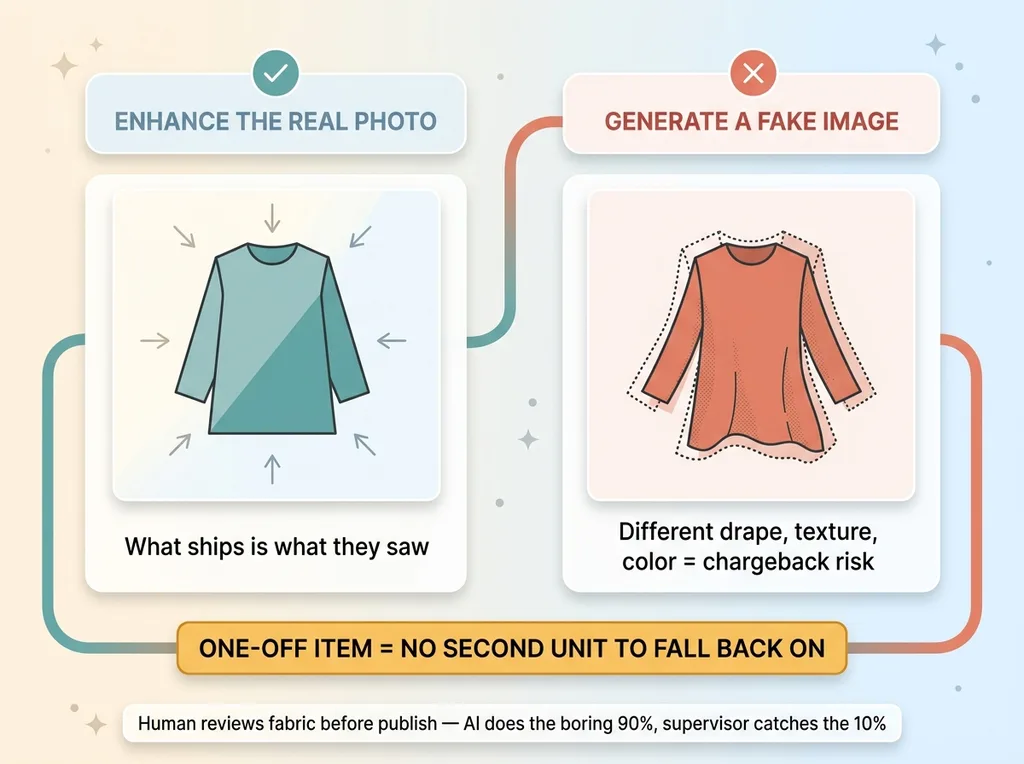 Geometry-Preserving Enhancement vs Generated Fake
She takes 1 to 5 photos. The AI reads them and pre-fills a title, a short description, and the fabric. Instead of staring at a blank text box on her phone (which is how you guarantee nothing gets written), she is editing a draft. She fixes anything wrong in a few seconds. Drafting is fast. Editing is faster. Blank boxes are where good intentions go to die.
Now the part I care about most, and the part most tools get wrong.
The photo enhancement is geometry-preserving. I do not generate a fake product image. I enhance the real shots so the buyer sees what actually ships. I wrote about why in I enhance the real photo instead of generating a fake one, and for a one-off item this is not a style choice. It is risk management.
Think about it. You have exactly one of this item. If the listing photo is a generated fantasy and the real thing has a different drape, a different texture, a slightly different color, you have no second unit to fall back on. The customer feels misled. That is how you eat a chargeback on the one item you cannot replace.
So the enhancement cleans up lighting and clarity on the actual photograph. It does not invent a product. What ships is what they saw.
Now the honest limitation. The AI gets fabric wrong sometimes. It will look at a photo and guess "cotton" when it is a cotton-linen blend, or miss a texture entirely. That is exactly why a human reviews the draft before the one-tap publish. The AI does the boring 90 percent. The supervisor catches the 10 percent that matters. Nobody is publishing a fabric claim the brand cannot stand behind.
One Tap: Live Product, Sold-Out Logic, and a Story Card
Here is the tap itself, and what it sets in motion.
It creates a real product on the store, with inventory of one (or whatever the limited count is), set to sell out cleanly. That last phrase is doing heavy lifting. Sold out cleanly means two people cannot buy the same item. The platform enforces scarcity. The DM flow never could. Two people DM-ing "I'll take it" at the same time is the double-sell I described at the top, and it just stops happening.
Checkout is real checkout. Not a DM and a payment-app request. Not "send me $80 and your address." The customer hits a product page, adds to cart, pays, and the order lands in the same system as every other order. The fulfillment side has a record. The accounting side has a record. There is a real trail.
The tap also outputs a vertical 9:16 card built to post to the social app. A tap on that card goes straight to the product page. So the customer's path is: see the post, tap, buy. No question about the price. No question about the size. No "is this still available" three hours later, because the page will say sold out if it is.
Make the contrast as sharp as I can: the DM flow had no checkout and no scarcity enforcement. This has both. That is the whole leap.
And a human still chooses to tap publish. This is not an autonomous system spraying products into the store. The supervisor reviews the draft, looks at the enhanced photos, and decides. I build it this way on purpose, the way I described in a human still taps the button. The AI removes the typing and the walking. The person keeps the judgment.
Limited drop inventory gets handled as real stock. Not a comment thread where you count "sold" replies by hand.
The Part Founders Forget: Where the Physical Item Goes
Here is the piece almost every social-selling setup skips, and it is the piece that separates a sale from a refund.
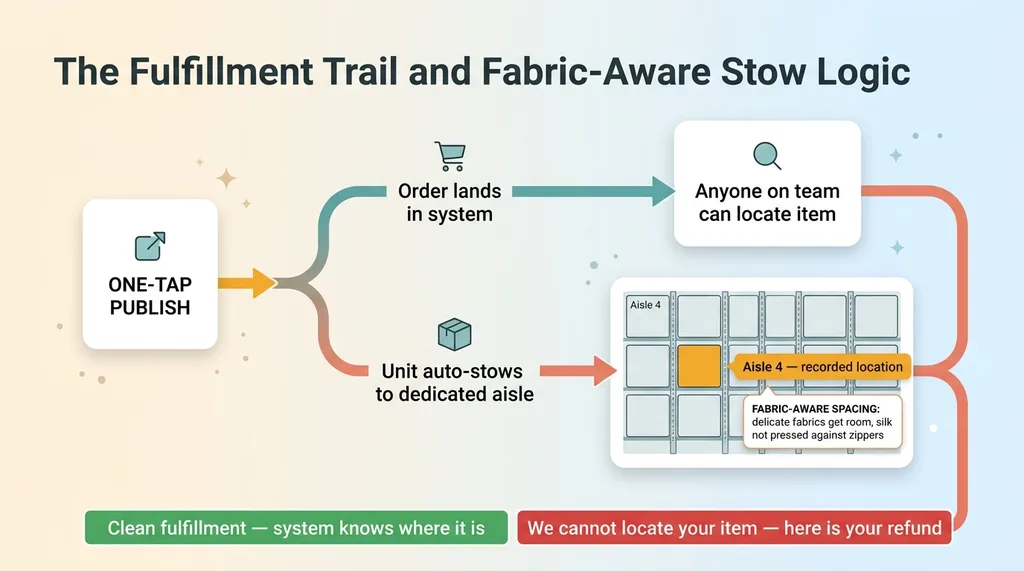 The Fulfillment Trail and Fabric-Aware Stow Logic
A listing without a fulfillment trail is half a system. You can have the prettiest tap-to-shop card in the world, but if the order comes in and nobody can find the one physical item that exists, you do not have a business. You have a promise you can't keep.
So on the tap, the unit auto-stows to a dedicated aisle. The tool records exactly where the item went. When the order lands, anyone on the team can find the one thing that exists, because the system knows where it is. Not the supervisor's memory. The system.
There is a detail in the stow logic I am a little proud of, because it only exists because I run this brand and felt the pain. Delicate fabrics cannot be jammed together. Press silk against a zipper or cram fragile pieces into one slot and you damage the only unit you have. So the stow logic respects spacing. It does not just say "aisle 4." It accounts for what the fabric can tolerate.
This is the unglamorous operational plumbing. It does not photograph well. It does not make a good demo slide. But it is the difference between a clean fulfillment and a "we genuinely cannot locate your item, here is your refund" email.
The boring trail is what makes social selling real. The card gets the customer to buy. The aisle is how you actually ship. A one-off product tool that ignores the physical item is a marketing toy, not an operations system.
Social Proof on Autopilot: Sold-Out Items Sink, Old Drops Archive
Two small touches that compound over time.
First, sold-out items do not vanish. They sink to the bottom of the collection. So a browser scrolling the drops page sees the available items up top and a wall of "sold" underneath. That wall is proof. It tells a new customer that drops actually move, that if they like something they should not wait. A generic platform treats sold-out as a dead end and hides it. I treat it as evidence.
Second, a scheduled job runs in the background and archives old drops. The storefront stays current without anyone managing it. Stale items from three months ago do not clutter the page. The cron does the housekeeping nobody wants to do at 11pm.
These are the details you only build when you run the brand yourself. A SaaS template ships with "sold out" meaning "gone" because the people who built it never watched a customer hesitate and lose the item, then come back wanting to buy faster next time.
This is what social selling automation looks like when it works while you sleep. Items move, the proof accumulates, the storefront cleans itself, and nobody is logging in at midnight to tidy up.
What This Replaced, and What It Means for Your Brand
Let me pull it together with the actual math.
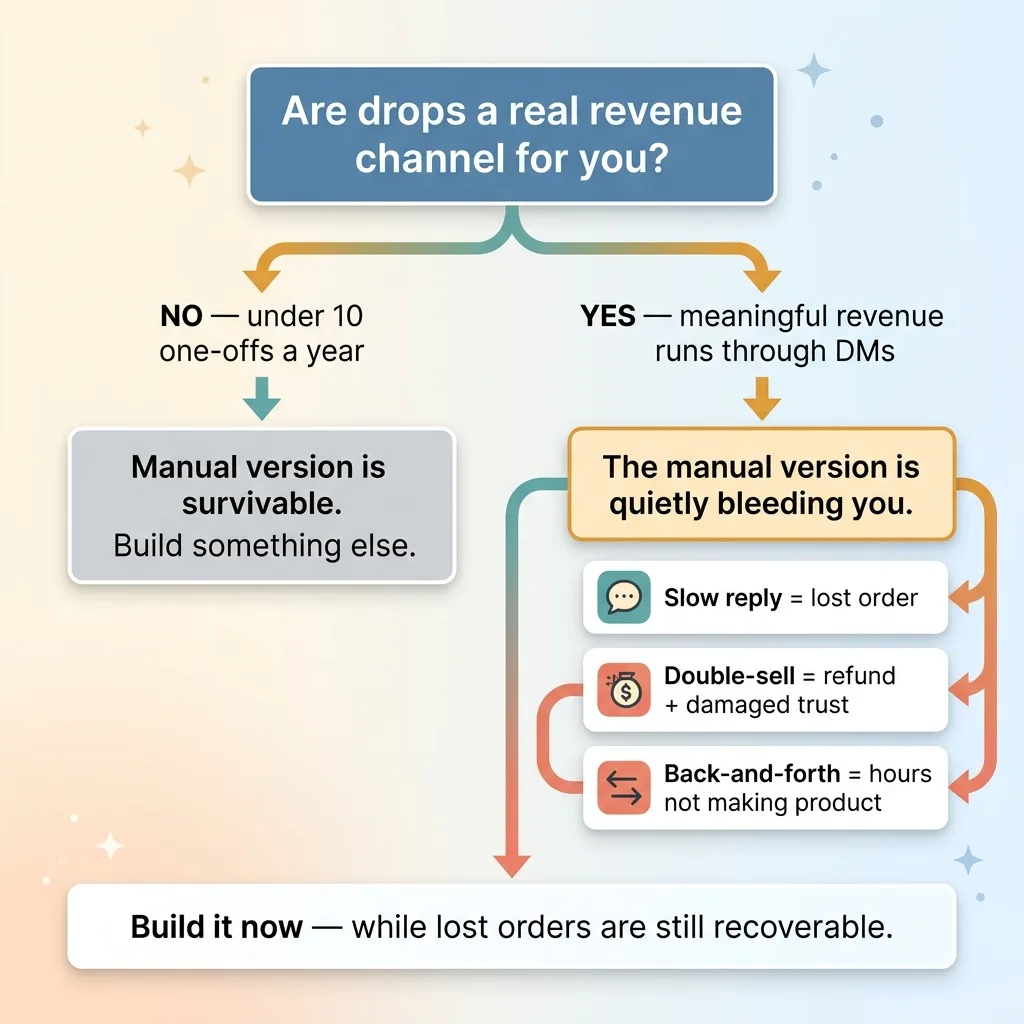 When This Tool Is Worth Building (Decision Guide)
The DM flow cost us orders. Slow replies sent buyers elsewhere. Double-sells forced refunds and apologies. And it cost us hours, every week, in manual back-and-forth with no records to show for it.
The drop tool turned a multi-message negotiation into one tap. It gave us real checkout, real inventory of one, a fulfillment trail to a known aisle, and a ready-to-post 9:16 card. The supervisor went from "managing threads" to "snap, edit, tap, post." That is the trade.
Now the honest part about scope. If you sell ten one-off items a year, you do not need this. The manual version is annoying but survivable. Build something else.
But if drops are a real channel for you, if a meaningful slice of your revenue runs through DMs right now, the manual version is quietly bleeding you. Every slow reply is a lost order. Every double-sell is a refund plus a damaged trust. Every hour of back-and-forth is an hour not spent making product.
This is one tool inside a larger operation. I run a whole stack of AI systems on my brand, and the drop wizard is one piece of it. I build these phone-native tools for the way a brand actually operates, not the way a SaaS template assumes you operate. The fabric-spacing logic exists because I felt the damage. The sold-out-sinks-to-the-bottom detail exists because I watched customers hesitate.
If social selling is real revenue for you and it still runs through DMs, that is a system worth building. Not someday. Now, while the orders you are losing are still recoverable.
Thinking about AI for your business?
If this resonated, let's have a conversation. I do free 30-minute discovery calls where we look at your operations and find where AI could actually move the needle, not where a vendor wishes it would.
Get AI insights for business leaders
Practical AI strategy from someone who built the systems — not just studied them. No spam, no fluff.
Hodgen.AI
Ready to automate your growth?
Book a free 30-minute strategy call with Hodgen.AI.
Book a Strategy Call