AI Systems for a DTC Brand: How I Actually Run One
I run a real apparel brand on AI systems. Here's what actually works: autonomous ads, custom feeds, fail-loud monitoring, and knowing when not to let AI act.
By Mike Hodgen
The Boring Truth About Running a Store on AI
Every week someone shows me a demo where "AI runs the whole store." Captions write themselves. Product descriptions appear like magic. The founder on stage looks thrilled.
Then I ask one question: what happens when your conversion pixel breaks at 2am on a Saturday?
Silence.
I run an actual DTC fashion brand out of San Diego. Handmade product, real inventory, real customers, real money moving every day. I'm not theorizing about AI systems for a DTC brand. I've built mine across the entire operation: 29 automation modes in production, 564+ products priced dynamically by AI, roughly 3,000 hours of manual work eliminated every year.
Here's the thesis, and it will sound boring on purpose: the durable value isn't "AI writes your captions." It's instrumentation, fail-loud monitoring, automation that understands your unit economics, and the discipline to NOT automate things that touch money carelessly.
The flashy stuff is the 5% anyone can demo. The other 95% is plumbing.
The old way was agencies, monthly PDF reports, and blind spend you reconciled six weeks too late. You found out a campaign was unprofitable when the invoice landed. You found out your feed was broken when sales quietly dropped and nobody could say why.
The new way is daily autonomous loops that adjust spend, defend the catalog, and watch the numbers themselves. A human only steps in on genuine unknowns. Not on routine decisions a well-instrumented system handles better than I do at 11pm.
If you want the full framework, I wrote the AI playbook for DTC brands separately. This article is the honest tour of what actually runs my store, including the parts that broke.
Let me start with the least glamorous system I own. The one that drives revenue more than any caption ever will.
The Product Feed Nobody Talks About (88 to 3,819)
Why the native channel was broken
Here's a problem no AI demo will ever show you.
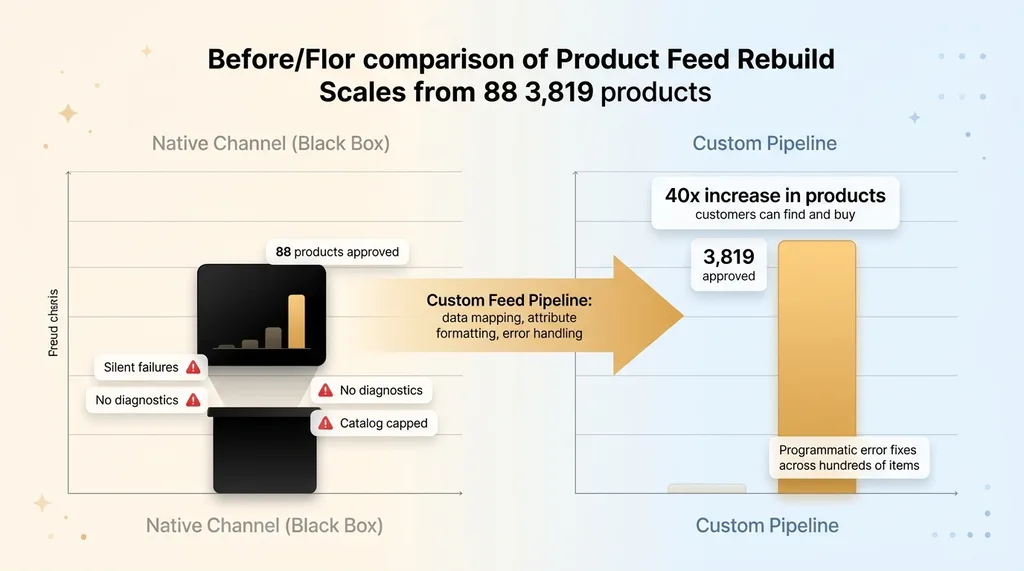
My native sales channel, the official integration that's supposed to push products into a major shopping feed, was surfacing 88 products. My catalog had thousands. So thousands of products that customers were searching for simply did not exist as far as that channel was concerned.
Think about what that means. It doesn't matter how clever your AI-generated copy is if the product isn't in the feed. You can have the best descriptions in your category and still be invisible. No impression, no click, no sale.
This is the unglamorous, high-stakes reality of running ecommerce on AI. The wins live in the plumbing, not the flash.
Why I rebuilt it myself
The native channel was a black box. It failed silently, gave me no diagnostics, and capped my catalog at a fraction of its real size. So I stopped trusting it.
 Product feed rebuild from 88 to 3,819 products
I bypassed it and built a custom feed pipeline from scratch. I controlled the data mapping, the attribute formatting, the error handling, all of it. When a product got rejected, I knew exactly why and could fix it programmatically across hundreds of items at once.
The result: 3,819 products approved. I wrote up the full breakdown of how I rebuilt my Google Merchant feed from 88 to 3,819 products if you want the technical detail.
That's not vanity. That's a 40x increase in products customers can actually find and buy. The revenue impact dwarfs anything I'd get from rewriting captions.
The lesson I want every CEO to absorb: the real money in AI ecommerce operations is in fixing the boring plumbing that nobody talks about. Feeds, data pipelines, error handling. The stuff that's invisible until it breaks.
Autonomous Ads With Hard Guardrails (POAS, Not ROAS)
Why profit-on-ad-spend beats return-on-ad-spend
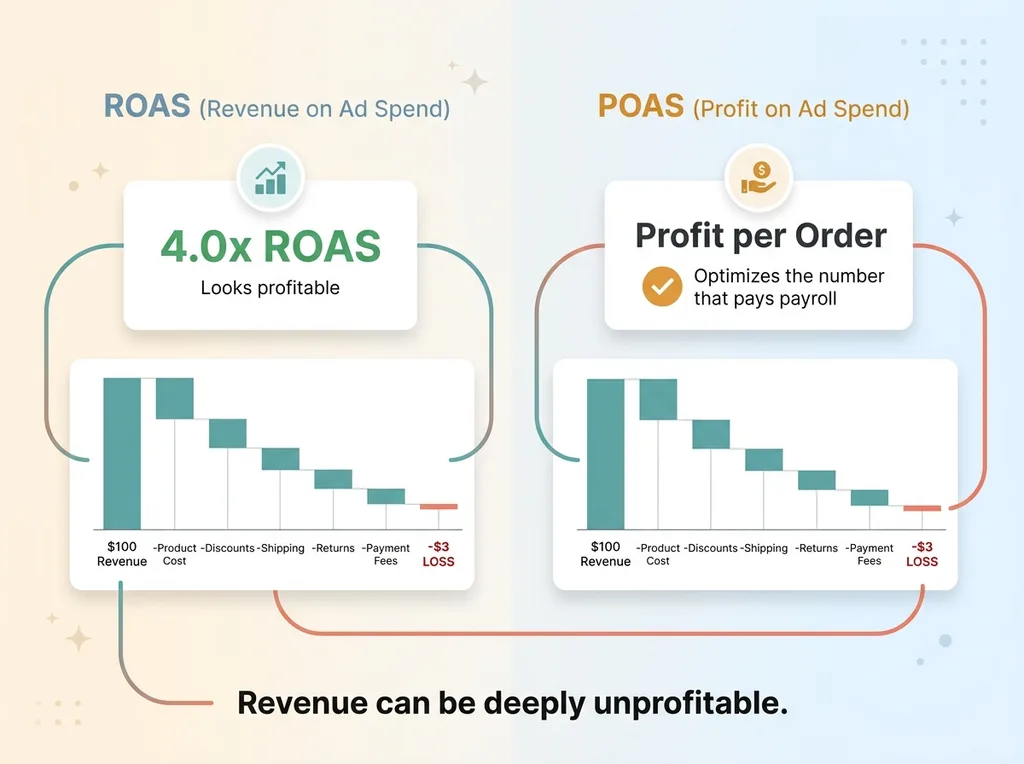
Most brands optimize ads on ROAS. Return on ad spend. Revenue per ad dollar.
 ROAS vs POAS profit leakage
I think that's a trap.
Revenue can be deeply unprofitable. A 4x ROAS order on a low-margin product after discounts, shipping, returns, and payment fees can lose money. You're celebrating a number that's quietly draining your bank account.
So I optimize on POAS. Profit on ad spend. Profit per order, after the real costs. Because the only number that pays my employees is profit, not revenue.
That shift sounds small. It changes everything about which campaigns the system feeds and which it starves.
My ad system runs daily autonomous loops. It adjusts spend across products and campaigns based on actual unit economics, not vanity metrics. It knows the margin floor on every product because it's tied into the same data that drives my pricing engine.
I consolidated this from a mess of separate tools. I wrote about how I collapsed three AI ad systems into one because running three brains that disagreed with each other was its own kind of chaos.
The brand-defense guardrails
Here's the honest part. An autonomous ad system can fail in two ugly ways.
It can report wins while doing essentially nothing. The dashboard looks green, the logs say "optimized," and nothing real changed. Demo-ware behavior.
Or worse, it can chase unprofitable revenue at full speed because nobody told it where the floor was.
So mine has hard guardrails. Spend caps it cannot exceed. Unit-economics floors that block any action that would push a product below margin. Brand-defense rules that protect my branded search terms from being cannibalized or abandoned.
The system has authority to act every day. But it acts inside a fence I built deliberately. That fence, plus monitoring that tells me when something hits a limit, is the difference between automation I trust and an agency sending me a PDF six weeks after the money's gone.
Defense Systems: Negative SEO and Conversion Watchdogs
Daily PBN and disavow defense
Most brands play offense with SEO and never think about defense.
I learned the hard way that you need both.
If a competitor or a bad actor points a wave of spam backlinks at your site, your rankings can tank before you even know it happened. By the time you notice traffic dropping, the damage is weeks deep.
So I built a system that monitors my backlink profile daily, flags suspicious spam and PBN links, and manages disavows automatically. It's not glamorous. It runs in the background and most days it does nothing visible. That's the point.
I broke down how I built an AI system that fights back daily against this stuff. It's a defensive layer most brands don't even know they're missing until a competitor exploits the gap.
Conversion-tracking watchdogs that fail loud
This is the one that keeps me up at night, so I built around it.
Picture this: your conversion pixel breaks. Your dashboard shows zeros. But you assume it's a slow day. Then a slow week. By the time someone notices, you've been flying blind for two weeks, making spend decisions on garbage data.
I've seen this happen to other brands. It's brutal.
So I run conversion-tracking watchdogs whose entire job is to fail loud. If tracking stops reporting, if a number that should never be zero goes to zero, if data diverges from expected patterns, the system screams at me immediately. Not in a weekly report. Now.
This is the heart of durable AI systems for a DTC brand. Fail-loud monitoring is the line between AI you can actually trust and a demo that looks impressive until the day it silently breaks. Anyone can build automation that works when everything's fine. The real engineering is making it tell you the truth when something's wrong.
The Loyalty Ledger and the Bugs That Taught Me Discipline
Let me tell you about the system that humbled me.
 Let AI judge, let code compute principle
I built a loyalty ledger. Points, credits, store balance. The kind of feature that drives repeat purchases and rewards your best customers.
The problem: a loyalty ledger touches real money. Credits are a liability. If the math is wrong, you either rob your customers or you rob yourself. Both are bad.
I hit bugs. Edge cases where credits applied twice, or refunds interacted with point balances in ways I didn't anticipate. None of it catastrophic, but every bug was a reminder that this is not the place for cleverness.
Here's what those bugs taught me, and it's now a core principle in everything I build:
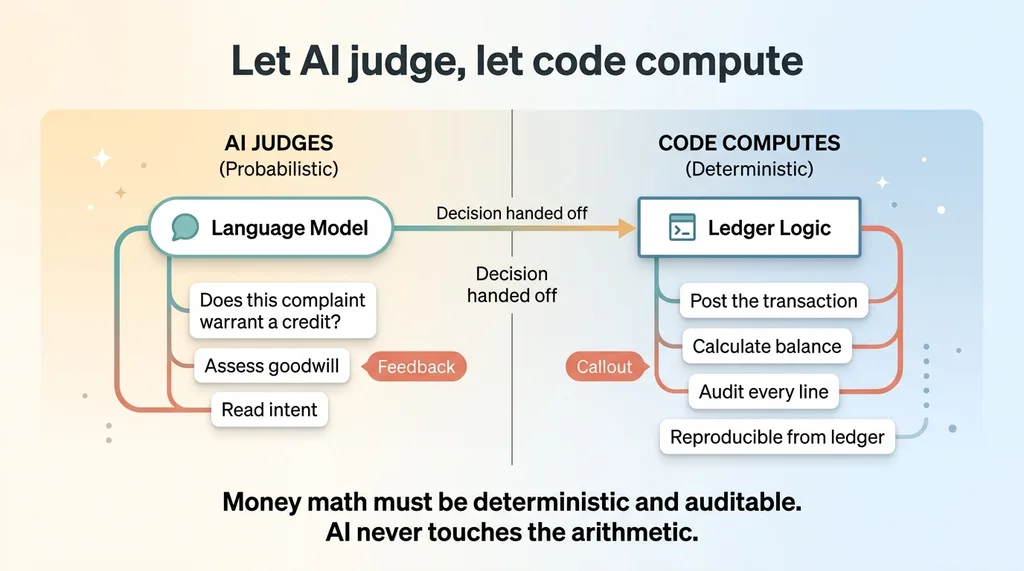
Let AI judge. Let code compute.
A language model is great at deciding whether a customer's complaint warrants a credit. It's terrible at being the system of record for how many credits they have. Money math must be deterministic and auditable. Every transaction traceable. Every balance reproducible from the ledger, not guessed by a model that might hallucinate a number.
So the ledger is plain, boring, deterministic code. AI never touches the arithmetic. AI might decide a customer deserves goodwill credit, but the actual posting is handled by logic I can audit line by line.
This is the part vendors won't tell you, because it's not exciting. The discipline of knowing what AI should never do is as important as knowing what it can. Anyone who hands your money math to a model is going to learn this lesson eventually. I'd rather you learn it from my bugs than your own.
The Support Agent I Deliberately Keep on a Leash
Why I run it in shadow mode
I built a support agent that can handle returns, exchanges, and refunds. It reads the customer message, understands the situation, drafts the resolution.
And I deliberately keep it on a leash.
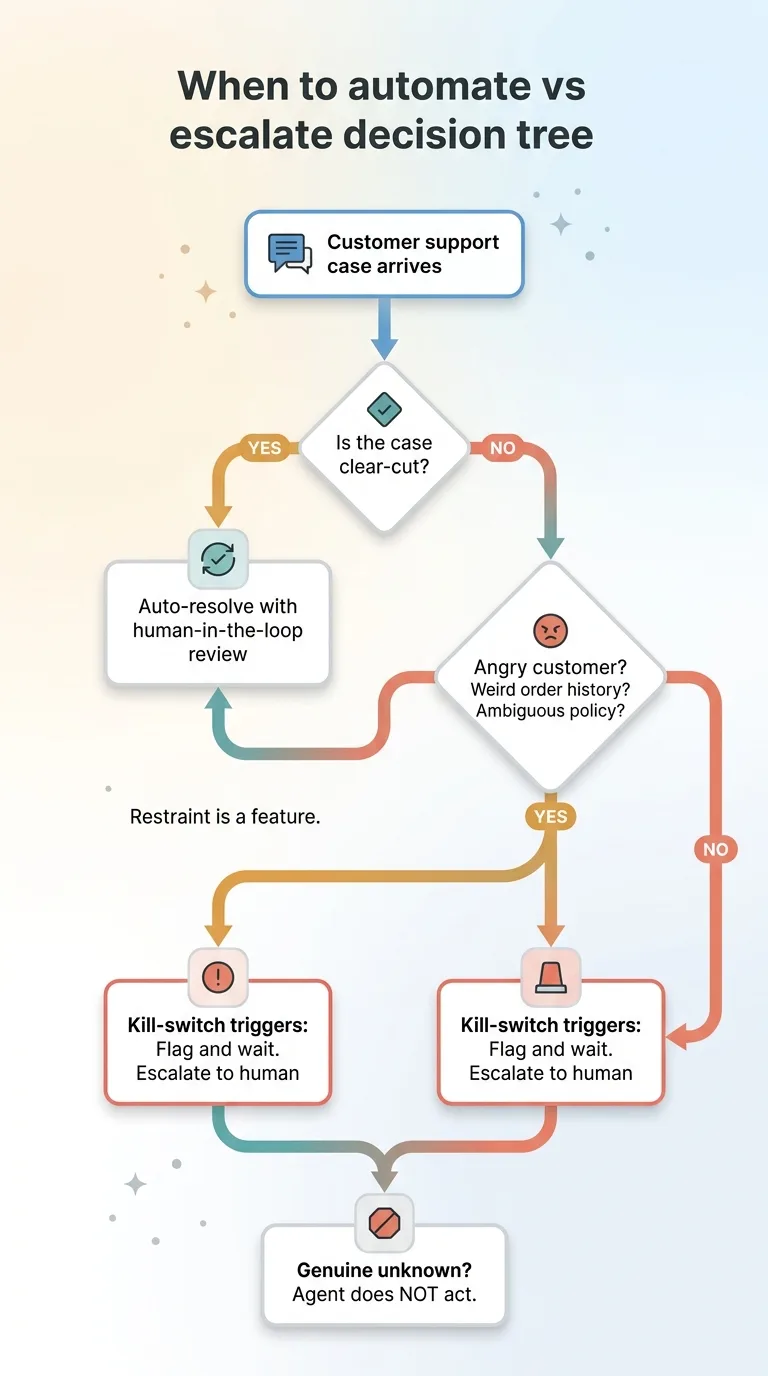
For a large class of routine cases, it operates with human-in-the-loop review. For genuine unknowns, situations it hasn't seen cleanly before, it doesn't act at all. It flags and waits.
This is the part that confuses people. "You built an autonomous agent and then you tied its hands?"
Yes. On purpose.
Knowing when NOT to let AI act
The skill in AI ecommerce operations is not making the AI do more. Any fool can give an agent full authority and let it run. The skill is knowing precisely where to pull the plug.
 When to automate vs escalate decision tree
A refund decision on a clear-cut case? Fine, automate it. A refund decision where the customer is angry, the order history is weird, and the policy is ambiguous? That's where a wrong automated answer costs me a customer for life and maybe a public review I can't undo.
So I built kill-switches and escalation triggers into the agent from day one. I wrote about the kill-switches I build into every system because this is the single most underrated part of an autonomous ecommerce stack.
Restraint is a feature. It's what makes everything else durable. A system that knows its own limits and hands off cleanly is worth ten systems that confidently act on things they shouldn't.
The brands that get burned by AI aren't the ones who automated too little. They're the ones who automated everything and trusted it blindly.
What This Means If You Run a Real Business
So, back to the question every skeptical CEO asks. Is "AI runs my store" real, or is it demo-ware?
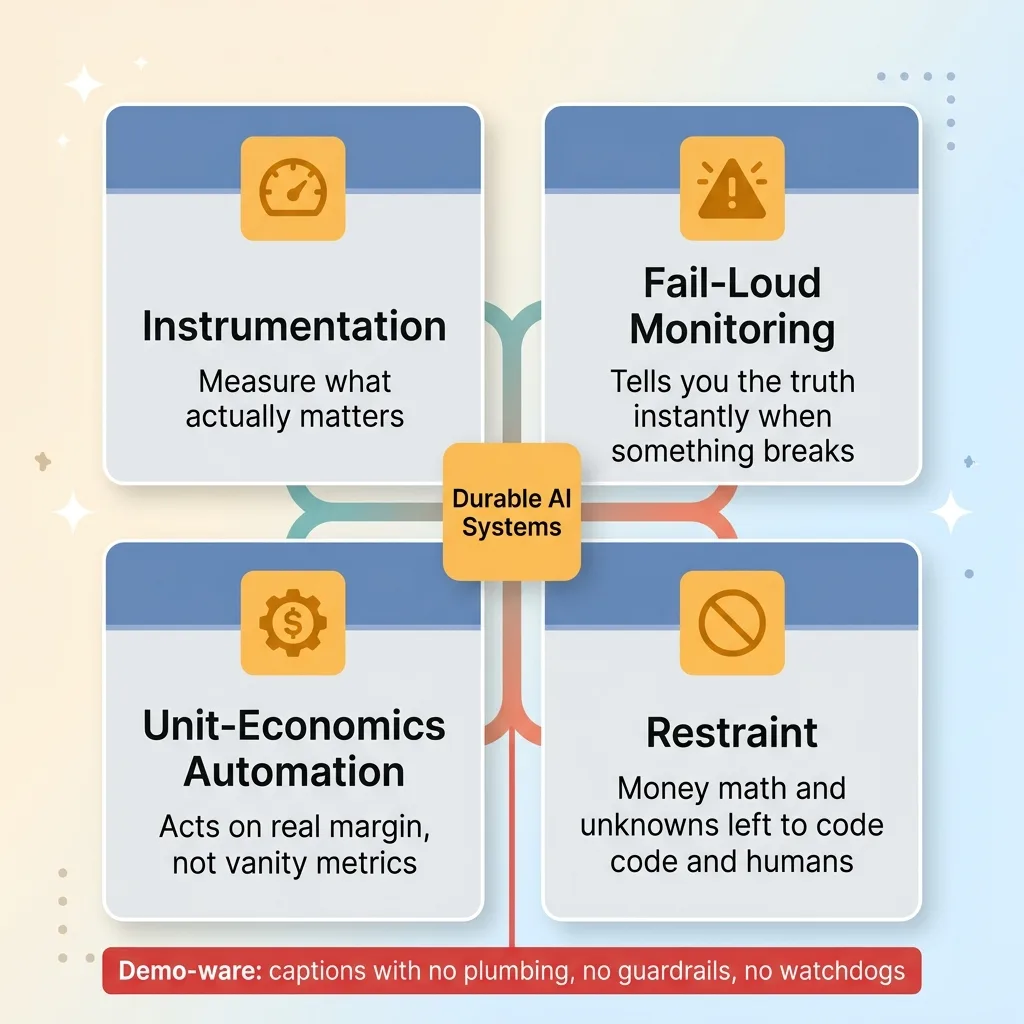 Four pillars of durable AI systems
Both. It depends entirely on how it's built.
It's real and durable when it sits on four things: instrumentation that measures what actually matters, fail-loud monitoring that tells you the truth, automation that understands your unit economics, and the restraint to leave money math and genuine unknowns to deterministic code and humans.
It's demo-ware when it's "AI writes your captions" with no plumbing underneath, no guardrails, and no watchdogs. That version looks great on stage and falls apart the first time a pixel breaks.
Here's the reframe I'd offer you. Don't ask whether AI can run your store. Ask whether your store is properly instrumented to be run by anything at all, human or machine. Most aren't. The feed is broken, the tracking is fragile, nobody knows the real margin per order. Fix that, and the AI part gets a lot easier.
I build these systems in my own brand first. Every system in this article runs in production on a real business with real revenue on the line. I break things, I learn, I harden them. Then I build them for clients. I don't experiment on your store with theories I haven't tested on mine.
If that's the kind of operator you want in your corner, put these systems to work in your business.
Ready to bring AI leadership into your company?
I work with a small number of companies at a time. If you're serious about AI, apply to work together and I'll review your application personally.
Get AI insights for business leaders
Practical AI strategy from someone who built the systems — not just studied them. No spam, no fluff.
Hodgen.AI
Ready to automate your growth?
Book a free 30-minute strategy call with Hodgen.AI.
Book a Strategy Call