Building Software for AI Agents, Not Just Humans
Building software for AI agents means more than a chatbot. Here's the agent-first architecture pattern that makes AI autonomy safe to ship.
By Mike Hodgen
What 'AI-Native' Actually Means (And What It Doesn't)
Let me address the doubt you're probably carrying. Most "AI features" you've been pitched are a chat box bolted onto an app that already existed. The vendor wrapped GPT around a search bar, called it AI-native, and charged you a premium for it.
That chatbot can talk about your data. It can't operate your business.
This is the core problem with how most people approach building software for AI agents. They start from the human app and try to make it chatty. The result is a system that can answer "how many units did we sell last week" but can't actually reorder the ones running low.
The chatbot trap
Here's the analogy I use with CEOs. Imagine you hire a competent operations person. Smart, fast, reliable. Now imagine you give them no login, no system access, no buttons to push. All you give them is a phone they can complain into.
"We're low on the navy hoodie."
Great. They can tell you that. They can't fix it.
That's a bolted-on chatbot. It observes and narrates. It doesn't do.
Talk vs. do
AI-native means something specific. It means you built the application so an agent can run it directly, the same way a competent employee would, with structured access to every real capability.
Not a chat layer on top. The app itself is legible to a machine.
I proved this pattern first on an agent-first e-commerce platform I built for a DTC fashion brand I run in San Diego. Real orders, real inventory, real money. The agents don't just describe what's happening. They operate the store, within boundaries I set.
The rest of this article is the architecture that makes that safe. No hype, no promises that AI will transform your business. Just the pattern that separates software an agent can actually use from a glorified search box.
Expose Every Capability Twice: The Dual-Interface Pattern
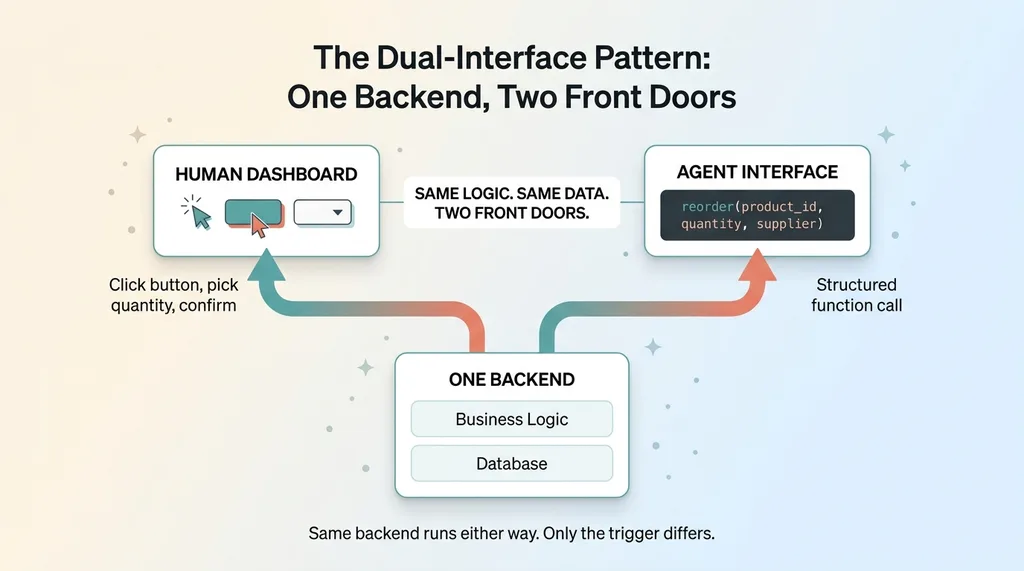
Here's the single most important architectural decision. Every capability on the platform is exposed two ways over the same backend: a human dashboard and a machine-readable interface an agent can call directly.
Same logic. Same data. Two front doors.
One backend, two front doors
Take reordering inventory. A human opens the dashboard, sees the navy hoodie is low, clicks a button, picks a quantity, confirms.
 The Dual-Interface Pattern: One Backend, Two Front Doors
An agent does the exact same thing differently. It calls a function with structured arguments: product ID, quantity, supplier. Same backend logic runs. Same database updates. The only difference is who pulled the trigger and how.
This is the heart of software built for agents to use. You don't build a separate "AI version" of your app. You build one backend and give it two interfaces.
I built 13 production skills this way, each one dual-interface from day one. Not retrofitted. Designed that way from the first line of code, because retrofitting agent access onto a human-only app is a nightmare you don't want.
Why the human dashboard still matters
People assume agent-first means humans get cut out. Wrong. The dashboard is still essential.
When an agent does something I want to inspect, I open the same dashboard a human always used and see exactly what happened. The agent's action shows up as a normal record, because it ran the same backend code a human click would have. No separate audit system. No mystery.
The platform is also multi-tenant by brand, so the same architecture serves multiple brands without cross-contamination. One brand's agent can't touch another's data.
The mental model: you're not building AI features. You're making your app legible to a machine. Once a capability is exposed cleanly, an agent can use it the same way a person does. For how those agent-callable tools actually get wired up, see how MCP changed the way I build.
Schema-Validated Output: Don't Trust the Model's Word
Here's where most bolt-on AI features fall apart, and where you find out whether someone actually shipped this stuff or just demoed it.
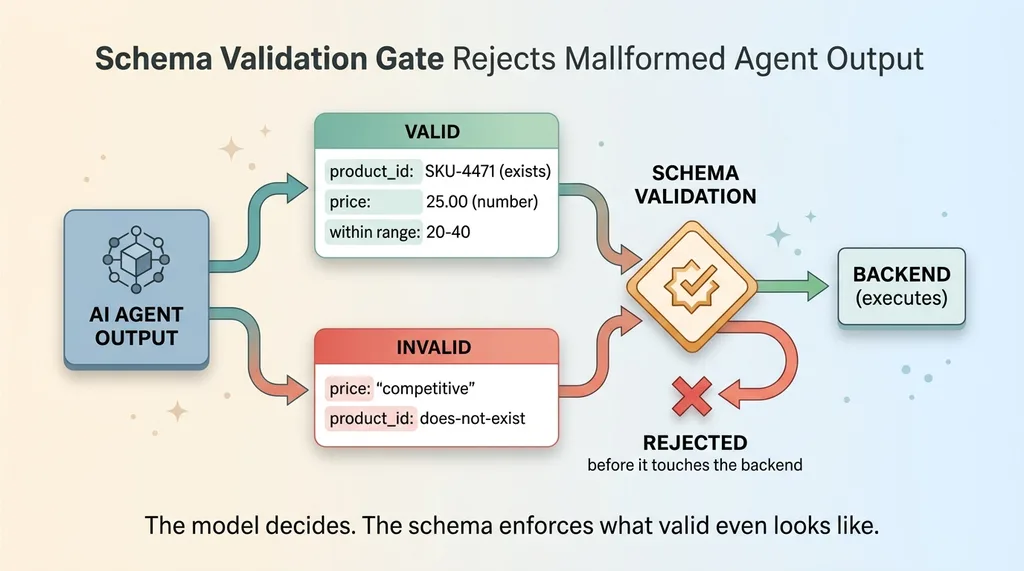
Every agent output is schema-validated before it touches the backend.
Free text is a liability
Language models produce text. Text is great for talking. It's a liability for operating a business.
If an agent says "I think we should drop the price of the linen shirt to somewhere around twenty-five dollars," that's a sentence. You can't run a pricing engine on a sentence. You need a number, tied to a real product, inside a valid range.
So I never let free text reach anything important. The model is allowed to decide and judge. But its output gets forced into a strict structure: typed fields, allowed values, required keys. If it doesn't conform, it gets rejected before it does anything.
Reject malformed before it touches the backend
Concrete example. An agent proposing a price change has to return a structured object: a valid product ID that exists in my catalog, a price as a number, and that number has to fall inside an allowed range I defined. Not a paragraph explaining its reasoning. A clean, typed proposal.
 Schema Validation Gate Rejecting Malformed Agent Output
If it returns garbage, a price of "competitive" or a product that doesn't exist, the schema rejects it. The backend never sees it.
This is the line between what the model decides and what the code computes. The model can judge whether a price should move. The code enforces what a valid price even looks like. That division is the whole game, and I wrote about it in detail in let the model judge, let the code compute.
Schema validation is the cheapest insurance you can buy against a hallucinated action. It's a few hours of work per skill. And it's the exact part bolted-on AI features skip entirely, because a chat widget doesn't need it. An operating agent absolutely does.
Event-Driven, Not Always-Running
The demos that go viral show an autonomous agent running forever in a loop, thinking out loud, taking action after action. Impressive to watch. Expensive and risky to run.
My agents don't work that way. AI calls are event-driven, not always-on.
Why a constantly-running agent is a cost and risk problem
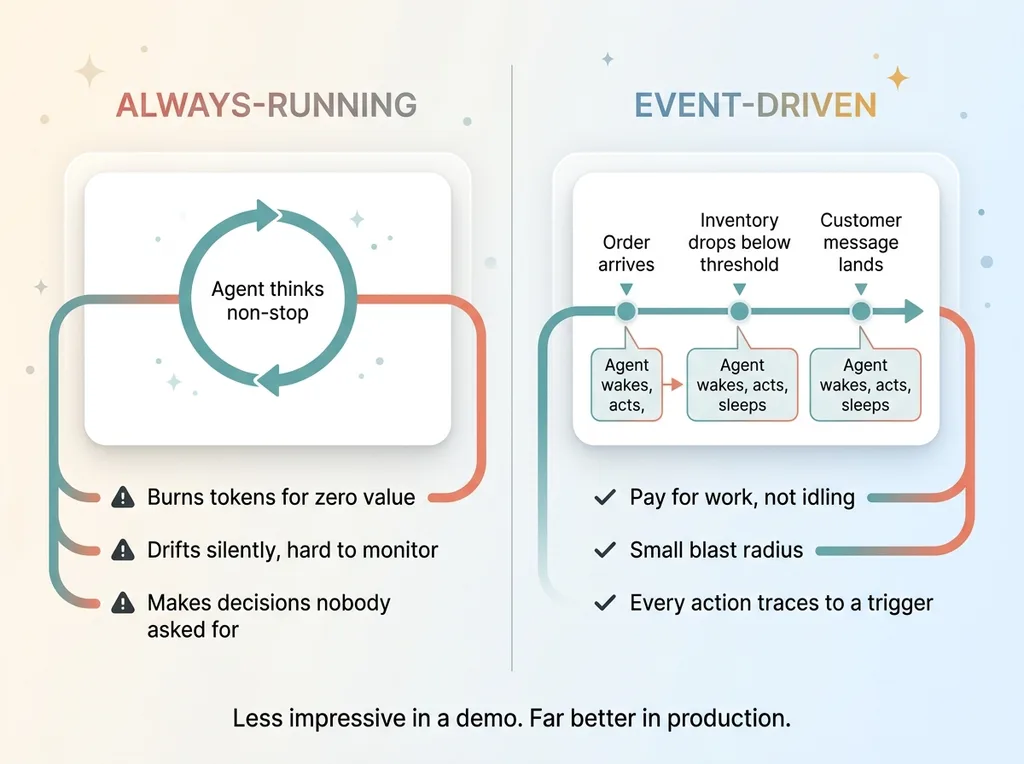
An always-running agent sits in a loop burning tokens, making decisions nobody asked for. Two problems with that.
First, cost. You're paying for the model to think even when there's nothing to think about. At scale that's real money for zero value.
Second, and worse, it's hard to monitor. An agent making decisions continuously can drift silently. It starts doing slightly wrong things, and because it never stops, nobody notices until something breaks.
Trigger on the event that matters
My agents wake up when a real event fires. An order comes in. Inventory crosses a threshold. A customer message lands. The agent acts on that specific event, then goes back to sleep.
 Event-Driven vs Always-Running Agent Comparison
You pay for work, not idling. And the blast radius stays small, because the agent only makes the decisions a real event demanded. Fewer decisions means fewer ways to go wrong.
This also makes the system honest. Every agent action traces back to a specific trigger. When I review what happened, I can see exactly what woke the agent and why. There's no mystery loop quietly making choices in the background. An event happened, the agent responded, it's logged. That's it.
Event-driven is less impressive in a demo. It's far better in production.
The Quality Gate: What Sits Between the AI and Anything Irreversible
This is the centerpiece, and it's the answer to the fear you actually have.
Your real worry isn't that AI is dumb. It's that it'll do something expensive and irreversible while you're not looking. A bad refund. A wrong reorder. A message that insults a customer.
So I put a gate between the agent and anything irreversible.
Money, inventory, and the customer are the three tripwires
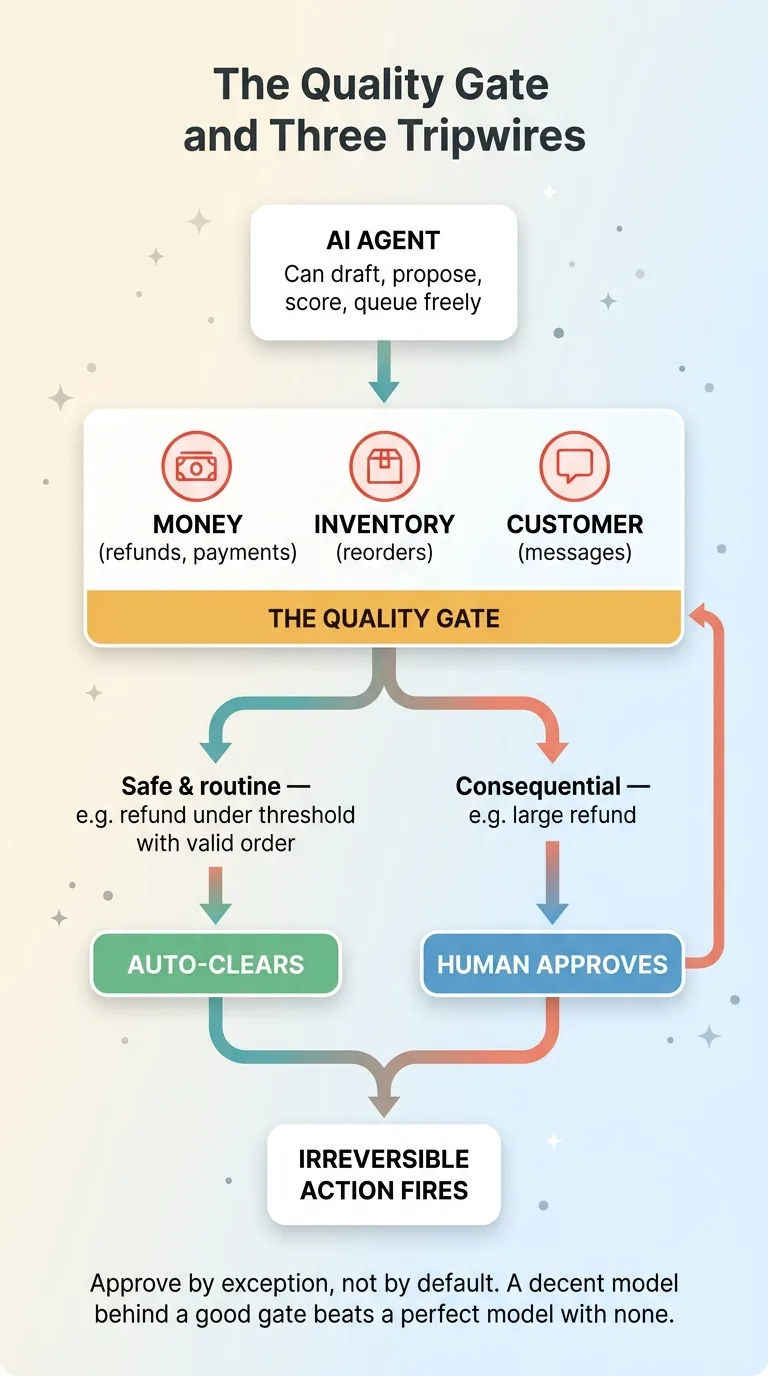
There are exactly three things I treat as dangerous: anything that moves money, anything that changes inventory, anything that reaches a customer. Those are the tripwires.
 The Quality Gate and Three Tripwires
The agent can do everything up to that line. It can draft, propose, score, and queue. It cannot pull an irreversible trigger without either a human approving it or it passing a deterministic quality check.
Example. An agent can compose a refund and stage it completely. Amount, customer, reason, all prepared. But the refund doesn't fire until it clears the gate. A human approves it, or it passes a hard-coded rule (refunds under a certain amount with a valid order can auto-clear, anything above gets a human).
Approve by exception, not by default
The trick is approving by exception, not by default. You don't want a human rubber-stamping every routine action. That just moves the bottleneck.
Instead, the gate clears the safe, routine stuff automatically and stops only on the consequential decisions. The human spends their attention where it matters, not on busywork.
This is what makes autonomy safe to ship. Not model quality. The gate. A perfect model with no gate is a liability. A decent model behind a good gate is a system you can actually trust with your operations.
Every AI system I build works this way, and I explained the full reasoning in every AI system I ship stops for a human. The point is that the gate answers your fear architecturally, not with a vendor's promise that "our AI is really accurate." Accuracy isn't a guarantee. A gate is.
What This Buys You Over a Bolted-On Chatbot
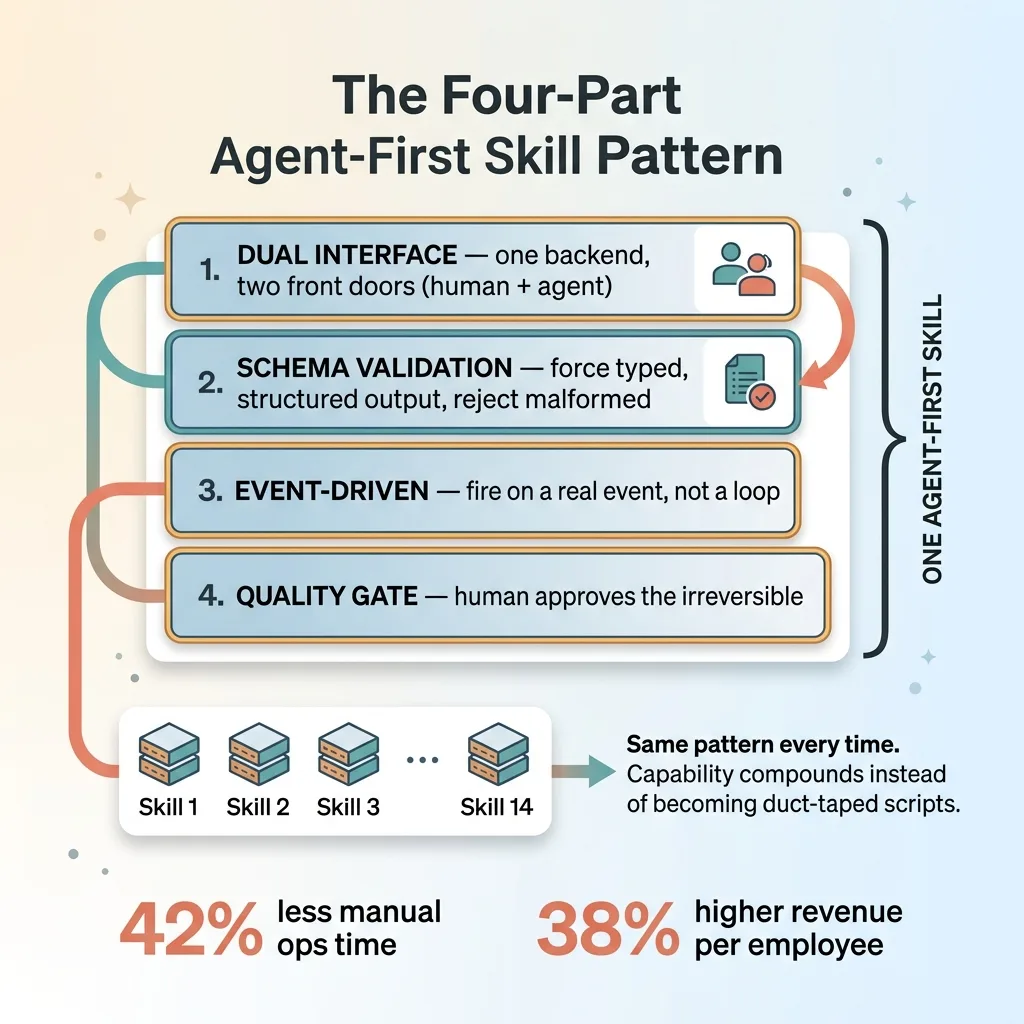
Put the four pieces together. Every skill is dual-interface, schema-validated, event-driven, and gated. Now you have software an agent can actually operate, not just talk about.
The capability compounds
Here's the part that matters over time. Because every skill follows the same pattern, new capabilities slot in cleanly. You're not building one-off integrations that each work differently.
 The Four-Part Agent-First Skill Pattern
Skill number 14 gets built the same way as skill number one. Dual interface, schema, event trigger, gate. The system compounds instead of turning into a pile of duct-taped scripts that each break in their own special way.
In the DTC brand, this means agents handle the routine operating decisions, humans approve the consequential ones, and work that used to demand constant attention now runs on triggers. That's part of how I cut manual operations time by 42% and pushed revenue per employee up 38%. Not from one clever AI feature. From a consistent pattern applied across 29 automation modes.
Honest limits
Now the honest part. This takes more upfront design than dropping in a chat widget. Building a skill dual-interface from day one is more work than bolting a chatbot onto an existing screen. There's no pretending otherwise.
And it only pays off if you have real workflows worth automating.
A five-page brochure site does not need this. If your business is mostly static pages and a contact form, a chatbot is fine. Don't over-engineer.
But a business with real operations, orders, inventory, pricing, customer messages, money moving every day, that's where this architecture earns its keep. The more real operating decisions you make, the more the pattern pays back.
Where to Start If You're Building This Yourself
If you want to build agent-first software yourself, here's a concrete starting sequence. One skill at a time.
Pick one workflow that involves an irreversible action. Refunds, reorders, or price changes are the usual suspects, because they're routine enough to automate and consequential enough to matter.
Then walk it through the pattern:
- Expose it as both a dashboard function and an agent-callable tool over the same backend. One backend, two front doors.
- Schema-validate the agent's output. Force structured, typed data. Reject anything malformed before it touches your system.
- Wire it to fire on an event, not a loop. An order arrives, inventory drops, a message lands.
- Put a human approval step in front of the irreversible part. Approve by exception, not by default.
That's one full agent-first skill. Then repeat for the next workflow.
Here's the honest note to close on. The hard part isn't the AI. The model is the easy, fun bit. The hard part is the boring architecture around it: the dual interface, the schemas, the event wiring, the gate. Those unglamorous decisions are what separate a system you can trust from a demo that falls over in production.
That boring architecture is exactly the work I do. If you've got real operations and you're tired of vendors selling you chat widgets, talk to me about your stack.
Thinking about AI for your business?
If this resonated, let's have a conversation. I do free 30-minute discovery calls where we look at your operations and identify where AI could actually move the needle.
Get AI insights for business leaders
Practical AI strategy from someone who built the systems — not just studied them. No spam, no fluff.
Hodgen.AI
Ready to automate your growth?
Book a free 30-minute strategy call with Hodgen.AI.
Book a Strategy Call