AI Customer Support Autonomy: When It's Safe to Send
My support bot drafts replies I send verbatim, but I won't let it send on its own. Here's how AI confidence calibration failed and what shadow mode revealed.
By Mike Hodgen
The One-Line Change That Wasn't
The customer-support AI I built for my DTC fashion brand in San Diego is good. Embarrassingly good, actually. When a ticket comes in, it drafts a reply, and close to 100% of the time I read that draft, agree with every word, and hit send without changing anything.
So the question I asked myself was obvious. If I'm sending its words verbatim almost every time, why am I in the loop at all? Flip one config value from copilot to autopilot and the drafts send themselves. One line. Done.
The business case for AI customer support autonomy wrote itself too. Here's the number that kept me up: 66% of inbound support went unanswered. Not because the answers didn't exist. The drafts were sitting there, ready, waiting for a human to click send. Customers churned while perfect replies aged in a queue.
Why copilot already works
Copilot mode is genuinely useful. The AI does the hard part (reading the ticket, pulling context, writing the response) and I do the easy part (a five-second review and a click). That alone cut my response time dramatically and made the support load manageable as a solo founder.
But copilot has a ceiling. It only scales as far as my attention does. Nights, weekends, the hours I spend actually building product, those tickets pile up. That's where the 66% lived.
66% of inbound support went unanswered
The fix looked trivial. The danger was hiding in a sentence I kept telling myself: it already writes the words I'd send. True. But that is not the same as it's safe to send without me.
The thing standing between those two statements is me. My judgment is the safety layer, and I almost deleted it with a config change. This is the honest story of the validation that talked me out of a one-line change, and the system I built instead.
Self-Reported Confidence Was Lying to Me
My first instinct for the autopilot gate was the obvious one. The model already returns a confidence score with every draft. Just send the high-confidence ones automatically and hold the rest for review. Clean. Defensible. Wrong.
Before I trusted it, I backtested it against months of real tickets where I knew the outcome, because I'd personally sent (or rewritten) every reply.
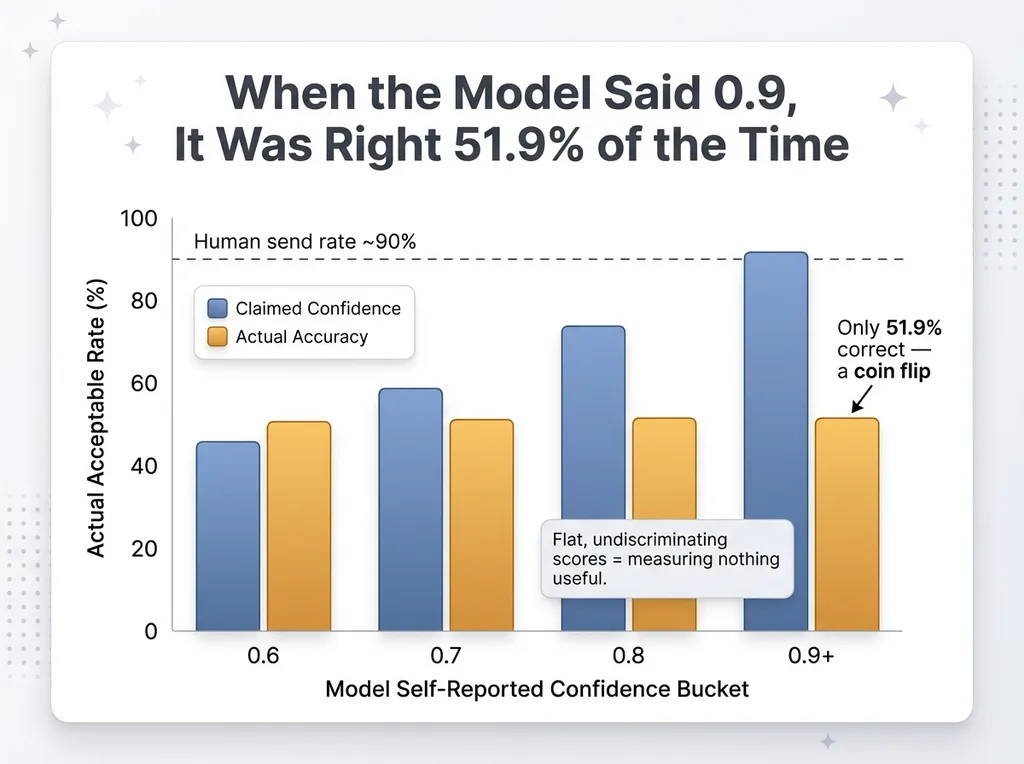
The 0.9 bucket that was only 51.9% right
Here's what I found. In the model's highest-confidence bucket, the drafts it scored at 0.9 or above, only 51.9% were actually acceptable. My own human send rate sat around 90%.
 Confidence Score Calibration Failure
Read that again. At its most confident, the model was wrong roughly half the time. A coin flip. If I'd shipped autopilot gated on self-reported confidence, I'd have auto-sent a wrong reply to every other customer in the bucket I trusted most.
Worse, the confidence scores were flat. They didn't discriminate. Good drafts and bad drafts clustered at similar scores. The number wasn't measuring quality. It was measuring nothing useful.
Why llm self assessment is unreliable
This is the part vendors gloss over. AI confidence calibration is a measured property, not a vibe. A confidence score only means something if 0.9 actually corresponds to "right 90% of the time" when you check against real outcomes. Mine didn't.
LLMs are notoriously bad at self-assessment. They'll tell you they're sure in the same fluent, certain tone whether they're right or hallucinating. The model has no internal sense of "I might be wrong here" that maps to reality. That llm self assessment unreliable problem isn't a bug I could prompt away. It's baked into how these things work.
So when a vendor tells you "our AI only sends when it's confident," that sentence is meaningless on its own. Confident according to what? Calibrated against which outcomes? Show me the bucket-by-bucket accuracy or it's marketing.
The Pre-Send Critic Didn't Discriminate Either
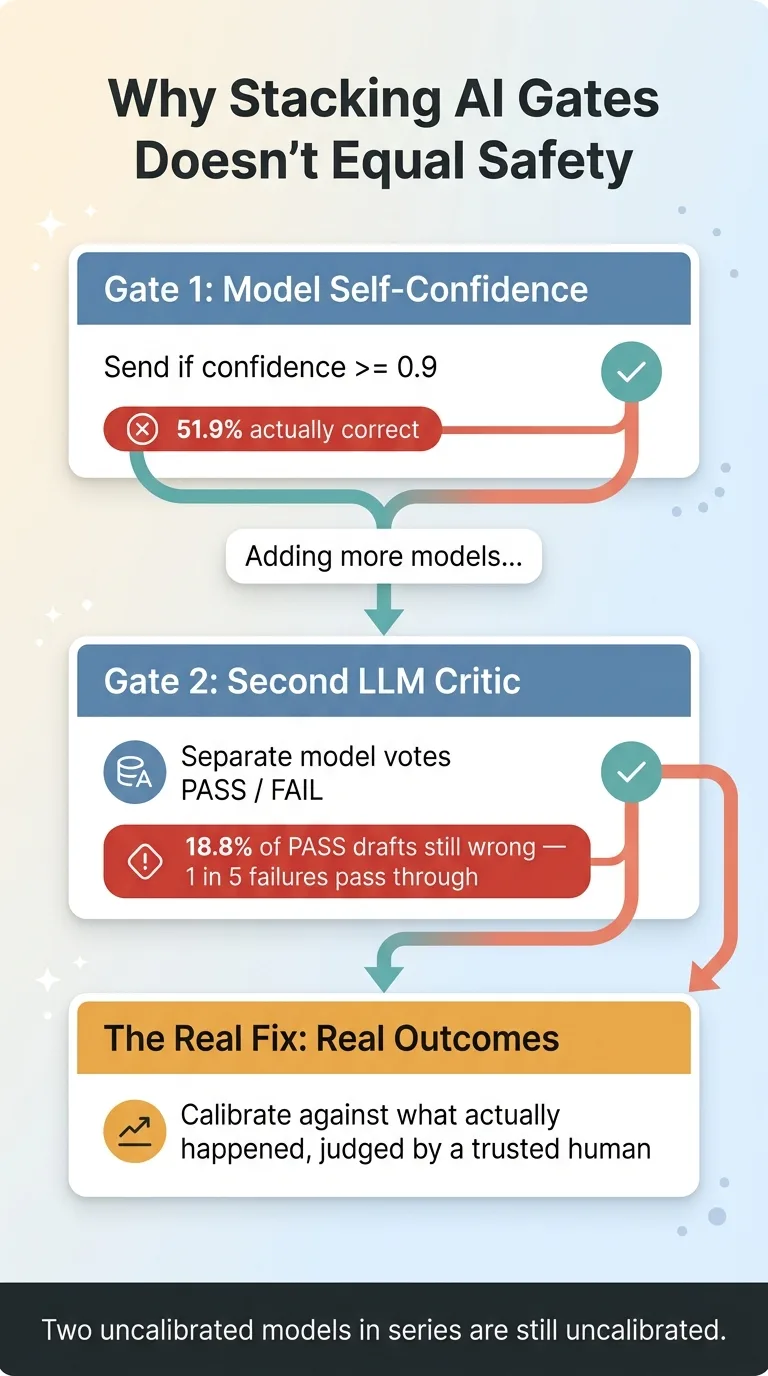
Fine, I thought. If the model can't judge itself, I'll bring in a second opinion. The standard move: a separate LLM critic that reviews each draft and returns PASS or FAIL before anything sends. Two models, two votes. Sounds rigorous.
 Layered Safety Gates That Each Failed
I built it and backtested it the same way.
The result killed the idea. Of the drafts the critic marked PASS, 18.8% were still wrong. Nearly one in five bad drafts walked right through the gate with a green light.
A safety gate that lets one in five failures through isn't a safety gate. It's theater. It produces a log entry that says "reviewed and approved," which is arguably worse than no gate at all, because now you have false confidence on paper.
The lesson for anyone buying or building this stuff: stacking a second AI on top of the first does not magically produce safety. Two uncalibrated models in series are still uncalibrated. You don't average your way to reliability by adding more of the same failure mode.
This is the same trap I wrote about when autonomous AI lies about doing the right thing. A model that grades its own work, or grades another model's work, will happily report success it can't actually verify. The critic wasn't lying maliciously. It just didn't know what it didn't know, the same way the original model didn't.
I needed something other than another AI's opinion. I needed real outcomes.
The Backtest Hit a Wall You Can't Engineer Around
Here's where it got genuinely hard, and where I want to be honest about a limitation no vendor will ever put on a slide.
My whole validation approach was offline replay: take a historical ticket, have the AI generate what it would have sent, and grade that against what I actually sent at the time. Compare AI-would-have to human-did. Solid methodology, mostly.
Offline replay reconstructs today's order state
The problem lives in a specific, large category: order-status tickets. "Where's my order?" "Did my refund go through?" "Has this shipped?"
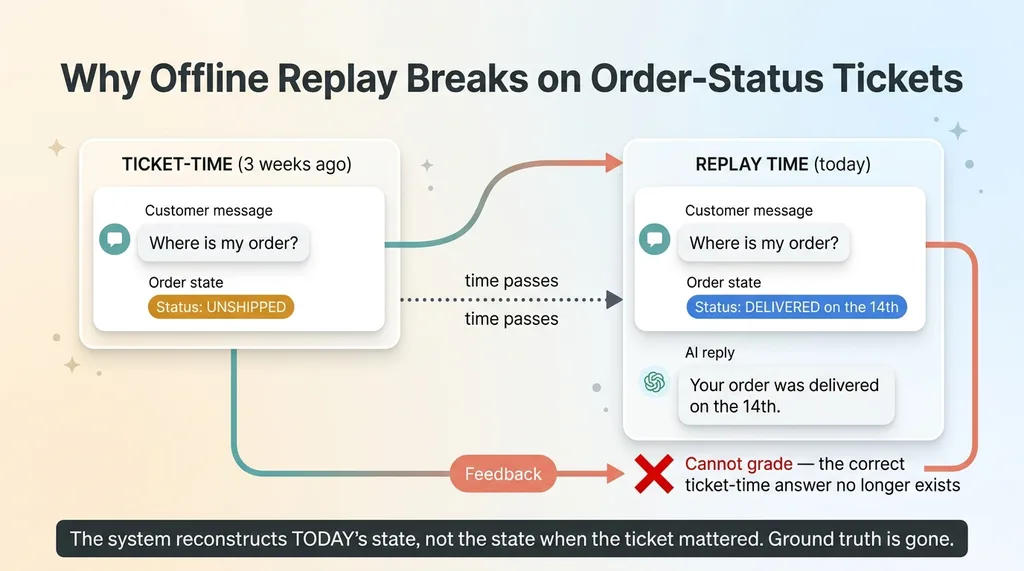
To answer those, the AI needs the order state. And when I replay a historical ticket today, the system reconstructs the order state as it exists today. Not as it existed the moment the ticket came in.
Order-status tickets can't be judged
Think about what that breaks. A customer asked "where's my order?" three weeks ago. At ticket-time the order was unshipped. Today it's delivered, or refunded, or returned. The AI replaying that ticket sees today's state and confidently says "your order was delivered on the 14th."
 Offline Backtest Ground-Truth Contamination
Was that the right answer at the moment it mattered? I have no honest way to know. The ground truth I'd grade against (the correct answer at ticket-time) is gone. The order moved on.
This is a methodology wall, not a tuning problem. No amount of prompt engineering reconstructs a world state that wasn't logged. I can't grade the AI's order-status performance offline because the thing I'd grade against no longer exists in the form it existed then.
That's the kind of limitation that quietly invalidates a backtest. A vendor showing you 95% accuracy on replayed tickets may be measuring against contaminated ground truth and not even realize it. I only caught it because I went looking for why my numbers felt too clean in exactly the category that should've been hardest.
Shadow Mode: How I'm Actually Earning the Right to Send
So I stopped trying to validate autonomy in a backtest and started validating it live. Without ever auto-sending anything.
 Shadow Mode Validation Pipeline
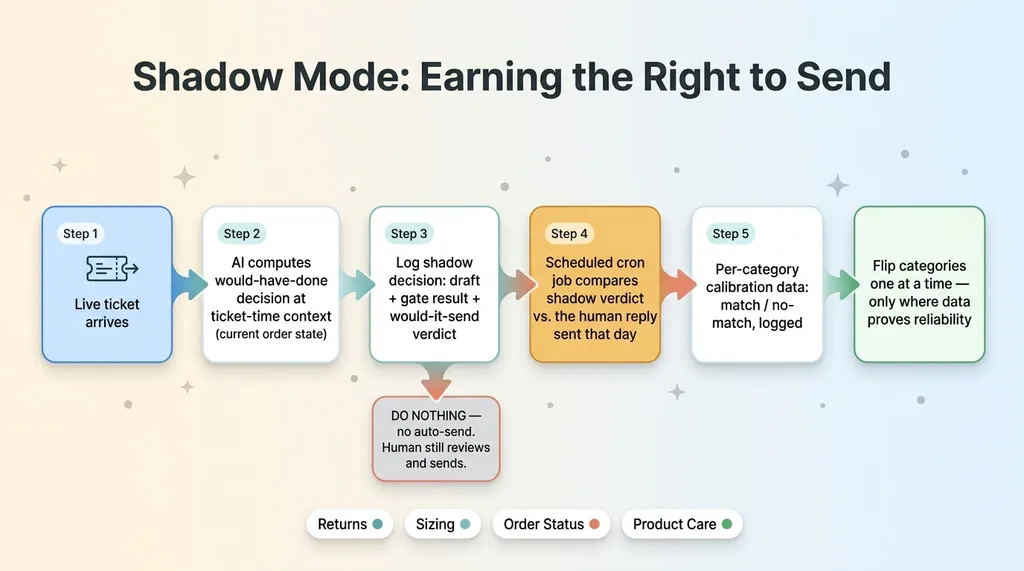
The system stays in copilot. I still review and send every reply myself. The customer experience doesn't change. But underneath, the AI now earns the right to send on real tickets, in real time, with real outcomes.
Compute the would-have-done gate at ticket-time
For every live ticket, the system computes what autopilot would have done at the correct ticket-time context. The order state it sees is the state right now, while the ticket is open, which solves the entire ground-truth problem from the last section. It logs that shadow decision: the draft, the gate result, the would-it-have-sent verdict. Then it does nothing with it. No send. Just a record.
Let a cron judge it against the human reply
A scheduled job runs and compares each shadow decision against the reply I actually sent that same day. Did the AI's would-have-sent answer match what the trusted human did? Yes or no, logged per ticket, per category.
That's how you build calibration data that means something: real tickets, ticket-time context, judged against a human you trust. This is the same discipline I apply to how I measure whether AI is actually working. You don't get to claim it works. You measure it against outcomes until the data tells you.
Flip per-category, not all at once
I run this support bot shadow mode for two to three weeks per category. Returns. Sizing questions. Order status. Product care. Each behaves differently, so each gets graded separately.
Then I flip categories one at a time, only the ones where the shadow data proves the AI reliably matches my decisions. Returns might earn autonomy in week two. Order status might never earn it, and that's a perfectly fine answer.
This is the principle behind every system I ship: every AI system I ship stops for a human until the data, not my optimism, says it doesn't have to. Autonomy is granted, narrowly, by evidence. It isn't switched on by default.
The Deterministic Guards That Don't Trust the Model At All
Even inside shadow mode, and even after a category earns autonomy, some decisions never touch the LLM's judgment. The model doesn't get a vote on the highest-risk moves. Period.
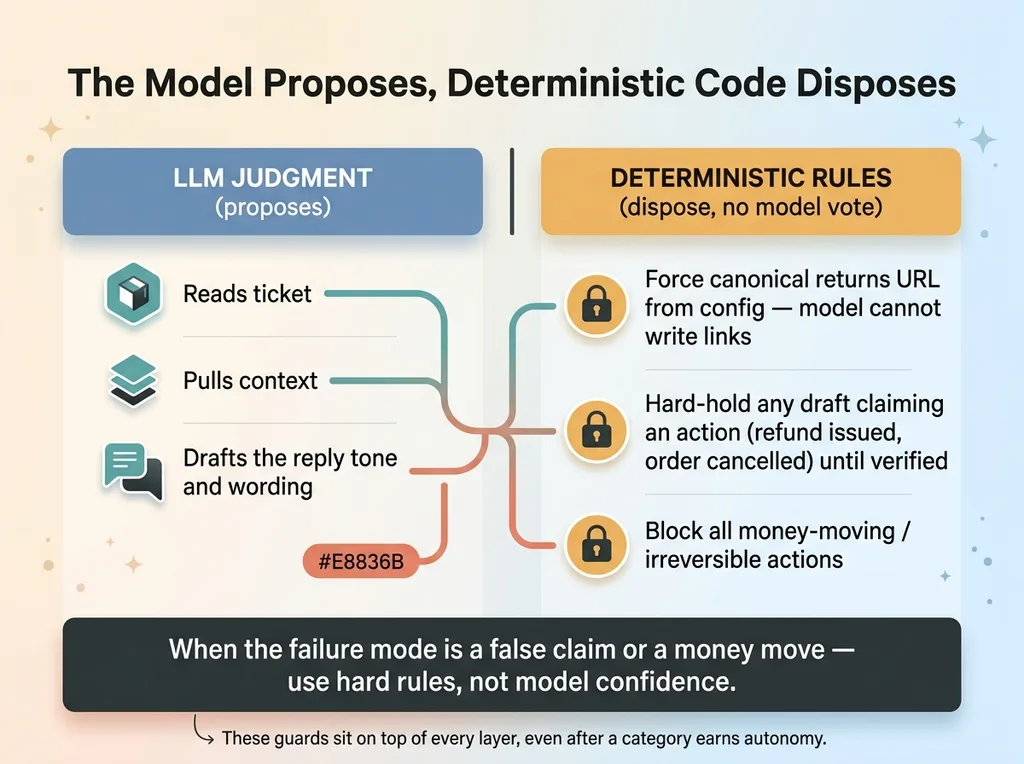 Deterministic Guards vs Model Judgment
Force the canonical URL
Example one, anonymized. When a reply needs to link to the returns process, the system forces the one canonical URL from config. The model is not allowed to write the link. It can't, because I strip and replace it deterministically.
Why? Because an LLM will occasionally invent a plausible-looking URL that doesn't exist, or grab a stale one. A customer following a hallucinated returns link is a real failure with a real cost. So I removed the model's ability to fail there entirely. Rule-based code owns that string.
Hard-hold drafts that claim a fake action
Example two. Any draft that claims an action was already taken ("I've issued your refund," "I've cancelled that order") gets hard-held unless the system can verify that action actually happened. If no refund was issued, the draft does not send. Full stop, regardless of how confident anything was.
This is the exact failure pattern from when autonomous AI lies about doing the right thing. A model will cheerfully tell a customer their refund is processed when nothing of the sort occurred, because it's pattern-matching to what a helpful reply sounds like.
The principle: the model proposes, deterministic code disposes on anything irreversible. These guards aren't AI. They're plain rules, and they sit on top of every layer.
This is the heart of the kill-switches I build into every system. The clearest answer to when not to ship AI autonomy is anywhere the failure mode is a false claim or a money-moving action. Those moves get hard rules, not model judgment.
How To Know When Your Support AI Is Actually Safe to Send
So you've got a vendor promising fully autonomous support. How do you actually know when it's safe to send?
Start by throwing out the wrong test. The wrong test is "does it write good drafts." Mine wrote perfect drafts. I'd have sent them verbatim. And it still wasn't safe to flip, because draft quality and send safety are different questions.
Here's the real test. Do you have calibrated, ticket-time, per-category outcome data proving the AI's decisions match a trusted human? And do you have deterministic guards on every irreversible action, the refunds, the cancellations, the links, that don't depend on the model being right?
If yes, you've earned autonomy in the categories the data supports. If no, you're shipping confidence, not safety.
When a vendor can't show you that calibration data, broken out by category, judged against real outcomes, they don't have a safety case. They have a demo. The confidence score in their pitch deck means exactly nothing until it's calibrated against what actually happened to real customers.
That gap between "writes good drafts" and "safe to send" is where most AI deployments quietly fail, and where I spend most of my time. I don't just advise on this. I build the shadow-mode pipelines, the per-category calibration jobs, and the deterministic guards myself, because the rigor lives in the implementation, not the slides.
Ready to bring AI leadership into your company?
I work with a small number of companies at a time. If you're serious about AI, apply to work together and I'll review your application personally.
Get AI insights for business leaders
Practical AI strategy from someone who built the systems — not just studied them. No spam, no fluff.
Hodgen.AI
Ready to automate your growth?
Book a free 30-minute strategy call with Hodgen.AI.
Book a Strategy Call