Your Agency Probably Owns Your Marketing, Not You
If you want to take marketing in-house from your agency, the first thing you need to know is uncomfortable: you probably don't own the accounts you've been paying to build.
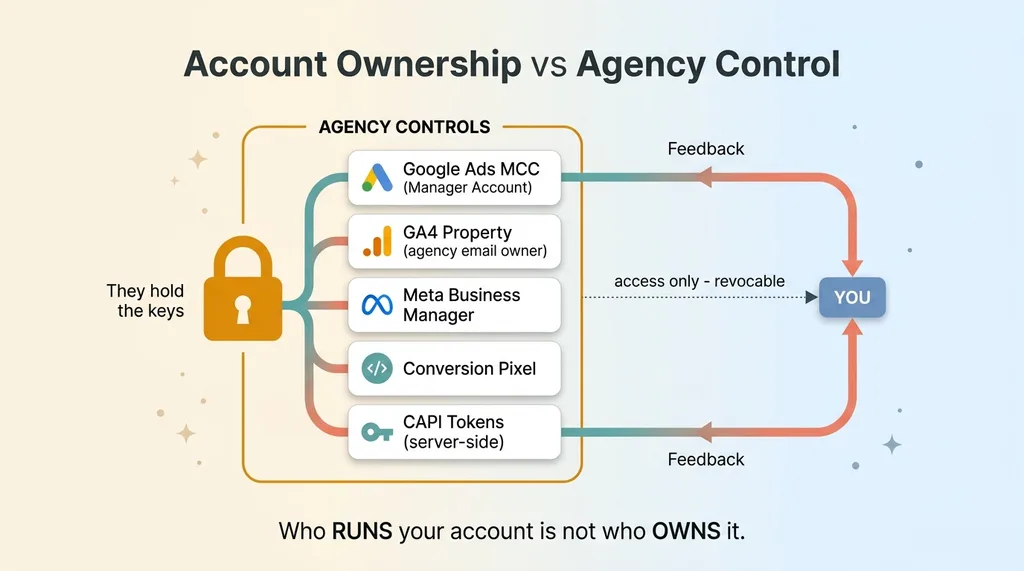 Account Ownership vs Agency Control (Who Holds the Keys)
I learned this the hard way working with a local service business that wanted out of a relationship with an offshore agency. The owner was frustrated, the results were mediocre, and the contract was month to month. Easy exit, right?
Wrong. The agency had set everything up under their own roof. The Google Ads account lived inside their Manager account. The GA4 property was created with their email as the owner. The Meta Business Manager, the pixel, the conversion tracking, all of it sat under accounts the agency controlled.
Walking away meant potentially losing years of campaign history, conversion data, and audience signals. The owner didn't realize that until I started digging.
Here's the question almost no business owner can answer: who owns my Google Ads account? Not "who runs it." Who actually owns it. If you can't answer that with certainty, that's the trap. The agency holds the keys, and they know you don't know.
This is the unglamorous part of marketing nobody talks about. It's not strategy, it's not creative, it's not the fun stuff. But it's the first thing I check when I take over marketing for a small business, because everything else depends on it.
Before you fire anyone, you need to understand what you stand to lose. The decision to fire your marketing agency cleanly starts with knowing exactly which assets are yours and which ones the agency is quietly holding hostage.
Why Losing Account History Costs More Than the Agency Did
Most owners think the cost of leaving an agency is the disruption. New provider, new ramp-up, a few weeks of chaos. That's not the expensive part.
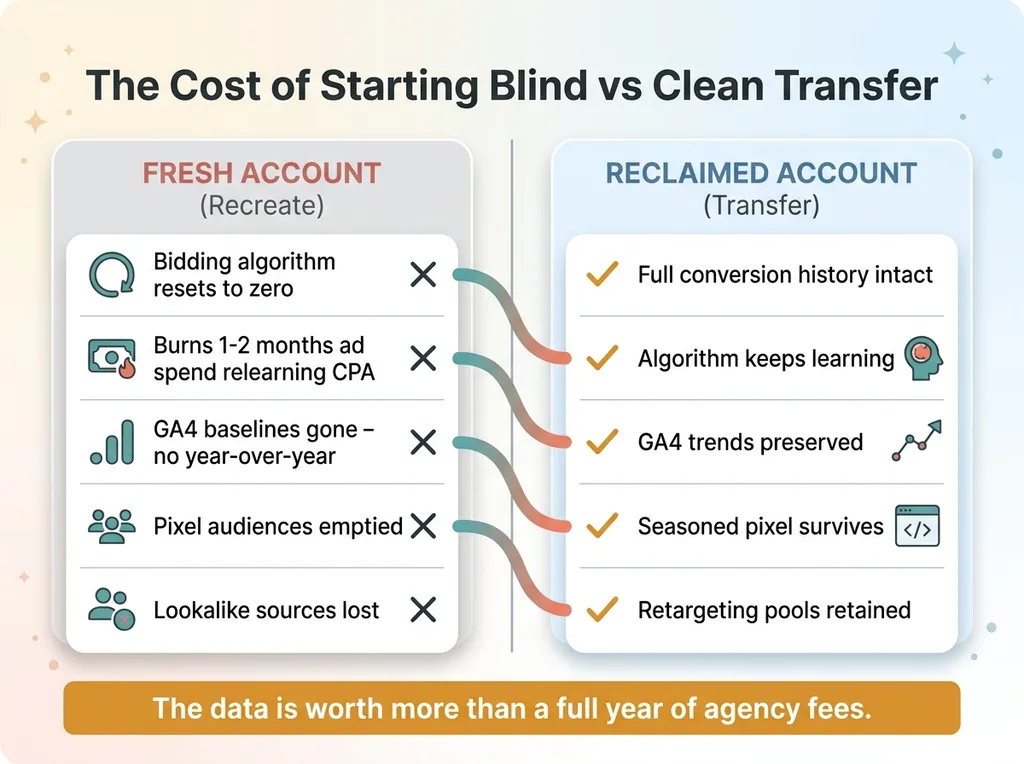 The Cost of Starting Blind vs Clean Transfer
The expensive part is starting blind.
Campaign history is training data
Google's bidding algorithms learn from your account's conversion history. Every click that turned into a sale, every audience that converted, every keyword that wasted money, all of that lives in your account and feeds the machine learning that makes your ads cheaper over time.
Start a fresh account and you throw all of that away. The algorithm goes back to zero. It has to relearn what your old account already knew, and it relearns by spending your budget. I've seen accounts burn through a month or two of ad spend just getting back to the cost-per-acquisition they had before the move.
That's real money. For most small businesses, the data you'd lose is worth more than a full year of agency fees.
Tracking continuity is revenue
GA4 historical data can't be fully exported and re-imported into a new property. You can pull reports, but you can't rebuild the property with its complete history. So the moment you spin up a new one, your baselines are gone. No year-over-year comparison. No seasonal trend you can trust. You're flying without instruments.
The pixel is worse. Recreate a Meta pixel and you lose its accumulated audience and optimization signal, the thing that took months to season. Your retargeting pools empty out. Your lookalike audiences lose their source.
This is why a clean break matters more than a fast one. Rushing the exit to escape a bad agency a week sooner can cost you the very asset you spent years paying to build.
The Marketing Agency Offboarding Checklist (What to Reclaim)
Here is the exact handover checklist I built for that service business, and the one I now run for every client leaving an agency. The word that matters in every line below is reclaim, not recreate.
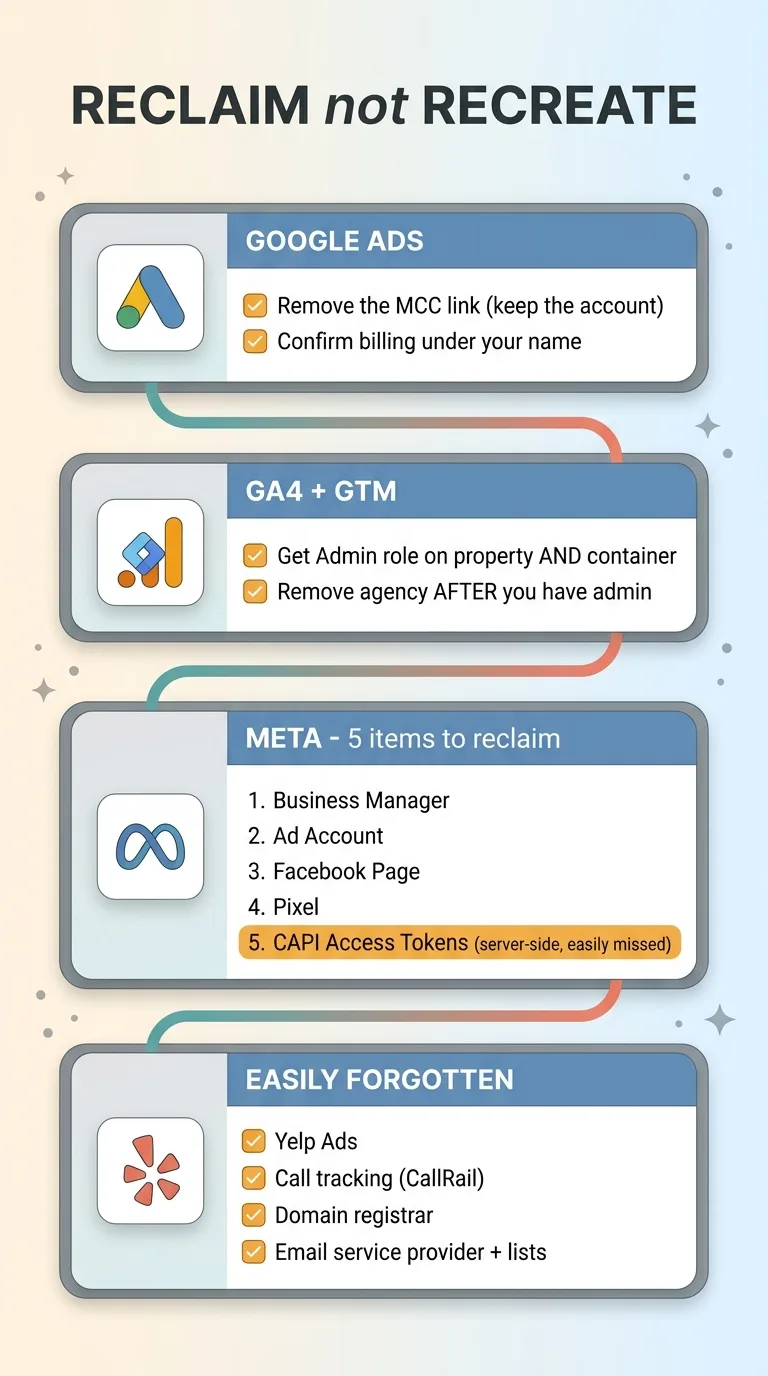 The Reclaim Checklist Across Platforms
Google Ads: remove the MCC link, keep the account
Your agency almost certainly holds your Google Ads account inside their Manager account, also called an MCC. This is the most misunderstood handover in the whole process.
You do not want them to give you "access to a copy." You do not want a new account. You want them to remove the MCC link so your existing account, with its full history intact, becomes independent and tied to your own email.
The campaigns, the conversion data, the bidding history, all of it stays. Only the agency's control gets cut. Confirm a billing profile under your own name so the account doesn't get suspended when their payment method drops off.
GA4 and GTM: transfer ownership
For Google Analytics 4 and Google Tag Manager, get yourself assigned the Admin role on both the property and the container. Use your own Google account, not a shared login the agency controls.
Once you have Admin, you remove the agency. Do it in that order. If you remove them first and you're only an Editor, you can lock yourself out.
Meta: reclaim Business Manager admin, pixel, and CAPI tokens
Meta is where agencies bury the most control. You need admin on five separate things:
- The Business Manager itself (not just the ad account inside it)
- The ad account
- The Facebook page
- The pixel
- The Conversions API (CAPI) access tokens
That last one trips up almost everyone. CAPI tokens live server-side, often inside the agency's own infrastructure or a third-party tool. If the agency holds them and you never reclaim them, your server-side tracking breaks the moment they leave, and you won't notice until your conversion numbers quietly collapse.
The smaller accounts everyone forgets
The big platforms get attention. These don't:
- Yelp Ads or other local platform accounts
- Any third-party call tracking (CallRail and the like)
- Your domain registrar, which agencies sometimes "helpfully" manage
- Your email service provider and the lists inside it
I've seen a client lose their entire email list because it lived inside an agency-owned Mailchimp account nobody thought to reclaim. Map every account. Reclaim every one. This is the part of taking marketing in-house from an agency that nobody enjoys and everyone regrets skipping.
The Termination Notice That Triggers a Clean Handover
Most agency contracts have two clauses buried in them that matter here: a notice period and an asset-handover clause. Read your contract before you do anything. If you signed something, the path to a clean exit is usually written in it.
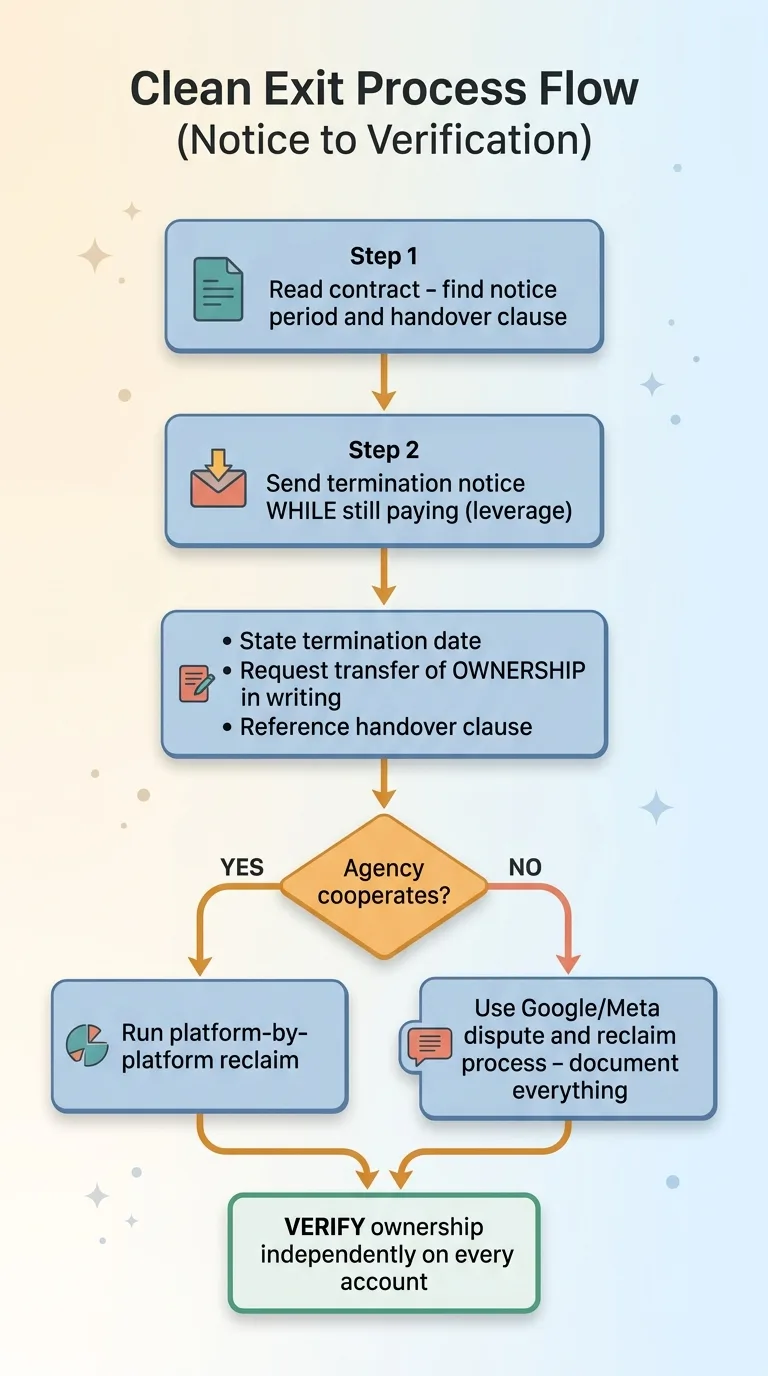 Clean Exit Process Flow (Notice to Verification)
Your termination notice should do three things:
- State the termination date clearly.
- Request specific asset transfers by that date, in writing. List every account from the checklist above.
- Reference the handover clause if your contract has one.
The language matters more than people think. Ask for transfer of ownership, not "exports" and not "access." Exports give you a copy and let the agency keep the original. Access can be revoked the day you stop paying. Ownership is the only thing that sticks.
Here's the leverage point most owners miss: send the termination notice before you stop paying. An agency that's still getting paid has a reason to cooperate on the handover. An agency you've already cut off has no incentive to do the unglamorous work of unlinking accounts and transferring admin roles.
Now the honest part. Some agencies, particularly low-quality or offshore shops, will drag their feet. A few will claim they "own" the accounts because they created them.
When that happens, you're not stuck. Both Google and Meta have dispute and reclaim processes for accounts tied to your business email, your domain, or your verified business identity. It's slower and more painful than a cooperative handover, but if the agency won't play ball, you can go over their head. Document everything in writing along the way, because those disputes turn on evidence.
Verifying You Actually Got Everything
A handover is not done when the agency says it's done. This is where most DIY offboardings quietly fail.
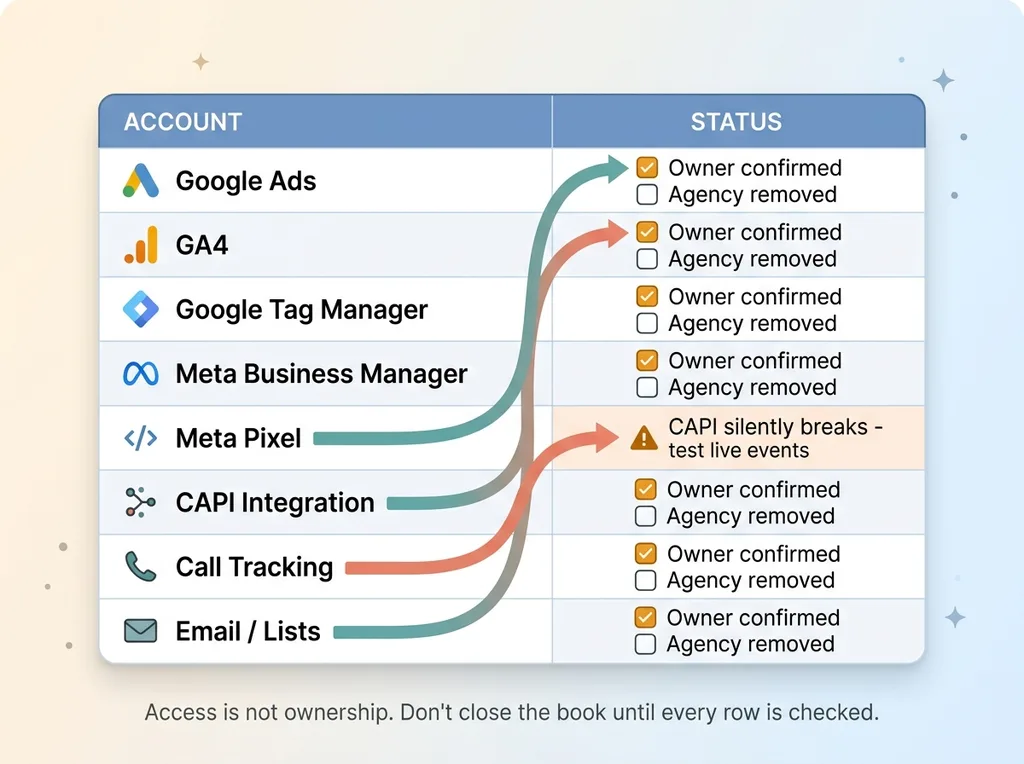 Verification Audit Matrix
People get access, see the accounts load, and assume the job is finished. Then three months later they discover the agency is still listed as an admin somewhere, still watching their data, or still holding a token that's about to break.
Verify everything yourself, independently, by logging into each account.
- Google Ads: Confirm you're listed as the owner, not just a user. Confirm the account is unlinked from the agency's MCC but still shows your complete historical campaigns. Run a date range that goes back a year. If the history is there, the transfer worked.
- Agency access removed: This is the one people miss. A "reader" or "analyst" role left behind still lets the agency see all your data. Check the user list on every platform and confirm they are fully out, not downgraded.
- The pixel: Confirm it's still firing. Use Meta's testing tools to see live events. Then confirm the CAPI integration survived the transfer, because that's the piece that silently breaks.
- GA4: Check data continuity. Confirm yesterday's data is flowing and that your historical reports still load.
Make a simple two-column list: account name, and "owner confirmed / agency removed." Don't close the book until every row is checked. The whole point of this exercise was ownership. Getting access while leaving the agency embedded is not ownership.
What Happens After You Own It All
Everything up to this point has been defense. Reclaiming, verifying, protecting the asset. Now you get to play offense.
Once you actually own the accounts, you can finally run marketing on your own terms. You can unify your analytics once you own the accounts and pull GA4, Search Console, and Google Ads into one view instead of squinting at whatever dashboard the agency decided to show you. That alone changes how you make decisions, because for the first time you're looking at your own complete picture.
You also get a real choice about who runs things next. Maybe a better provider. Maybe in-house. Maybe a single operator who can cover what used to take a full agency team. In my experience, one operator can deliver what a studio used to, especially with the right systems doing the heavy lifting underneath.
The point is this: owning the keys is the precondition for everything else. You cannot optimize what you don't control. You cannot improve a conversion funnel you can't fully see. You cannot fire an underperforming campaign you don't have admin rights to.
Taking marketing in-house from an agency isn't just about saving the monthly retainer. It's the only way to keep the asset you've been paying to build all along. The retainer was always the small number. The data, the history, the seasoned pixel, that's the thing worth protecting.
How I Handle This for Clients
When I take over marketing for a small business, this handover is almost always the first deliverable. Before we touch a single campaign, before we talk strategy, before anything fun happens, I make sure the client actually owns their stuff.
I write the termination notice. I map every account in their stack, including the small ones nobody remembers. I run the reclaim process platform by platform, and then I verify the agency is fully out, not just downgraded to a quieter role.
It's unglamorous work. It doesn't make for an impressive slide. But it's what protects the client's data and gives them real ownership, and it's the foundation everything else is built on.
If you're thinking about leaving your agency and you don't actually know what you'd lose, that audit is exactly where I start. I'll map your accounts, find the landmines, and tell you the truth about what's recoverable before you send a single email.
Get the next build note.
I write up each system I build, including what broke. Subscribe to my newsletter and I'll send you the next one.