AI Replacing Small Business Staff: 3 Real Examples
How AI is replacing small business staff: a voice receptionist, a collections clerk, and a marketing agency. Three real builds and the honest tradeoffs.
By Mike Hodgen
The Way Main Street Used to Buy These Three Jobs
For about forty years, a local business under $50M in revenue bought the same three functions in the same three ways. You hired a receptionist to answer the phone and book appointments. You hired or outsourced a bookkeeper to chase the invoices that went past due. And you retained an agency to run ads you could never actually verify worked.
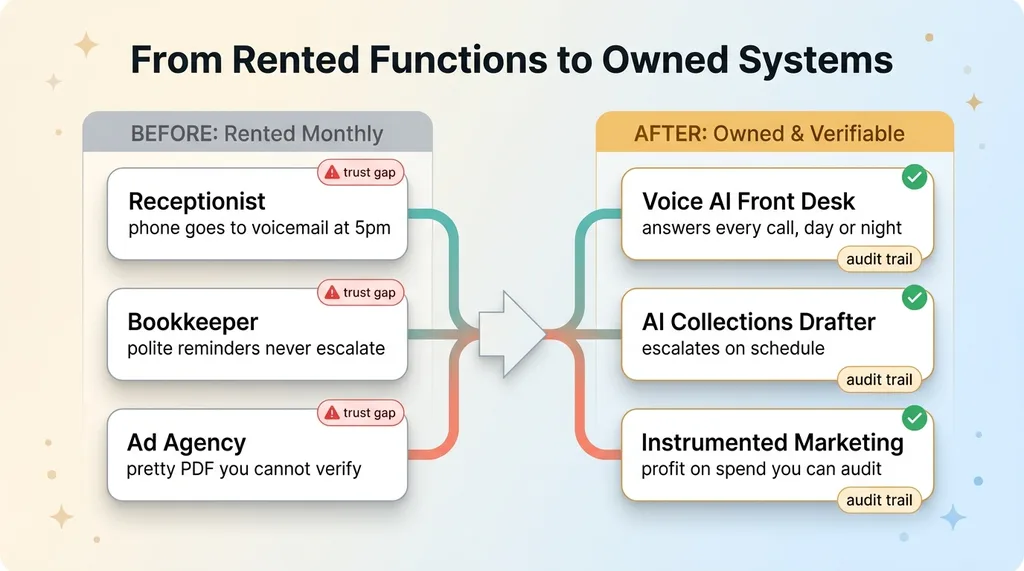 The Three Rented Functions Becoming Owned Systems
Each of those came with a fixed monthly cost. Each came with a trust problem nobody talked about.
The receptionist goes home at five and the phone rings into voicemail. The bookkeeper hates being aggressive about money, so the polite second reminder turns into a fourth polite reminder. The agency sends you a beautiful PDF full of impressions and reach, and you nod along because you have no way to check any of it.
Here is the thesis, plainly: reception, receivables, and marketing are now being absorbed by AI systems that an owner can run and verify themselves. This is the real story behind AI replacing small business staff, and it is more specific and more boring than the headlines suggest.
I am going to use three industries to show you what this looks like in practice: a salon, a contractor, and a local service business. I have built versions of all three.
If you are reading this as a skeptic, good. The honest question at this stage is simple: is this real or is it hype? So I am going to give you concrete before and after for each one, including the parts that do not work yet. No transformation talk. Just what the system does, what it costs, and where a human still has to step in.
The Front Desk: A Voice AI That Answers and Books the Slot
What the salon used to pay for
A salon I worked with had a part-time front desk person covering the busy stretches. The problem was the rest of the day. Calls came in while three stylists were heads-down with clients, and they went to voicemail. Calls came in after close and went nowhere. Then came the voicemail tag, the callback that never connected, the booking that quietly walked across the street.
Here is the math that makes this hurt. Every missed call to a salon is a potential $80 to $200 appointment. Miss a few a day and you are losing real revenue to a competitor who simply picked up.
What the AI actually does
We built an AI that answers the phone and books the job. It answers every call, day or night. It checks the live calendar, finds the open slot, books it, and confirms by text. No voicemail tag. No callback roulette.
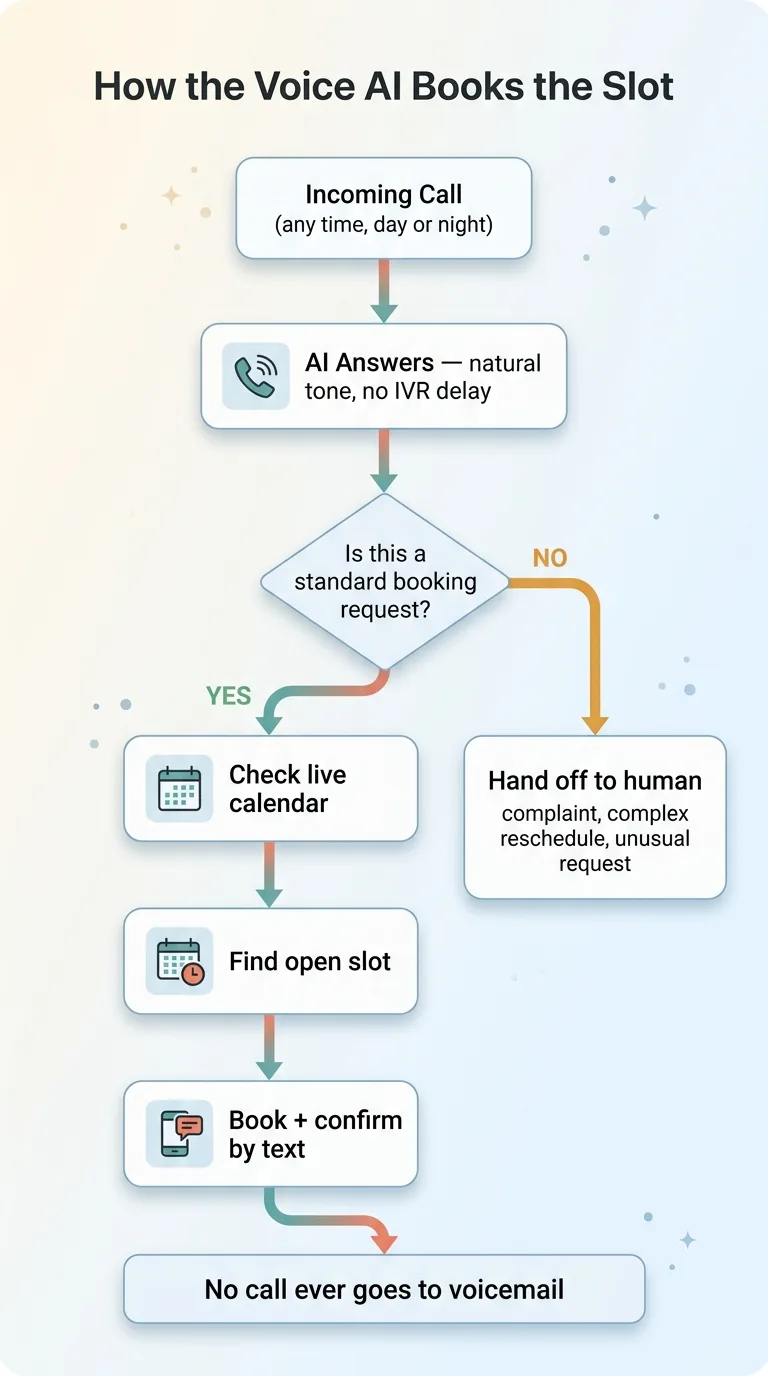 Voice AI Front Desk Call Flow
The caller does not wait on hold for the one person who knows the schedule. They just get booked.
The hard part nobody mentions
The technology to answer a call is not the hard part anymore. Making it not sound like a bot is the hard part.
The first versions were awful. They had that hollow, over-eager "Wonderful! I'd be happy to help with that!" energy that tells any human being instantly they are talking to software. We stripped all of it out. We also tuned the timing so it stops talking the moment the customer starts, instead of plowing over them like every IVR system you have ever hated.
And it has limits I will state directly. Anything outside its scope, a complicated reschedule, a complaint, an unusual request, gets handed to a human. This is augmentation of the front desk, not a magic replacement for it. The win is that no call ever goes unanswered, not that the software handles every conversation a person could.
The Collections Clerk: AI That Drafts the Escalating Email and the Legal Notice
Why owners hate chasing money
Talk to any contractor and you will find the same quiet problem: late receivables. The work is done, the invoice is out, and the money is just sitting somewhere it should not be.
The reason it lingers is human. The owner hates chasing it. The bookkeeper hates chasing it. Asking for money you are owed feels confrontational, so the reminders stay soft long past the point where soft works. Meanwhile the cash flow that keeps the business breathing gets quietly strangled.
Tone-laddered drafts plus the lien notice
For a contractor, we built an AI that escalates a collections email the way a tired tradesman actually would if he were not so busy and so conflict-averse.
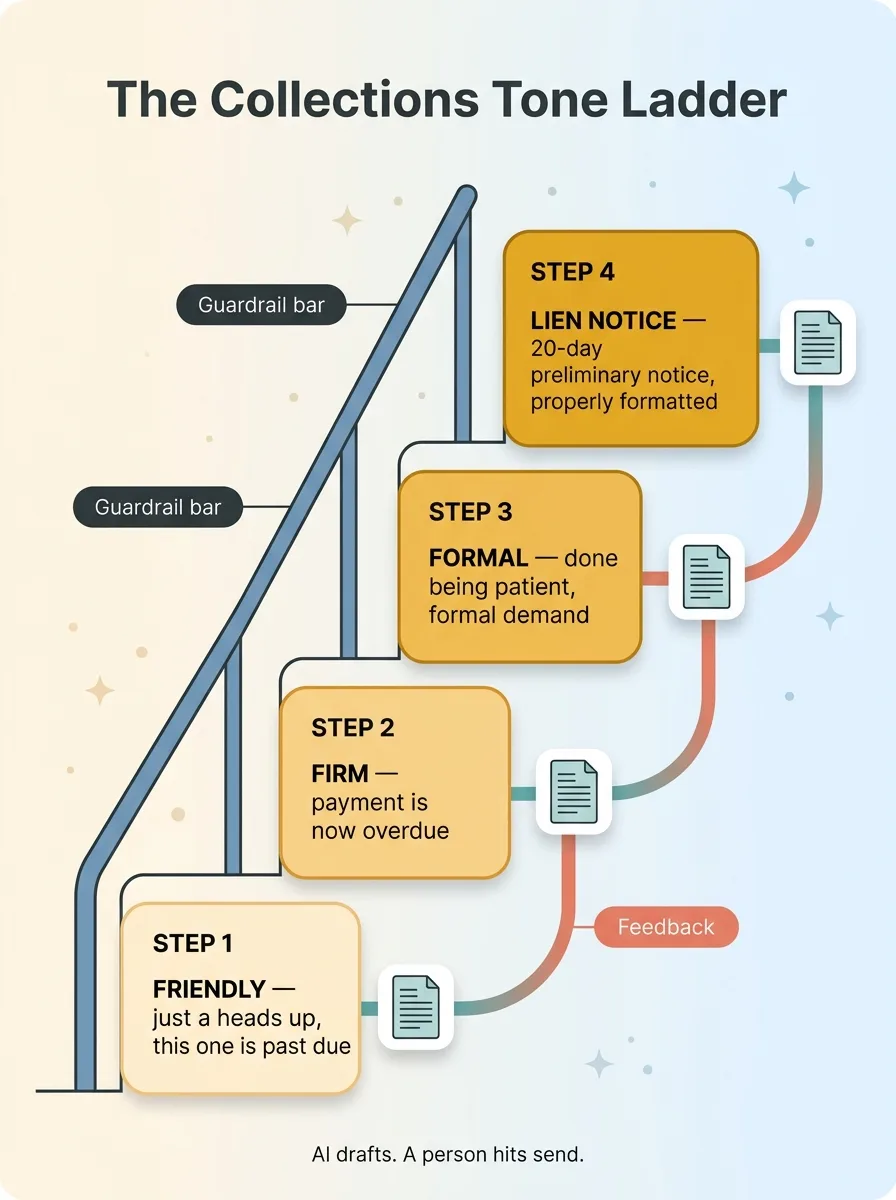 Tone-Laddered Collections Escalation
It drafts a tone-laddered sequence. The first message is friendly: hey, just a heads up, this one is past due. The next is firm. The one after that is formal, the kind of language that signals you are done being patient.
For the trades, there is a second piece that matters more than the emails. In many states the mechanics-lien process, including the 20-day preliminary notice, is the actual reason contractors get paid. So the system can generate that document too, properly formatted, with the right details pulled in. That single capability is often worth more than the entire email sequence.
Why a human still hits send
Here is the line I do not cross, and I built it that way on purpose. The AI drafts. It does not auto-send anything related to money.
Every escalation stops and waits for the owner to read it and approve it. Nothing about a lien, a formal demand, or a payment communication goes out on its own. This is human-in-the-loop by design, not a shortcoming I am apologizing for. You want a person deciding when to send a formal notice to a customer. What the AI removes is the blank-page friction and the emotional dread that kept those messages from going out at all.
The Marketing Agency: An Instrumented System That Tells You If It Worked
The agency report you can't verify
The marketing problem is different from the other two. With the front desk and collections, the pain is doing the work. With marketing, the pain is not knowing if the work mattered.
A local service business I worked with was paying an agency a few thousand a month. Every month a polished report arrived: impressions up, reach up, engagement up. And the owner had no way to tie any of that to a single dollar of revenue. The core problem was never effort. The agency was working. The problem was verification.
A 90-day experiment, not a promise
So we built a 90-day experiment instead of a marketing promise. Instead of running campaigns and reporting on vanity numbers, the system runs marketing as a measurable experiment and tells the owner, after 90 days, whether it actually paid for itself.
This is the real AI vs marketing agency question, and it is not the one people expect. The win is not cheaper ads. AI does not magically make clicks cost less. The win is accountability. You finally get to see whether the spend produced bookings or just produced a nice-looking chart.
Profit, not vanity metrics
The metric we track is profit on ad spend, not impressions. Did the campaign generate more revenue than it cost, after the cost of fulfilling the work it brought in? That is the only number that matters, and it is the one the old report conveniently never showed.
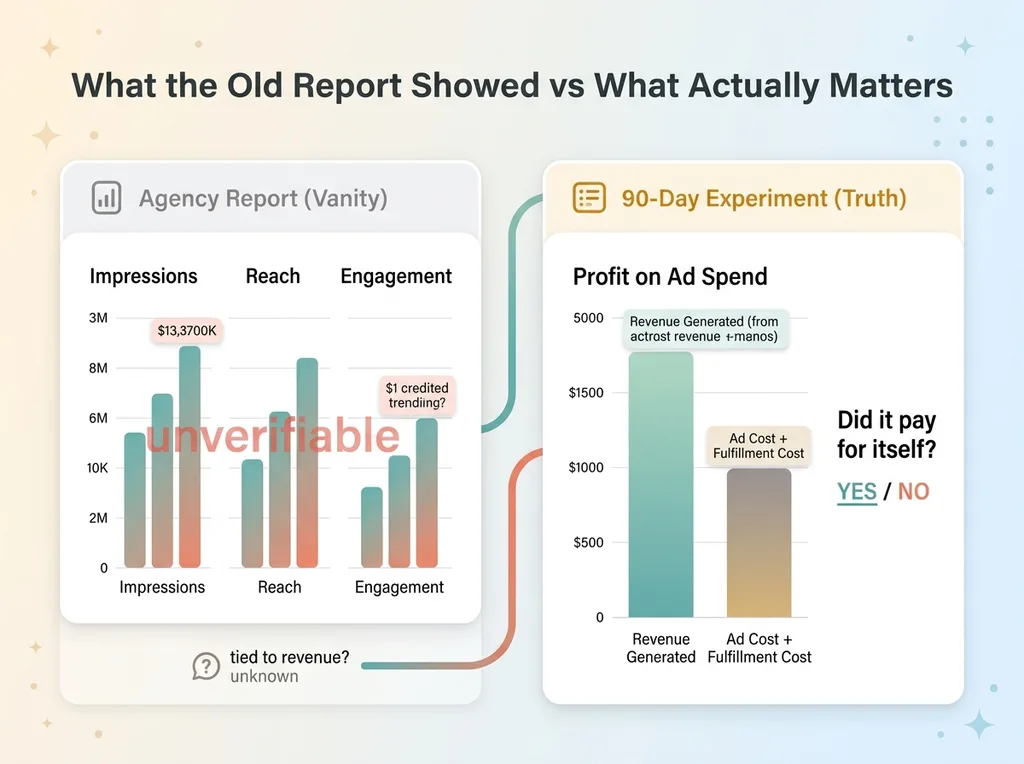 Vanity Metrics vs Profit on Ad Spend
I will be honest about the boundary here. AI can run the campaigns and measure them rigorously. What it cannot do is make the strategy call. Deciding that a $99 offer is the right hook, or which story actually resonates with your customers, is still a human judgment. The AI tells you the truth about what happened. A person still has to decide what to try.
The Fair Questions a Skeptical Owner Should Ask
If you run a business and a guy on the internet tells you AI is replacing the front desk, the bookkeeper, and the agency, you should push back. These are the three objections worth raising, and here are my honest answers.
Quality: is it good enough?
The fear is that you are getting a generic chatbot with your logo on it. Fair. The difference is that these systems are tuned, scored, and constrained for one job. The salon voice AI is not trying to be a general assistant. It books appointments and hands off everything else. The collections drafter is built around how a real tradesman escalates, not generic templates. Narrow and tuned beats broad and impressive every time in a real business.
Trust: what happens when it's wrong?
This is the one I take most seriously. The answer is that every money-moving or customer-facing action stops for a human. The lien notice does not send itself. The marketing budget does not reallocate itself. The front desk hands off the conversation it cannot handle. Nothing auto-submits in the places where being wrong is expensive. That constraint is the design, not a patch.
Accountability: who owns the outcome?
With an agency or an outsourced vendor, accountability lives somewhere you cannot audit. You get the report and you take their word for it. When you own the system, accountability lives with you. You can see the call logs, the draft history, the actual profit-on-spend numbers. That is a different relationship to your own business.
I dig deeper into this in the honest answer on which jobs AI actually replaces, but the short version is this: the shift is real, and it is not "fire everyone." It is that functions you used to rent at a fixed monthly cost are now systems you can own and verify.
What Actually Changes for a Local Business
Step back and look at all three together. Reception, receivables, and marketing used to be the same kind of thing: a recurring outsourced expense with a trust gap baked in. You paid every month and you mostly hoped.
Now they are owned systems with audit trails.
The numbers move in the directions you would expect. Missed-call rates drop toward zero because every call gets answered. Invoices get collected faster because the awkward escalation happens on schedule instead of whenever someone works up the nerve. And marketing finally has a number you can check, profit on spend, instead of a chart you have to trust.
This is how AI changes local business in practical terms. An owner of a five-person company gets the kind of operational leverage that used to require a much bigger payroll. You are not adding headcount to cover the phones at 7pm. The system does it.
But I want to be precise about what does not change, because the hype crowd will not tell you. Someone still has to decide the strategy. Someone still has to approve the edge cases, the formal notice, the new offer. Someone still has to actually care about the customer in front of them.
AI replaced the typing and the chasing. It did not replace the judgment. The owner who understood their business before still has to understand it now. They just spend their hours on the decisions instead of the busywork.
Where to Start If You Run One of These Businesses
Do not try to do all three at once. Pick the one function that is bleeding the most money or the most time right now.
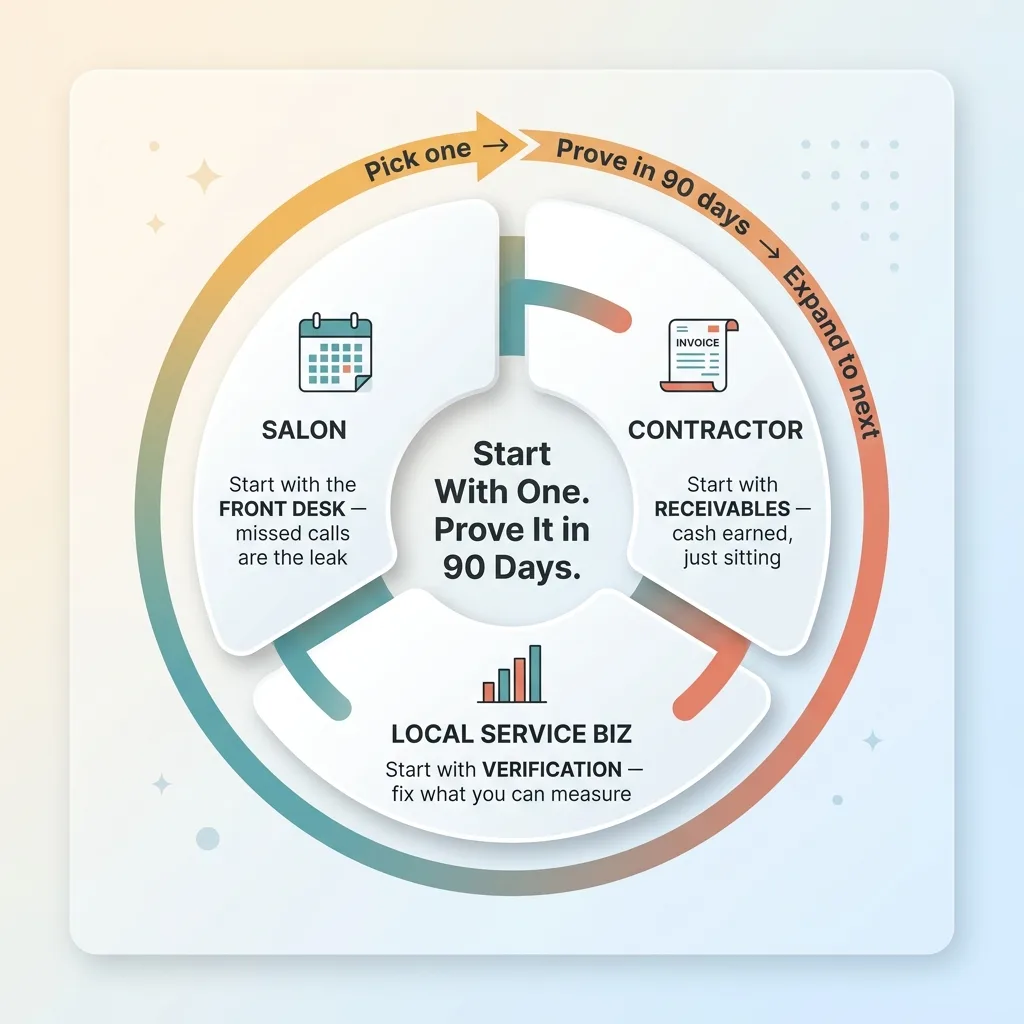 Where to Start, Pick the Biggest Leak First
For a salon, it is almost always the front desk. The missed calls are the leak. For a contractor, it is receivables, because the cash is already earned and just sitting there. For a local service business pouring money into ads, it is verification, because you cannot fix what you cannot measure.
Start with one. Prove it in 90 days. Then expand to the next one. That order matters, because a single system that demonstrably works builds the trust you need before you touch anything else.
I should be clear about what I do. I build these systems. I do not just advise on them from a slide deck. I have shipped all three of these in real businesses, and I run a stack of similar systems in my own DTC fashion brand every day.
If you want to talk through which one to build first for your specific business, that is the conversation I have with owners. No pressure, no pitch deck.
Thinking about AI for your business?
If any of this resonated, let's talk. I do free 30-minute discovery calls where we look at how your business actually runs and find the one place AI could move the needle first. No slides, just a straight conversation about your operations.
Get AI insights for business leaders
Practical AI strategy from someone who built the systems — not just studied them. No spam, no fluff.
Hodgen.AI
Ready to automate your growth?
Book a free 30-minute strategy call with Hodgen.AI.
Book a Strategy Call