Nine Industries, One Substrate
Here's the assumption I hear constantly: if you build software across nine unrelated industries, you must be running nine different tech stacks, and each one must take months to learn before you ship anything useful.
It's a reasonable guess. It's also wrong.
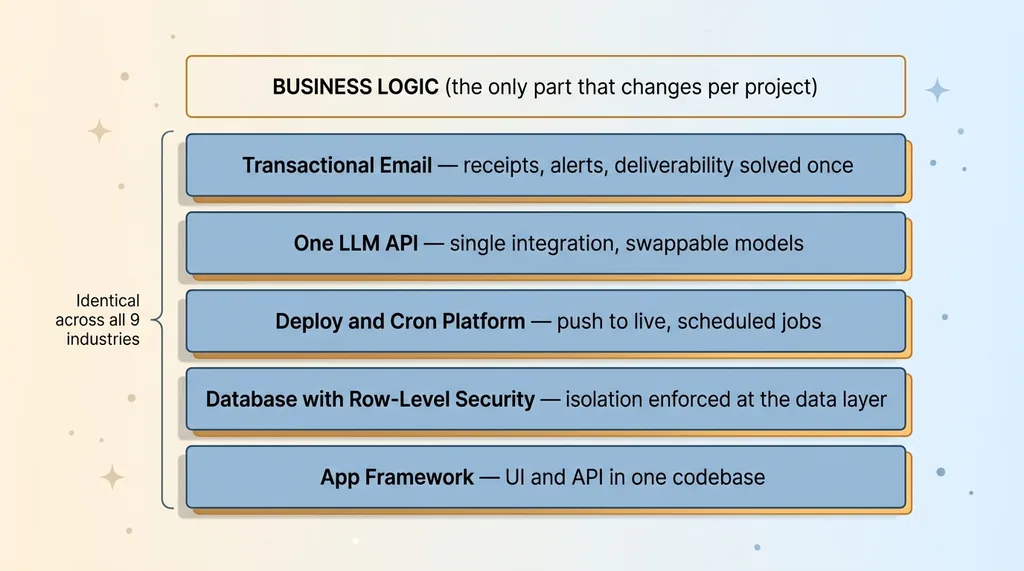
Across dozens of products I've built in completely unrelated industries (manufacturing, regulated financial services, fitness, ecommerce, compliance SaaS, health monitoring), nearly every single one rides the same five primitives. The plumbing is identical. The only thing that actually changes per project is the business logic sitting on top.
That's not a shortcut. It's the whole reason one person can move between industries in days, not months instead of staffing up a team and burning a quarter on setup.
The thesis is simple: a tight, owned, repeatable stack is what makes days-not-months possible. When the foundation never changes, all your time goes to the part that's actually hard, the domain rules. And the domain rules are where the value is anyway.
I run a DTC fashion brand handmade in San Diego, and the AI systems behind it (564 products dynamically priced, 313 blog articles managed, a product pipeline that goes concept to live in 20 minutes) all sit on this same substrate. So do the systems I've built for clients in industries that have nothing to do with fashion.
In this article I'm going to walk through the five primitives I standardize on, why I choose owned primitives over rented platforms, and why the substrate staying boring and identical is exactly what lets me ship fast without the work turning into nine fragile snowflakes.
Let's start with the five things that show up in every project.
The Five Primitives (By Category, Not Brand)
I'm going to describe these by category, not brand, because the category is the durable idea. The specific tool can be swapped. The job it does cannot.
 The Five Primitives substrate
App framework
One framework that builds the UI and the API in the same codebase. Not a frontend repo and a separate backend service held together with hope. One project, one mental model, one deploy. When the interface and the server logic live together, I'm not context-switching between two worlds or maintaining two sets of conventions. New project, same folder structure, same patterns.
Database with row-level security
One place for data, with security enforced at the row level. This matters more than it sounds. Row-level security means every client, every tenant, every user is isolated at the database itself, not in some auth middleware I have to rewrite for each project. I define the access rules once, and the database refuses to hand back rows the requester shouldn't see. That's a security model I trust because it doesn't depend on me remembering to check permissions in every endpoint.
Deploy and cron platform
Push code, it goes live. No servers to provision, no infrastructure to babysit. Just as important: I can schedule recurring jobs (nightly price recalculations, inventory syncs, report generation) without standing up a separate scheduling system. The same platform that hosts the app runs the scheduled work.
One LLM API
A single integration point for all the AI work. I use a multi-LLM architecture underneath (one model for content, another for images, custom chaining for cost), but the application talks to one consistent interface. The model is swappable. The integration pattern is not. When a better or cheaper model ships, I change the layer underneath, not the whole app.
Transactional email
One service for receipts, alerts, password resets, and notifications. Boring, necessary, solved once. Every project needs to send email reliably. I don't re-solve deliverability for each one.
Here's the part that surprises people: these five categories are identical whether I'm building a tool for a manufacturing floor, a regulated services website, or an ecommerce backend. The industry doesn't change the plumbing.
Why Primitives Beat Platforms
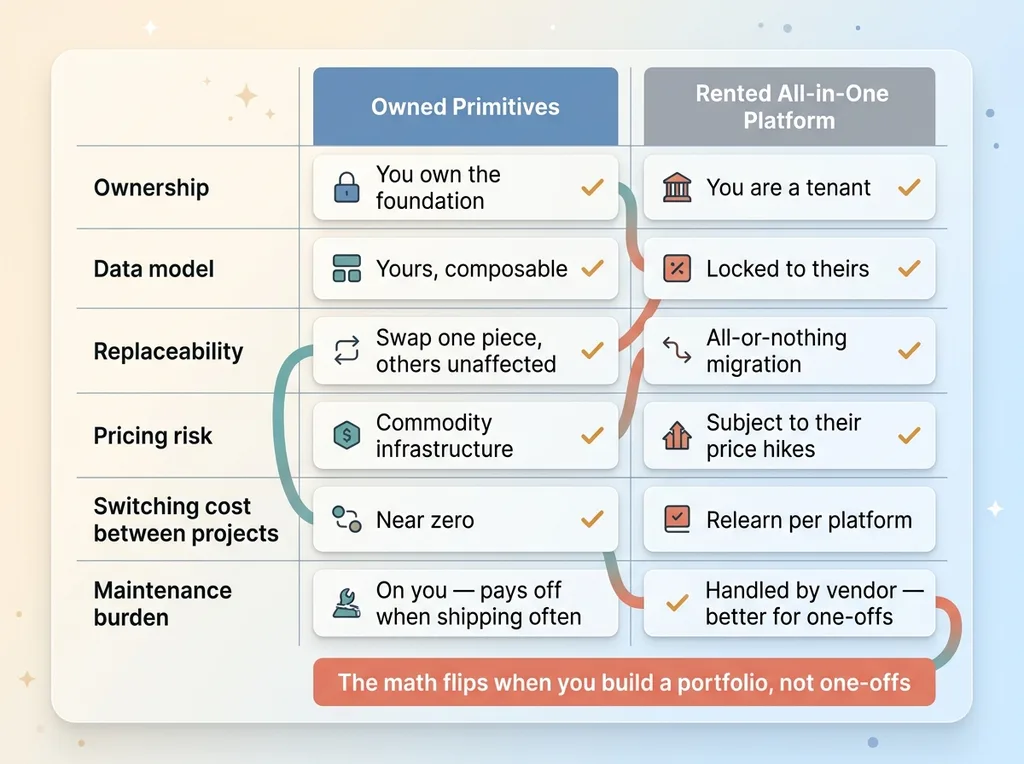
The alternative to assembling primitives is renting an all-in-one platform that promises to do everything. I've watched that road end badly enough times to avoid it.
 Primitives vs Platforms tradeoff
Platforms lock you into their data model, their pricing, and their roadmap. The day they raise prices, deprecate a feature you depend on, or decide your use case isn't a priority, you're stuck. You don't own the foundation. You're a tenant, and you discover the lease terms at the worst possible moment.
Primitives are composable and replaceable. I pay for primitives and build the logic myself. I'm paying for boring infrastructure (compute, storage, deploy, email delivery) and building the logic that's actually the differentiator on top. The infrastructure is a commodity. The logic is the product.
The concrete payoff: when the same five primitives appear in every project, the switching cost between projects is close to zero. I'm not relearning a stack. And the cost of replacing any single primitive is low too, because each one does a narrow, well-defined job. If my email provider gets expensive, I swap that one piece. The other four don't notice.
Now the honest tradeoff, because there always is one.
Owning more means maintaining more. With a platform, somebody else handles the upgrades and the edge cases. With primitives, that's on me. This only pays off when you're shipping repeatedly. If I built one app a year, a platform might genuinely be the better call. But I'm building constantly, and the substrate compounds. Every project makes the next one faster, because the foundation is already proven in production.
The math flips the moment you stop building one-offs and start building a portfolio.
The Substrate Never Changes, Only the Business Logic
This is the actual answer to the buyer's doubt: how does one person build for so many industries, fast, without it descending into chaos?
 Same substrate, different business logic across industries
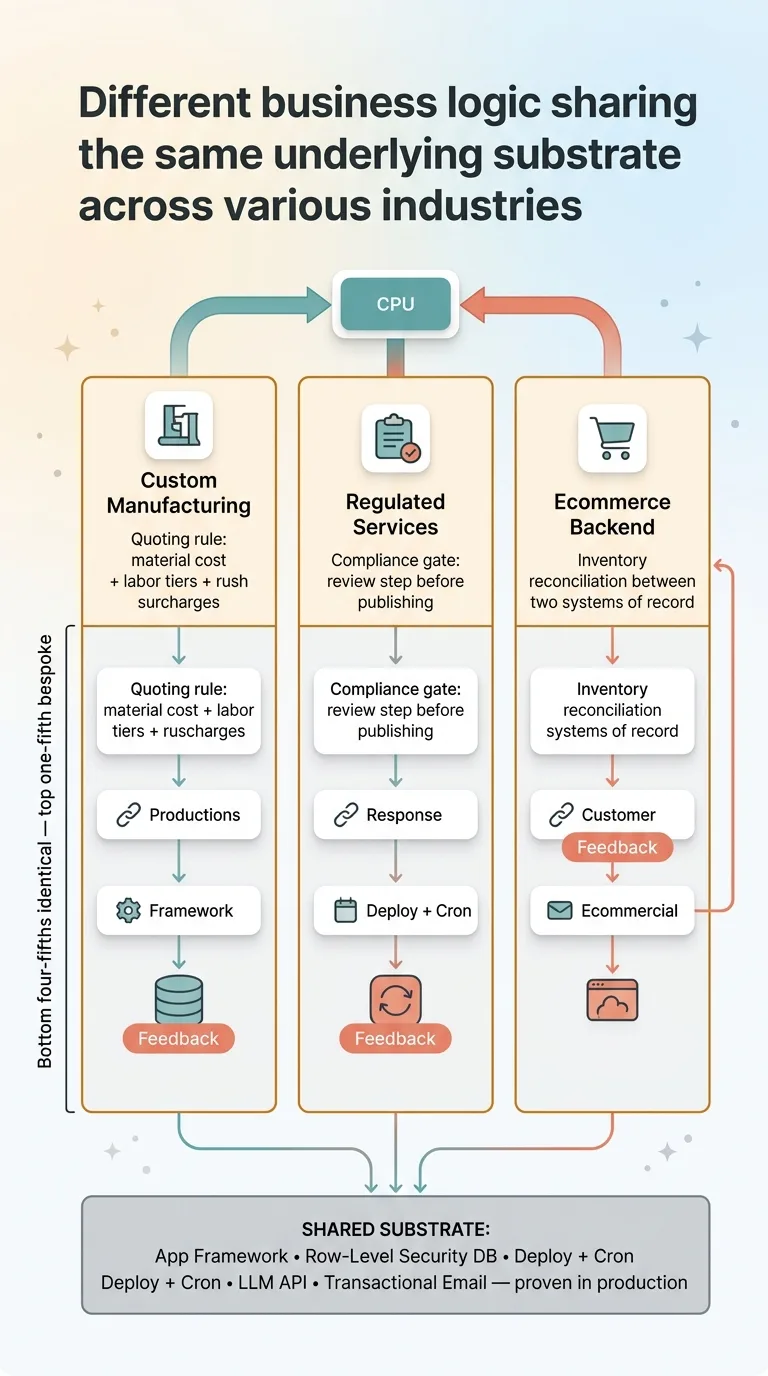
Because the bottom four-fifths of every project is identical and already solved.
Auth, data isolation, deploys, scheduled jobs, transactional email, the LLM integration pattern. All proven in production across multiple industries. When I take on a new project in an industry I've never touched, I am not learning a new stack. The stack is the one constant in my life.
What I'm learning is the domain. The business logic. The rules that are unique to that specific business and exist nowhere else.
For a custom-manufacturing client, the hard part was the quoting rule: how a quote gets calculated when material costs, labor tiers, and rush surcharges all interact. That logic is bespoke. The database storing the quotes, the API serving them, the email confirming them, all standard.
For a regulated services firm, the hard part was a compliance gate: certain content can't go live without phrasing that satisfies the regulator, so the system has to route it through a review step before publishing. The gate is unique. The publishing pipeline underneath it is the same one I use everywhere.
For an ecommerce backend, the hard part was an inventory reconciliation between two systems of record that disagreed about what was actually in stock. Resolving that disagreement is custom logic. The scheduled job that runs the reconciliation nightly is a cron task on the same platform I use for everything.
See the pattern. Each project has genuinely unique, hard business logic riding identical, boring plumbing. The time goes where it should, into the part that requires understanding your business. The part that should be commodity stays commodity.
That's the discipline. Refuse to make the foundation interesting.
What the Same Stack Does NOT Solve
I'd be selling you something if I pretended the stack solves everything. It doesn't, and being clear about the limits is how I keep my own work honest.
 What the stack does NOT solve, human-in-the-loop and limits
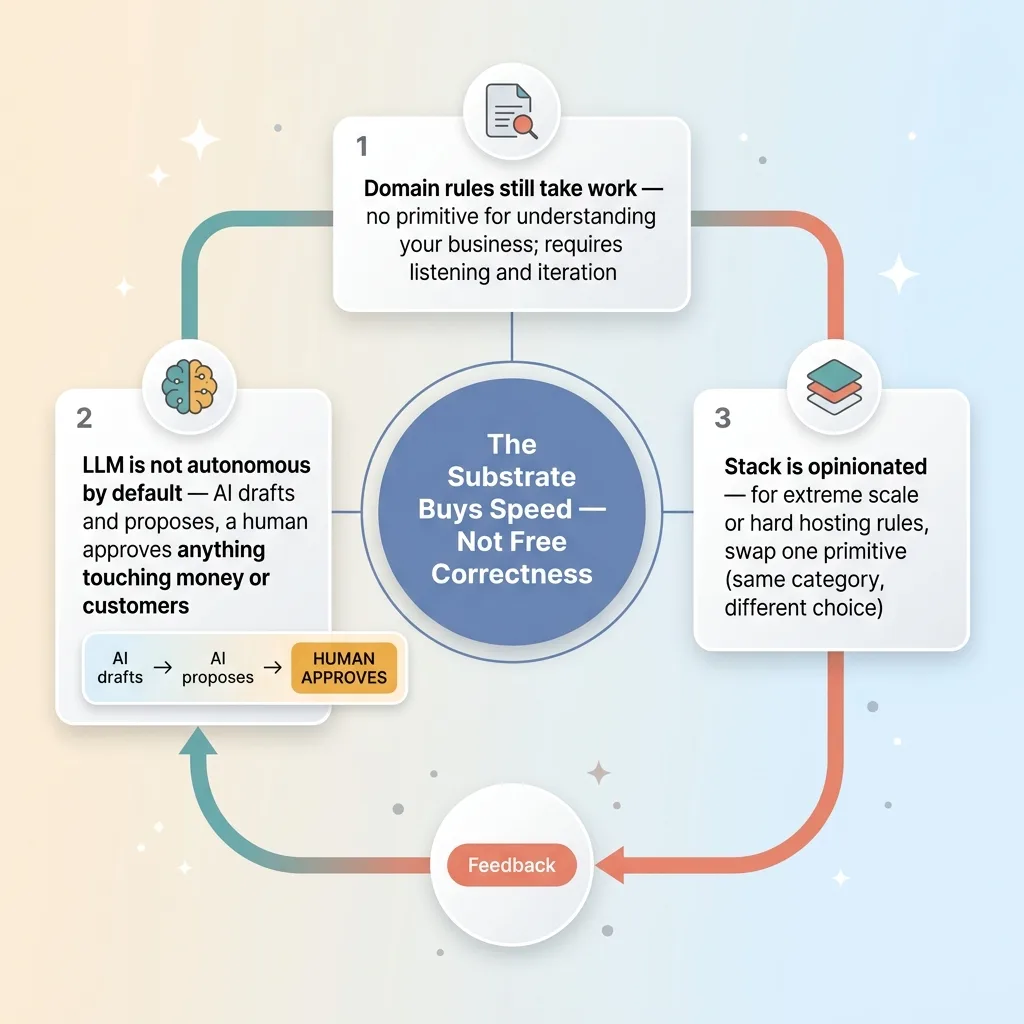
The stack gives you speed on the substrate. It does not give you free correctness on the logic.
The domain rules still have to be right, and getting them right takes listening and iteration. A repeatable foundation means I'm not spending three weeks on auth, so I can spend those three weeks getting your quoting logic or your compliance rules actually correct. But the rules themselves are work. There's no primitive for "understands your business." That comes from conversation and getting things wrong a few times before they're right.
The LLM primitive also doesn't make decisions autonomously by default. I build so that every money-moving or customer-facing action stops for a human. The AI drafts, suggests, prepares, and proposes. A person approves anything that touches money or customers. That's a deliberate design choice, not a limitation I'm apologizing for. Autonomous-by-default is how you get expensive mistakes at scale.
And the stack is opinionated. Most of the time that's a feature. Occasionally a project genuinely needs something the substrate can't do well: extreme scale beyond what the default database handles, or a hard regulatory requirement that data live in a specific hosting environment. When that happens, I swap that one primitive instead of fighting the whole stack. The category stays the same (still a database, still a deploy target), the specific choice changes.
The point of the substrate isn't that it does everything. It's that it buys back the time you'd otherwise waste on solved problems, so you can spend it on the things that actually need judgment.
What This Buys You: Days Instead of Quarters
Let me connect this to outcomes you actually care about.
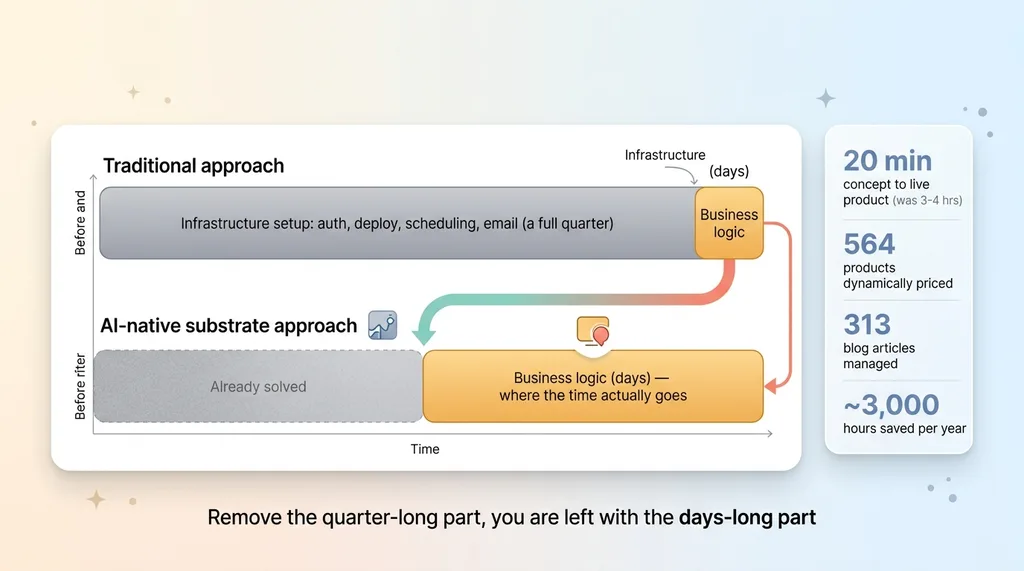 Days instead of quarters time breakdown
Because the substrate is pre-solved and repeatable, a new product can go from conversation to live in days. Not a quarter of discovery and setup. Days.
In my own brand, the product creation pipeline takes a concept to a live, priced, described product in 20 minutes. That used to take three to four hours of manual work. That pipeline runs on the exact five primitives I described above. Nothing exotic. The speed comes from the foundation being done before I start.
If you want to see what this pace actually produces over time, I wrote about what a quarter of this actually produces. The short version: 313 blog articles managed with AI-assisted SEO, 564 products under dynamic pricing, 29 automation modes in production, and roughly 3,000 hours saved a year. One operator covering what used to take a team of specialists.
I want to be precise about why that's possible, because it's easy to mistake for recklessness. It's the opposite of reckless. The speed comes from the boring discipline of never reinventing the foundation. I'm fast on new work specifically because I refuse to be creative about infrastructure. Creativity goes into the business logic, where it belongs.
This is also why the work stays maintainable across industries. If every project had its own bespoke stack, I'd be maintaining nine fragile snowflakes, each with its own quirks and failure modes. Instead I maintain one substrate and nine sets of business logic. When the foundation improves, every project improves. That's the difference between building a system and accumulating technical debt.
Days instead of quarters isn't a marketing claim. It's arithmetic. Remove the part that takes a quarter and you're left with the part that takes days.
Your Differentiator Is the Logic, Not the Plumbing
If you're evaluating AI work for your business, I want to reframe the question you should be asking.
The question isn't "what's your tech stack." Honestly, you shouldn't care much. The stack is commodity, and anyone serious has settled on something reasonable.
The right question is "how fast can you get to my actual business logic." How quickly can we stop talking about infrastructure and start talking about the rules and decisions that are unique to your business, the things only you and your team actually know?
A repeatable AI-native substrate is what makes that possible. It means the time we spend together goes to the part that's irreplaceable, your quoting rules, your compliance constraints, your reconciliation logic, your pricing strategy, instead of weeks spent standing up auth and deploy pipelines that should have been commodity from the start.
You bring the hard, domain-specific problem. The plumbing is already handled. That's the whole arrangement, and it's why one person can deliver across industries that look nothing alike.
Get the next build note.
I write up each system I build, including what broke. Subscribe to my newsletter and I'll send you the next one.