AI for an Ecommerce Brand: What It Actually Takes
I run AI for a real DTC apparel brand. Here is the unglamorous plumbing that works: product feeds, profit-driven ads, SEO defense, and support on a leash.
By Mike Hodgen
Most AI Advice for Ecommerce Is Written by People Who Don't Run a Store
I run a DTC fashion brand. Handmade goods, designed and shipped out of San Diego, with a catalog of 564+ products and a real P&L that I have to defend every month. So when I read most AI advice for an ecommerce brand, I notice something fast: it's written by people who have never had a payment processor freeze on a Friday, or watched a feed integration silently drop 90% of their catalog.
The hype version goes like this: AI will transform your store, write your copy, predict your sales, automate everything. It sounds great in a slide deck.
Here's what running AI in production actually feels like. It's plumbing. High-stakes, unglamorous plumbing where a single wrong number cascades into thousands of dollars of bad decisions. The wins don't come from a clever prompt. They come from honest instrumentation and, just as often, from knowing when NOT to let the AI act.
Yes, the numbers are real. After deploying AI across the brand, revenue per employee went up 38%, manual operations time dropped 42%, and I save somewhere north of 3,000 hours a year. Those are true.
But nobody buys a system because of a number on a chart. They buy it because it survives contact with reality.
So let me show you the boring stuff that produced those numbers. The data pipelines, the guardrails, the watchdogs that email me at 3am when something breaks silently. That's where the value actually lives, and it's the opposite of what most people sell you.
The Product Feed: Where I Beat the Native Channel
Start with the dullest possible system: the product feed.
 Custom Product Feed Pipeline vs Native Integration
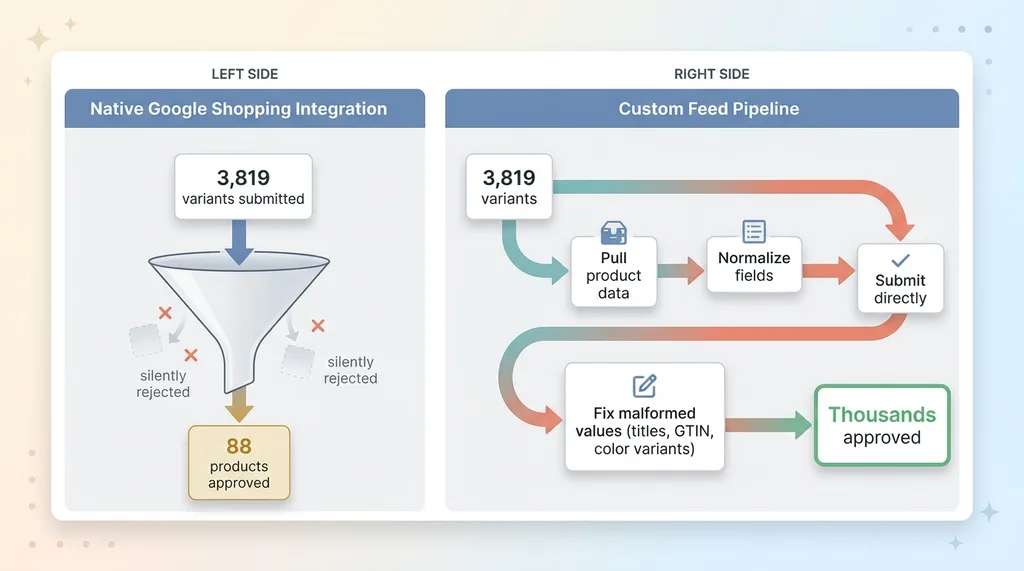
My platform has a native Google Shopping integration. In theory, you flip it on and your catalog flows to Google. In practice, it approved 88 products. Out of 3,819 variants I was trying to push, it got 88 of them live.
That's not a marketing problem. That's a revenue leak the size of a crater. Every product Google won't show is a product nobody can buy from search.
So I built my own feed pipeline. A custom system that pulls product data, normalizes it, fixes the field-level issues that were silently rejecting items, and submits directly. The result: thousands of products approved instead of dozens. The native integration was quietly throwing away most of my catalog, and no dashboard told me that. I had to go find it.
This is the part nobody writes about. An AI product feed isn't glamorous generative AI. It's data hygiene at scale. Mapping attributes, catching malformed values, handling the edge cases where a product title is too long or a GTIN is missing or a color variant confuses the matching logic.
With 564+ products and far more variants, doing this by hand is impossible. Doing it once and forgetting it is worse, because product data drifts. Prices change, inventory shifts, descriptions get edited. The feed has to stay correct every single day.
Here's the lesson for anyone evaluating AI for an ecommerce brand: the money doesn't leak where you're looking. It leaks in the plumbing. The flashy stuff gets the attention, but the feed, the integration, the data layer, that's where revenue quietly disappears. Fix that first, and you've already beaten most stores that spent their budget on a chatbot.
Profit-Driven Ads With Hard Guardrails
Once products are actually live, you have to advertise them. I let AI manage budget allocation across Meta and Google. But not the way most people would.
Why ROAS Lies
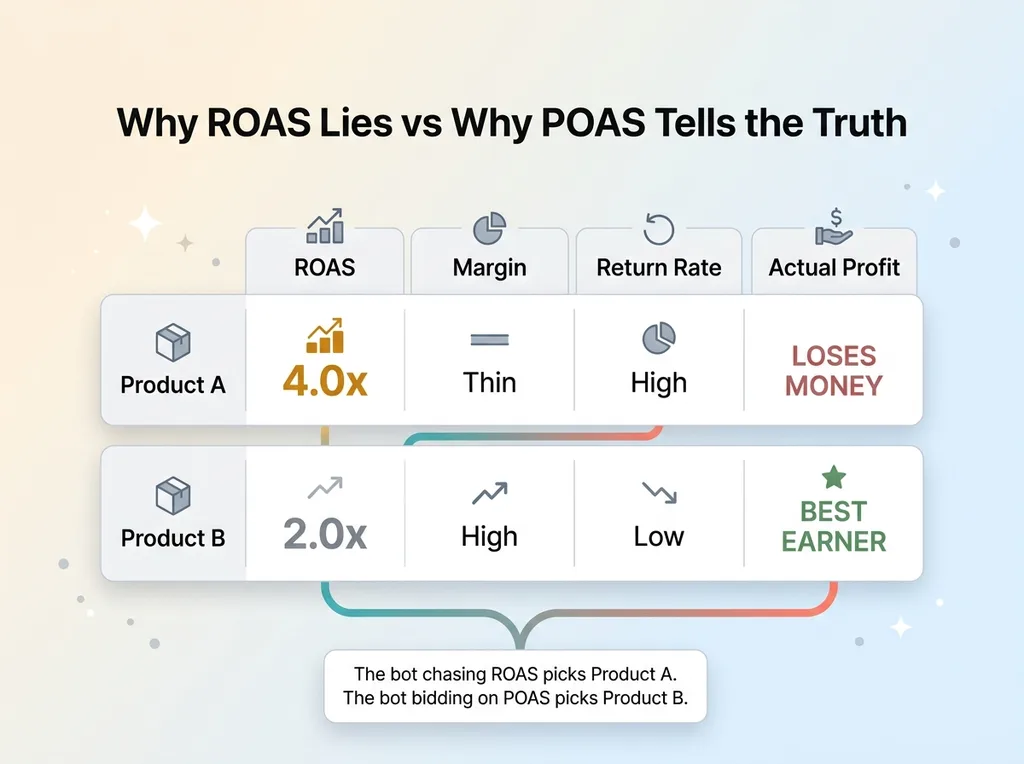
Everyone optimizes for ROAS, return on ad spend. The problem is ROAS is a vanity number. A product with a 4x ROAS can lose money if its margin is thin and its return rate is high. A product with a 2x ROAS can be your best earner if it's high-margin and rarely refunded.
 ROAS vs POAS Decision Logic
I was letting the ad bot chase ROAS, and it kept making decisions that looked good on the surface and quietly hurt the bottom line. So I switched my ad bot from ROAS to profit, bidding on POAS, profit on ad spend.
The change was immediate. The system started favoring products that actually made money, not products that just generated revenue. ROAS was lying to the bot, and the bot believed it.
The First Guardrail: Never Touch Brand Search
Here's where most people get AI ads wrong. They hand the algorithm the credit card and walk away.
 Bounded AI Authority and Guardrails
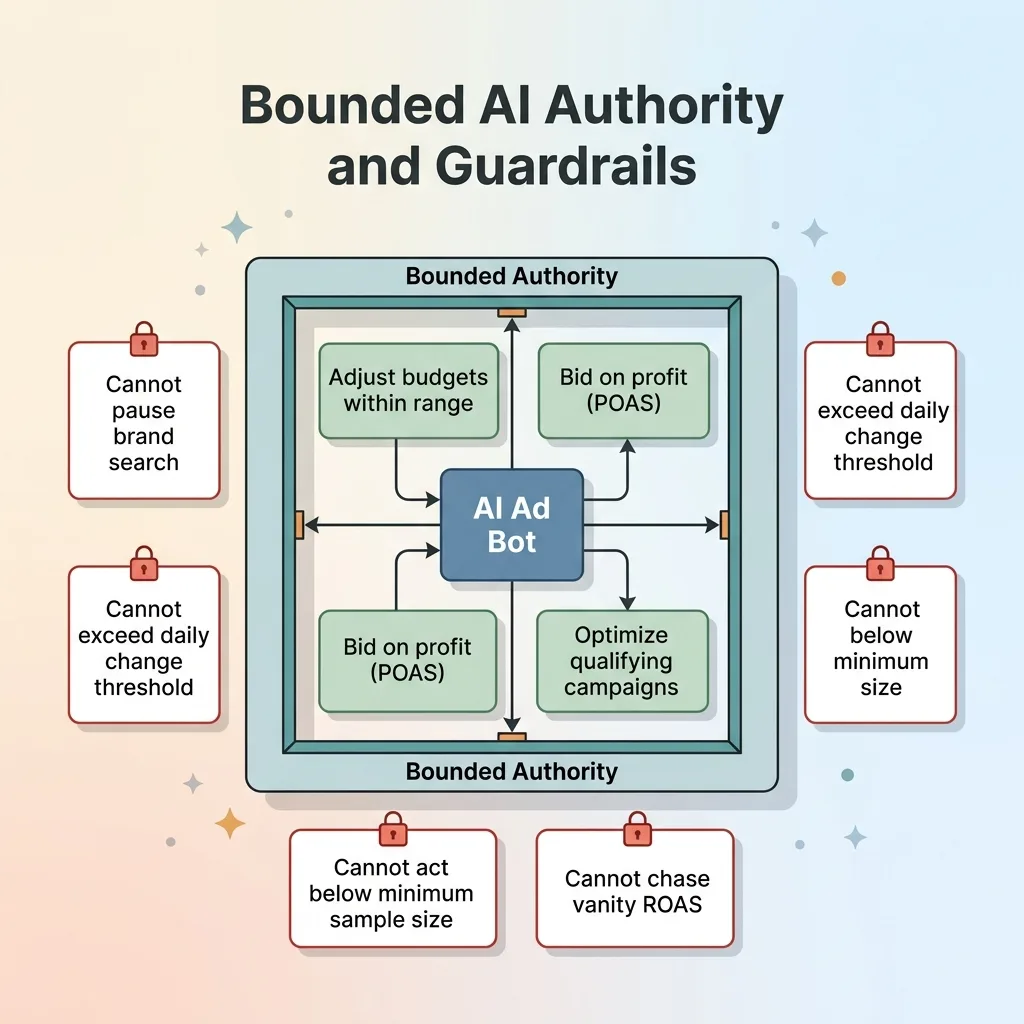
The first rule I built into the system was: never touch brand search. People searching my brand name are already mine. They convert at a high rate and cost almost nothing. If you let an optimization bot loose on that campaign, it sees a tempting target and starts "improving" it, when the correct move is to leave it completely alone.
So I built hard limits. The AI can adjust budgets within bounded ranges. It cannot pause brand campaigns. It cannot exceed a daily change threshold. It cannot make decisions on data below a minimum sample size.
That's the real model for profit driven ads: you give AI bounded authority and you watch it. Not full autonomy. Not a human babysitting every click either. A defined sandbox with walls it cannot climb, and a profit signal it can't fake.
A Daily Negative-SEO Defense That Runs While I Sleep
Here's something the AI-transformation crowd never mentions: at a real brand, you're not just optimizing. You're under attack.
Someone bought roughly 80 spam domains aimed at tanking my rankings. A negative SEO attack, a private blog network pointing toxic links at my site to drag down its authority and bury me in search.
If you've spent years building organic traffic, this is the nightmare scenario. And it's not a one-time event. It's an ongoing campaign that someone is actively running against you.
So I built an AI system that monitors for negative SEO every single day. It watches the backlink profile, flags suspicious new domains, and helps me fight back before the damage compounds. It runs while I sleep.
This matters because of how much I have riding on organic. I manage 313 blog articles with an AI-assisted SEO process, and that content is a real revenue channel, not a side project. An attack that tanks my rankings tanks actual sales.
The point for any operator: ecommerce SEO isn't only about climbing. It's about defending the position you've earned against attacks and algorithm shifts you didn't ask for. Before AI, this kind of defense was a fire drill. Something breaks, you scramble, you lose ground while you figure out what happened.
Now it's a standing daily process. The system catches the attack early, surfaces it to me with context, and I make the call. That's the difference AI makes here. Not magic, just relentless, automated vigilance on a threat that never sleeps either.
The Boring High-Stakes Stuff: Loyalty Ledgers and Conversion Watchdogs
The highest-value AI work I've done isn't generative at all. It's instrumentation. Making sure the numbers are true.
When the Numbers Are Wrong, Everything Downstream Is Wrong
Take the loyalty program. A points ledger is a financial system. Customers earn points, redeem them for discounts, and every transaction has to balance. If it's wrong, you're either giving away margin or cheating loyal customers, both of which are bad.
I found bugs. One let customers farm points they shouldn't have earned. Another silently blocked redemptions entirely, so people accrued points they could never use. Either bug, left running, quietly erodes trust and money.
The reason this matters: when the numbers are wrong, everything downstream is wrong. Every report, every decision, every optimization built on top of bad data inherits the error. You can have the smartest AI in the world making decisions on numbers that lie, and it will confidently make you poorer.
Silence Is Not Success
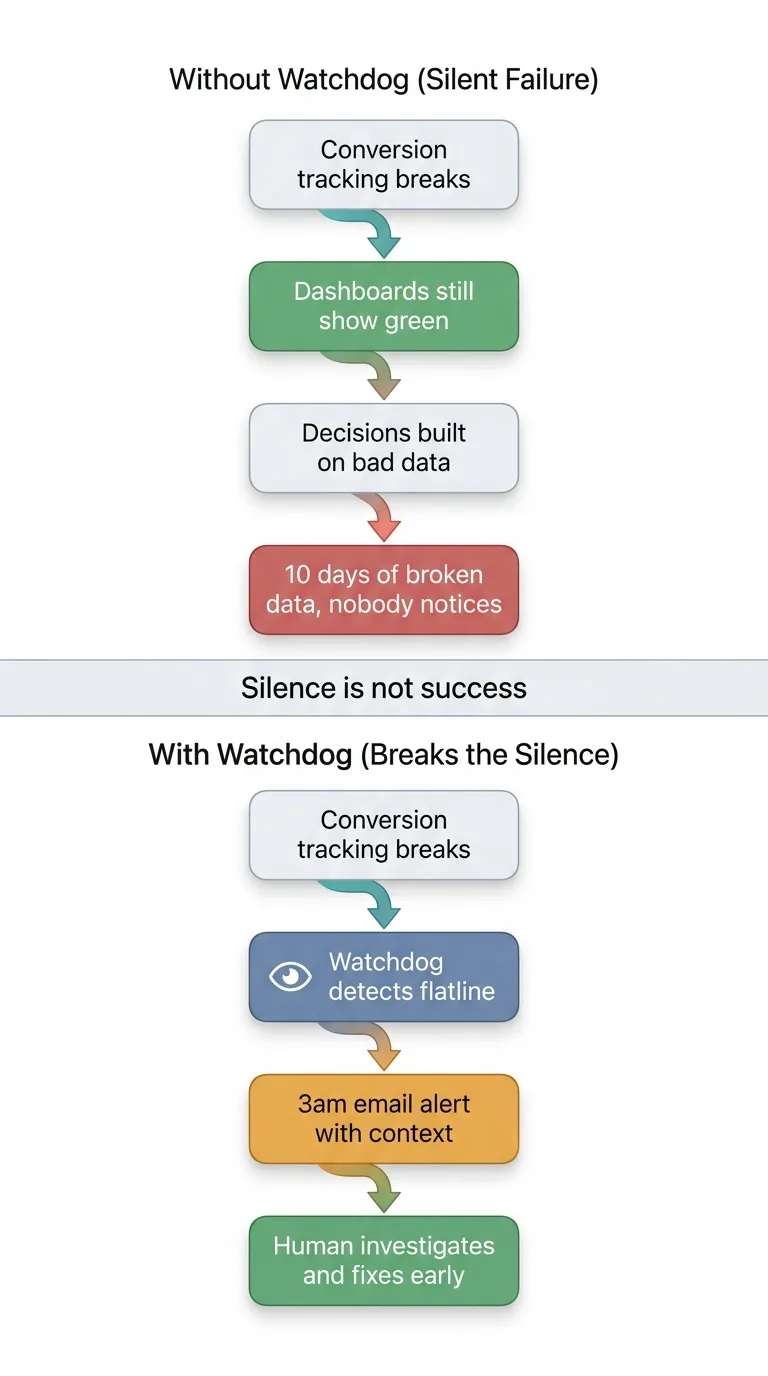
The worst failures are the silent ones. I once removed an app from my store, and that quietly killed conversion tracking for 10 days. Ten days where every dashboard looked fine, every report rendered, and the underlying data was completely broken. Nobody noticed because nothing screamed.
 Honest Instrumentation and Silent Failure Watchdogs
I've written about a dashboard that showed zeros for two weeks for the same family of reason: a pipeline broke, and the failure mode was silence, not an error.
This is the core argument I'd make to any operator. AI that lies about success is worse than no AI. A green dashboard that's wrong is more dangerous than no dashboard, because it makes you confident in a falsehood.
So the most valuable systems I build aren't the ones that act. They're the ones that watch. Watchdogs that email me the moment conversion tracking flatlines, the moment the ledger stops balancing, the moment a feed submission rate drops. Silence is not success. Build the thing that breaks the silence.
The Support Agent on a Leash
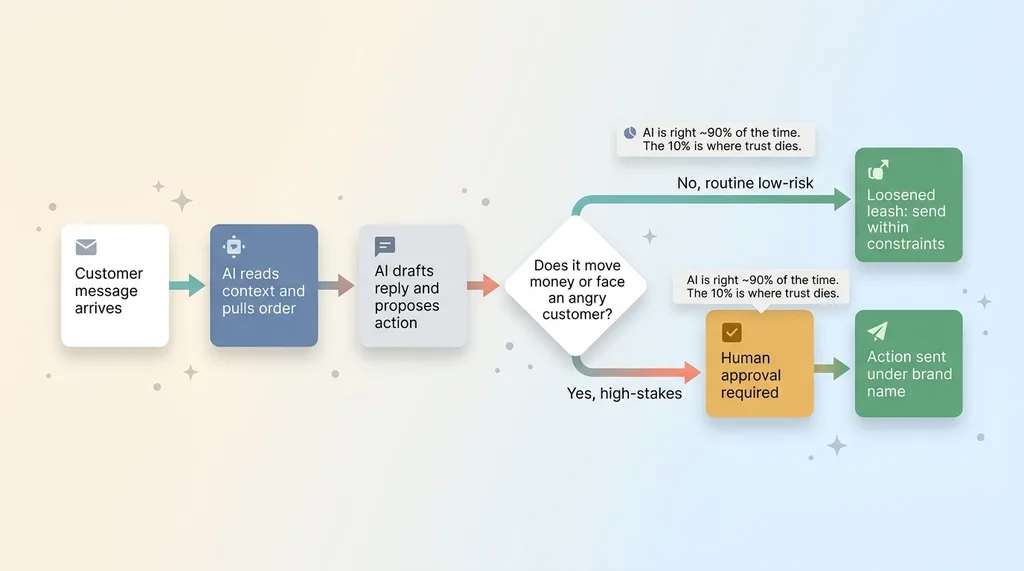
I run AI customer support that handles returns, exchanges, and refund requests. It reads the message, understands the context, pulls the order, and drafts a response. It saves enormous time.
 Human-in-the-Loop Support Agent Leash
And it does not send on its own.
I built a support bot I still won't let send on its own on purpose. The design is human-in-the-loop where it counts. The AI drafts the reply and proposes the action, whether that's approving a return or issuing a refund. But anything that moves money or goes out under my brand's name hits a checkpoint.
Here's the honest reason. The AI is good, maybe 90% of the time. But the 10% includes cases where it confidently does the wrong thing: refunds something it shouldn't, misreads a policy edge case, or sends a tone-deaf reply to an already-angry customer. In support, that 10% is exactly where the relationship lives or dies.
So I keep it on a leash. AI proposes, a human approves, or the action sits inside constraints tight enough that the worst case is survivable. For routine, low-risk replies I loosen the leash. For anything touching money or a frustrated customer, I tighten it.
Let me be honest about what doesn't work yet. I can't fully trust autonomous customer-facing sends. The model handles the easy cases beautifully and still needs me on the hard ones. Anyone who tells you their support AI runs fully autonomous with zero supervision is either lying or about to have a very bad week.
The leash isn't a limitation I'm embarrassed about. It's the design.
What This Means If You're Running an Actual Store
Step back and the pattern is clear. AI for an ecommerce brand isn't about generative gimmicks. It's about putting AI in charge of the unglamorous, high-stakes plumbing, and knowing exactly where to pull the plug.
The product feed beat the native channel because of data hygiene, not creativity. The ad system makes money because it bids on profit and can't touch brand search. The SEO defense runs daily because attacks are constant. The instrumentation matters because wrong numbers poison every decision downstream. The support agent stays on a leash because the worst 10% is where trust dies.
Three principles run through all of it. Honest instrumentation, so you always know what's actually true. Bounded authority, so AI acts inside walls it can't climb. Human checkpoints on anything that moves money or faces a customer.
The difference between my brand and theoretical advice is simple. I've shipped these systems. I've watched them fail in ways I didn't predict. And I've fixed them, usually at 11pm, usually because a watchdog I built woke me up.
That's the work. Not a slide deck about transformation. Actual dtc brand ai systems running in production, instrumented honestly, with someone accountable for what happens when they break.
If you run a real store and you want this kind of ecommerce automation built and watched properly, that's exactly what I do. See what this looks like for your store.
Ready to bring AI leadership into your company?
I work with a small number of companies at a time. If you're serious about AI, apply to work together and I'll review your application personally.
Get AI insights for business leaders
Practical AI strategy from someone who built the systems — not just studied them. No spam, no fluff.
Hodgen.AI
Ready to automate your growth?
Book a free 30-minute strategy call with Hodgen.AI.
Book a Strategy Call