The Question Every Loyalty Program Dodges
I ran a loyalty program on my DTC fashion brand for months without knowing if it made me a single dollar.
Members were earning points. Rewards were going out. The dashboard showed loyalty members spending more than non-members, and everyone nodded along like that settled it. But I had a nagging question I couldn't answer: am I actually making money here, or am I just handing margin to people who would have bought from me anyway?
That question is the entire point of loyalty program A/B testing, and most brands never ask it.
Here's the trap. Your loyalty platform shows you gross revenue from members. It tells you "members spend 2x more" with a straight face. That number feels like proof. It isn't. It's a vanity number that measures who your loyal customers already are, not what your program did to them.
The only number that matters is incremental revenue: the dollars that exist because the program exists. Strip those out and you're left with discounts you gave to people who needed no convincing.
I've seen brands point to a glowing loyalty dashboard while quietly bleeding margin. The program looked profitable. It was net-negative once you subtracted the rewards handed to repeat buyers who'd have purchased at full price.
I refuse to trust any system until I can measure it. That goes for my pricing engine, my content pipeline, and yes, my loyalty program. So I built a way to actually answer the question instead of guessing. The rest of this article is how that works, and why "members spend more" should make you suspicious, not satisfied.
Why "Members Spend More" Is a Trap
Selection bias hides the truth
Think about who joins your loyalty program. It's your best customers. The people who already love you, already buy from you, already plan to come back.
So when the dashboard says members spend 2x more, of course they do. They were your high spenders before they ever clicked "join." The program didn't create that behavior. It just labeled it.
This is selection bias, and it poisons nearly every loyalty stat I've ever seen. The correlation between membership and spending is real. The causation is imaginary. You're measuring who joined, not what the program changed.
Incrementality is the only metric that pays rent
Incrementality is the revenue that exists only because the program exists. Nothing else counts. Measuring loyalty incrementality means isolating the lift caused by the program from the spending that would have happened regardless.
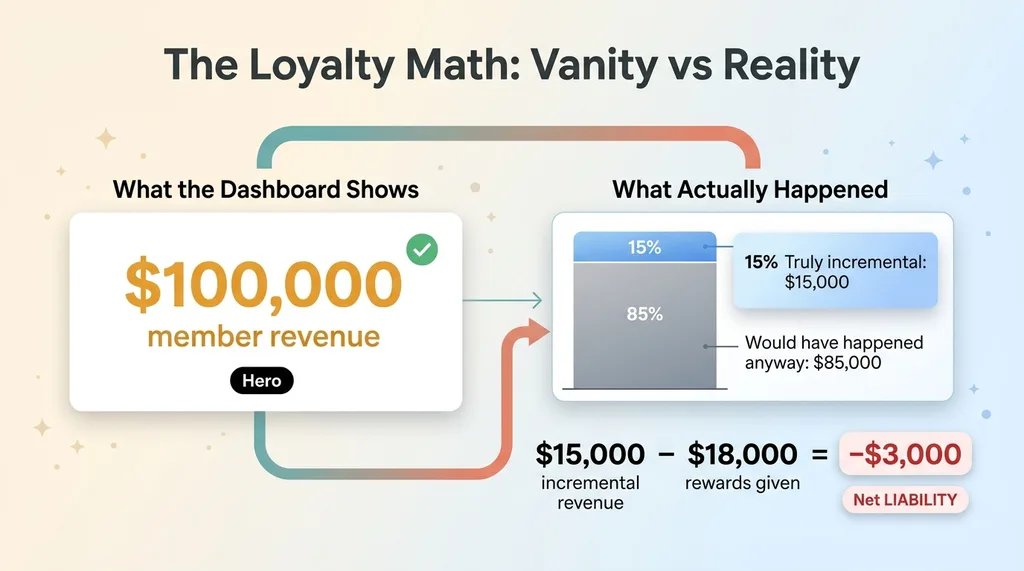 The vanity number vs incrementality math
Here's a worked example using my brand's framing. Say members generate $100,000 in revenue over a quarter. The dashboard celebrates. But suppose 85% of that revenue would have happened anyway, because those buyers were already loyal. The program only caused $15,000 of genuinely new spending.
Now subtract the rewards. If you gave away $18,000 in points and discounts to earn that $15,000 in incremental revenue, your program is net-negative by $3,000. The dashboard says hero. The math says liability.
That gap is exactly why I don't trust a number until I can prove what caused it. I measure the ROI of anything I build before I let it run unsupervised, and a loyalty program is no exception. A program you can't measure is just a faith-based line item on your P&L.
The Cohort A/B System I Built
Splitting visitors into treatment and control
The only honest way to measure incrementality is a controlled experiment. So I split incoming visitors into two cohorts.
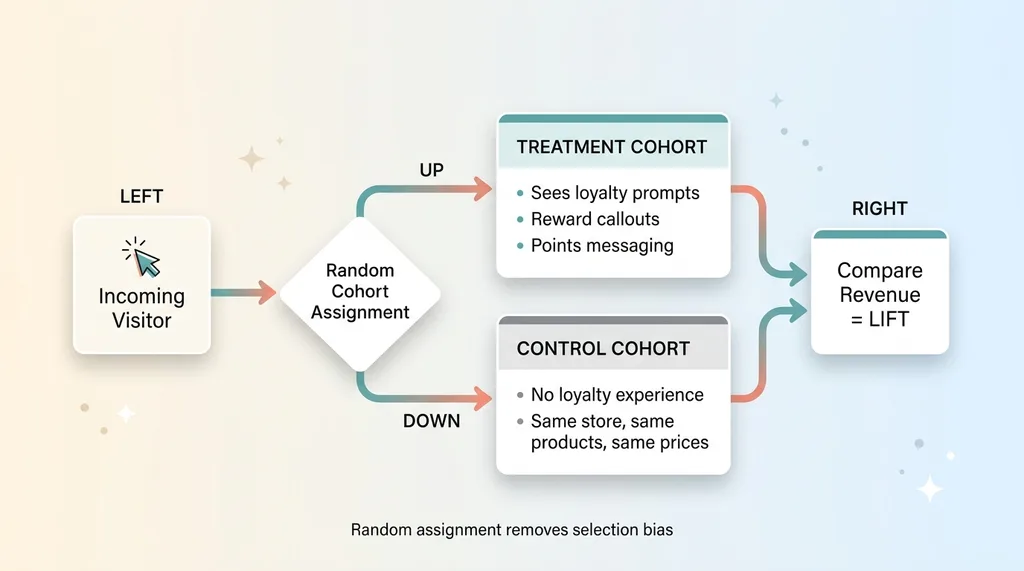 Cohort A/B split between treatment and control
The treatment cohort sees the full loyalty experience: program prompts, reward callouts, points messaging. The control cohort sees none of it. Same store, same products, same prices. The only difference is whether the loyalty program exists for that visitor.
Now you have a clean comparison. If treatment revenue beats control revenue, the gap is your incrementality. That's the whole game. No selection bias, because the buckets were assigned randomly, not self-selected by your best customers.
Assigning a cohort tag that travels with the order
The hard part isn't the split. It's making the assignment survive the entire customer journey.
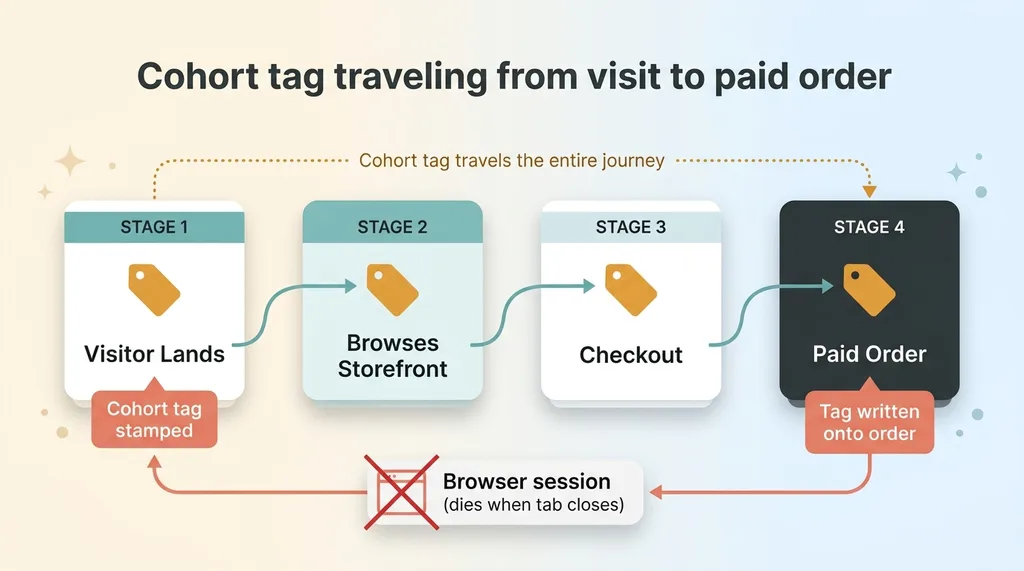 Cohort tag traveling from visit to paid order
When a visitor lands, they get bucketed and stamped with a cohort tag. That tag can't just live in a browser session, because sessions die. Tabs close, devices switch, days pass before someone buys. If the cohort label evaporates before checkout, your experiment is worthless.
So the tag travels. It rides with the user through the storefront, into checkout, and gets written onto the order itself. That's the key design decision behind reliable cohort attribution: the cohort label has to be physically attached to the order, not inferred later from fuzzy session data.
When the order is paid, I can read its cohort tag and know with certainty which bucket that revenue belongs to. Treatment or control. No guessing.
One hard constraint shaped all of this: it had to be measurable without slowing the storefront down at all. A measurement system that hurts conversion is measuring a store you broke. More on that next.
Tracking Without Slowing the Store Down
Why sendBeacon instead of a normal fetch
There's a cruel irony in experiment tracking. The act of measuring conversion can tank conversion.
A normal synchronous tracking call makes the browser wait. It fires a request, blocks, and holds up rendering or checkout until the server answers. Add 200 milliseconds here and there and you've measurably hurt the exact metric you're trying to study. Your measurement system poisons its own data.
So I don't use blocking fetches for tracking. I use sendBeacon. The browser hands off the data to the OS and moves on instantly. The page never waits. Checkout never stalls. The event gets delivered in the background whether or not the page is still open.
The hard requirement was zero storefront performance cost. sendBeacon is how I hit it.
Firing impression and purchase events
Two events matter. An impression event fires when a cohort member actually sees the experience, so I know the treatment group was genuinely exposed. A purchase event fires at checkout to mark the transaction.
Impressions matter because "assigned to treatment" and "actually saw the loyalty prompt" aren't the same thing. If half your treatment cohort never saw a reward callout, your lift calculation is wrong. The impression event keeps the experiment honest.
Here's where I get paranoid on purpose. Tracking events fail silently more often than people realize. A beacon gets blocked, a handler throws, and the data just quietly doesn't arrive. I've written before about silent pipeline failures that show zeros on a dashboard while everything looks fine. The same rot can wreck an experiment.
So I instrument the tracking carefully and treat missing data as a red flag, not a rounding error. Browser-side events are useful, but they are not where I let money be decided. That job belongs to the webhook.
Attributing Purchases Through the Order Webhook
Reading the cohort tag off the paid order
The browser beacon tells me someone saw the experience. The order-paid webhook tells me someone actually paid. Those are very different levels of trust, and money gets attributed by the second one.
When an order is paid, the webhook fires server-side. It reads the cohort tag stamped on that order, the one that traveled all the way from the first visit, and attributes the revenue to treatment or control. That's the moment real attribution happens. Clean, server-confirmed, tied to actual money that actually changed hands.
Why the webhook is the source of truth, not the browser
I learned to never trust the browser as the source of truth for revenue.
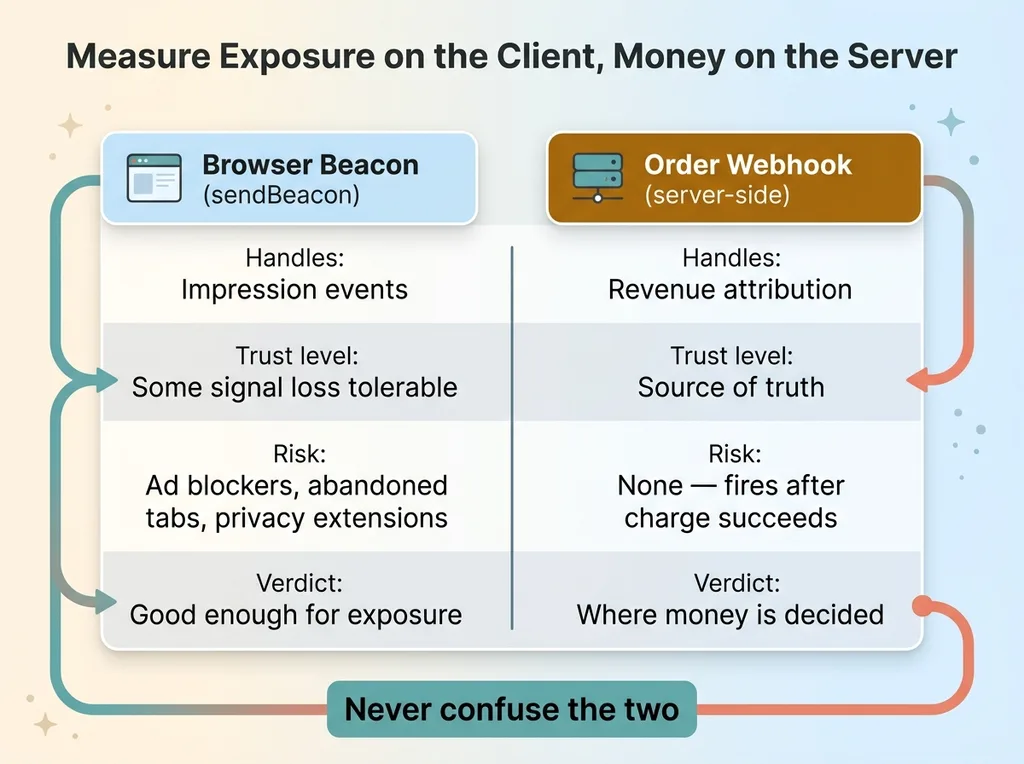 Browser beacon vs server webhook split of responsibilities
Client-side beacons get eaten by ad blockers. Tabs get abandoned mid-checkout. People run privacy extensions that nuke half your events. If I attributed dollars based on browser signals, my numbers would be quietly wrong in ways I'd never catch.
The webhook can't be faked by any of that. It fires from the payment system itself, after the charge succeeds. There's no ad blocker on a server-to-server call. There's no abandoned tab. It either happened or it didn't.
So I split the responsibilities. Browser beacons handle impressions, where some signal loss is tolerable. The webhook handles revenue attribution, where it isn't. This separation is the foundation of trustworthy ecommerce experiment tracking: measure exposure on the client, measure money on the server, and never confuse the two.
That's how I make sure the lift number I eventually read off the dashboard is built on transactions that genuinely occurred, not on optimistic client-side noise.
Reading the Dashboard: Lift, CVR, AOV, Revenue per Cohort
The four numbers that settle the argument
Once the data is clean, the dashboard settles the argument with four numbers, over a selectable date range.
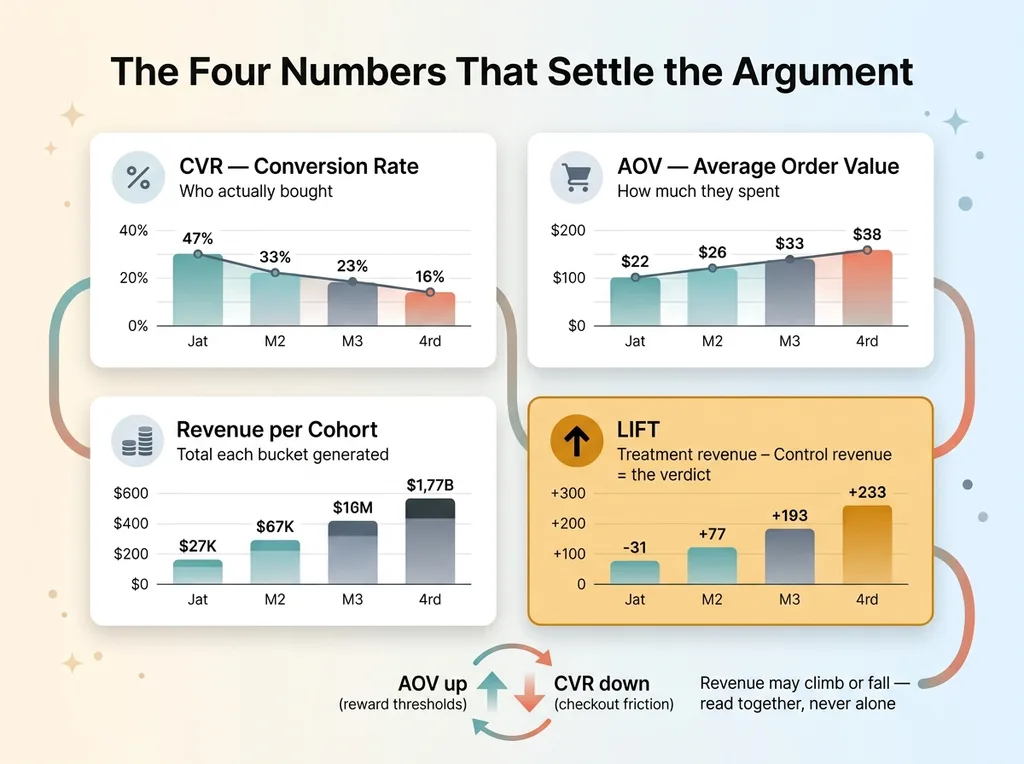 The four dashboard numbers and how they interact
Conversion rate (CVR) per cohort: what percentage of each group actually bought. Average order value (AOV) per cohort: how much they spent when they did. Revenue per cohort: the total each bucket generated. And lift: the verdict.
These numbers interact in ways that catch people off guard. A loyalty program can raise AOV (people buy more to hit a reward threshold) while lowering CVR (the prompts add friction at checkout). Revenue might still climb, or it might not. You can't read any single number alone and know the truth.
Lift is the number that ends the debate. It's treatment revenue minus control revenue, normalized for cohort size. Positive lift means the program created incremental revenue. Flat or negative lift means you've been giving away margin. That's your loyalty ROI in one figure, finally grounded in causation instead of correlation.
I surface all of this in the same centralized analytics dashboard I use to watch the rest of the business, so loyalty performance sits next to everything else instead of hiding in a vendor portal.
Choosing a date range that isn't lying to you
Short windows lie. A three-day sample with forty orders per cohort will swing wildly and tempt you to ship a conclusion you'll regret.
You need statistical patience. Enough orders per cohort before the lift number means anything. I'd rather wait two weeks for a stable read than act on a glamorous five-day spike that was just noise.
And I'm honest about what this still misses. The attribution window captures purchases inside it. It doesn't fully capture long-term retention, the customer who comes back in month four because of points they banked today. Cohort A/B tracking proves short-to-mid-term incrementality cleanly. The long tail still requires judgment.
What I'd Tell You Before You Trust Your Own Loyalty Numbers
A loyalty program you can't measure is a faith-based expense. You're paying for it on the belief that it works, with a dashboard designed to make you feel good rather than tell you the truth.
The fix is not a fancier rewards tier or a slicker points UI. It's cohort A/B tracking that proves incrementality. Split your traffic, stamp a tag that travels to the order, fire impressions without slowing the store, attribute money through the webhook, and read lift over a date range long enough to trust. That sequence turns a guess into a number.
Be clear-eyed about the limits. You need real traffic volume, or your cohorts never reach significance. You need patience, because short windows mislead. And attribution windows mean some long-term value stays invisible. This isn't magic. It's just honest measurement, which is rarer than it should be.
That measurement instinct is what I bring to every system I build, not just loyalty. My pricing engine, my product pipeline, my content operation, all of it gets the same treatment: prove it works before you trust it. You can see how the pieces fit together in the systems stack behind my brand.
If you're a CEO or operator with a loyalty program, or any program, that you're paying for without knowing if it works, you're flying blind on a real expense. That's a fixable problem. The hard part isn't the rewards. It's the measurement layer that tells you the truth.
Get the next build note.
I write up each system I build, including what broke. Subscribe to my newsletter and I'll send you the next one.