Why You're Paying Six Figures and Waiting Quarters
Here's the question I get from CEOs more than any other: do you still need a development agency to ship real software? You believe you do. You believe building a production app genuinely requires a roomful of specialists, each one billing, each one essential. So you sign the six-figure contract and you wait a quarter.
I understand the logic. For twenty years it was true.
It isn't anymore. AI is replacing agencies, but not in the way the hype suggests. AI doesn't replace the people who decide what to build. It replaces the people who type. The execution seats collapse. The decision seats don't.
That's the whole thesis, and I'll spend the rest of this article proving it seat by seat.
Let me give you a real frame. I deliver work for a sales partner of mine. Things that used to get quoted in months, I now ship in days. Not because I work faster than seven people. Because I am all seven people, and AI does the building while I hold the judgment.
There's no project manager scheduling a call to align with the designer. No designer waiting on the engineer's questions. No engineer blocked on a copy deck. The whole org chart lives in one head, and the typing happens at machine speed.
The agency model isn't slow because the people are slow. It's slow because the work passes through six pairs of hands, and every handoff loses context and adds a meeting.
So let's walk the old org chart. Seat by seat, I'll show you which ones AI absorbs, which one it can't touch, and how to tell the difference for your next build.
The Old Org Chart: Who It Took to Ship a Real App
Picture the staffing for one production app at a traditional agency. It looks like this.
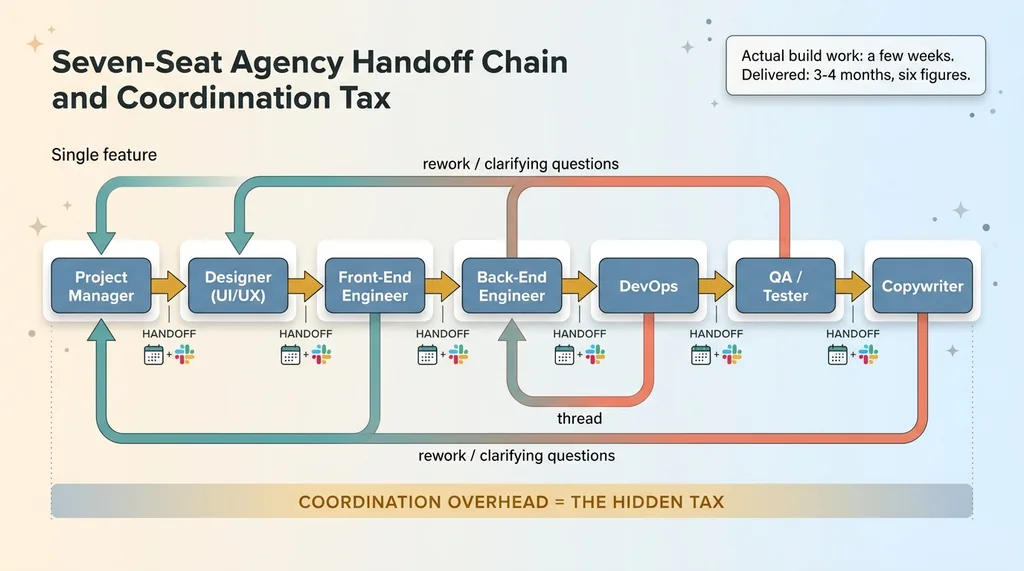 The seven-seat agency handoff chain and coordination tax
A project manager to run the engagement. A designer for UI and UX. Two engineers, one front-end, one back-end. A DevOps person for deployment and infrastructure. A QA pass, sometimes a dedicated tester. A copywriter for the interface text and marketing.
Seven seats, give or take. Each one bills against the project.
That's how a build that involves maybe a few weeks of actual work stretches to three or four months and lands at six figures. The math isn't in the building. It's in the coordination.
Watch how a single feature moves. The PM writes a scope document. The designer reads it, asks three clarifying questions, waits a day for answers, then mocks it up. The mock goes to review. Two rounds of feedback. Then it goes to the front-end engineer, who finds an edge case the designer didn't consider, so it goes back. The back-end engineer needs an API contract that nobody wrote down. DevOps gets looped in late and discovers the deployment assumptions were wrong.
Every one of those arrows is a handoff. Every handoff is a status meeting, a Slack thread, and a chance to lose context.
I've sat in those weekly check-ins. They feel productive. They move almost nothing. The real output is a synced calendar and a vague sense that progress is happening.
Here's the part nobody puts on the invoice. Most of what you're paying for isn't building. It's the friction between roles. The scope docs exist because the PM can't read the designer's mind. The review cycles exist because the copywriter never talked to the engineer. The timeline stretches because work waits in queues between people.
That coordination overhead is the hidden tax. And it's exactly the tax AI removes.
The Seats AI Collapses (Execution)
Let me be specific about what genuinely moves from a person to a prompt, and what doesn't.
The engineering seats
This is the big one. AI does the implementation. The typing, the boilerplate, the wiring between systems, the CRUD endpoints, the form validation, the data transforms. The stuff that ate most of an engineer's billable day is now generated and reviewed in minutes.
I've written over 22,000 lines of custom Python in my own AI toolkit. I didn't type most of it by hand. I directed it. My product creation pipeline takes a concept to a live product in 20 minutes. That used to be three to four hours of manual work.
To be clear, I'm not advising on this from a slide. I don't just advise on AI, I build it. The engineering seat doesn't vanish. It collapses into one operator who knows what good code looks like and directs the AI to produce it.
DevOps and QA
DevOps is configuration, deployment, and infrastructure-as-code. All of it is text, and text is what AI is best at. Spinning up environments, writing deploy scripts, setting up CI pipelines, debugging config errors. AI handles the bulk with a human checking the output.
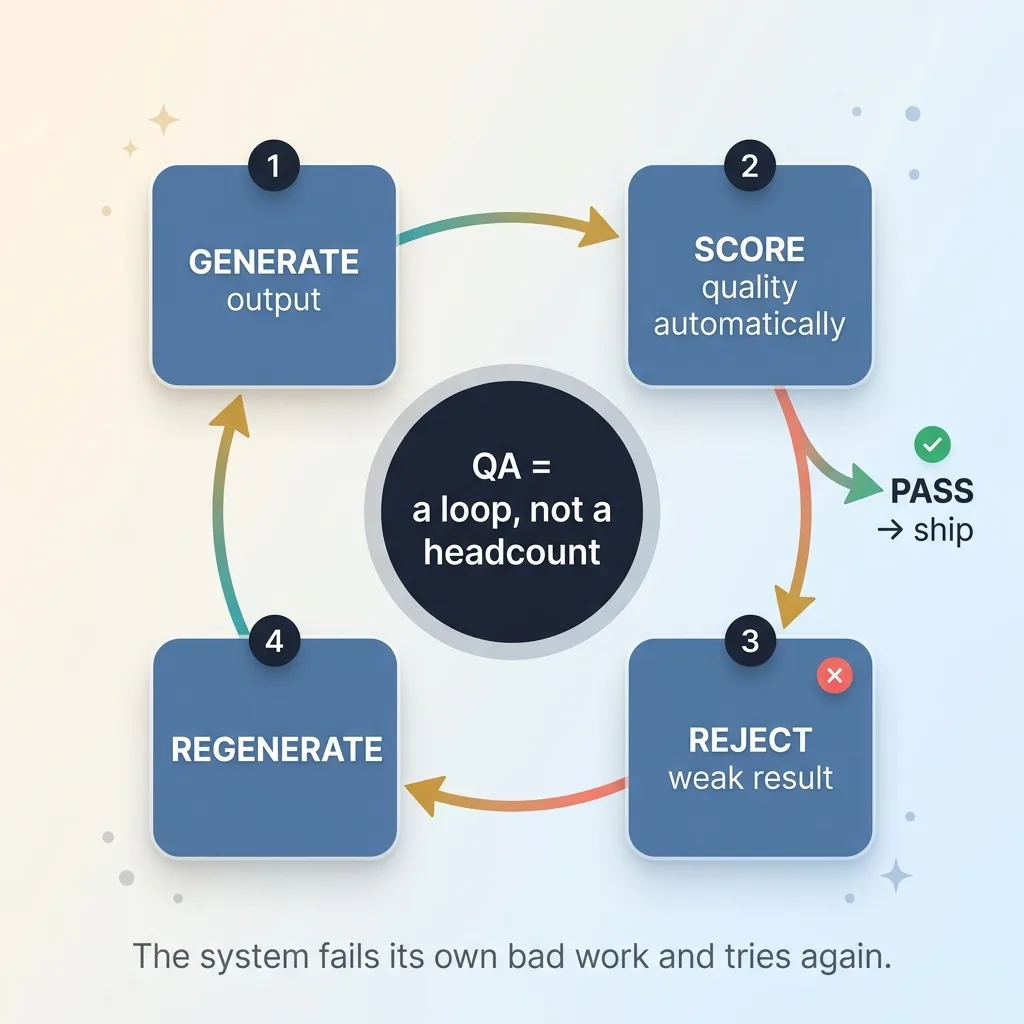 Self-scoring QA loop replacing a QA headcount
QA is the one people underestimate. I built systems that score and reject their own bad work. Instead of a person manually testing every output, the system runs a quality check, fails its own weak results, and regenerates. The QA pass becomes a loop, not a headcount.
The copywriter and the designer
AI drafts interface copy, marketing text, and product descriptions. I manage 313 blog articles with AI-assisted SEO. The first draft is never the problem anymore. The editing judgment is the value, and that stays with the operator.
Design is partway there. AI generates layouts, image assets, and component variations fast. I use Gemini for image generation across hundreds of products. The taste call still belongs to a person, but the production grind is gone.
If you want proof of volume, look at what AI development velocity looks like at scale. The execution seats don't disappear. They fold into one operator directing the machine.
The Seat AI Does Not Collapse (Judgment)
Here's where I lose the people selling you "AI does everything." It doesn't.
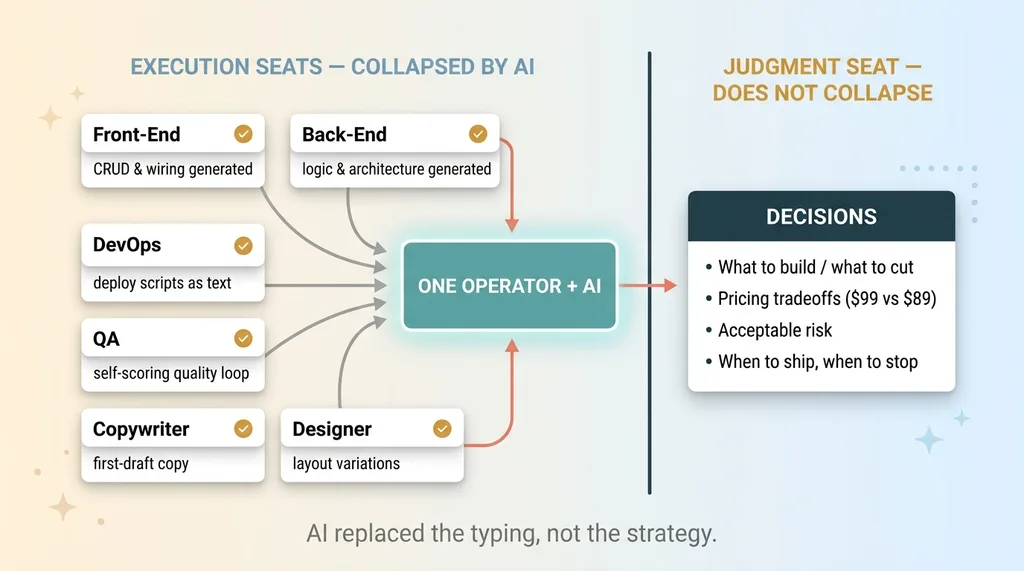 Execution seats collapse, judgment seat stays
AI does not collapse the decision seats. Someone still has to decide what to build and, more importantly, what to cut. What tradeoff to make on pricing. What risk is acceptable. When to ship and when to stop. AI has no opinion that matters on any of these, because it has no skin in your outcome.
Real example. On my DTC brand I run a pricing engine that dynamically prices 564-plus products across a four-tier classification. The AI handles the mechanics beautifully. But when it came to whether a specific product should sit at $99 or $89, the AI couldn't make that call. That number depends on brand positioning, margin targets, and what I know about my customer that no model has access to. I made it. AI executed it.
Scope decisions are the same. On more than one build, the right answer was to build less. To cut the feature the client asked for because it would confuse the user and double the timeline. An AI will happily build whatever you point it at. It won't tell you that you're pointing it at the wrong thing.
This is the core point, and it's the one most people get backwards. AI replaced the typing, not the strategy.
The reason one operator beats a seven-seat agency isn't that AI does everything. It's that AI does the execution while one person holds all the judgment in a single head, with no handoff loss.
Now the honest limit. An operator who can't actually hold the judgment layer fails just as hard as an agency. Maybe harder, because there's no team to catch the bad call. Take away the seven seats and put a junior in the chair with a powerful AI, and you get fast garbage. The model only works when the one head holding it has real judgment. That's the whole game.
Why One Head Beats Seven Seats
The agency's weakness was never the talent. The engineers are good. The designers are good. The weakness is the seams between them.
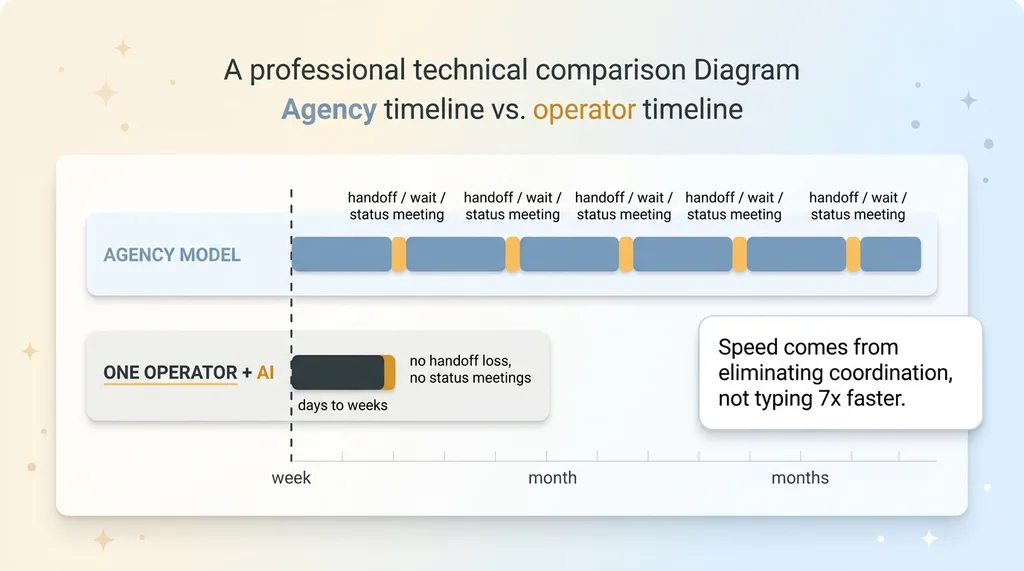 Agency timeline vs operator timeline for the same scope
Every place where work passes from one role to another is a place to lose context, add a meeting, and stall the timeline. The designer knows something the engineer doesn't. The PM translates between them and gets it slightly wrong. The copywriter never saw the actual product. These aren't failures of skill. They're failures of structure.
When one operator holds PM, design, engineering, QA, and copy in the same head, the context never gets handed off, so it never gets lost. The thing the designer knew and the thing the engineer needed are the same thought in the same brain.
Speed doesn't come from working faster. It comes from eliminating coordination. There's no status meeting when you're the only attendee. There's no scope document when the person writing it is the person building it.
Here's the timeline contrast that matters. The agency quotes three to four months. The operator ships in days to weeks for the same defined scope. That's not me typing seven times faster than seven people. That's me cutting out the six handoffs that ate the calendar.
I've written more about the new timeline for custom software and why it shrank so hard. The short version is that coordination was always the bottleneck, and AI removed the one thing that justified all that coordination, which was the slow, manual typing.
The honest ceiling: this works for a defined product scope. A production app, an internal tool, a launch. It does not work for an unbounded enterprise platform with 40 stakeholders, because at that point you have genuine parallel scope and political coordination that one head can't physically hold. Know which one you have.
When You Still Need the Agency (And When You Don't)
Let me draw the line honestly, because pretending one operator wins every fight would make me exactly the kind of vendor you've been burned by.
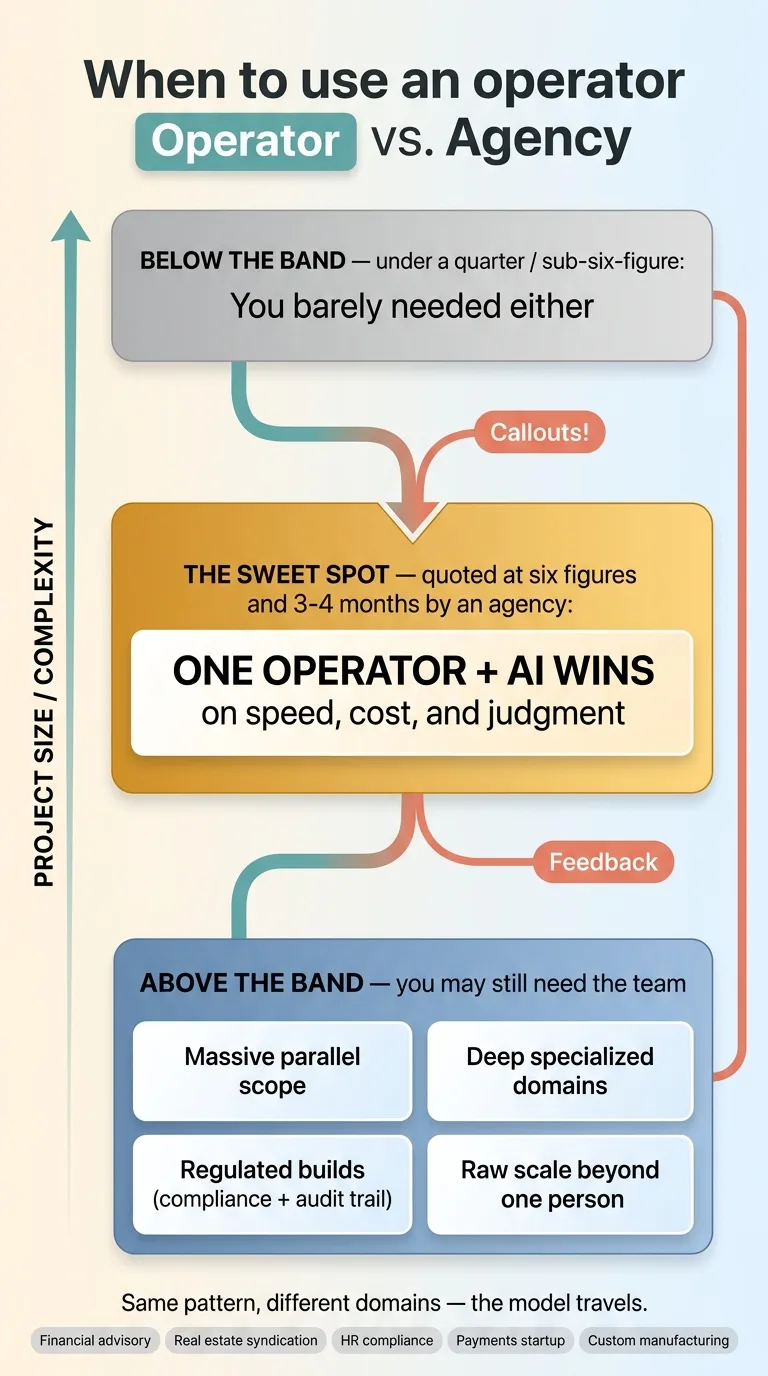 Decision frame: when to use an operator vs an agency
The operator-plus-AI model wins for a defined production app, an internal tool that streamlines real operations, a marketing site, or a focused product launch. Anything where the scope is knowable and one sharp person can hold the whole picture. This is where you're choosing AI vs hiring an agency and the operator wins on speed, cost, and judgment at the same time.
The agency or a larger team still makes sense in four cases.
Massive parallel scope, where the work genuinely needs many things built at once and no single person has the bandwidth. Deep specialized domains, where you need a true expert sitting in the seat, not an operator directing AI through unfamiliar territory. Regulated builds that require dedicated compliance staff and an audit trail. And raw scale that exceeds what one person can carry, full stop.
Here's the decision frame I give people. If your project would have been quoted at six figures and three to four months by an agency, that is exactly the band where one operator with AI now wins. That's the sweet spot. Above it, you might still need the team. Below it, you barely needed either.
I've delivered in this band across wildly different industries. A financial advisory firm managing 500 million-plus in assets. A real estate syndication client. An HR compliance client. A payments startup. A custom manufacturing client. Different domains, same pattern: a defined build that an agency would have stretched into a quarter, shipped by one operator in a fraction of the time and cost.
The range proves the point. It's not that I'm a domain expert in all of those. It's that the model travels, because the bottleneck it removes is the same everywhere.
What This Means for Your Next Build
Reframe the question you started with. The issue was never whether software needs specialists. Of course it does. The real question is whether it needs a roomful of them with a handoff between every seat.
It doesn't anymore. The specialist knowledge still matters. The seven separate chairs and the coordination tax between them do not.
So before you sign the next agency contract, do one thing. Scope the project as if a single operator held every role at once. No PM-to-designer handoff. No designer-to-engineer review cycle. No status meetings to keep seven people aligned.
When you scope it that way, you'll see how much of the quote was building and how much was coordination you no longer have to pay for. In my experience it's most of it.
That's not a one person agency gimmick or a fractional product team you rent by the hour. It's a structural shift. The execution seats collapsed. The judgment seat didn't. The operator who can hold both is now faster and cheaper than the studio, without giving up the decisions that actually matter.
Get the next build note.
I write up each system I build, including what broke. Subscribe to my newsletter and I'll send you the next one.