The Problem: Your Best Ad Creative Is Buried in Tags You'll Never Watch
My customers make better ads than my agency ever did.
Every week, people who buy from my DTC fashion brand in San Diego tag us in video. Someone films themselves throwing on a jacket before they walk out the door. Someone does a 20-second haul. Someone shows the stitching up close because they're genuinely impressed. That content converts. It looks native to the feed because it is native to the feed, and it routinely beats studio-produced ads on cost-per-acquisition for exactly that reason.
Here's the catch. It pours in at a volume no human can process. Hundreds of tagged reels, each one 15 to 60 seconds, sitting in a notifications tab. The honest truth is nobody watches them. I'm not going to scroll through three hours of customer clips between running pricing, content, fulfillment, and everything else a founder does in a day. So the good stuff dies in the notifications tab, and I keep paying to produce ads that perform worse than the free content I already have.
That's the buyer doubt, stated plainly: I have tons of customer content and zero time to sort it. AI video content scoring is supposed to fix this. The pitch is that a model can watch the videos for me, find the winners, and surface a shortlist I can actually act on.
That pitch is mostly true. But "mostly" is doing a lot of work in that sentence.
Because there are two ways this goes wrong. The tools either don't actually watch the video, or they hand you a high-scoring reel you have no legal right to run. I hit both walls before I had anything worth using. This article is how I got past them, and why AI video content scoring only pays off if you build the rights check into the same system as the scoring.
Why Most Tools Can't Actually Watch the Video
The 'score from the thumbnail' trap
Most so-called video scoring tools never see the video.
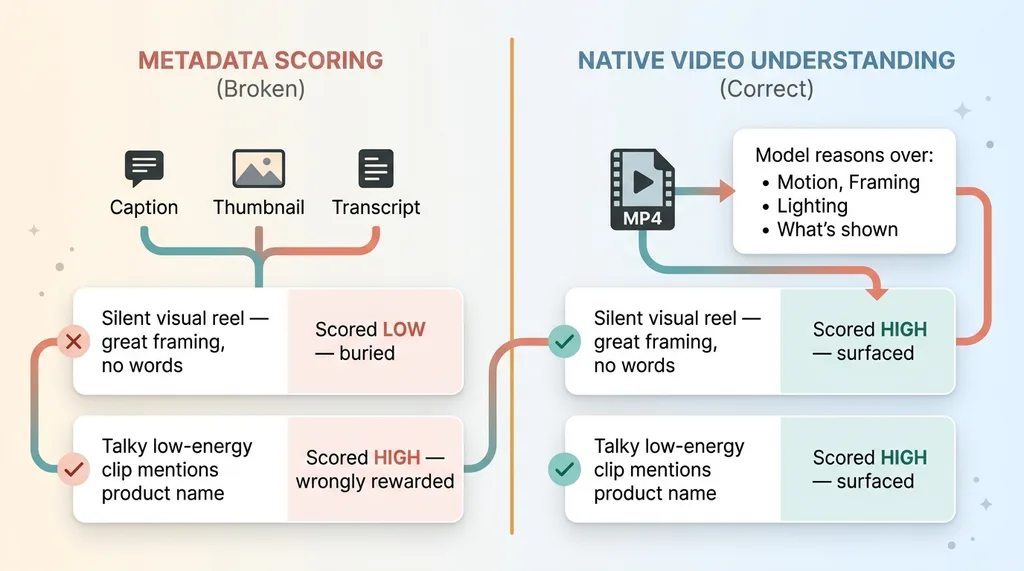 Why most tools fail, scoring thumbnails/transcripts vs actually watching the video
They score the caption. Or the thumbnail. Or a transcript if they're feeling ambitious. None of that is watching. A reel where someone silently shows off the fit, no voiceover, no on-screen text, just good framing and good energy, gets scored as low-signal because there are no words to read. That's the exact reel that performs best as an ad, and the tool throws it in the trash.
This burned me early. My first pass at UGC curation automation leaned on transcripts, and it systematically buried the silent, visual reels (the best ones) while rewarding talky, low-energy clips that happened to mention the product by name.
The fix is video understanding AI in the literal sense. You pass the actual MP4 to a model and it reasons over motion, framing, lighting, and what's physically being shown on screen. Not the metadata around the video. The video. I wrote up the technical side of this in scoring video with a model that actually watches it if you want the deeper mechanics.
The safety-filter refusal problem
The second failure mode is sneakier. The wrong model refuses to score your best content.
Enthusiastic customer video trips safety filters. A rave review, an energetic product demo, anything with strong positive sentiment can get flagged by a model that decides the content is "promotional" or otherwise off-limits, and instead of a score you get a refusal. The model just declines. Now your highest-energy reels (again, the ones that make the best ads) are exactly the ones your pipeline can't process.
I lost real time to this before I understood what was happening. My scores had holes in them and I couldn't figure out why until I traced it back to refusals on the most excited clips. The lesson: the model you pick and how you prompt it matters as much as the architecture. Picking wrong means your AI ad creative selection is blind in exactly the spots where the value is highest.
The Pipeline: From Tagged Post to Ranked Creator
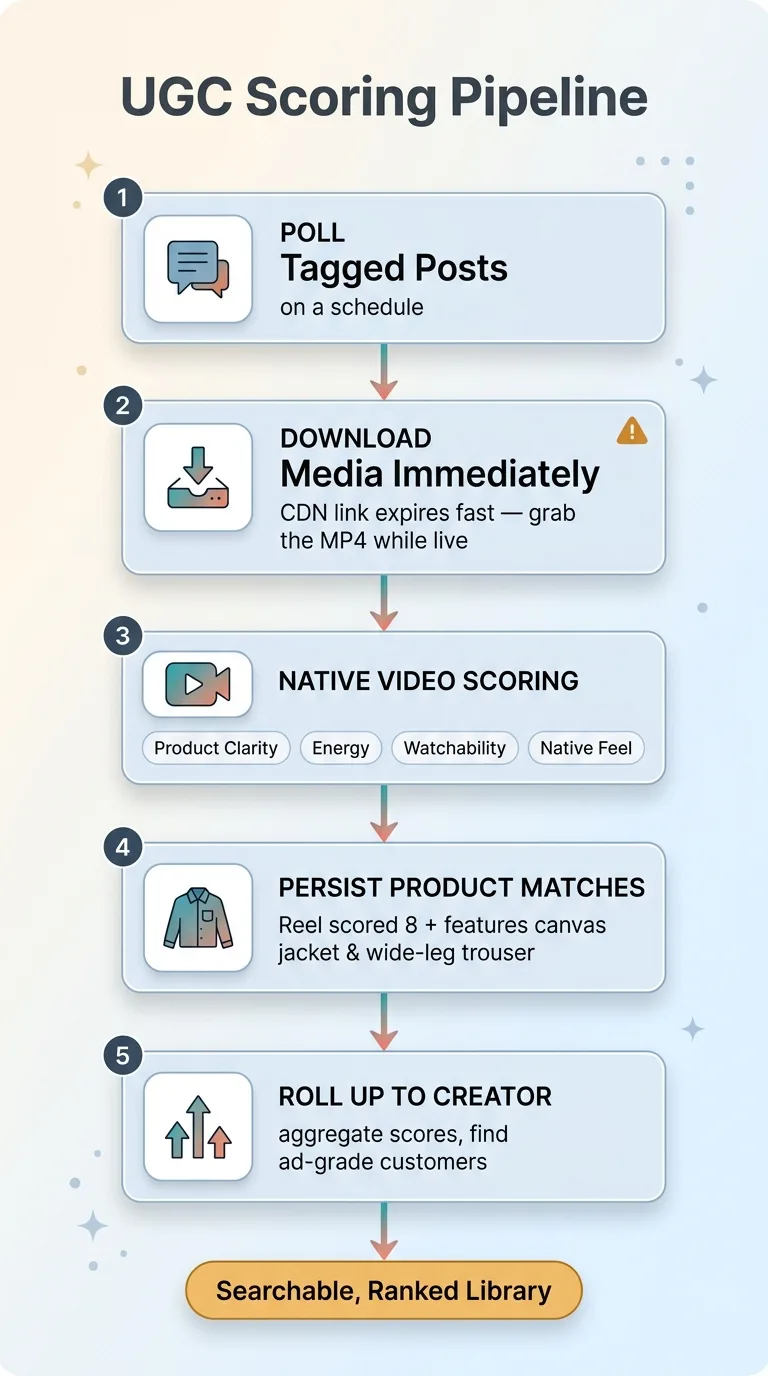 The 5-step UGC scoring pipeline from tagged post to ranked creator
Polling tagged posts and beating the expiring CDN link
Step one is boring. Poll for tagged posts on a schedule.
Step two is the detail that quietly breaks pipelines: download the media immediately. The CDN link to the original video expires fast. You have a narrow window to grab the MP4 before the URL goes dead, and if your scoring job runs an hour later off a stored link, half your videos are already gone. I learned this the unglamorous way, with a batch of null downloads and no idea why.
So the rule is: poll, then download right then, while the link is live. Persist the actual file, not the URL. Everything downstream depends on having the bytes on hand.
Native video scoring on the real MP4
Step three is the scoring itself. I pass the downloaded MP4 to a model that understands video natively and ask it to rate the reel on the dimensions that actually matter for ad creative:
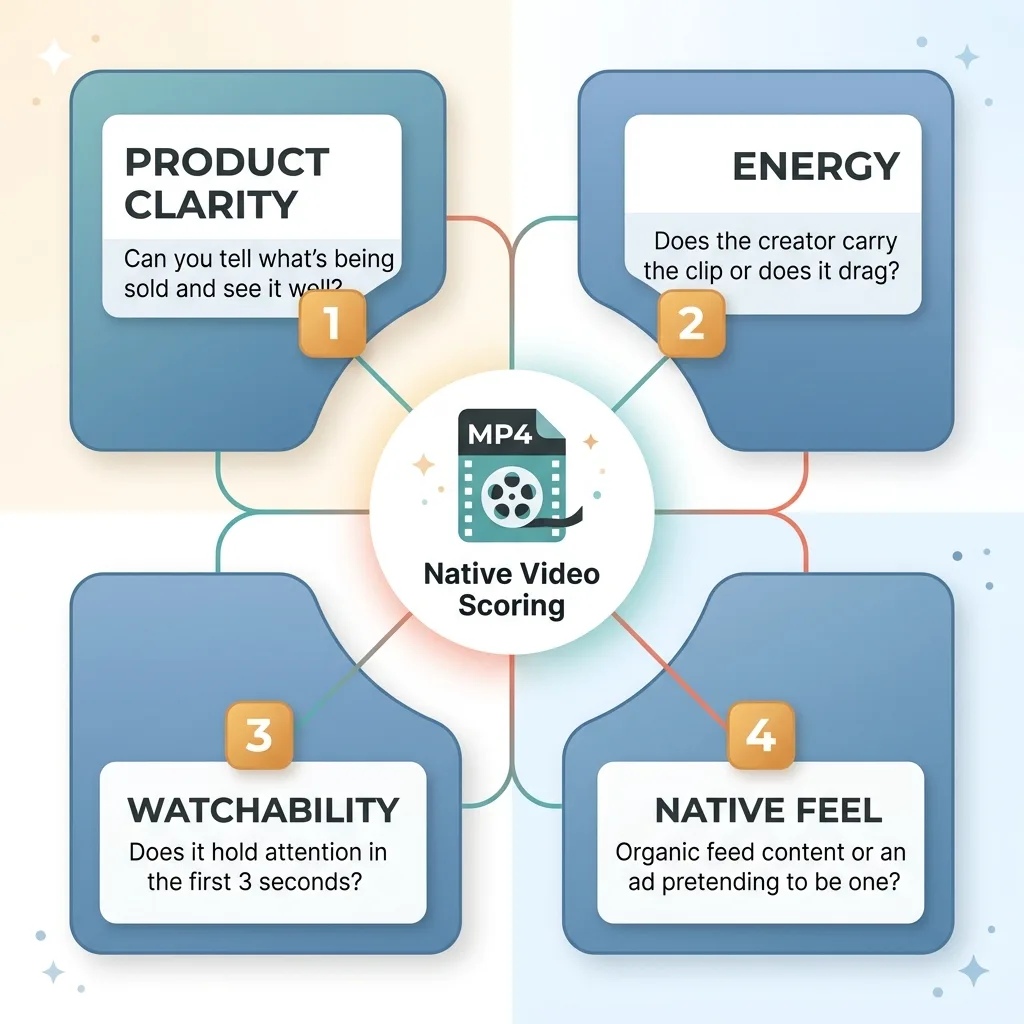 The four scoring dimensions for ad-grade creative
- Product clarity, can you tell what's being sold and see it well?
- Energy, does the creator carry the clip or does it drag?
- Watchability, does it hold attention through the first three seconds?
- Native feel, does it look like organic feed content or like an ad pretending to be one?
These are the things a human reviewer would judge in the first few seconds of watching. The difference is the model watches all of them, every one, without getting tired or distracted.
Persisting product matches, not just scores
Step four is where this turns from a one-time score into an actual asset. I match the products shown in each video against my catalog and persist those matches. Not just "this reel scored an 8." This reel scored an 8 and features the canvas jacket and the wide-leg trouser.
That's the difference between a number and a searchable library. Later, when I want to push a specific product, I can ask "show me the best reels featuring this jacket" and get an answer in seconds, ranked by score, instead of re-watching everything.
Step five rolls the scores up to the creator level. When I aggregate scores across everything a given customer has posted, I learn which customers consistently produce ad-grade content. Those are the people worth building a relationship with, the ones whose next reel I might want to license or remix. And once I've got a winning reel identified, I can feed it into the rest of my content system, including the pipeline that turns product photos into AI reels when I need more variations of a proven creative.
Persisting the product matches is the part most people skip, and it's the part that compounds. A score you don't store is a decision you make once and throw away.
The Consent Gate: Why a High Score Isn't Permission
Tagged is not licensed
Here's where a toy becomes a real system, and it has nothing to do with the AI.
A customer tagging you does not grant you the right to run their video as a paid ad. Read that again, because it's the part most brands ignore until it bites them. Tagged is not licensed. The person filmed themselves, they own that footage, and a tag is them showing it to you, not handing you commercial usage rights.
Most brands run merely-tagged content in paid ads constantly and get away with it, right up until a creator with a lawyer or a big following notices their face selling your product without a contract. Then it's not a fun conversation. This is real user generated content rights exposure, and the highest-scoring reel is often the one most likely to cause a problem, because the best creators are the ones who know what their content is worth.
The hard block at the launch chokepoint
So I built a hard consent gate. Paid ads can only pull from two sources: the brand's own posts, or creators who have an approved usage claim on file. Merely-tagged UGC, no matter how high it scores, gets blocked at the launch chokepoint.
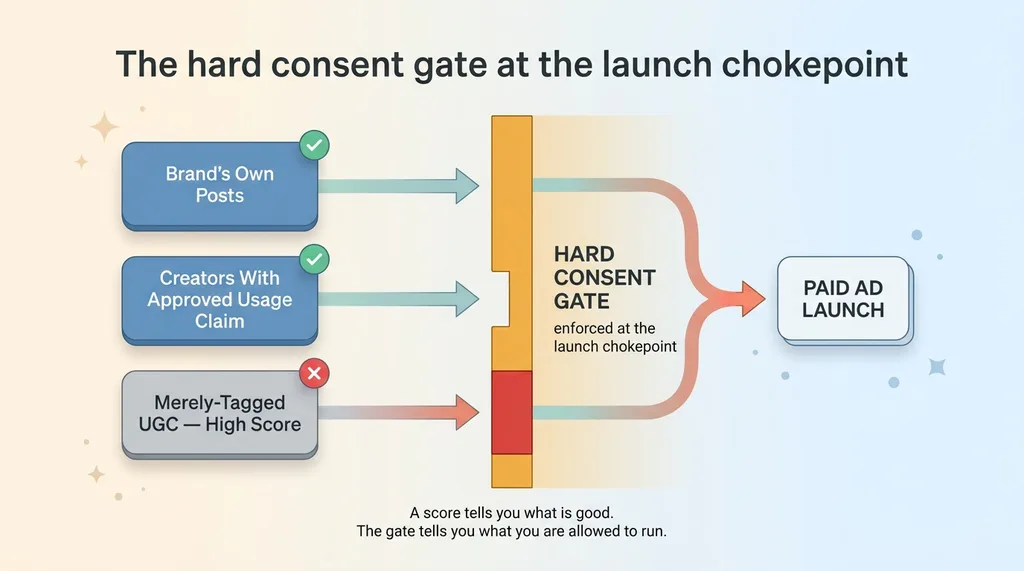 The hard consent gate at the launch chokepoint
The critical word is hard. The gate is enforced where the ad actually gets created, not as a friendly warning earlier in the funnel. A soft warning gets clicked past. Every single time. If the only thing standing between you and a legal problem is a checkbox that says "I confirm I have rights," someone tired at 6pm will check it and move on. So the rights status is a structural wall at the exact moment of launch, and there's no path around it.
This is the same human-in-the-loop, legal-default design I apply everywhere I build. The safe behavior is the default, and you have to do explicit work to leave the safe path, not the other way around. I broke down the mechanics in the one-line gate that defuses the legal landmine.
So when a client asks "can AI keep me legal here?" the answer is yes. But only if the rights check is a wall, not a suggestion. A score tells you what's good. The gate tells you what you're allowed to run. You need both, and they have to live in the same system.
What I Get Out of It: Time, Better Creative, and a Defensible Library
Instead of nobody reviewing the tags, I get a ranked shortlist of ad-grade reels surfaced automatically, already filtered down to only the ones I'm cleared to use.
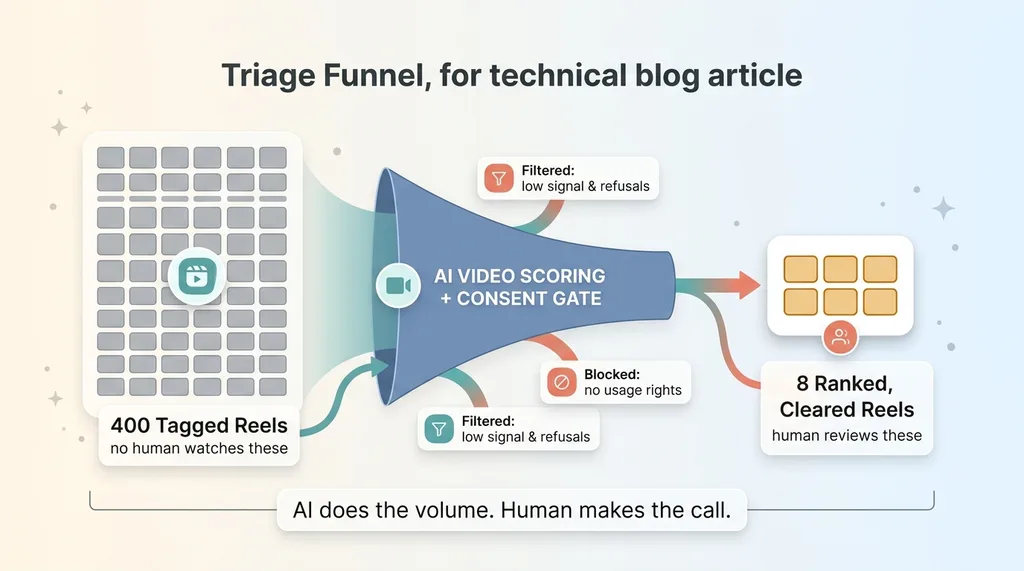 AI does the volume, human makes the call, the triage funnel
The time saved is the obvious win. I'm not scrolling through hundreds of clips anymore. But honestly, the bigger win is creative quality. I'm running reels that a model actually watched and scored, matched to the exact products I want to push, instead of guessing which of my own customers made something good. My ad creative selection went from "whatever I happened to notice" to "the top of a ranked list, watched and scored on the dimensions that predict performance."
And because product matches and consent status are persisted, I have a searchable, defensible asset library. Not a folder of screenshots someone has to dig through. A real index I can query by product, by score, by creator, by rights status. When I want three new reels featuring a specific item, that's a search, not a project.
Now the honest part. The model's score is a strong filter, not a final judgment. It's right about most things and occasionally wrong about one, and I still glance at the top of the list before I launch anything. The AI does the triage. I make the call. That's the whole arrangement, and it's the only arrangement I trust. A model that watched 400 videos so I have to watch 8 is a massive win. A model I let launch ads with zero human eyes is a liability waiting to happen.
That balance (AI does the volume, human makes the decision) is the principle behind every system I keep in production. The point isn't to remove me from the loop. It's to make sure that when I'm in the loop, I'm looking at the eight that matter instead of the four hundred that don't.
If You're Sitting on Customer Video You're Not Using
Here's the situation, and tell me if it sounds familiar.
You've got a pile of customer content. Reels, tags, unboxings, demos, growing every week. You have no time to sort it, so most of it never gets used. And in the back of your mind there's a nagging worry that even if you did use it, running someone else's video might not be legal.
That's exactly the kind of problem worth building a system around. Not buying a tool that scores thumbnails. Building something that actually watches the video, matches it to your catalog, ranks your creators, and refuses to let you launch anything you don't have the rights to run.
This is one piece of how I run my own DTC brand, from finding the winning creative to turning it into more reels. If you want the wider view, I laid out the whole approach in the AI playbook for DTC brands, and the photos-to-reels pipeline covers what happens after you've found a winner and want more of it.
I build these systems. I don't just write decks about them. If you've got the content volume and the catalog to make this worth doing, let's talk about what it would actually look like for your business.
Get the next build note.
I write up each system I build, including what broke. Subscribe to my newsletter and I'll send you the next one.