A Year Ago, Generating a Usable Image Was the Whole Business
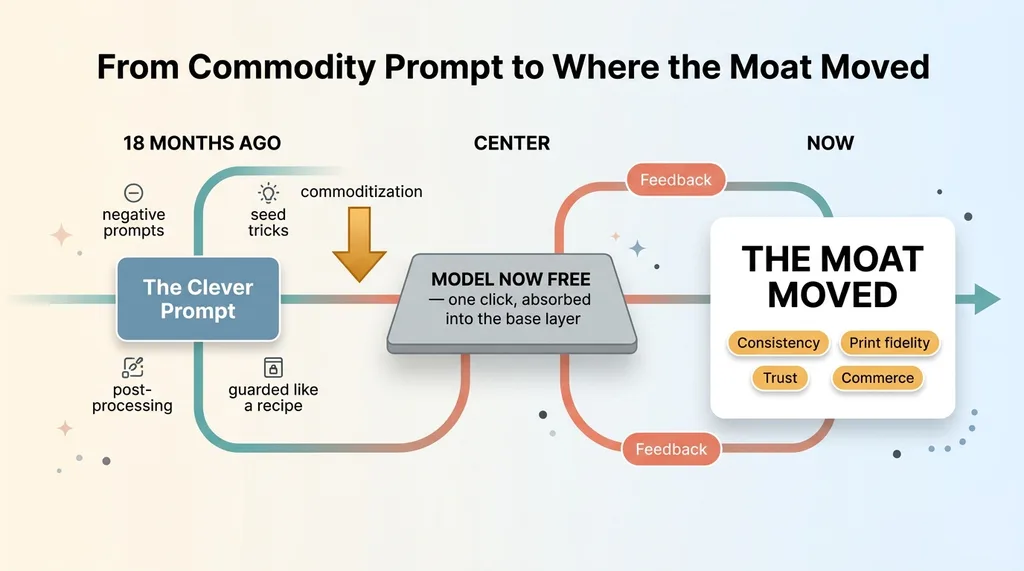
Twelve to eighteen months ago, getting a frontier model to produce a usable, on-brand image was genuinely hard. You needed to know the right incantations, the negative prompts, the seed tricks, the post-processing that turned a melted mess into something a human would accept. Founders raised real money on exactly this. The clever prompt was treated like a trade secret, guarded the way a recipe gets guarded.
 From Commodity Prompt to Where the Moat Moved
Then the floor dropped out. The frontier image model is now a commodity, and the platform owner ships a free version that does in one click what used to take a careful operator twenty minutes. I wrote about this in detail in the AI image model is now free. The short version: the thing people were charging for got absorbed into the base layer.
Here is the part most people get wrong. The moat didn't disappear. It moved.
I'm saying this not as a spectator but as someone building a consumer AI product right now. It turns family photos into printed photobooks, and the image generation, the part that felt impossible eighteen months ago, is the easiest piece of the whole thing. I'll come back to it throughout this piece because it makes the abstract concrete.
This is a framework for where defensibility actually sits when the model itself is free. Not a pep talk, not a prediction about the future of AI. A working theory of what's left to own when the magic is given away.
If you're a CEO trying to figure out whether your AI feature is a real business or a rented one, this is the question that matters most. An ai moat strategy that depends on the model being hard is already obsolete. The model is not hard anymore. So what's left?
Why Owning a Clever Prompt Is Not a Moat
The most common question I get from CEOs right now is some version of: is this AI feature defensible, or is the model vendor going to eat it?
 Rented Wrapper vs Owned Business
It's the right question. Here's the honest answer.
The model vendor will eat thin features
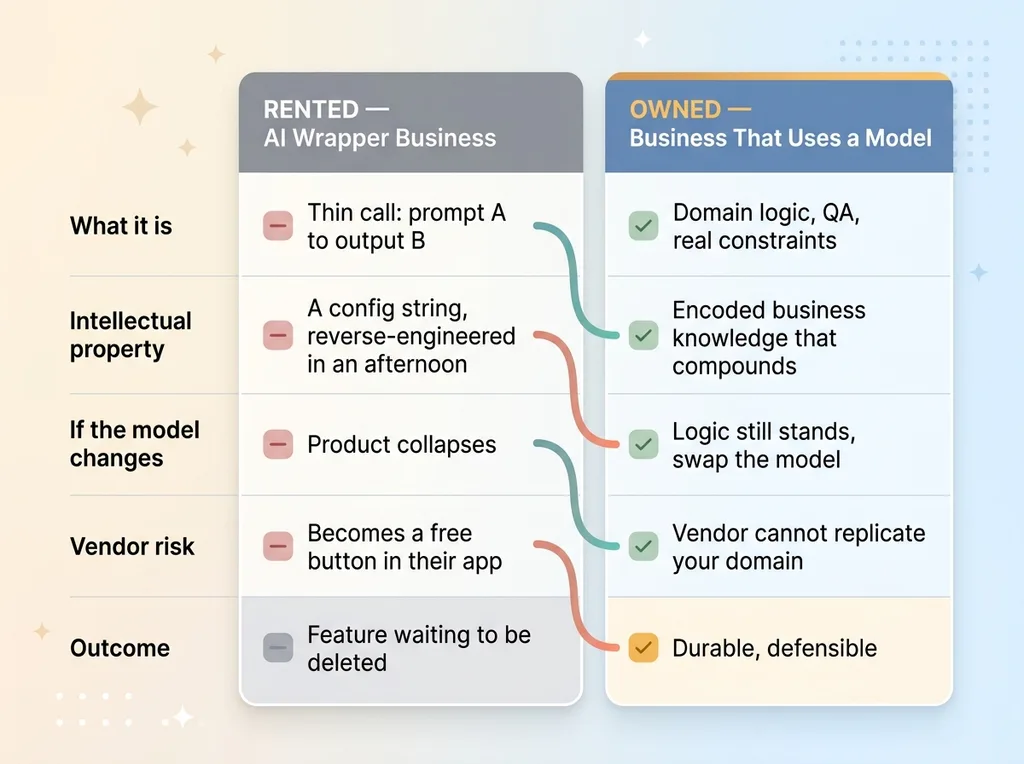
A prompt is not intellectual property. It's a config string. Anyone with a free afternoon and a screenshot can reverse-engineer the gist of what you're doing. There is no patent, no trade secret, no real barrier. The clever phrasing that felt like an edge in 2023 is now something the model gives away to everyone, including your competitors, by default.
Worse, the platform owner has every incentive to ship the obvious feature themselves and bundle it for free. If your product is a thin layer that turns prompt A into output B, you are building inside someone else's roadmap. The day they decide that capability should be a button in their own app, your business becomes a slower, paid version of something free.
Commoditization compresses every layer above it
Ai commoditization is the process by which a capability that was scarce and expensive becomes abundant and cheap, usually because the underlying primitive gets absorbed into a platform. Image generation went through it. Text summarization went through it. Transcription, translation, basic code completion, all commoditized.
When a layer commoditizes, it compresses everything sitting directly on top of it. If your entire product is a thin call to a foundation model, your margin and your defensibility get squeezed at the same time.
The lesson is blunt. If your whole product is a wrapper around a model call, you are renting a business from a vendor who is also your competitor. That's the ai wrapper business trap, and it only applies when the wrapper adds no real engineering of its own. A wrapper that does serious work is a different animal. A wrapper that just passes a string through is not a business, it's a feature waiting to be deleted.
Where the Moat Actually Moved: Four Layers the Base Model Won't Give You
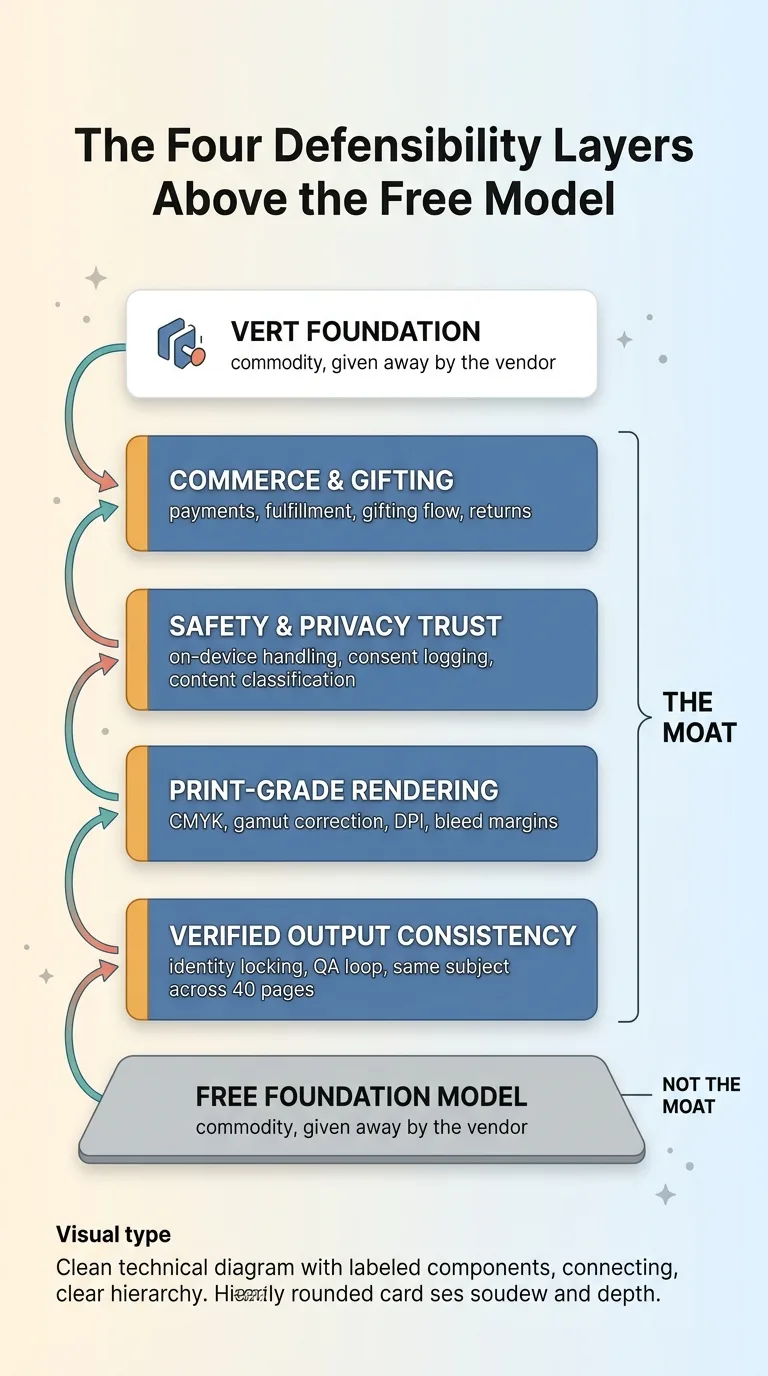
So if the model is free, where does durable value live? In my experience building this photobook product, it lives in four places the base model will never hand you.
 The Four Defensibility Layers Above the Free Model
Verified output consistency
The model produces a plausible image in a second. Plausible is not the same as correct. For a photobook, the same child has to look like the same child across forty pages. The layout has to never break. The text has to never overflow the margin.
The model has no concept of "the same subject across pages." It generates each image fresh, with no memory of the last one. The consistency layer, the identity locking, the QA loop that catches and rejects bad output before a human ever sees it, that's all engineering I had to build. The model contributes none of it.
Print-grade and gamut-correct rendering
Screen RGB does not survive contact with a real printer. A color that looks gorgeous on a phone can come out muddy or wildly off on paper. The base model knows nothing about gamut correction, DPI requirements, bleed margins, or CMYK color profiles.
This is unglamorous engineering and it's exactly where the value sits. I wrote about why you should composite the real thing instead of trusting raw generation for output that has to be physically correct. The model gets you a pretty pixel grid. Getting from there to something a printer can reproduce faithfully is real work.
Safety and privacy trust
A consumer product touching faces and family content carries a trust burden the model has no awareness of. Parents need to know their kids' photos aren't being mishandled. That means on-device handling where possible, consent logging, content classification to catch anything inappropriate, and a privacy posture a reasonable parent can actually feel safe with.
None of that is the model. All of it is the difference between a product a parent trusts and one they close immediately.
The commerce and gifting layer
Then there's the entire business around the image. Payment processing. Print fulfillment. The gifting flow, where a grandparent orders a book for a grandchild and the recipient experience has to be delightful. Shipping, returns, customer service.
The model touches exactly zero percent of this. And it's most of what makes the product worth paying for.
Four layers. None of them is the model. All of them are the moat.
The Unglamorous Engineering Is the Defensibility
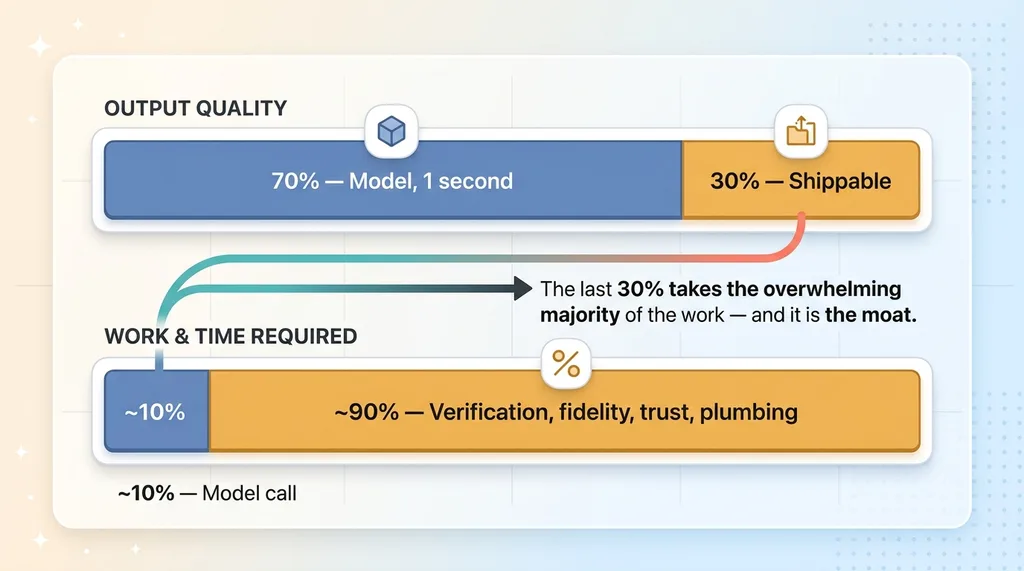
Here's the contrast that clarifies everything. The model gives you a 70-percent-correct image in one second. Getting from 70 percent to shippable is the remaining 30 percent, and that 30 percent takes the overwhelming majority of the work. No vendor will do it for your specific use case, because your constraints are yours alone.
 The 70% Model Output vs 30% Engineering Effort
Defensibility in AI products comes from that boring 30 percent, not from the magic that produces the first 70. Building on foundation models is a starting line, not a finish line. I made this argument in detail in AI is the last thing I build, not the first. The model is the last layer I add, after I've built the pipeline that makes its output correct, trustworthy, and shippable.
This is not unique to images. It's true across every AI product I've built. The model is the easy part. The plumbing that enforces correctness, handles edge cases, logs for trust, and ships clean output is where time accumulates and where durable advantage accumulates with it.
It mirrors exactly what I learned running my DTC fashion brand. I've built 15-plus AI systems there: a product creation pipeline that takes concept to live in 20 minutes instead of 3-4 hours, a pricing engine handling 564 products across four tiers, an SEO system managing 313 articles. The systems that hold their value are never the ones that just call a model. They're the ones wrapped in domain logic, quality control, and real-world constraints.
The pricing engine isn't valuable because it calls an LLM. It's valuable because it encodes how my specific business thinks about margin, inventory, and demand. Swap the model and the logic still stands. That's the difference between owning something and renting it.
A Simple Test for Whether Your AI Feature Is Defensible
You don't need a consultant to evaluate this. Run any AI feature through three questions.
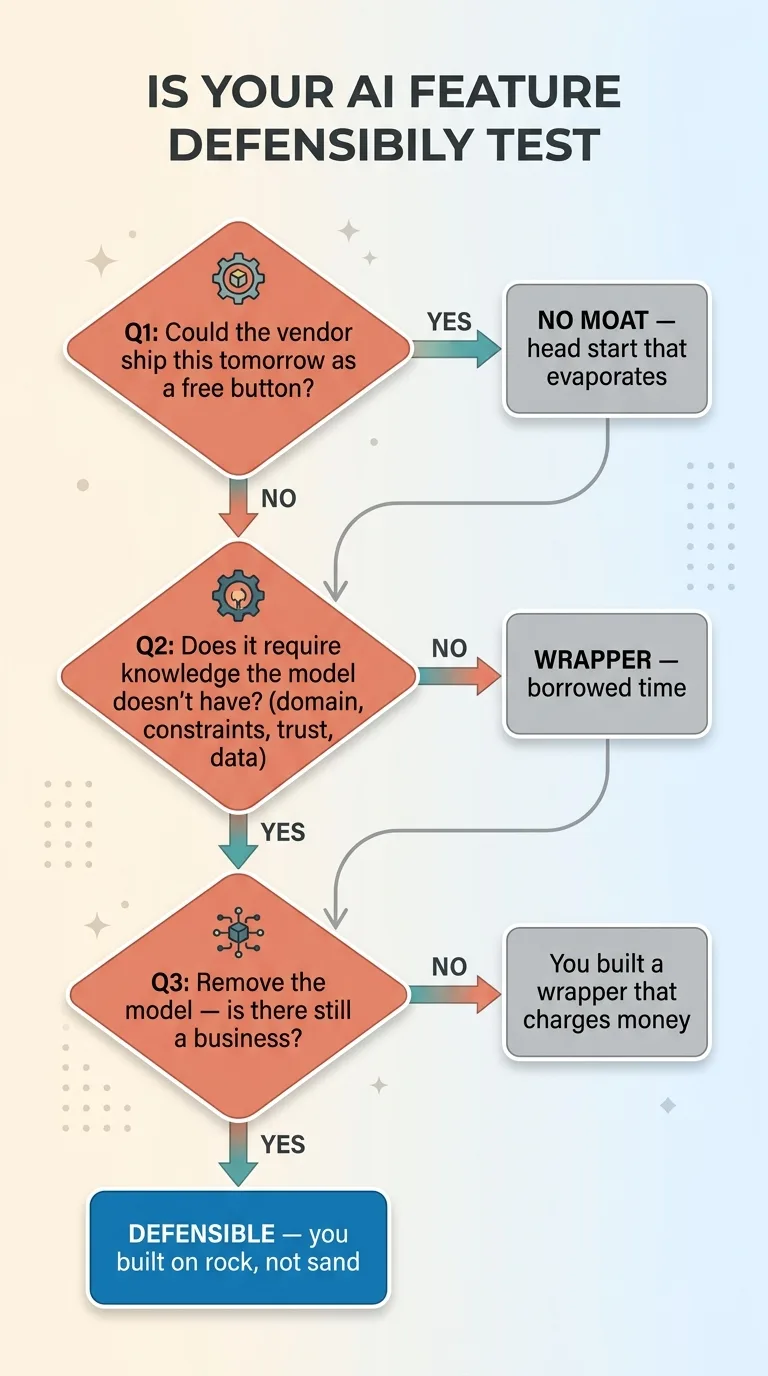 The Three-Question Defensibility Test
Could the vendor ship this tomorrow?
Could the model vendor ship your exact feature tomorrow, as a free button inside their own app, with no extra engineering? If the answer is yes, you have no moat. You have a head start that evaporates the moment they notice you.
Be honest here. "It would be hard for them" is not the same as "they can't." If your feature is the obvious next button on their roadmap, assume it ships.
Does it require knowledge the model doesn't have?
Does your product depend on domain knowledge, real-world constraints, or trust the model has no access to? Print specifications. Regulatory rules. Proprietary data. A fulfillment network. A consent and privacy architecture. The way your specific industry actually operates.
If yes, that's where your value sits. The model can't acquire your domain knowledge by getting bigger. That knowledge is yours, and it's the part of the product that compounds.
Would removing the model still leave a business?
Imagine the model vanishes and you swap in a competitor's model, or an open-source one. Would the rest of your product still be worth paying for?
If yes, you built a business that uses a model. If no, you built a wrapper that happens to charge money. The first is durable. The second is borrowed time.
One honest caveat. Passing this test doesn't guarantee you'll succeed. Plenty of well-built products fail for reasons that have nothing to do with the model. What the test tells you is narrower and more useful: whether you're building on rock or on sand. That's worth knowing before you spend six months.
How I'd Build Durable Value When the Model Is Free
Here's my working stance, stripped of theory.
Assume the model is free. Assume it's getting better every quarter, faster than you can keep up with. Then build everything above it.
Invest in verification, because output that's right matters more than output that's impressive. Invest in fidelity, because the last 30 percent is what people actually pay for. Invest in trust, because in any product touching real people's lives, trust is the product. Invest in commerce, because revenue lives in the transaction, not the generation.
All four of those compound over time. The model does not compound for you, it compounds for the vendor. Pay for the primitive. Own the logic.
This is exactly how I think about every system, whether I'm building it for my own brand or for a client. The AI is a component. The defensible thing is the engineering wrapped around it, the part tuned to a specific business, a specific constraint, a specific user.
It's also why I don't sell slide decks about AI strategy. I build the wrapper engineering that makes a model output correct and shippable. I wrote about that distinction in I don't just advise on AI, I build it. The strategy only matters if someone builds the thing, and most of the value is in the building.
If your board is asking whether your AI feature is defensible, or whether the vendor is going to eat it, that's a conversation worth having now. Before you've spent six months building on the wrong layer and learned the answer the expensive way.
Get the next build note.
I write up each system I build, including what broke. Subscribe to my newsletter and I'll send you the next one.