A Year Ago, Making the Image Was the Hard Part
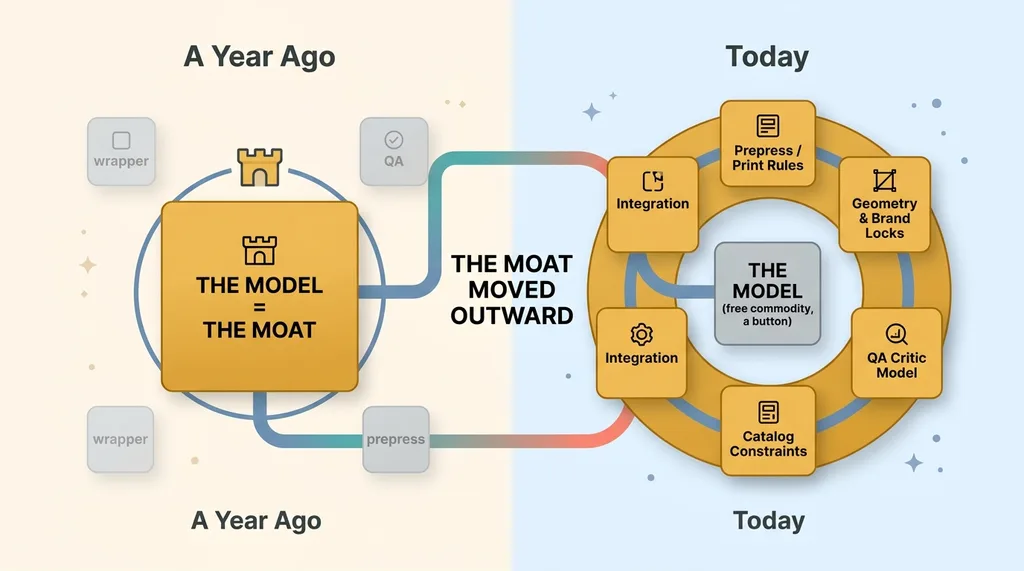
A year ago, the entire ai image generation moat was the picture itself. If your model could produce a usable product image, you had something. Teams raised money on it. Founders built whole products around the single claim: "we can generate the picture." That was the wall around the castle.
That wall is gone.
The frontier image model is a commodity now. The platform owners ship a free version of it inside the tools you already pay for. The thing that used to be defensible is a button. I run image generation across a DTC fashion catalog (handmade in San Diego), so I watched this happen in real time. Eighteen months ago I was stitching together workarounds to get one clean product render. Now the raw generation is the cheapest part of my whole stack.
Here is the thesis, plainly: the model is commoditized. The buyer who looks at AI image hype and thinks it is mostly noise is half right. The model really is noise now. Anyone can press the button.
But the value did not disappear. It moved.
It moved to everything that surrounds the button. The constraints, the quality checks, the file formats that survive a real printer, the integration into a catalog with 564 products that all need to be correct, not just pretty. That is the part nobody demos. That is the part that is actually hard. And that is where I spend my time, because that is where the money is.
If you have seen a hundred image-gen demos and shrugged, keep reading. You are right about the demos. You are probably wrong about the opportunity.
The Demo Looks Like Magic. The Catalog Looks Like a Lawsuit.
Why raw generation fails on real products
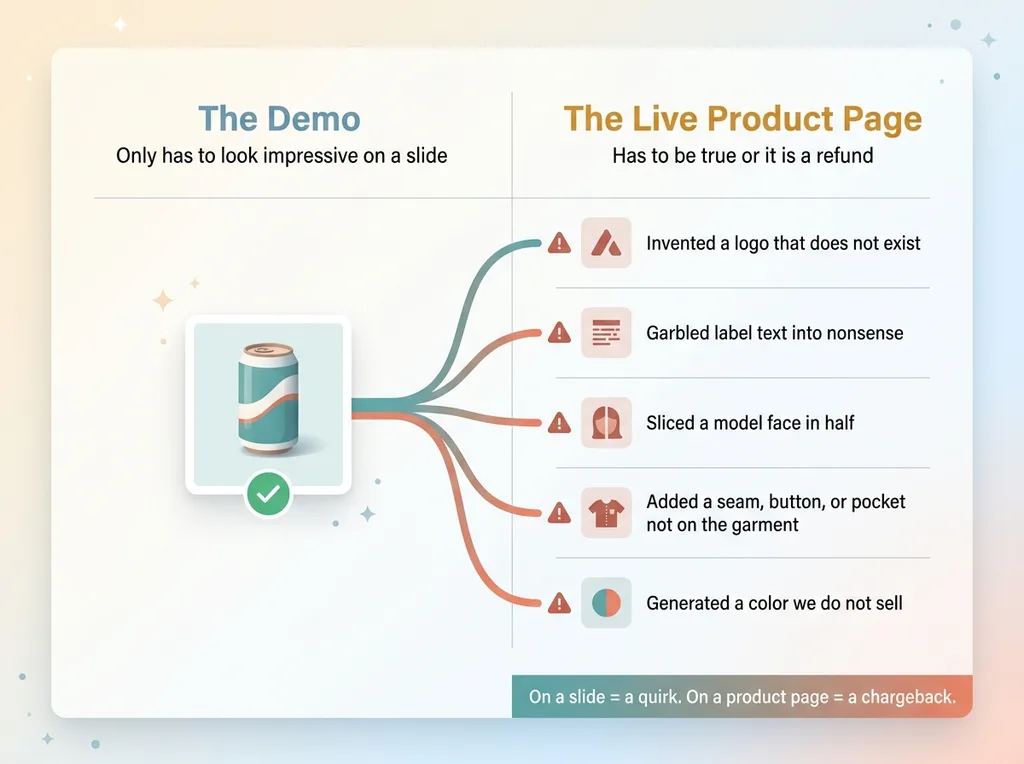
A demo image generator does one job: make something that looks impressive on a slide. It does not have to be true.
 Demo image vs shipped product asset failure modes
A real product image does. And raw generation lies constantly. I have watched models invent a logo that does not exist on my product. Garble the text on a label into nonsense letters. Slice a model's face in half. Add a button or a seam or a pocket the actual garment does not have. Generate a color we do not sell.
On a slide, that is a quirk. On a live product page, that is a refund. A chargeback. A customer who got something different from what they ordered. Do it enough and it is a real problem with payment processors, not just angry emails.
This is exactly why, for real products, I usually composite the real thing instead of generating it. The actual product, photographed once, placed into AI-generated scenes and contexts. The hero asset is real. The environment is synthetic. The customer gets what they paid for.
The gap between a slide and a shipped asset
The demo merchant stops at "look, it made a picture." That is the finish line for them.
For an operator, that is the starting line. I do not need one picture. I need that picture shipped across hundreds of products, every one of them legally accurate, on-brand, and print-ready. Across my catalog that is 564 products under dynamic pricing, each needing imagery that represents the actual item.
You cannot eyeball your way through that. One person reviewing one beautiful render is a demo. Shipping correct imagery at catalog scale without misrepresenting a single product is a system. The gap between those two things is the entire job, and it is the part the magic-trick demo never shows you.
Where the AI Image Generation Moat Actually Moved
When the model is free, value concentrates in everything around the model. The ai image generation moat today is the wrapper, not the generator. Here is what that wrapper actually contains.
 Value moved from the model to the wrapper
Prepress and print-grade rules
A pretty PNG off a model is not a deliverable. If that image is going on physical product, packaging, or anything that gets printed, it has to survive a real printer.
That means resolution that holds up at print size, not screen size. Correct color profile, because RGB off a model and the CMYK a printer needs are not the same thing, and the difference shows up as wrong colors on the finished item. Bleed and safe margins so nothing important gets cropped. A file format that does not fall apart when it hits production equipment.
The free model does none of this. It hands you a screenshot. The prepress layer turns that into something a factory can actually run.
Geometry and brand locks
The product proportions have to stay true. A bag cannot get wider because the model felt creative. A label has to stay legible and in the right place. The logo has to be the actual logo.
I build geometry locks so the AI works inside fixed constraints instead of freelancing. The product stays the product. The brand stays the brand.
The output has to be correct before it's pretty
This is the part that reorders everyone's priorities. The model optimizes for "impressive." My pipeline optimizes for "correct," and only then for "beautiful."
A gorgeous image of a product I do not sell is worthless. Worse than worthless, it is a liability. So the rules run first. Accuracy gates the aesthetics.
None of this is glamorous. There is no demo for "our color profiles are correct." But it is durable, and the free model will never do it for you. When the model is a commodity, the boring layer is the moat.
The QA Critic That Catches the Sliced Face Before a Human Does
A second model that judges the first
Here is the piece that makes a pipeline trustworthy instead of just fast.
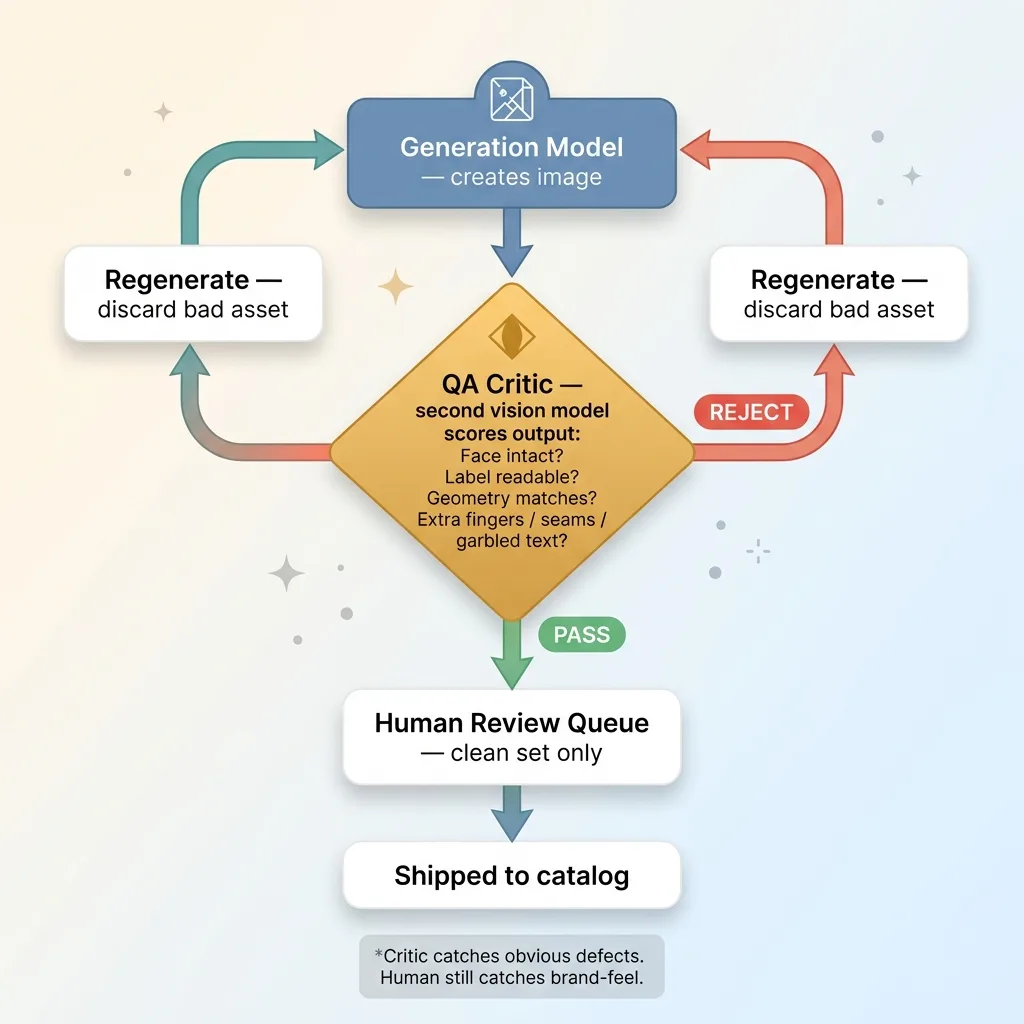
I do not let the generation model grade its own homework and ship. A separate vision model reviews every output and scores it. Is the face intact? Is the label readable? Does the geometry match the real product? Are there extra fingers, invented seams, garbled text? The critic looks for the specific defects that turn a usable asset into a refund.
This is the core of a pipeline that scores its own work. One model creates. A second model judges. The judge does not care that the image looks cool. It cares whether it is correct.
Reject-and-regenerate beats hope-and-check
The default workflow most people run is hope-and-check. Generate a batch, hope it is fine, have a human spot-check what they can, and pray the rest is okay.
 Reject-and-regenerate QA loop with a critic model
That does not scale. I cannot eyeball every image across hundreds of products, and neither can you. At volume, the critic is the entire difference between a usable system and a liability.
So instead of hope-and-check, I run reject-and-regenerate. The critic flags a defect, the asset gets thrown out, and the pipeline generates a new one before a human ever sees it. This is an AI that rejects its own bad work. By the time something reaches my review queue, it has already passed the automated gate. The human reviews a clean set, not a slush pile.
Honest note, because I do not want to oversell this. The critic is not perfect. It catches the obvious, expensive defects reliably, sliced faces, garbled text, broken geometry. It still misses subtle brand-feel problems, the "this is technically fine but it does not look like us" cases. Those still need a human eye. The critic does not replace taste. It removes the garbage so the human spends their attention on judgment, not janitorial work.
Free Model, Expensive Pipeline: The Economics Nobody Demos
Let me reframe the cost conversation, because the pricing intuition most buyers have is backwards.
 Free model, expensive pipeline economics
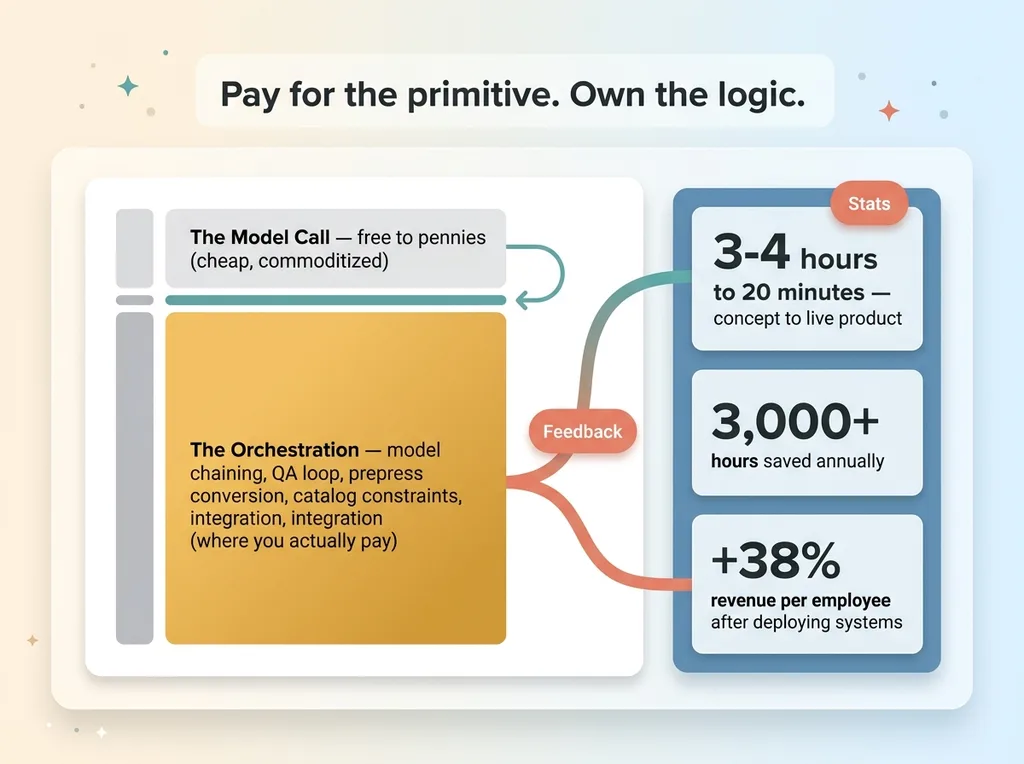
The model call is cheap. Often free, sometimes pennies. That is the part everyone fixates on, and it is the part that does not matter anymore.
The expensive, defensible part is the orchestration. Chaining models together. The QA loop that scores and regenerates. The prepress conversion. The catalog constraints that stop the AI from inventing products. The integration into wherever the asset actually gets used, the product page, the ad, the packaging. That is the work. That is what you are really paying for, and that is what holds value when the model underneath goes free.
This is exactly why I run a multi-model setup instead of one magic button. Different models are good at different jobs. I use one for content reasoning, another for image work, and custom chaining to keep costs down. No single tool does the whole thing well, so I do not pretend one does.
The numbers from my own product pipeline make the case. Concept to live product used to take three to four hours of manual work. Now it is about 20 minutes. Across the catalog and everything else I run, that adds up to more than 3,000 hours saved annually, and it is part of why my revenue per employee is up 38% after deploying these systems.
None of that came from the model being good. It came from the pipeline being good. So here is the buyer takeaway: pay for the primitive, the model, because it is cheap and getting cheaper. Build or own the logic, because that is the part that compounds.
Why the Skeptic Is Right and Still Behind
If you have sat through a dozen image-gen pitches and walked out thinking "this is commoditized hype," I am not going to argue with you. You are right.
The model is commoditized. The demos are shallow. The founder showing you a slick render and calling it a product has shown you the easy 10% and hidden the hard 90%. Your skepticism is well-calibrated to what you have been shown.
Here is where it stops serving you.
You are pattern-matching the demo to the opportunity, and those are not the same thing. The demo is commoditized. The work is not. The value relocated to the pipeline, the constraints, the QA, the integration, and that is precisely the work the demo merchant skips and the serious operator does.
So the skeptic ends up correct about the demos and wrong about the business. Writing off image-gen because the pitches are thin is like writing off databases because someone showed you a flashy spreadsheet. The flashy thing is not where the value is. It never was.
The advantage now belongs to whoever builds the boring layer around the free model. That is a smaller club than the demo crowd, because the boring layer is hard and unglamorous and does not photograph well for a pitch deck. The skeptic who recognizes this gets ahead. The skeptic who stops at "it's all hype" stays exactly where the demos left them, behind the operators who did the unsexy work.
The Boring Layer Is the Whole Business
When the model is free, the durable value is in the wrapper. The constraints that keep the AI honest. The QA that catches the defect before a customer does. The prepress that survives a real printer. The integration into where the asset actually lives.
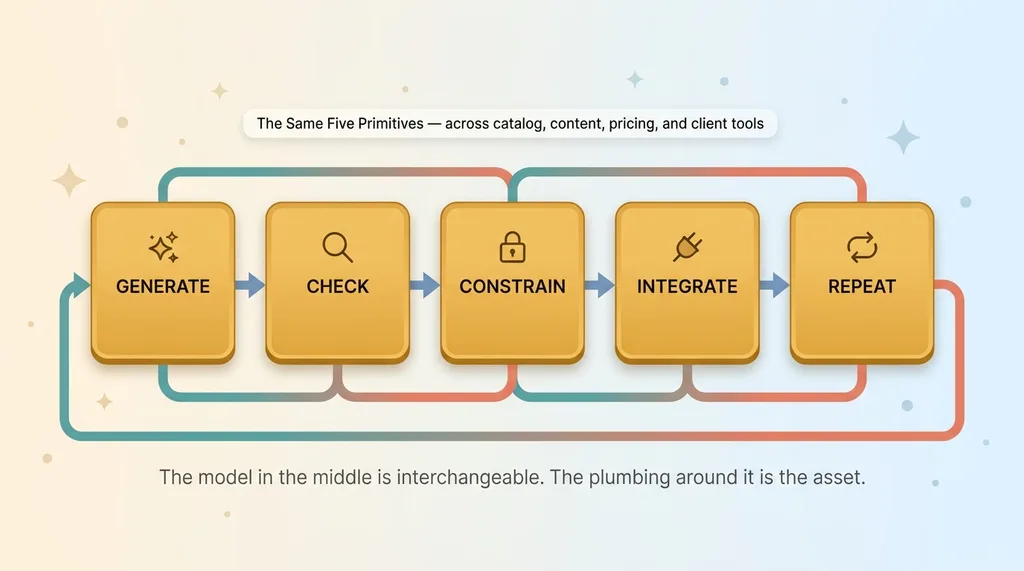 The five repeatable primitives
I have noticed the same thing building across very different domains. A DTC catalog, content systems, pricing engines, client tools. It is always the same handful of primitives doing the real work. Generate, check, constrain, integrate, repeat. The model in the middle is interchangeable. The plumbing around it is the asset.
That is the part I build. Not the demo. The system that ships hundreds of correct assets and does not get you sued.
Get the next build note.
I write up each system I build, including what broke. Subscribe to my newsletter and I'll send you the next one.