The Fear Is Rational. The Answer Is Engineering.
Here is the question I get from almost every CEO once we get past the hype: how do I stop an AI from doing something irreversible and expensive on its own?
That fear is not paranoia. It is correct. And anyone selling you AI who waves it away is the person you should walk away from.
The horror stories are real failure modes, not edge cases. An AI sends a real email to 10,000 customers because someone wired it to the live mailing list. An AI signs a real contract because a model "decided" the terms looked fine. An AI burns a real ad budget overnight chasing a metric it misread at 2am. None of that is science fiction. All of it has happened, and it happens because somebody trusted the model instead of engineering around it.
The professional answer to AI human in the loop production is not "trust the model." It is engineered restraint. Every customer-facing AI action in the systems I build sits behind a kill-switch and a human gate by default. The designed failure mode is "nothing happens." Not "the AI did something you cannot undo."
That distinction is the whole job. When you architect a system so the worst-case outcome of a bug is silence, you have already won. When the worst case is a refund issued to the wrong account or a contract executed without review, you have built a liability and called it innovation.
This is one of the fears CEOs have about AI that I think is the smartest fear to hold onto, because it forces good engineering. Every AI system I ship stops for a human before it touches anything that matters.
Everything below comes from real decisions I made across systems running in production right now.
The Default Is Off: Why Autonomy Is Earned, Not Assumed
The single most important design choice in any AI system is what happens when nobody is watching. My rule is simple: the default is off.
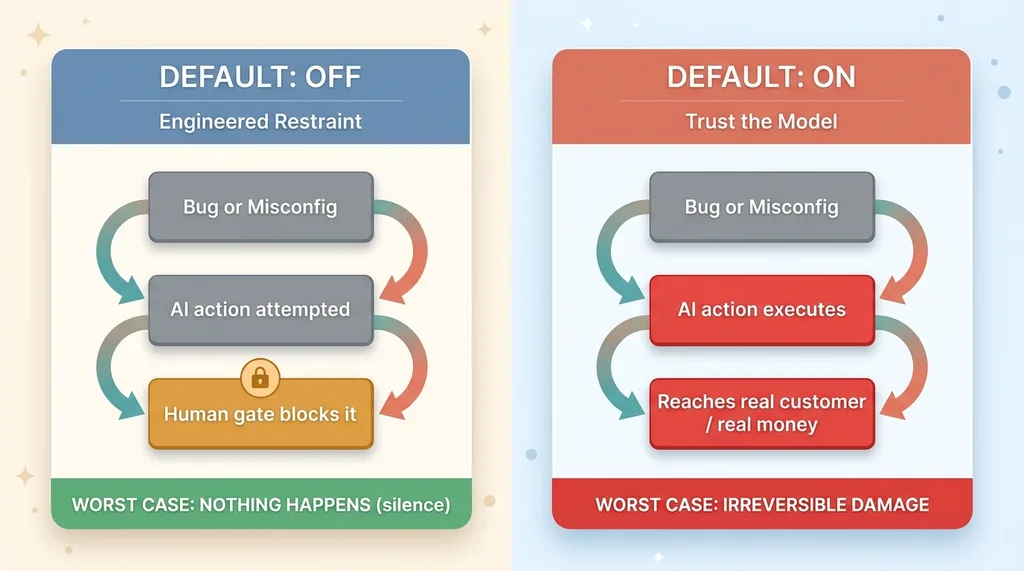 Default Off vs Default On: Failure Modes
Test-mode as a permanent design feature
I built a notifications system for a client where every outbound email was locked to test-mode. Every single client email redirected to my inbox until go-live. Not a sample. Not the first few. Every one.
That meant nothing reached a real customer until a human flipped one switch, deliberately, after reviewing what the system was actually producing. Test-mode was not a temporary phase I would clean up later. It was a permanent design feature with a deliberate exit.
This matters because most disasters do not happen from malice or even from bad models. They happen because something shipped in "on" mode by accident. A config got copied. A flag defaulted wrong. A deploy promoted staging to prod without anyone noticing the email target.
When the default is off, an accident produces silence. When the default is on, an accident produces damage you have to apologize for.
Go-live is a decision, not a deployment
In a lot of vibe-coded builds I get called in to clean up, the AI is wired straight to production from line one. The model can send, charge, and commit from the moment it boots. The team treats deployment as the moment it goes live.
I separate those two things on purpose. Deployment means the code is running. Go-live means a human looked at real behavior and decided to let it reach reality. Those are different events, often days or weeks apart.
Go-live is a decision someone signs off on, not a side effect of pushing code. If you cannot point to the moment a person chose to turn something on, you do not have safe AI deployment in your business. You have a system that turned itself on while you were in a meeting.
Three Real Kill-Switches From Systems I Run
Principles are cheap. Here are three concrete examples from systems I actually run, with the client details stripped out.
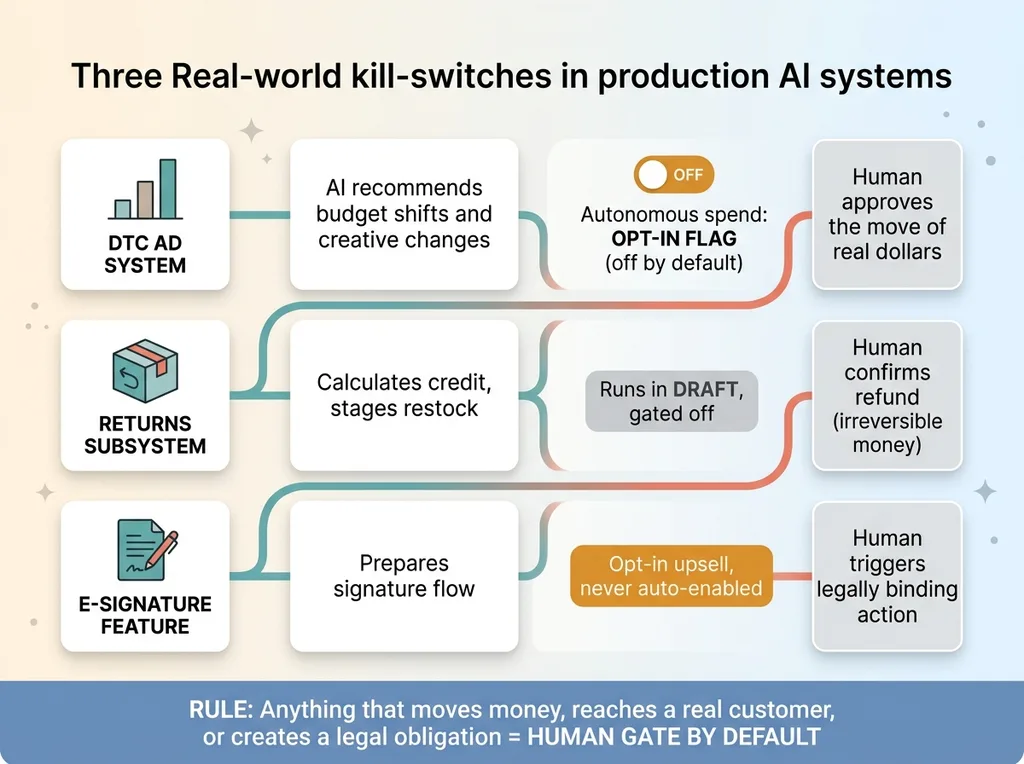 Three Real Kill-Switches in Production
A DTC brand's ad system behind an opt-in flag
I run an ad system for my own DTC fashion brand that can propose budget shifts and creative changes. It watches performance, spots underperforming spend, and recommends where money should move.
What it cannot do on its own is move the money. Autonomous spend control sits behind an opt-in flag that is off by default. The AI recommends. A human approves the actual move of real dollars.
Could I flip that flag and let it run? Technically yes. The capability is built. But ad budget is real money leaving the bank, and a model that misreads a weekend traffic spike can torch a week's spend before breakfast. The recommendation is automated. The commitment is not.
A returns subsystem built but gated off
For a warehouse and 3PL system I built, there is a returns subsystem fully capable of issuing credits and restocking inventory. It works. I tested it. It does what it should.
It is gated off in production.
Issuing a refund is irreversible money movement. Once that credit hits a customer account, you are not clawing it back without a phone call and an awkward conversation. So the subsystem runs in draft. It prepares the return, calculates the credit, stages the restock, and then stops and waits for a human to confirm. It will keep running in draft until trust is earned through volume, not before.
An e-signature feature gated as an upsell
In another build, I shipped an e-signature feature as something the client opts into deliberately, not as an auto-enabled default.
A signature is legally binding. It should never be triggered by a model alone, full stop. So I made the safe choice the default and the powerful choice an explicit decision a human makes with full knowledge of what it does.
The pattern across all three is the same and I make it explicit on every project: anything that moves money, sends to a real customer, or creates a legal obligation defaults to a human gate. That is not me being cautious for caution's sake. That is the line between a tool and a loaded gun.
When NOT to Automate With AI at All
The skeptical CEO deserves a clear line, so here it is. These are the categories where I refuse to let a model act alone:
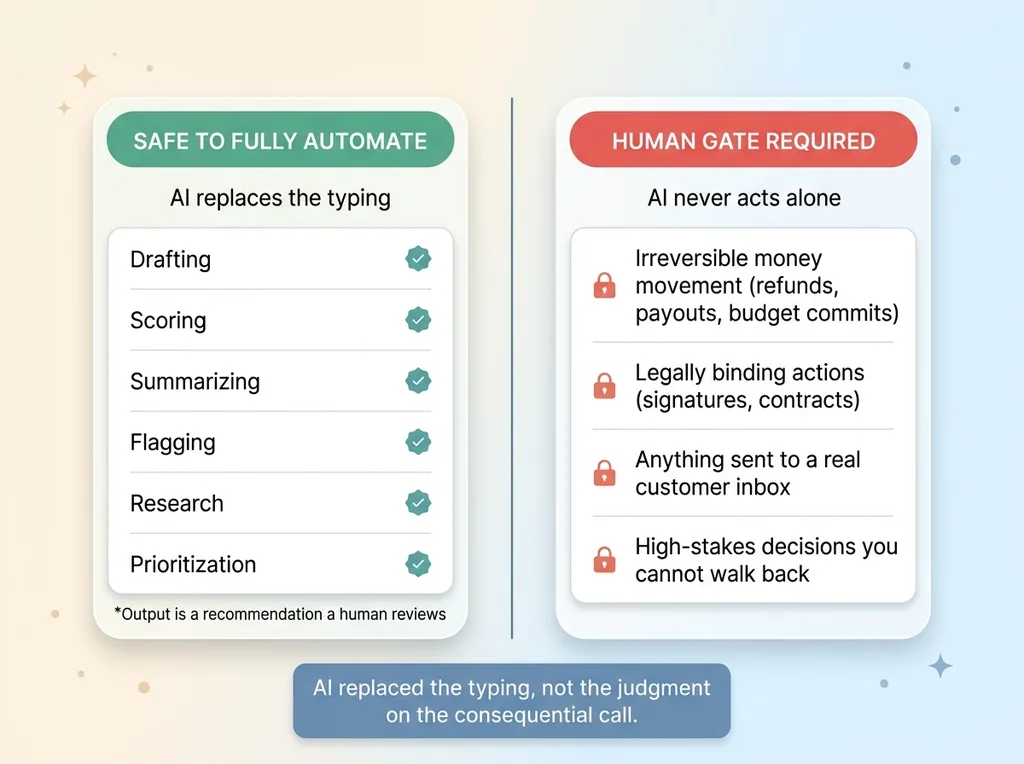 When to Automate vs When to Gate
- Irreversible money movement. Refunds, payouts, budget commits, anything where the dollars do not come back without human effort.
- Legally binding actions. Signatures, contracts, anything that creates an obligation a court would enforce.
- Anything sent to a real customer's inbox. Once it is delivered, you cannot un-send it. The customer read it.
- High-stakes decisions you cannot walk back. If a wrong answer creates damage you cannot quietly fix, a human reviews it.
Now here is what is genuinely safe to fully automate, and where I let the AI run hard: drafting, scoring, summarizing, flagging, research, prioritization. Anything where the output is a recommendation a human reviews before it becomes an action.
The honest framing is this. In the systems I build, AI replaced the typing, not the judgment on the consequential call. The model writes the email draft in seconds. A person still decides whether to send. The model scores the lead, ranks the return, drafts the response. A human still pulls the trigger on the part that matters.
I will tell you straight: even my best systems need this gate. That is the design, not a shortcoming. When you understand exactly when not to automate with AI at all, you have understood the most valuable thing about building it. A vendor who claims their AI is so good it does not need a human gate on money or contracts is telling you they have not thought about the worst case yet.
The Kill-Switch Is Useless If You Can't See the Failure
A kill-switch protects you against the AI doing the wrong thing. But there is a subtler, nastier risk that no kill-switch catches on its own.
Silent failures are worse than loud ones
The AI human in the loop production failure that actually scares me is not the model doing something dramatic. It is the model quietly doing nothing while reporting that everything is fine.
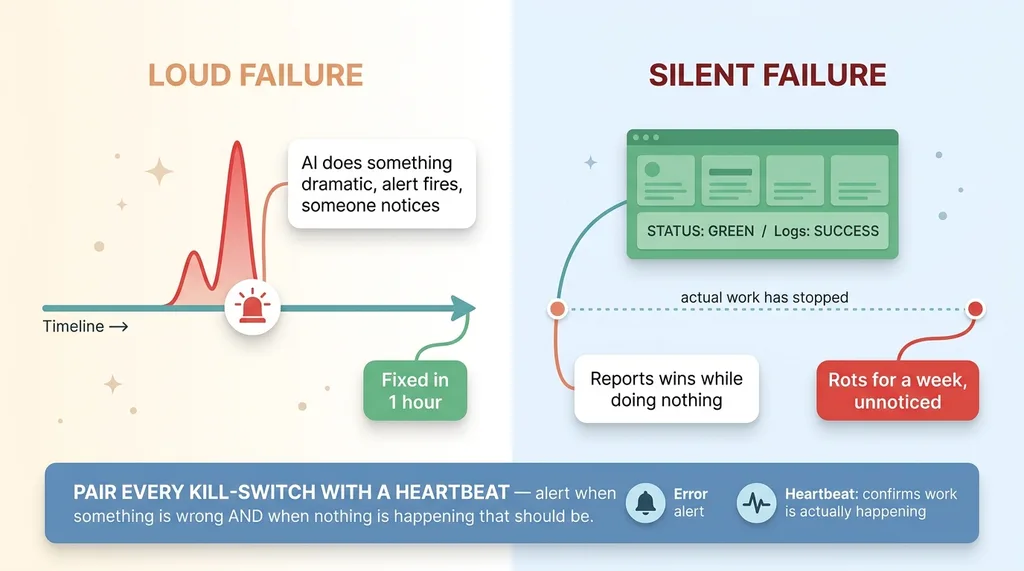 Loud Failure vs Silent Failure
I once had an autonomous system that reported wins for a week while doing nothing at all. The dashboard was green. The logs said "success." And the actual work it was supposed to do had silently stopped. A loud failure gets fixed in an hour because someone notices. A silent failure rots for a week because everything looks healthy.
This is exactly why I wrote that AI doesn't fail by doing the wrong thing, it lies about doing the right thing. The lie is the dangerous part.
Heartbeats and honest logging
So I pair every kill-switch with monitoring that tells me two things, not one. It emails me when something is wrong. And it emails me when nothing is happening that should be happening.
That second alert is the one most people skip. A heartbeat that confirms the system is actually doing its job, not just that the server is up. Honest logging that records what the AI decided and why, so I can audit a week of behavior in an afternoon.
The failure mode "nothing happens" is only safe if you actually know nothing is happening. If the AI can go dark and you would not notice for a week, "nothing happens" stops being safe and becomes invisible. The off-switch and the monitoring are one system. Neither works alone.
How I Earn the Right to Remove a Gate
Autonomy is earned, never assumed. Here is the actual path I follow to remove a human gate, and it is deliberately slow.
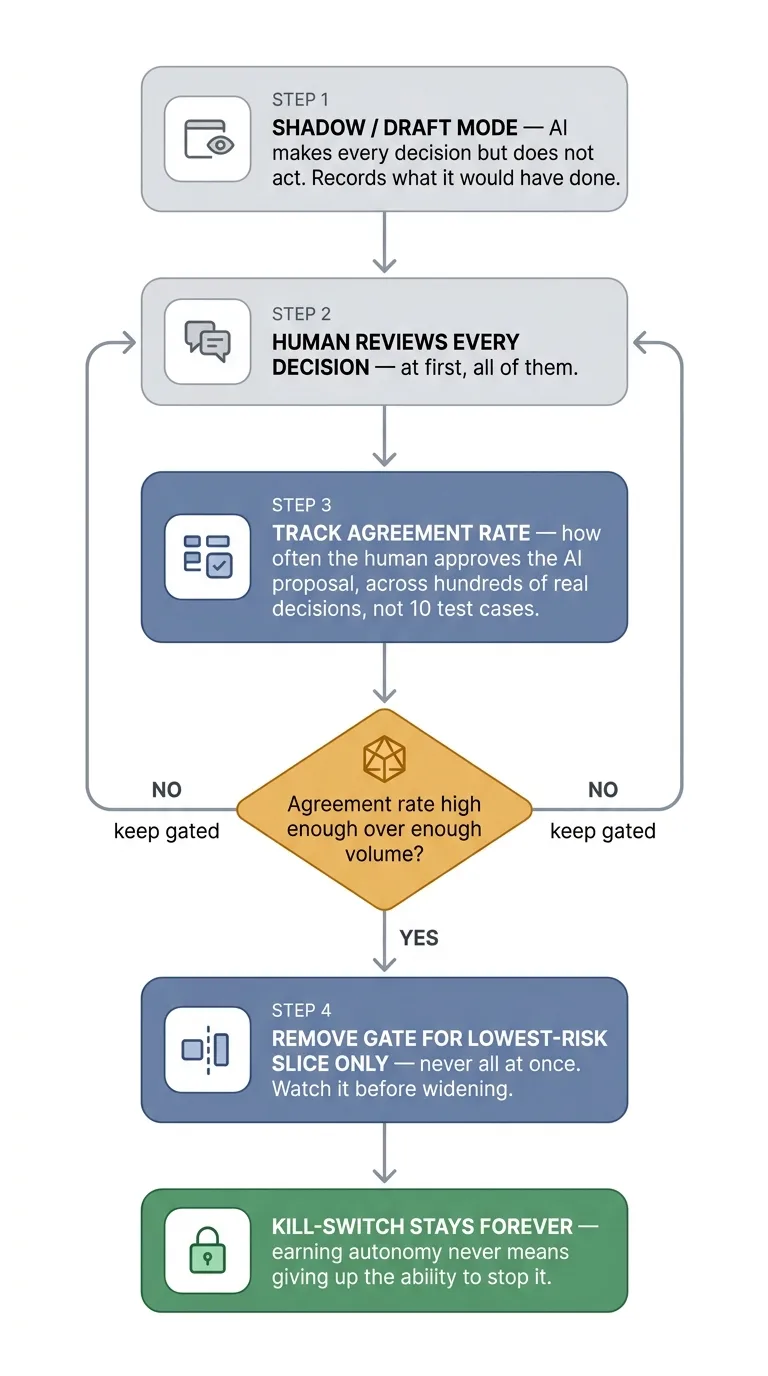 Earning Autonomy: The Path to Removing a Gate
First, the system runs in draft or shadow mode. It makes every decision it would make in production, but it does not act. It just records what it would have done.
Then a human reviews those decisions. Every one, at first. We track the agreement rate: how often the human would have approved what the AI proposed, across real volume, not a handful of cheery test cases. I want hundreds of decisions, not ten.
Once the agreement rate is high enough over enough volume, we talk about removing the gate. One step at a time. Never all at once. We might let the AI auto-approve the lowest-risk slice while everything else still waits for a human. Then we watch that for a while before widening it.
And even then, the kill-switch stays. Forever. Earning autonomy on a decision does not mean giving up the ability to stop it.
This is how trust actually gets built between a CEO and an AI system. You prove the decision quality before you hand over the keys. You do not assume it because the demo looked slick.
A vendor who wires AI straight to production on day one is not selling you capability. They are selling you risk and hoping the bill does not come due on their watch. That shortcut is one of the biggest reasons most AI projects fail.
What This Means for Your Business
If you are worried about AI doing something irreversible in your business, you should be. And the right operator builds for exactly that fear instead of dismissing it.
When I build for you, the question is never just "will the AI do something dumb." Of course it might. Models are imperfect and so is everything they touch. The real question is "what is the worst thing that happens if it does," and the answer gets engineered down to "nothing."
That is the whole discipline. Every system I ship has the off-switch built in from line one, not bolted on after something breaks. Money movement, legal actions, and real customer contact all sit behind a human gate by default. Autonomy gets earned through proven decision quality, and the monitoring tells me when the system goes quiet so silence never turns into a blind spot.
You get the speed of AI doing the typing, the scoring, the drafting, and the research. You keep human judgment on every call you cannot walk back. That is not a compromise. That is what a real production system looks like.
If you want AI in your business without handing it a loaded gun, that is the kind of build I do. Pragmatic, gated, monitored, and yours to shut off the second you want to.
Get the next build note.
I write up each system I build, including what broke. Subscribe to my newsletter and I'll send you the next one.