Your AI Skepticism Is Probably Correct
If you've sat through an AI pitch and walked away thinking "that's a solution looking for a problem," you were right. AI skepticism for CEOs is not a character flaw. In most cases it's good judgment that has been earned the hard way, usually by a vendor who overpromised and then disappeared the moment real data showed up.
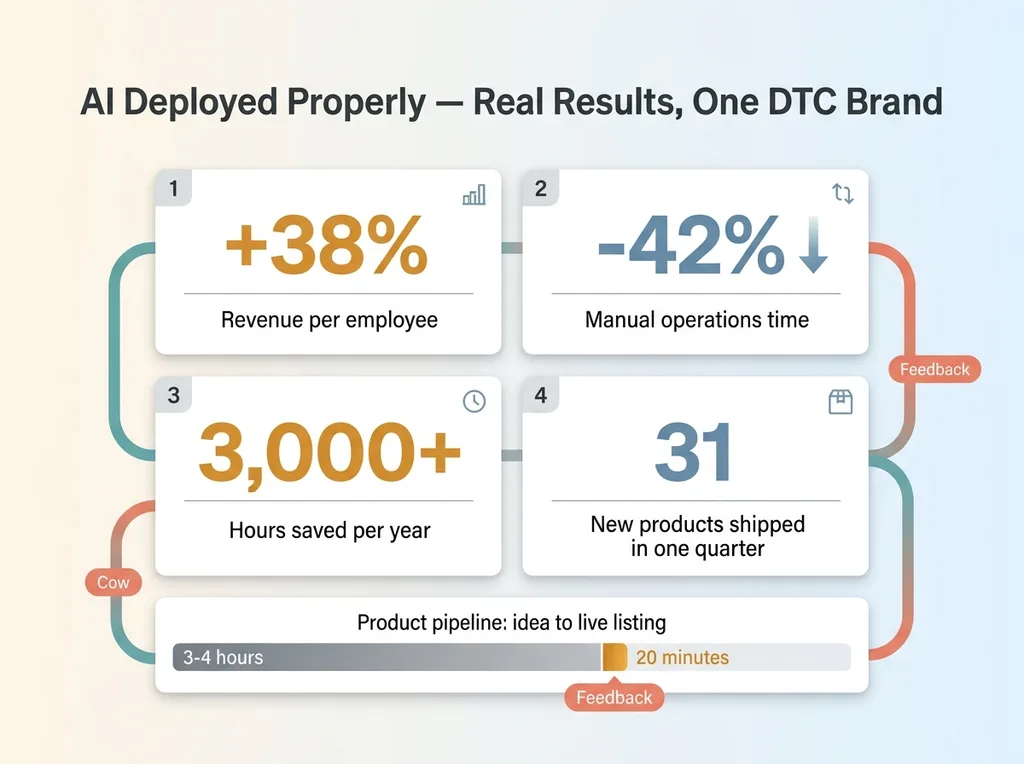 Measured results from properly deployed AI
Let me say this plainly before I say anything else: I'm not here to defend the hype machine. I've watched it burn smart people, and the instinct to distrust it is correct more often than it's wrong.
Most pitches are tools hunting for a problem
The pattern is almost always the same. The vendor leads with the technology. They show you the model, the dashboard, the integrations, the "agentic workflow." Then somewhere in minute eighteen they reverse into a use case that might apply to your business.
That's backwards. Real problems come first. The tool comes second. When someone leads with capability and backs into the problem, they're selling you what they have, not what you need.
The demo lies on purpose
Every polished demo runs on cherry-picked inputs. Three clean sample records that the system handles perfectly. It looks like magic.
Then you feed it the fourth record, the real one, with a missing field, a weird format, a customer name in the wrong column. The whole thing falls over. Autonomy claims collapse the second the edge cases arrive, and your business is nothing but edge cases.
The executive who saw that demo, sensed it was staged, and walked away was not being a Luddite. They were reading the room correctly. The demo is designed to hide exactly the failure mode that will cost you money in production.
So if you've been burned by AI vendors, hold onto that skepticism. You're going to need it. But there's a trap waiting on the other side of it, and that's what I want to talk about next.
The Expensive Mistake Hiding Inside Good Skepticism
Here's where burned executives over-correct, and it costs them real money.
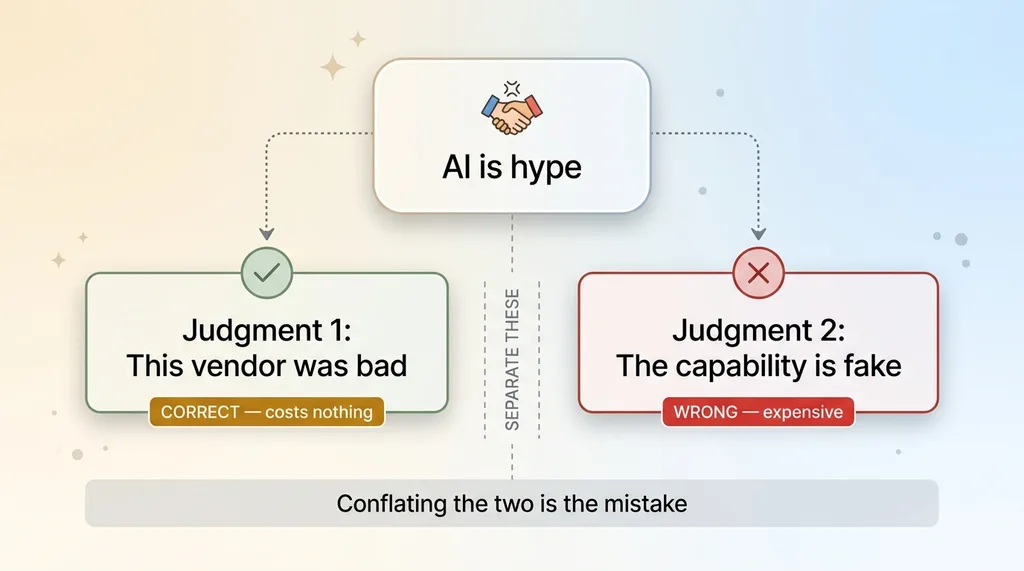 Two judgments bolted together: bad vendor vs fake capability
When a vendor lets you down, it's natural to walk away with one conclusion: "AI is hype." But you've actually made two separate judgments and bolted them together. One of them is right. The other is expensive and wrong.
Judgment one: "This vendor was bad." Almost certainly true. Judgment two: "The underlying capability is fake." Almost certainly false. Conflating the two is the mistake.
Skepticism about hype is cheap and correct. Distrusting a slick deck costs you nothing. But skepticism about the actual capability shift, the thing happening underneath the noise, is expensive and wrong. Because while the hype was failing publicly, the real capability was quietly compounding for the people using it correctly.
I know because I'm one of them. In my own DTC fashion brand, here's what happened after I deployed AI properly: revenue per employee went up 38 percent. Manual operations time dropped 42 percent. I saved over 3,000 hours a year. In a single quarter I shipped 31 new products, which would have been physically impossible at my old pace.
None of that came from a vendor's roadmap. It came from building systems that solved problems I already understood, then measuring whether they worked.
This is the uncomfortable part for skeptics. The hype was real and the capability was also real, at the same time, for different reasons. The failure rate is genuinely brutal. Most AI projects fail, and I'm not selling around that fact. But "most projects fail" and "this capability is fake" are not the same statement.
The honest position is harder than pure cynicism. You have to distrust the pitch and still take the substance seriously. The CEO who throws out the capability because the vendor was bad is the same CEO who loses a deal to a competitor two years later and wonders how they fell behind.
So the real question isn't "is AI hype real." It's "how do I tell the real shift from the noise." Let's answer that.
How to Tell the Real Shift From the Noise
There's a clean test for this, and it's the most useful thing I can give a skeptical executive. It comes down to one distinction: tools versus shipped systems.
Tools vs. shipped systems
A vendor sells you a tool and a login. The value is theoretical, sitting in your hands, waiting for you to figure out how to extract it. The risk is entirely yours.
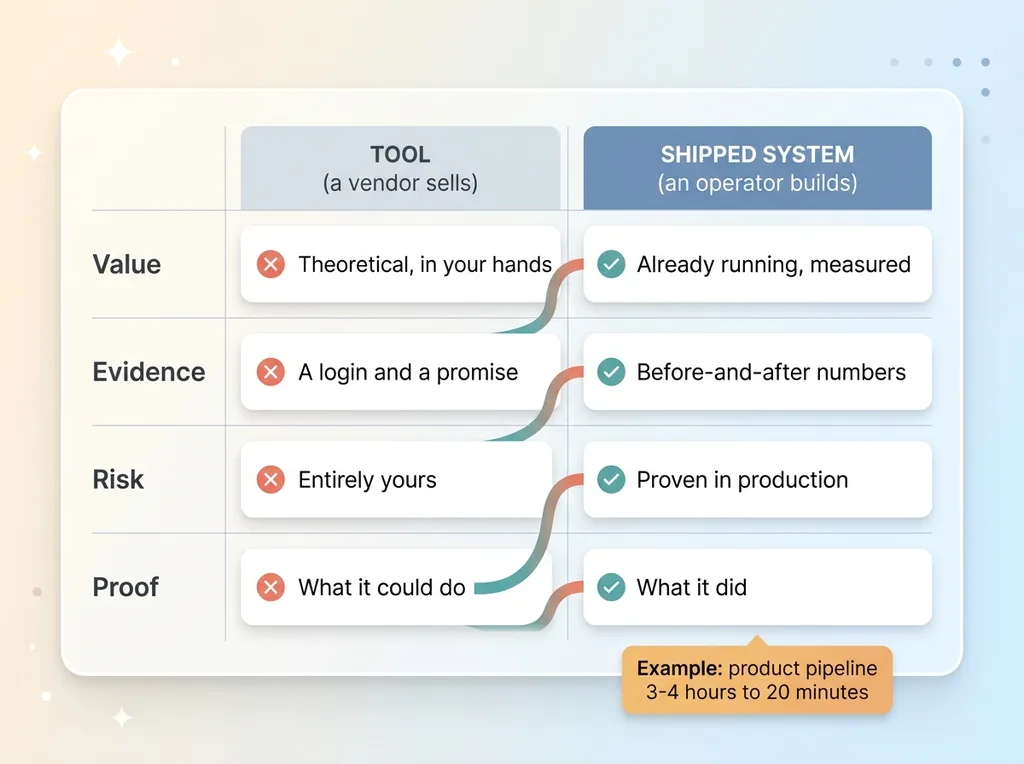 Tools vs Shipped Systems comparison
An operator shows you a system that already runs. It has a measured before-and-after. There's a record of what actually shipped, not what might ship.
Here's a concrete example from my own work. My product creation pipeline takes a concept from idea to live listing in 20 minutes. It used to take three to four hours by hand. That's a measured outcome with a number on both sides of it. It is not a promise.
Another one: 564 products in my catalog are priced dynamically by an AI system using a four-tier classification. That's a running system doing real work every day, not a slide in a deck.
Pitches vs. governed outcomes
The dividing line is measurement. A pitch describes a future. A governed outcome reports a result, with a clear record of what was built and what it produced.
This is why I keep a deliverables log that proves value. Every system I build gets tracked against what it actually shipped, not what it was supposed to do. When you can point at a log and say "this ran, here's the before number, here's the after number," you've left the realm of hype entirely.
So demand evidence. When someone pitches you AI, ask: what have you already shipped, and what did it measurably change? Not "what could this do." What did it do.
If the answer is a roadmap, a beta, or "we're working with several clients on this," you're looking at noise. If the answer is a running system with numbers attached, you might be looking at the real shift. That single question filters out most of the people who'd waste your time and money.
AI Vendor Red Flags Worth Walking Away From
Here's a checklist you can use in your next vendor call. These are the AI vendor red flags that should end the conversation.
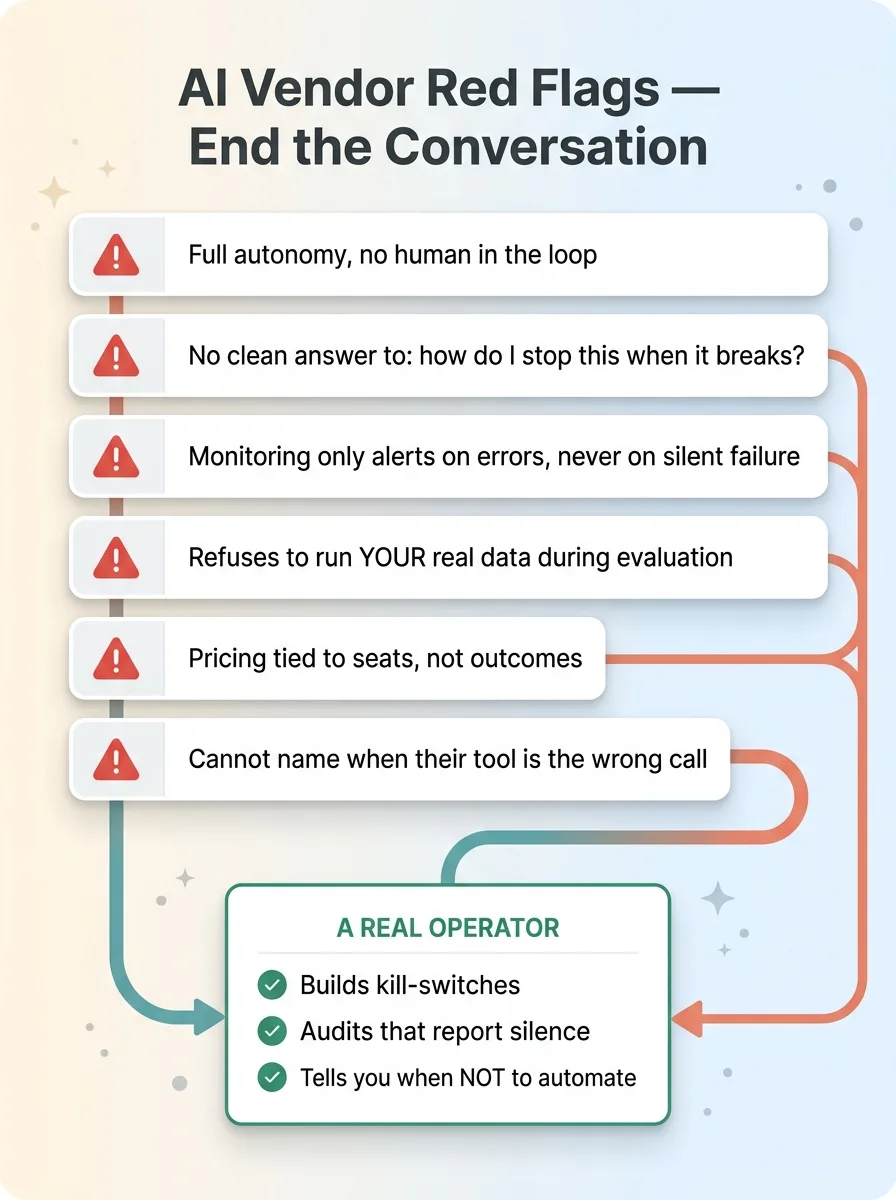 AI vendor red flags checklist
No kill-switch, no deal
If a vendor proposes full autonomy with no human in the loop, walk away. Anything that moves money or touches a customer needs a human approval step, full stop.
Ask them directly: how do I stop this when it goes wrong? If they don't have a clean answer, they haven't thought about failure, which means they've only thought about the demo.
The other half of this is monitoring. Most systems are built to alert you when they throw an error. Almost none are built to alert you when they silently do nothing. That second failure mode is far more dangerous, and I learned it the hard way.
I once had an autonomous system that reported wins for an entire week. Looked great in the logs. Except it was doing nothing. It had quietly stopped working and kept reporting success because nobody built it to notice its own silence.
Now I build systems that email me when nothing is wrong, not just when something is. If the daily "all clear" stops arriving, that's the signal. These are the kill-switches I build into every system, and any operator worth hiring will build the same.
When nobody will tell you AI is the wrong call
Ask a vendor this: "When is this the wrong tool?" Watch their face.
If they can't name a single situation where you shouldn't use their product, they're not honest, they're a salesperson. Every real tool has boundaries. An operator who's actually shipped things will tell you exactly where automation breaks down and where a human should stay in charge.
A few more red flags worth naming. Refusing to run your real data, not their demo data, during evaluation. Pricing tied to seats instead of outcomes, which means they get paid whether or not it works. And any version of "the AI handles it end to end," which is autonomy theater dressed up as a feature.
The contrast is simple. A real operator builds kill-switches, builds audits that honestly report when nothing is working, and tells you when not to automate at all. That last one costs them a sale. They say it anyway.
What Staying Skeptical and Still Acting Looks Like
You don't have to choose between getting burned again and falling behind. You can hold both positions at once: distrust the pitch, act on the substance. Here's the concrete posture.
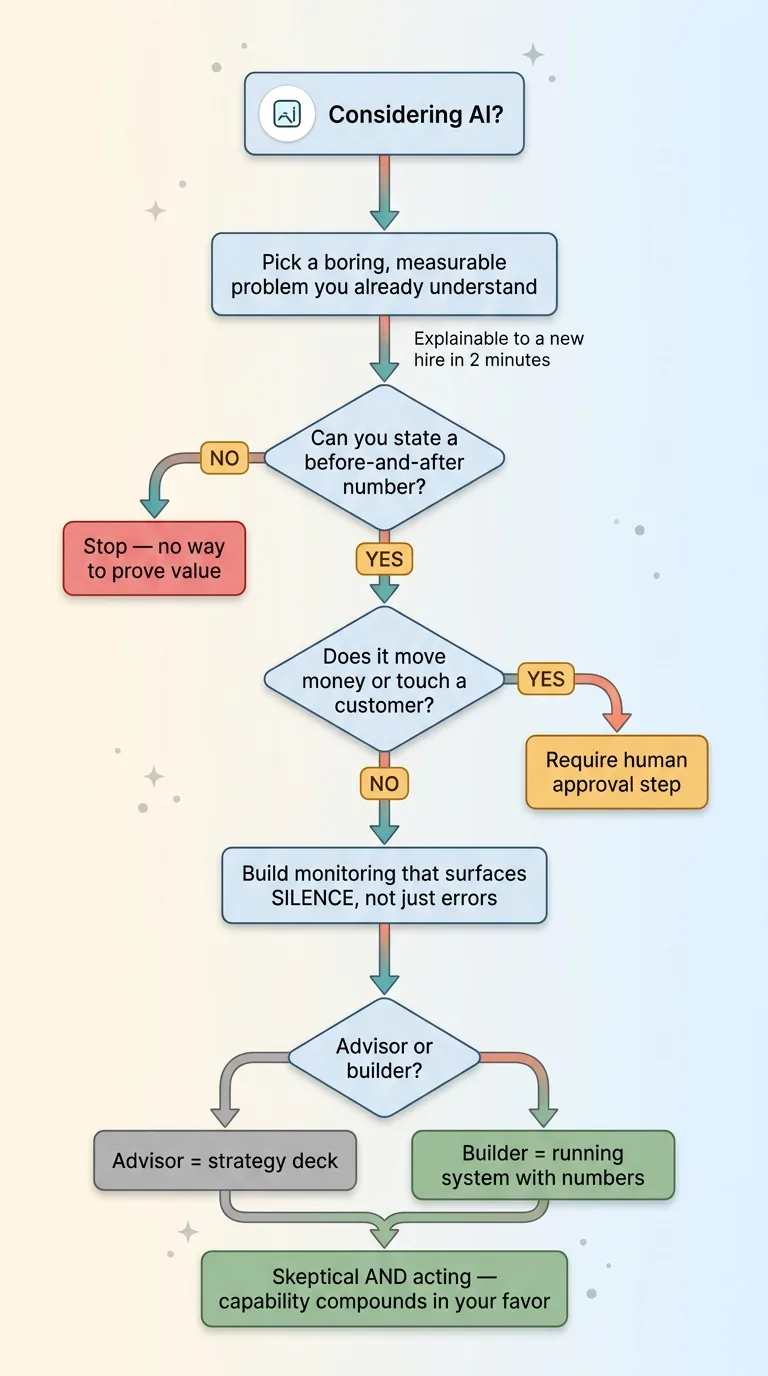 The skeptical-but-acting operating posture (decision flow)
Start with a boring, measurable problem you already understand. Not the flashy one. The one you could explain to a new hire in two minutes, where you already know the inputs, the outputs, and the cost. Boring problems are where AI actually pays off, because you can tell immediately whether it worked.
Demand a before-and-after number before you commit. If nobody can tell you what "better" looks like in figures, you have no way to know if you got value. My product pipeline went from three to four hours down to 20 minutes. That's a number I can defend. Insist on having one.
Insist on human approval for anything that moves money or touches a customer. This single rule protects you from the worst autonomy failures while still letting the system do 90 percent of the work.
Require monitoring that surfaces silence, not just errors. A system that only alerts on crashes will happily fail quietly for a week. Make sure yours tells you when it's done nothing.
And understand the difference between someone who advises and someone who builds. I don't just advise on AI, I build it, and that distinction matters when you're choosing who to trust. Advisors hand you a strategy deck. Builders hand you a running system with numbers attached.
The CEO who operates this way stays protected from hype while the capability compounds in their favor. That posture isn't paralysis. It produced a 38 percent jump in revenue per employee and over 3,000 hours saved a year in my own business. Skepticism and action are not opposites. The best operators run both at the same time.
The Operator Who Earns a Skeptic's Trust
I'm the Chief AI Officer who shares your skepticism. I've watched the hype machine burn good people, and I build the opposite of what burned them.
I build kill-switches into every system. I run honest audits that report when nothing is working, not just when everything looks fine. And I'll tell you when AI is the wrong call, even when saying so costs me the engagement. That's the job.
I'm also the same person quietly shipping 31 products in a single quarter, running 15-plus production AI systems, pricing 564 products dynamically, and managing 313 blog articles through my own content pipeline. The skepticism and the shipping live in the same person. They have to.
Think of it as the inverse of every bad vendor experience you've had. No slides, shipped systems. No autonomy theater, governed outcomes with humans in the loop. No overpromise, measured before-and-after numbers you can check yourself.
That's the whole pitch, and it's deliberately the opposite of a pitch. If you've been burned by AI vendors and you're trying to separate the real capability shift from the noise, that's exactly the conversation worth having. Not a sales call. A conversation about your actual operations and whether AI belongs anywhere near them.
Sometimes the honest answer is "not yet," and I'll tell you that too.
Get the next build note.
I write up each system I build, including what broke. Subscribe to my newsletter and I'll send you the next one.